
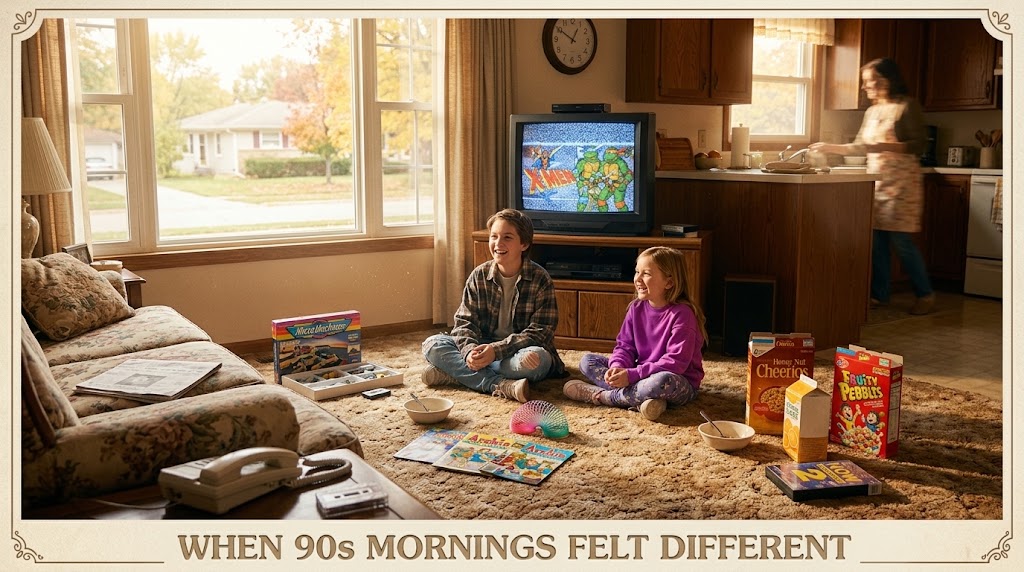
There was something different about waking up on a weekend morning in the 1990s.
The house was usually quiet. There was no phone buzzing beside the bed, no endless notifications, and no one checking social media before even getting out of bed. You could hear the television from the living room, the sound of dishes in the kitchen, or sometimes just the noise of a fan turning above you.
For many people, the 1990s were not perfect. Life had its problems then too. But everyday life felt slower, and some of the simplest moments became memories that people still talk about today.
A Saturday morning could be as simple as watching cartoons, eating cereal, and deciding what to do with the rest of the day.
Saturday Morning Was Something to Look Forward To
For kids growing up in the 90s, Saturday morning had its own routine.
You didn’t need anyone to tell you what was on television. You already knew.
You would wake up, grab something to eat, and sit in front of the TV before your favorite show started. If you were lucky, you got there before your brothers or sisters and had control of the remote for a little while.
There was no streaming service where you could simply choose any episode you wanted.
If you missed your favorite cartoon, you missed it.
That made those mornings feel important.
Shows such as Rugrats, Doug, Hey Arnold!, The Powerpuff Girls, Animaniacs, and many others became a regular part of childhood for millions of kids.
The shows were not just something to watch. They became part of the rhythm of the week.
The Kitchen Had Its Own Morning Sounds
The kitchen was often the busiest room in the house.
Someone might be making toast. A parent could be pouring coffee. Cereal boxes sat on the counter, and the smell of breakfast filled the room.
There was something comforting about those ordinary sounds.
The refrigerator opening.
A spoon hitting a cereal bowl.
The toaster popping.
The television playing somewhere in the background.
Nobody thought much about these things at the time. They were just normal parts of everyday life.
Years later, those same little details can bring back an entire childhood.
Sometimes nostalgia works that way. You don’t remember the whole day. You remember a sound, a smell, or a small moment.
The Phone Was Not Always in Your Pocket
One of the biggest differences between the 1990s and today was the telephone.
Many families had one main phone in the house.
If you wanted to talk to a friend, you called the house and hoped your friend answered.
Sometimes you had to ask:
“Is Sarah there?”
And then you waited while someone went to get her.
There were no smartphones, group chats, or instant messages.
If your friend wasn’t home, you simply called again later.
It sounds strange now, but people got used to it.
Teenagers often spent hours talking on the phone, especially in the evenings. Parents sometimes complained about the phone bill or asked why someone had been talking for so long.
It was a completely normal part of growing up.
Going Outside Was Still a Big Part of Childhood
After watching TV for a while, many kids eventually went outside.
There was usually a friend somewhere nearby.
You might ride a bicycle around the neighborhood, play basketball, kick a football, or simply walk around looking for someone to hang out with.
There was no need to arrange everything through a group chat.
You could knock on a friend’s door.
Sometimes you would hear:
“Can you come outside?”
And that was the entire plan.
Kids spent hours outdoors without knowing exactly when they would come home.
Parents usually had one simple rule:
“Be home before dark.”
That sentence probably brings back memories for a lot of people who grew up during the 1990s.
The Neighborhood Felt Like a Bigger World
For children, the neighborhood could feel enormous.
A few streets seemed like a whole world.
You knew which house had the friendly dog, which driveway had the basketball hoop, and which family had the biggest collection of bicycles.
There were familiar faces everywhere.
People sat outside during warm evenings. Kids rode bikes up and down the street. Someone was always mowing the lawn, washing a car, or working in the garage.
These were not extraordinary events.
They were just everyday life.
That is probably why they are remembered so clearly.
Music Was Everywhere
The 1990s also had a soundtrack of its own.
Music came from radios, cassette players, CDs, car stereos, and music television.
People had favorite songs, favorite bands, and favorite singers.
You might record songs from the radio onto a cassette and hope the DJ didn’t start talking before the song ended.
Making a mixtape for a friend was more personal than simply sending a playlist today.
You had to choose the songs.
You had to find them.
And sometimes you had to wait until the right song played on the radio.
That little bit of effort made the finished tape feel special.
The Family Car Was Part of the Adventure
For many families, getting into the car meant going somewhere.
Maybe it was a trip to the shopping mall.
Maybe it was a visit to grandparents.
Maybe the family was going on vacation.
The back seat could become its own little world.
Kids argued over who got the window seat. Someone complained about the temperature. Someone asked how much longer the trip would take.
And, of course, the famous question appeared sooner or later:
“Are we there yet?”
There were no smartphones to keep everyone busy.
You looked out the window.
You listened to music.
You talked.
Or you simply watched the road go by.
Shopping Malls Were More Than Stores
Before online shopping became a normal part of everyday life, going to the mall was an experience.
People went to the mall to buy clothes, eat something, see a movie, meet friends, or simply walk around.
For teenagers, the mall could be a place to spend an entire afternoon.
There were food courts, record stores, arcades, clothing shops, bookstores, and movie theaters.
You didn’t need a special reason to go.
Sometimes going to the mall was the activity.
Video Games Became a Huge Part of Growing Up
The 1990s were also an important decade for video games.
Systems such as the Super Nintendo Entertainment System, Sega Genesis, Sony PlayStation, and Nintendo 64 became major parts of childhood for many players.
Games were often played with friends sitting beside you.
There was no online lobby filled with strangers.
If someone wanted to play, they came over.
You passed the controller around and waited for your turn.
Losing could be frustrating, especially when you had been waiting for ten minutes just to play.
But those afternoons created memories that lasted much longer than the game itself.
There Was More Waiting
Looking back, perhaps one of the biggest differences was how much waiting people did.
You waited for photographs to be developed.
You waited for a new movie to come out on VHS.
You waited for your favorite television show.
You waited for someone to call.
You waited for a letter.
You waited for the weekend.
Today, technology has removed much of that waiting.
That is convenient, but sometimes the waiting itself made certain things feel more exciting.
When you finally got something you had been waiting for, it felt like an event.
Why 90s Memories Still Matter
The 1990s were not just about old technology or popular television shows.
For many people, nostalgia is really about people.
It is about parents who were younger.
Grandparents who were still around.
Friends who lived a few houses away.
Family vacations.
School days.
Birthday parties.
First cars.
First CDs.
First video game systems.
And ordinary afternoons that nobody realized would become precious memories.
That is the strange thing about growing up.
While we are living those moments, they feel completely normal.
We don’t know which afternoon will become a memory we think about twenty years later.
A Different Kind of Childhood
The 1990s were not necessarily better than today.
Every generation has its advantages and problems.
But childhood during the 90s had a particular rhythm.
There was television, but there was also plenty of time away from the screen.
There were video games, but you usually played them in the same room as your friends.
There were telephones, but they weren’t always in your pocket.
There was music everywhere, but sometimes you had to search for your favorite song.
And there was a little more space between wanting something and actually getting it.
Maybe that’s why so many people remember the decade so warmly.
Looking Back
Today, an old commercial, a familiar song, or even the sound of a dial-up connection can suddenly take someone back to the 1990s.
For a moment, you can almost picture the old living room.
You remember the television.
You remember the kitchen.
You remember the people who were there.
You remember being younger.
That is what makes 90s nostalgia so powerful.
It isn’t really about wanting every part of the past back.
It’s about remembering a time in your life that cannot be repeated.
The 1990s are now history, but the memories remain.
And sometimes, all it takes is an old song, a photograph, or a Saturday morning cartoon to bring them back.