Close your eyes and listen. Click. A canyon opens up in front of you, red rock stretching so far it makes your stomach drop a little. Click. A waterfall thunders past so close you half expect to feel the spray. Click. And just like that, you are somewhere else entirely — and you never even left the living room carpet. If that sound just pulled a memory straight out of you, then you already know what View-Master memories are made of.
I can still feel the weight of it in my small hands: a chunky little viewer, warm from being held too long, pressed up against my eyes while I stood by the window because the light had to be just right. That was the deal with the View-Master. No batteries. No screen. No sound effects. Just you, a paper reel, and sunlight — and somehow, that was more than enough.
Here is the thing nobody tells you about childhood magic: it rarely announced itself. It showed up in a cardboard packet, slid into a drawer, and waited for a rainy afternoon to change everything.
View-Master Memories: Table of Contents
The Click That Opened Another World
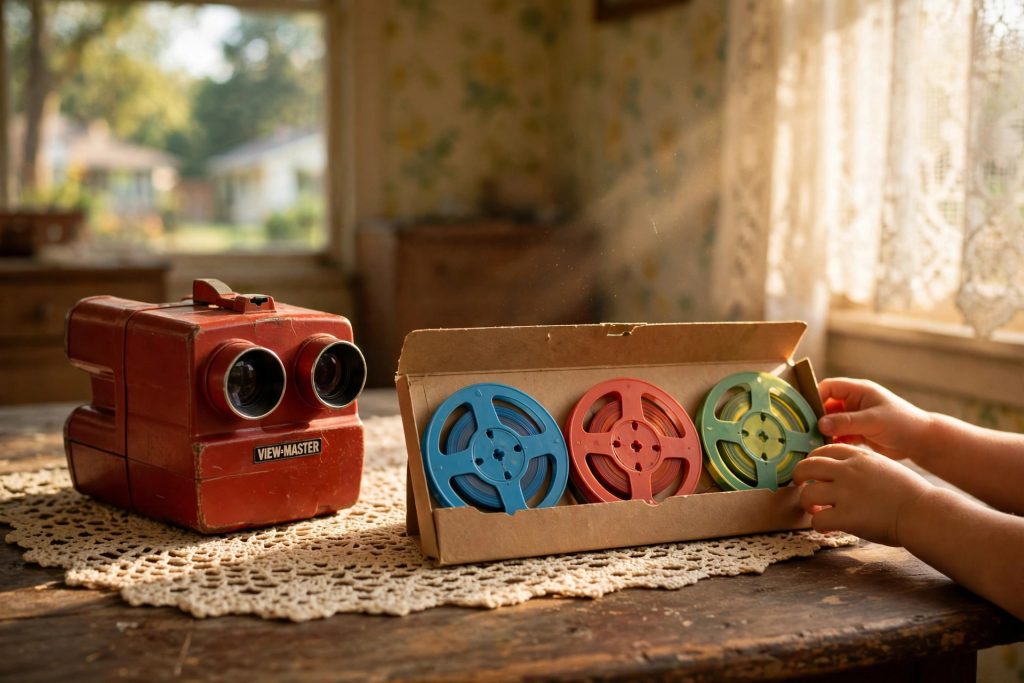
Every kid who ever owned a View-Master remembers the ritual, because the ritual was half the fun. You slid the round reel into the slot at the top of the viewer until it seated with a soft little thunk. You lifted the whole thing to your eyes. And then — that lever. You pressed it down with your thumb, and the world inside changed with a click so satisfying that toy companies today would pay a fortune to bottle it.
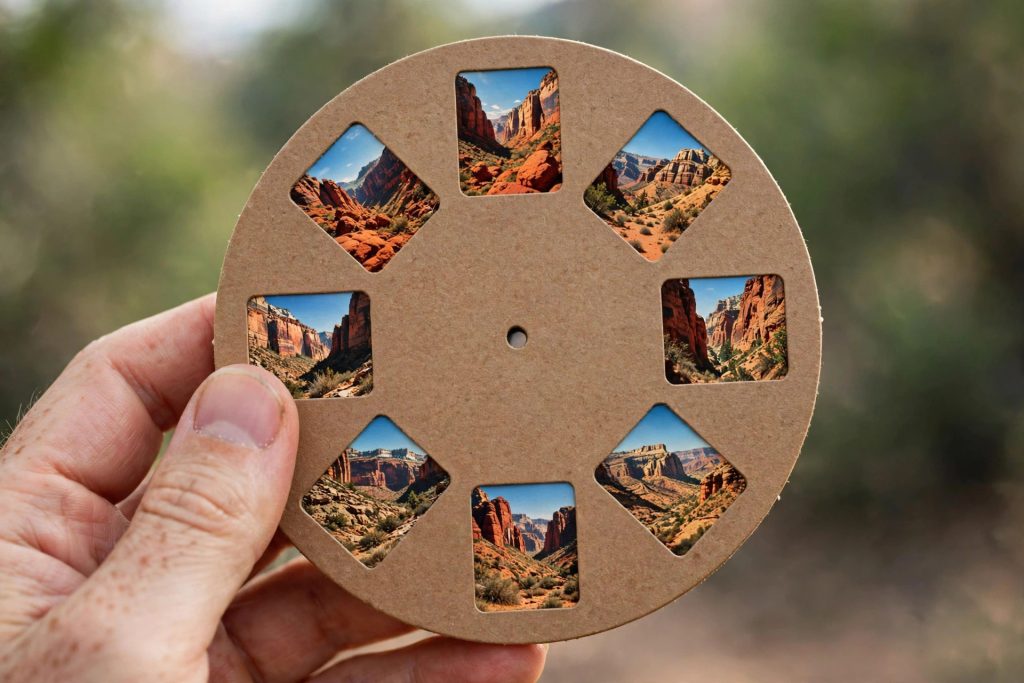
Seven scenes. That was all you got on a single reel, seven tiny windows into somewhere else. And yet somehow, seven was plenty. You did not rush through them the way we scroll through photos now. You lingered. You studied the edges of each picture, trying to see what was hiding in the corners. You clicked back and forth between two favorites, arguing with your brother or sister about which one was better. The Grand Canyon always won in our house. It just did.
There is a word people use now for that feeling, but back then we just called it fun. The pictures were not flat. They had depth — real depth, the kind that made you reach out a finger before you remembered there was nothing to touch. Two tiny photographs, one for each eye, tricking your brain into believing you were standing right there. It felt like a small miracle, and nobody in the house thought it was strange that a toy could do that.
Born in a Cave: How the View-Master Began
The story of the View-Master starts somewhere you would never guess: inside a cave in Oregon, in 1938. A man named William Gruber was visiting the Oregon Caves with a homemade camera rig — two cameras bolted together to take stereoscopic pictures — when he met Harold Graves, the president of a company called Sawyer’s. Graves took one look at Gruber’s rig and saw something bigger than a hobby. Gruber’s real stroke of genius was mounting tiny Kodachrome film chips into a round paper reel, so that a whole little journey could fit in your pocket.
A year later, in 1939, the View-Master made its debut at the New York World’s Fair, stamped “Patent Applied For.” The patent on the viewing device followed in 1940. But here is the part that surprises most people: it was not sold as a toy at first. You found it in photography shops, stationery stores, and the gift shops at scenic attractions, marketed as a grown-up alternative to the picture postcard. Instead of mailing a flat photo of the Grand Canyon to a friend, you could hand them a reel and let them stand inside it.
The first reels showed exactly what you would expect from that idea: Carlsbad Caverns and the Grand Canyon, places so grand that a flat photograph felt like an insult. Seven stereoscopic pairs per reel, fourteen tiny transparencies in all, each one glowing with that rich Kodachrome color that made everything look a little more alive than real life.
Seven Little Windows
Think about what those seven frames demanded of a kid. Patience. Attention. Imagination. You could not skip ahead, could not fast-forward, could not swipe. You clicked, and you looked, and you looked some more. If you wanted to see the waterfall again, you clicked all the way around the reel and came back to it, and somehow it was even better the second time.
That slowness is part of why the memory sticks. Psychologists will tell you that the things we pay attention to are the things we remember, and the View-Master forced you to pay attention. The light had to be right, so you hunted for the brightest window in the house. The viewer had to sit right against your eyes, or the picture doubled and blurred. You learned to hold still, to breathe quietly, to let the scene settle. It was the closest thing to meditation most of us ever got as children, and we had no idea.
And the colors. Oh, the colors. Kodachrome had a way of making reds redder and blues deeper, so the Grand Canyon looked like it had been painted by someone who loved it. When people talk about the past looking golden, this is partly what they mean — not that the past was perfect, but that the way we captured it made everything glow.
Then Disney Came Along
The View-Master might have stayed a scenic souvenir if not for one very smart acquisition. In 1951, Sawyer’s bought its rival Tru-Vue, and with it came the Walt Disney Studios licence. Suddenly the reels were not just canyons and caverns anymore. They were Cinderella and Mickey Mouse and, before long, Disneyland itself. Sales took off like nothing before, because now the viewer was not just showing you somewhere you might visit one day — it was showing you the characters you already loved, in a depth that made them feel almost touchable.
This was the turning point. The View-Master moved from the gift shop shelf into the toy box, and from the toy box into millions of childhoods. A packet of three reels became a birthday present, a Christmas stocking surprise, a souvenir from a family vacation that you could relive on any rainy Sunday for years afterward. Kids collected them the way later generations collected trading cards, trading reels on the playground and begging parents for the packet with the cartoon they had not seen yet.
For a lot of us, those Disney reels were our first taste of something strange and wonderful: a story you could step inside, one click at a time. Long before anyone said the words “virtual reality” out loud, we were already holding a little version of it in our hands, and it ran on nothing but sunlight.
The Ritual: Packets, Drawers, and Whose Turn It Was
Ask anyone of a certain age where they kept their View-Master reels, and watch their face. It was always a drawer. The junk drawer, the bedroom dresser drawer, the one with the rubber bands and the old batteries rolling around. The reels lived there in their paper packets, a little bent at the edges, and finding them again after months felt like discovering treasure you had buried yourself.
And then there was the turn-taking. Good grief, the turn-taking. One viewer, two or three kids, and a whole afternoon to fill. “You already had seven clicks!” “That was only six!” The arguments were fierce and completely unserious, the way only childhood arguments can be. Somebody always hogged the Disneyland reel. Somebody always dropped a reel under the sofa and blamed the dog. And when the reel finally jammed — because somebody pushed the lever too hard, usually the same somebody — the whole room groaned like it was the end of the world.
Those little annoyances are part of the memory now, and that is the funny thing about nostalgia. The things that drove us crazy then are the things that make us smile now. The jammed reel. The fight over turns. The way the picture went dark every time a cloud passed over the sun and you had to wait, viewer still pressed to your face, for the light to come back. We did not know we were making memories. We thought we were just passing a rainy afternoon.
The Lighter Years: Plastic, Cartoons, and Talking Reels
The View-Master kept changing with the times, the way all great toys do. In 1962, a lighter thermoplastic Model G viewer replaced the heavier Bakelite-style models, so smaller hands could hold it longer without getting tired. In 1966, Sawyer’s was acquired by GAF, and under GAF the reels leaned even harder into what kids actually wanted: movies, television shows, and cartoons. The scenic reels never went away, but the toy box belonged to the cartoon characters now.
Then came the Talking View-Master, which ran from about 1970 to 1997. It paired the pictures with a little record that narrated the story as you clicked through the frames, so the scenes did not just look alive — they talked. If you grew up with one of those, you can probably still hear that voice in your head, telling you to advance the reel right before the music swelled. It was gloriously clunky by today’s standards, and it was completely magical at the time.
Even the United States military found a use for the viewer during the Second World War, employing View-Master viewers and reels for training. Think about that for a second: the same little device that showed your grandmother the Grand Canyon also helped train soldiers. It is a reminder that the best inventions refuse to stay in one lane.
Why It Still Matters
In 1999, the View-Master was inducted into the National Toy Hall of Fame, alongside the kinds of toys that define American childhood. That honor makes sense when you think about what the viewer really was. It was not just a toy. It was a promise: that the world was bigger than your street, bigger than your town, and that you could visit it any time you wanted, just by holding something up to the light.
Look at what we hand kids today. Endless feeds, infinite scroll, a thousand pictures a day that nobody really looks at. The View-Master gave you seven pictures and asked you to truly see them. There is a lesson in there, and I do not think it is just about toys. The things we love most are rarely the things we have the most of. They are the things we paid attention to.
That is why a grown adult can hear a single click and be eight years old again, standing by a window with the sun in their eyes. The sound is a time machine. The reel is a ticket. And the living room carpet is still, somehow, the Grand Canyon.
If you still have a View-Master tucked away somewhere — in a drawer, in a box in the attic, at the back of a closet — go find it. Hold it up to the light. Click through whatever reel is still in it. And if you remember the argument over whose turn it was, or the packet of three reels you begged for at the gift shop, or the exact scene that made you gasp the first time you saw it in 3D, then you know exactly what I am talking about.
These days we carry the whole world in our pockets, and we barely glance at it. Once, we carried seven tiny pictures in a paper circle — and we saw everything. If you want more trips down memory lane, take a look at the toys every kid wanted in the 90s, or another way we kept our pictures before phones did it for us. For the full history, the View-Master story on Wikipedia is a wonderful rabbit hole, and the story of Sawyer’s original 1939 viewer fills in the early years beautifully.
Your Turn: What Did You See First?
So here is my question for you, and I really want to hear the answer: what was the first reel you ever clicked through? Was it the Grand Canyon, glowing red in the sun? A Disney reel you watched until the pictures practically wore out? Or some strange scenic packet from a family road trip that nobody else in the world would remember but you?
Drop your answer in the comments, and if this post brought back a click you had forgotten, share it with the friend you used to fight over turns with. They will know exactly what you mean — click, click, another world.
Pingback: Etch A Sketch Memories: Draw, Shake, Start Again