There was a moment, sometime in the early eighties, when music stopped belonging to the living room. It slipped off the big wooden stereo cabinet, shrank down to the size of a deck of cards, and climbed into our pockets.
If you were a kid back then, you remember the exact weight of it in your jacket — that small, solid rectangle humming against your ribs as you walked to school, the foam headphones warming your ears, the whole world suddenly carrying a private soundtrack that nobody else could hear. That was the Walkman, and this Walkman history is really the story of how music became personal.
I still remember the Christmas morning it arrived. The box was wrapped in that shiny paper my mother reused every year, and inside sat a silver-and-blue machine no bigger than my hand, with chunky buttons that clicked like they meant business. I loaded a cassette — Michael Jackson, obviously — pressed play, and the opening bars of Thriller flooded my head while the rest of the house carried on with wrapping paper and breakfast noise, completely unaware. In that instant, I understood something my parents’ generation never had: I could be somewhere and somewhere else at the same time.
Before the Walkman: Music Was Something You Shared (Whether You Wanted To or Not)
To appreciate this chapter of Walkman history, you have to remember what came before. In the seventies, music lived in rooms. The family stereo was furniture — a hulking console in the living room that Dad controlled with the authority of a ship’s captain. If you wanted to hear your music, you negotiated. You waited your turn. You listened to whatever the household had agreed upon, which usually meant your father’s jazz records or your mother’s easy-listening compilations, and your own tastes were something you endured in silence until you could escape to a friend’s bedroom.
Teenagers did have one portable option: the boombox. And what a glorious, ridiculous machine it was — a shoulder-mounted wall of speakers that announced your taste to the entire street. The boombox was social, confrontational, communal. You carried it on your shoulder like a badge, and everyone within fifty feet became your unwilling audience. There was no privacy in it, no intimacy. It was music as a statement, not music as a companion.
Headphones existed, of course, but they were tethered to the home stereo by long coiled cords that tangled around chair legs. The idea that you could take high-quality stereo sound out into the world — on the bus, on a walk, lying in a park — simply didn’t exist as a consumer reality. Music was either a shared household event or a public broadcast. The private listening experience, the one we now take so completely for granted that we can’t imagine life without it, hadn’t been invented yet.
July 1979: The Little Machine That Started Walkman History
The Walkman history begins, fittingly, with a very human problem. Sony’s co-founder Masaru Ibuka loved listening to music on long business flights, but the portable players of the day were bulky and sounded terrible. He asked Sony’s engineers for something better — a small, great-sounding stereo cassette player he could take on a plane. The engineers took an existing Sony Pressman (a portable recorder marketed to journalists), ripped out the recording circuitry and the speaker, and what remained was a slim playback-only device with two headphone jacks.
When chairman Akio Morita saw the prototype, he had one of those flashes of genius that define careers. He didn’t just see a gadget for executives on airplanes. He saw teenagers. He saw joggers. He saw commuters. He reportedly insisted that young people would want to listen to music all day long if only someone gave them a way to do it — a claim Sony’s own marketing department thought was absurd. Who would want to walk around wearing headphones? It sounded antisocial. It sounded strange.
Morita pushed ahead anyway. The TPS-L2 launched in Japan on July 1, 1979, priced at 33,000 yen. Sony’s sales team had modest expectations. They sold out almost immediately, and Walkman history was officially underway. Within two months, they’d moved tens of thousands of units, and by the end of the Walkman’s first decade, Sony had sold over 100 million of them. The marketing department’s skepticism became one of the great misjudgments in business history — right up there with the record executive who told a young Elvis that guitar groups were on the way out.
The Rituals We All Remember
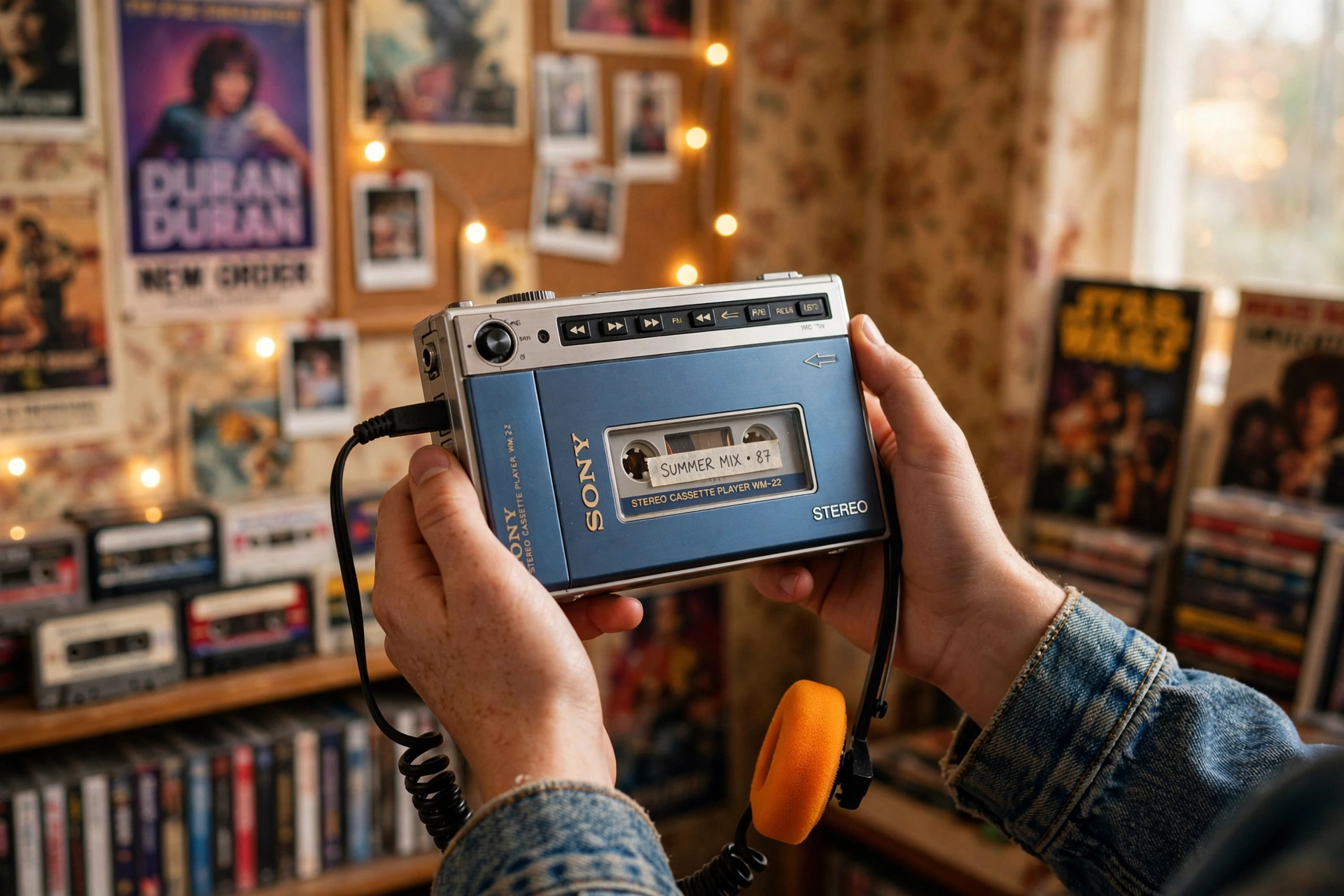
Owning a Walkman wasn’t just owning a gadget; it was owning a piece of Walkman history. It was joining a culture with its own rituals, its own etiquette, its own small miseries and joys. Ask anyone who had one and watch their eyes go distant — the memories are that specific.
The Sacred Art of Cassette Selection
Leaving the house with a Walkman meant making a decision: which tape? You couldn’t carry your whole collection, so you chose one cassette the way you’d choose a companion for a journey. The night before a long bus ride, you’d agonize over it. The upbeat tape for energy, or the moody one that matched the rain on the windows? And if you were really prepared, you carried a second tape in your other pocket, just in case the mood shifted mid-journey. If you want to understand how deeply cassettes shaped our relationship with music, our post on the lost art of the mixtape goes even deeper into that world.
Batteries, Foam, and the Economics of Childhood
Two AA batteries. That was the price of freedom, and every Walkman kid became an amateur economist. You learned which brands lasted longest. You learned to flip the auto-reverse off to save power. You learned the special heartbreak of the music slowing down mid-chorus — that woozy, sinking pitch that meant your batteries were dying and there was no store in sight. Wealthy kids carried spares. The rest of us just suffered, or begged.
And the headphones! Those iconic orange foam pads that disintegrated if you looked at them wrong. They’d flatten, they’d tear, they’d absorb an entire summer of sweat, and replacing them cost money you didn’t have. Some of us wrapped them in socks. Some of us just endured the scratchy plastic underneath. It didn’t matter. The music still sounded like magic.
The Etiquette of the Unplugged Ear
There was an unspoken rule among Walkman users: one earbud out means I’m available; both in means don’t talk to me. Parents learned to wave frantically in your peripheral vision. Teachers developed a sixth sense for the telltale foam nubs peeking from beneath long hair. The Walkman created the first generation of people who were physically present but mentally elsewhere — a condition we now consider completely normal, but which genuinely worried adults in 1983. Sound familiar? Every generation’s technology panic is just the last generation’s nostalgia waiting to happen.
Why the Walkman Mattered More Than the Music
Here’s what the history books sometimes miss when telling Walkman history: the Walkman didn’t just change how we listened to music. It changed how we experienced being alone in public. Before the Walkman, solitude in a crowd was an accident — you happened to be alone with your thoughts on a bus. After the Walkman, it became a choice. You could curate your own emotional atmosphere anywhere: sad songs for rainy windows, pump-up anthems for the walk to the big game, something dreamy for staring at the ceiling and thinking about the person you liked.
Psychologists would later write papers about this — about how personal stereos gave people control over their sonic environment and, by extension, their emotional state. But we didn’t need the papers. We knew. The kid who put on headphones to survive a miserable family road trip knew exactly what the technology was for. It was armor. It was a diary with a volume knob.
It also quietly rewired public space. Cities got louder — everyone retreating into their own audio bubble — and simultaneously more private. The shared soundscape of the street, the bus, the park began to fracture into millions of individual ones. When people complain today about everyone staring at phones, they’re describing the second act of a play the Walkman started. We were the first generation to walk through the world half somewhere else, and honestly? Most of us wouldn’t trade those somewhere-elses for anything.
The Competitors, the Clones, and the Golden Age of the Aisle
Success breeds imitation, and the eighties electronics aisle became a glorious battlefield. Toshiba, Panasonic, Aiwa, and a dozen others rushed out their own personal stereos. Some were excellent — Aiwa’s models were genuinely beloved by audiophiles on a budget. Some were terrible plastic knockoffs that ate your tapes and died by Christmas. Choosing between them was a rite of passage, debated with the intensity of sports rivalries.
Sony kept innovating: the WM-2 shrank the whole thing to the size of a cassette case. The Sports Walkman arrived in bright yellow, waterproofed for joggers. There were models with FM radio, with recording, with bass boost that made your skull rattle. Each iteration felt like the future arriving in installments. And through it all, the word “Walkman” became generic — people called every personal stereo a Walkman regardless of brand, the way they called every tissue a Kleenex. That’s when you know you’ve won: when your trademark becomes the language.
From Walkman to iPod to Streaming: The Legacy in Your Pocket
Trace the line of Walkman history forward and it’s unbroken. The Discman (CDs, skipping on every bump — we suffered for our music). The MiniDisc (Sony’s beautiful, doomed format). The MP3 players of the late nineties. Then 2001: the iPod, which was really just a Walkman with a hard drive and better marketing. Then the iPhone, which swallowed the iPod whole. Then Spotify, which swallowed the very idea of owning music.
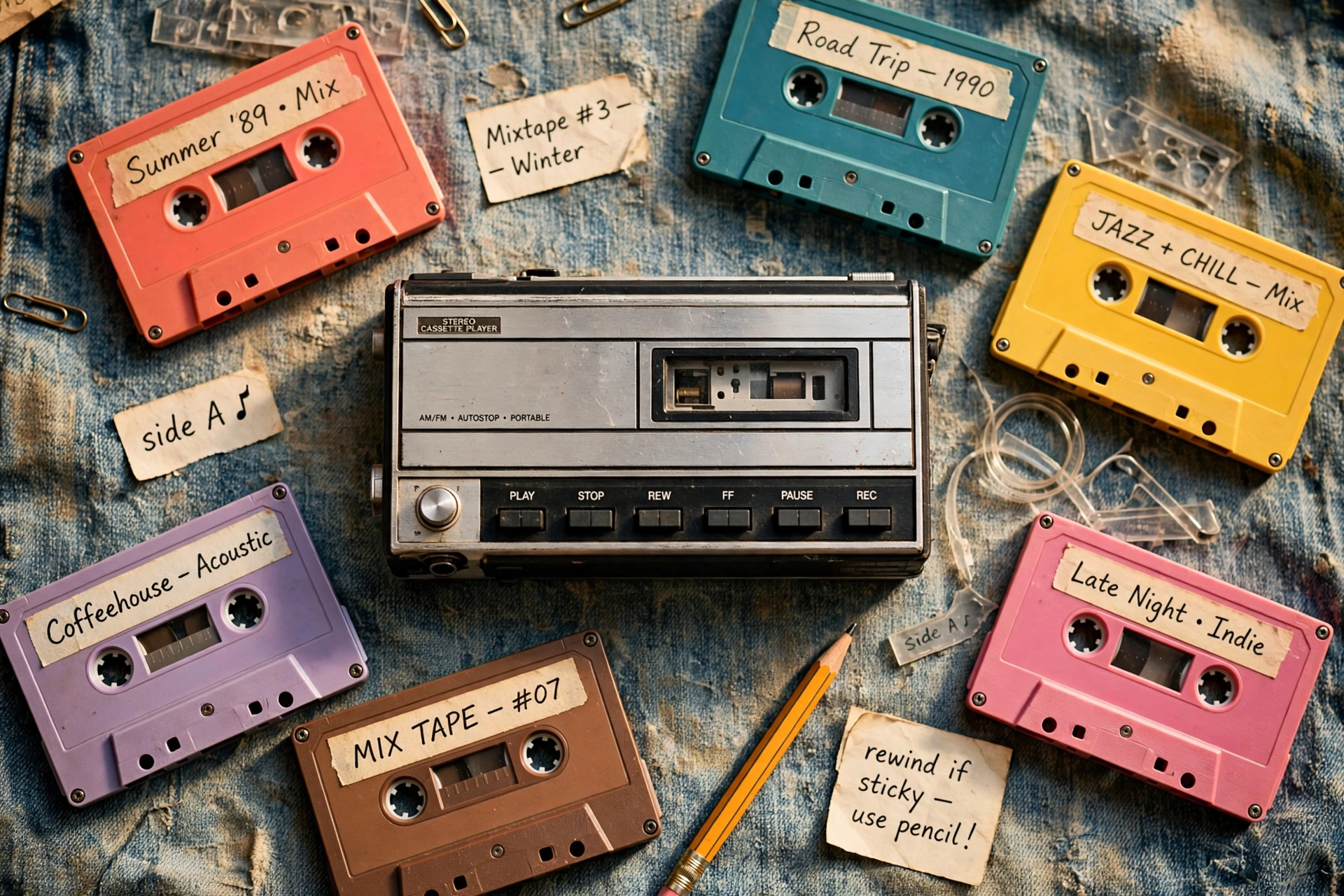
Every step made the experience more convenient and, arguably, a little less magical. A thousand songs in your pocket is a miracle, but it ended the sacred ritual of choosing one tape. Shuffle ended the album as a journey. Streaming ended the mixtape as a love letter — though as we explored in our piece on mixtape history, the impulse behind it never really died; it just moved to playlists.
But here’s the thing the Walkman understood that the algorithm never will: limitation was part of the pleasure. One tape. Two sides. Ninety minutes. You listened to the songs you skipped, because skipping meant fast-forwarding blind. You memorized track orders. You knew exactly where the best song started by the feel of the tape counter. Constraint bred intimacy, and the Walkman’s constraints — battery life, tape length, the weight in your pocket — made the music feel earned in a way that infinite choice never quite manages.
The Walkman Deserves Its Place in History
In 1979, Sony’s marketers worried nobody would want to wear headphones in public. Today, you’d look stranger without them. The Walkman didn’t just sell a hundred million units; it sold an idea — that your inner life deserves a soundtrack, and that you get to choose it. Every pair of earbuds on every subway platform in the world is a descendant of that little blue-and-silver box.
Sony officially discontinued the cassette Walkman in 2010, thirty-one years after Walkman history began — and the announcement made news around the world, which tells you everything about what it meant. They still make a digital Walkman line for audiophiles, a quiet nod to the name. But the real monument isn’t a product. It’s a generation of us who learned, somewhere between home and school with foam on our ears, that music could be a private room you carry with you. If you grew up in that era, you might also enjoy our journey through why the 1990s feel like home — same decade, same magic, different memories.
So dig out that old shoebox if you still have one. The tapes are probably in there, labels faded, foam long gone. Hold one up to the light. You can still see the brown ribbon wound tight inside, holding ninety minutes of who you used to be — your personal Walkman history. Press play in your memory. It’s all still there.
For the full official story, Sony maintains a Walkman design gallery and history, and the Encyclopaedia Britannica entry on the Walkman covers its cultural impact in detail.
Pingback: Rewinding Cassette Tapes with a Pencil: The Analog Hacks We All Knew - NostalgiaHub
Pingback: Remember When the Mall Was the Whole World? Inside the 90s Mall Culture We All Miss - NostalgiaHub