Table of Contents
The history of the mixtape is a story of love, patience, and musical devotion. There was a time when telling someone you liked them didn’t involve a text message or a social media like. It involved a cassette tape, a radio, a lot of patience, and a pen. The mixtape was one of the most beautiful forms of communication ever invented. And we’ve completely lost it.
What a Mixtape Really Was: A History of the Mixtape
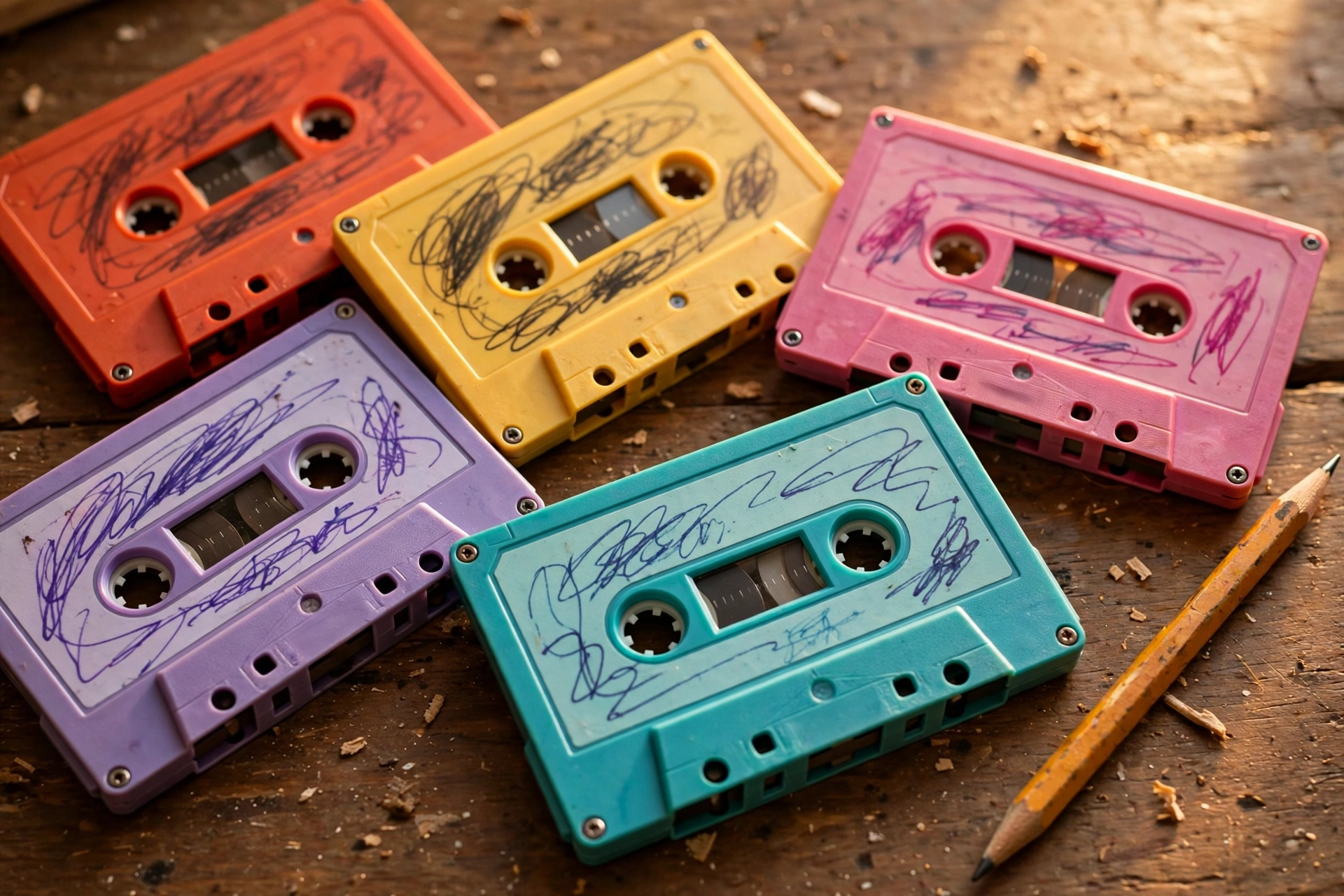
A mixtape was a cassette tape onto which you’d record songs in a specific order, for a specific person. Making one took hours — not just because you recorded in real time, but because curation was everything. Every song was a message. The order mattered. You were telling a story, and the songs were your words. A mixtape said: I thought about you for hours. Try conveying that with a Spotify link.
The Ritual of Recording
You’d start with a blank cassette, then gather source material. Recording from the radio was an art — you’d wait hours for the right song, hit record at exactly the right moment, praying the DJ wouldn’t talk over the intro. A 60-minute tape took 60 minutes to make. There was no fast-forwarding. You were present for every second, thinking about the person, imagining them listening. This is what makes mixtape history so fascinating.
The Cover Was Art
The cardboard insert was a canvas. People drew designs, cut magazine pictures, wrote tracklists in their best handwriting. The tape got labeled too — recipient’s name, a date, a cryptic message like “for late nights.” This physicality made mixtapes precious. You could hold someone’s effort. It had weight, literally and emotionally.
The Anxiety of Giving
Handing someone a mixtape was terrifying. You were sharing your taste, your feelings, your inner life. If they didn’t like it, it felt like rejection. But when it worked — when they called to talk about track seven, when you heard in their voice that they understood — it was magic. Pure connection.
Mixtapes as Time Capsules
Unlike editable playlists, a mixtape was permanent. Years later, finding one was like getting a message from your past self. The songs brought back the room, the person, the way the air smelled. I have a box of old mixtapes I can’t throw away, even without a cassette player. They’re artifacts of who I was.
What We’ve Lost
Streaming is a miracle — millions of songs instantly. But we’ve lost slowness and intentionality. When you add a song in two seconds, it doesn’t mean what an hour of real-time recording meant. Playlists are fluid; mixtapes were snapshots. And we’ve lost physicality — the weight of a tape, the texture of a hand-drawn cover.
Mixtape History: Can We Bring It Back?
Next time you share music, slow down. Make a playlist with intention. Write why you chose each song. Tell them the order. Or burn a CD, make a labeled USB, handwrite a tracklist. The medium matters less than the mindset. A mixtape was never about the cassette. It was about saying: you matter enough for my time.
The Songs Remember
There’s a song I haven’t heard in twenty years that I can still sing word for word because someone put it on a mixtape for me. That’s the power — not just music, but memory, emotion, and connection on a spool of magnetic tape.
Start Your Own Tradition
This week, make someone a mixtape. Not a quick playlist — a real, intentional collection. Pick ten tracks. Think about the order. Write why you chose each one. In a world of infinite instant content, the most radical thing is to slow down and make something with care. Understanding mixtape history helps us appreciate slow, intentional connection.
For more nostalgic journeys, explore why the 1990s feel like home.
Pingback: 1990s Nostalgia: Why the 90s Feel Like Home | NostalgiaHub
Pingback: The Dial-Up Internet Era: Beeps, Busy Signals, and the Sweet Sound of Connection - NostalgiaHub
Pingback: Walkman History (1979): Sony's Ultimate Portable Music Revolution - NostalgiaHub
Pingback: Classic Rock: The Anthems That Raised a Generation - NostalgiaHub
Pingback: Early 2000s Nostalgia: Best MSN & Burned CD Memories
Pingback: Boombox: The Giant Stereo That Ruled 1980s Streets
Pingback: Columbia House Memories: The Unbelievable 12 CDs Deal