You could hear it before you saw it. A wave of bass rolling down the block like summer thunder, and then — there he was, shoulder dipped low, walking like a king. On his shoulder sat a silver monster the size of a suitcase, chrome flashing in the sunlight, and the whole street turned its head. The boombox wasn’t just a radio you carried. It was a declaration.
There has never been a music player quite like it, and honestly, there never will be again. Before playlists lived in pockets, before earbuds shrank music into something private, music was public, heavy, and loud — and it rode around on your shoulder like a badge of honor.
The Boombox Was Never Just a Stereo
Let’s get one thing straight: calling a boombox a “portable radio” is like calling a Harley a “bicycle with a motor.” Technically true. Spiritually insulting.
The boombox arrived on the American market in the late 1970s, and by the early 1980s it had exploded into something no electronics company had planned for. Yes, it played AM and FM radio. Yes, it had cassette decks — the good ones had two of them. But what it really was, what it truly was, was a mobile throne. Whoever carried the box controlled the soundtrack of the block, and whoever controlled the soundtrack controlled the day.
Think about how personal music has become since. One person, one phone, two earbuds, volume at twelve percent so nobody on the train is annoyed. The boombox was the exact opposite of that. Music wasn’t private property. It belonged to the corner, the park, the stoop, the rooftop. You didn’t ask anyone’s permission to fill the air with sound — you just pressed play and the whole neighborhood got the show.
It had other names, depending on where you stood. Jambox. Radio-cassette. Ghettoblaster. That last one — “ghetto blaster” — came straight out of urban America, where the box was most at home. Some people used it proudly; others heard the edge in it. But whatever you called it, everybody knew what it meant: the big silver beast with the twin speakers that made the windows rattle three houses down. Even Wikipedia’s boombox entry notes how closely the device became linked to urban youth culture and the rise of hip-hop in America.
You Didn’t Carry It. You Wore It Like a Crown.
Here’s the thing nobody tells you about carrying a boombox: it was heavy. A serious box could weigh more than twenty pounds, and the bigger ones stretched wider than your shoulders. But that’s exactly what made the shoulder carry so iconic.
You didn’t hug it to your chest like a baby. You didn’t wheel it around on a cart like an appliance. You hoisted it up, set it on one shoulder, and walked. One hand on the handle to steady it. Head slightly tilted away from the speaker blasting into your ear. Elbow out. Chin up. That posture — the boombox lean — was a whole language. It said: I’m here. This is my music. Follow if you can keep up. As Gizmodo’s history of the boombox once put it, these shoulder-borne machines helped launch an urban revolution of style and technology.
Kids saved up for months for a decent box the way kids today save for a phone. A cheap one got you laughed off the corner. A JVC RC-M90 — the legendary “King of Boomboxes,” the same model LL Cool J put on the cover of his 1985 debut album Radio — that got you respect before you even pressed play. The Sharp GF-777, with its six speakers and dual decks, could drown out anything else on the block. The Panasonic and Lasonic models had their own loyal armies. People knew these machines by name the way car people know engines.
And there was always that one kid whose box was bigger than everyone else’s, who walked into the park like he owned the concrete. You know what? For those afternoons, he kind of did.
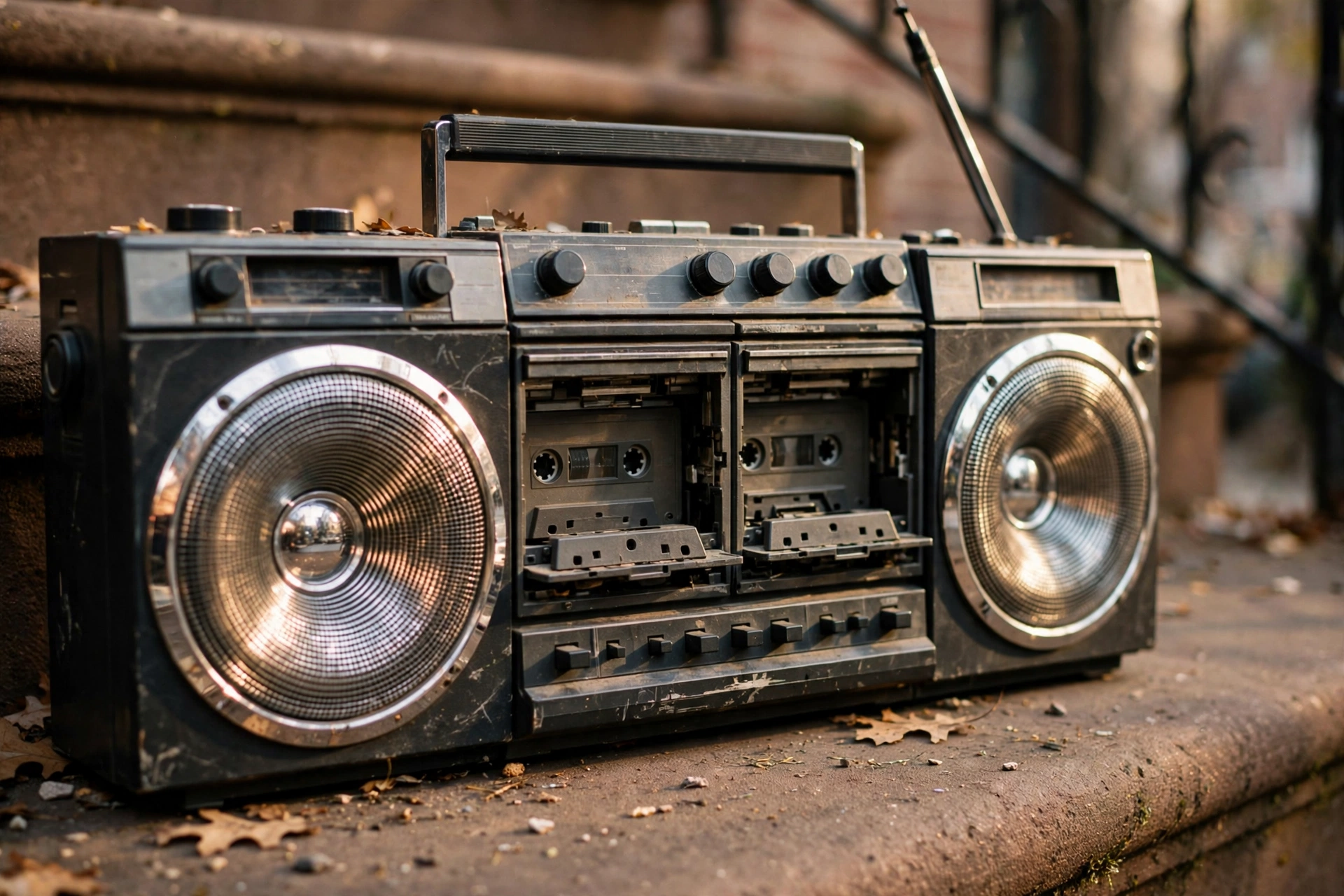
The Streets of New York Gave It a Job
To really understand the boombox, you have to go to the South Bronx and the Brooklyn corners of the late 1970s and early 80s — the birthplace of hip-hop. This is where the box stopped being a product and became infrastructure.
Breakdancing didn’t happen in studios with mirrored walls. It happened on cardboard laid over concrete, in parks and schoolyards and parking lots. And breakdancing needs breaks — those funky drum sections DJs looped from records. No DJ booth on the corner? No problem. Somebody’s boombox, cranked to ten, became the club. The whole scene — the cyphers, the battles, the crowds that gathered like gravity — ran on batteries and bass.
DJs would bring their boxes to block parties. MCs would freestyle over whatever was playing. Graffiti writers sketched while the music pumped. The boombox was the common denominator of it all: the thing that turned a patch of empty pavement into a party. Hip-hop’s earliest spread didn’t travel through record stores or radio stations first. It traveled through these boxes, carried on shoulders from borough to borough.
That’s why when you look at photos from hip-hop’s golden era, the boombox is always there. In the Beastie Boys’ photo shoots. On the cover of Radio. In every music video that wanted to signal “this is real street culture.” The industry didn’t invent that association. The streets earned it.
Two Decks and a Mission: The Art of Dubbing
Now let’s talk about the feature that turned teenagers into amateur record labels: the double cassette deck.
The high-end boomboxes — the ones worth their weight in D batteries — came with two tape decks side by side. And they weren’t just for convenience. They were for dubbing: copying a cassette from one deck to another, in real time, at high speed. Your friend had the new album? He didn’t lend it to you for a week. He brought his tape, you brought a blank, and twenty minutes later you both walked away with the record.
Whole libraries got built this way. One kid bought the album, ten kids owned it by Friday. It was the original file-sharing network, except instead of servers and torrents it ran on patience, blank Maxell tapes, and somebody’s dad’s stereo.
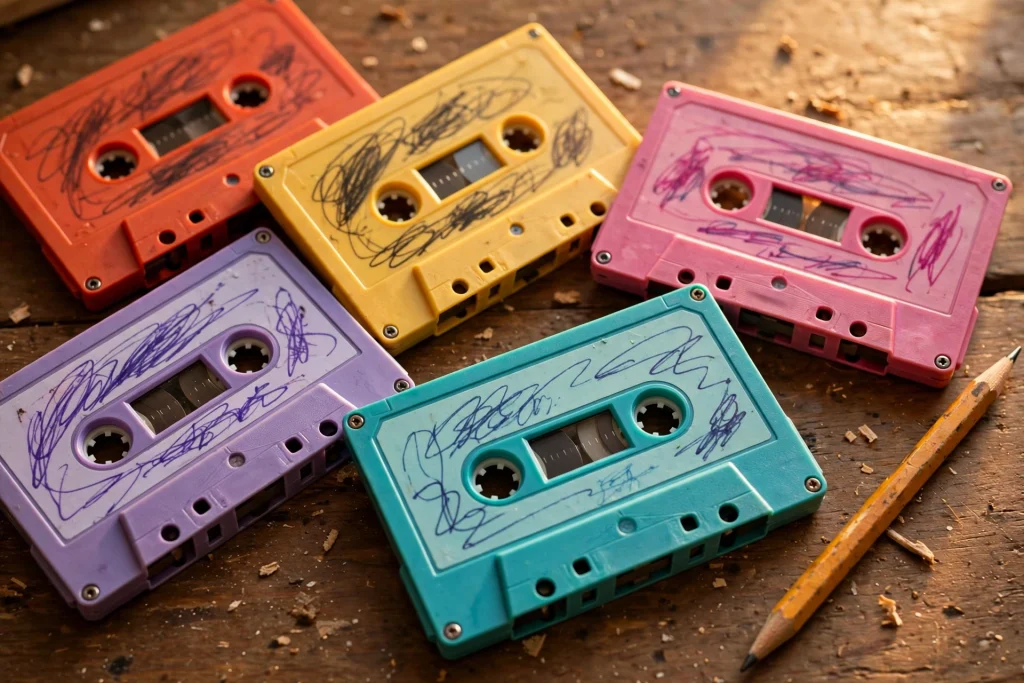
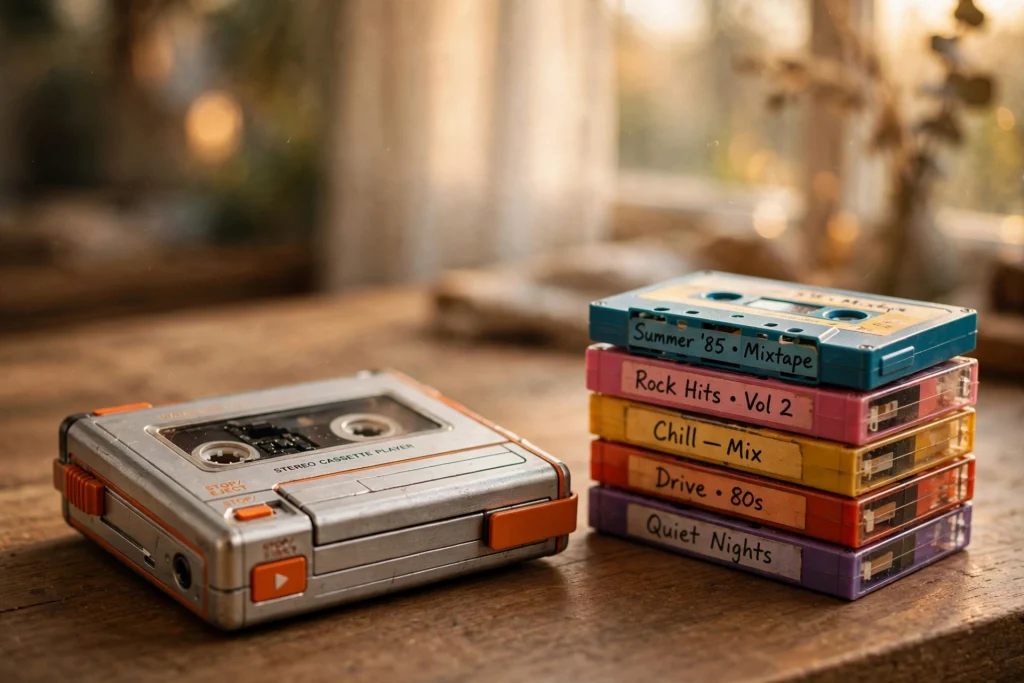
And it wasn’t only about copying albums. The real artists made mixtapes — or, as they were really called on the street, pause tapes. You’d sit there with a finger on the pause button, recording the hook from one record, hitting pause, swapping in another tape, catching a verse, layering it all together. It was clumsy, it hissed, the timing was never perfect — and it was magic. Every pause tape was a one-of-a-kind collage that no streaming service could ever recreate, because it had your fingerprints all over it.
Honestly? The dubbing deck was the first “share” button. We just had to press it with our whole hand. If that ritual sounds familiar, you’ll feel right at home in our deep dive into the lost art of the mixtape — the pause-button craft that turned teenagers into curators.
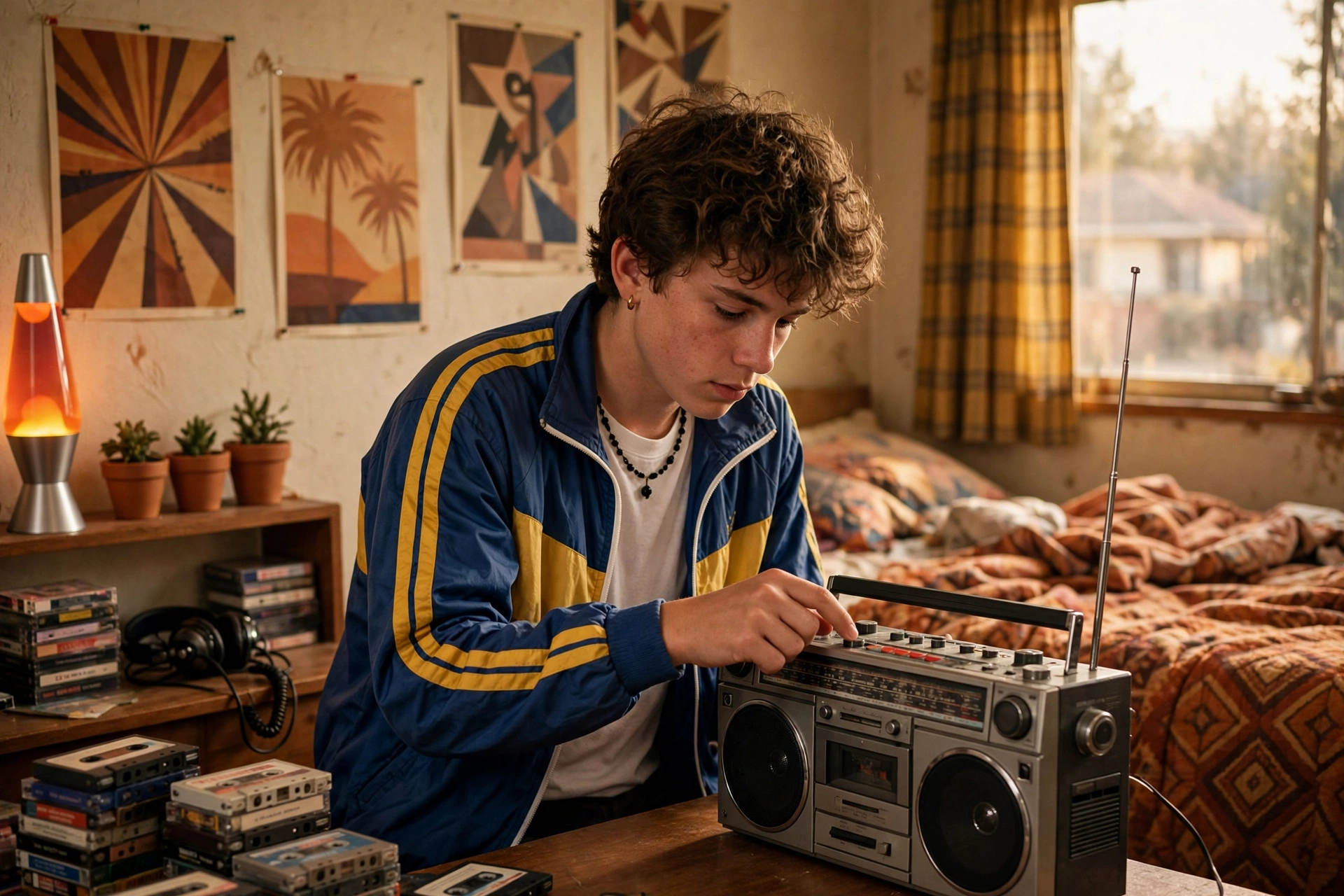
D Cells: The Appetite of a Beast
A boombox ran on batteries the way a muscle car runs on gas: gloriously, and far too fast.
The standard was eight D-cell batteries. Eight of them, lined up in the belly of the box like ammunition. The bigger monsters wanted ten. And when you cranked the volume to the level a proper box demanded, you were lucky to get a few hours before the bass started sagging and the tape started dragging into that sad, low-pitched warble that meant party’s over, somebody’s walking to the store.
Ask anyone who lived it: the battery run was a sacred mission. You’d pull the dying cells out, line them up, and do the ritual — shake them, roll them between your palms, maybe warm them in your hands like they were tiny heaters. Everybody knew it didn’t really work. Everybody did it anyway.
Then there was the cost. D batteries weren’t cheap, and a boombox that got heavy daily use could eat through a pack a week. Kids negotiated battery money the way kids today negotiate phone data. “If I mow the lawn, can I get the four-pack?” Some families bought the giant rechargeable packs. The smart ones plugged into the wall whenever they could — there was always one corner of the park near an outlet that became prime real estate.
Here’s my favorite truth about it: the battery aisle at the drugstore was the original streaming subscription. You paid monthly, it kept the music flowing, and when you stopped paying, everything went quiet. We just carried ours home in a paper bag.
Recording the Radio: Finger on the Button, Heart in Your Throat
Before dubbing, before pause tapes, there was the most nerve-wracking sport of the boombox era: taping songs off the radio.
It went like this. You heard your song was “coming up” on the countdown show. You grabbed a blank tape, rewound it to the start, and sat there with your finger hovering over the RECORD button like a sniper. The DJ would talk. And talk. Commercials. The weather. A traffic report. Your finger would cramp. Your heart would pound.
And then — the first notes. NOW. Record and play, punched together in one desperate motion.
Half the time, the DJ talked right over the intro. “That was — you’re listening to — up next we got—” And you’d scream at the radio. Because that intro was now permanently part of your recording, the DJ’s voice baked into the first eight seconds of the song forever. No undo. No re-record. That tape was going in your collection with a radio host yelling through the opening chords, and you learned to love it that way.
Sometimes you’d miss the first five seconds because you flinched. Sometimes you’d catch the song perfectly and feel like you’d won the lottery. Either way, when you played it back and it worked, you felt like a studio engineer. We built our libraries one shaky, DJ-interrupted, hissing cassette at a time — and we treasured them more than any playlist I’ve ever made since.
There was even an etiquette to it. You never talked during someone’s recording session. You held your breath when the antenna was extended and the signal was fragile. And when your friend finally got a clean capture of the song everybody wanted? That tape got dubbed so many times the copies sounded like they were recorded underwater. Nobody cared. It was ours.
The Bass You Felt in Your Chest
Let’s talk about the sound itself, because this is where nostalgia gets physical.
A good boombox didn’t just play music. It moved air. The bass hit you in the sternum before it reached your ears — a deep, round thump you felt in your ribs like a second heartbeat. Modern Bluetooth speakers are engineering marvels. They are precise, clean, efficient, and they fit in a cup holder. And not one of them has ever made a grown adult stop mid-sentence and say “oh no, that’s MY song” from half a block away.
The boxes had real engineering behind the noise: five-band graphic equalizers on the JVC, separate bass controls, loudness switches, big paper-cone woofers with actual excursion. Cranked up, the needle on the VU meter would slam into the red and stay there, bouncing like it was dancing. The whole box would vibrate. The handle would rattle. Your shoulder would go numb after an hour — and you’d keep walking anyway, because turning it down was never an option.
That’s the thing about bass you can feel: it doesn’t ask for your attention. It takes it. It rearranges the furniture in your chest. Scientists can measure frequency response all day long, but no graph captures what it felt like to stand in front of a wall of sound pouring out of a chrome-faced box on a hot summer evening, the concrete still warm under your feet, the whole block moving to the same beat.
Portable speakers today want to disappear. The boombox wanted to be seen. Chrome dials, flashing LEDs, speakers big enough to see the cones pump — it was furniture, jewelry, and a PA system all at once. Subtlety was not in the spec sheet.
Why the Boombox Still Echoes
By the early 1990s, the era was winding down. The Walkman had taught the world that music could be private — we traced that whole revolution in our story of how Sony’s Walkman put a soundtrack in everyone’s pockets. The Discman came next, then MP3 players, then the phone that ate everything. The giant chrome boxes shrank into black plastic, then into docks, then into thin rectangles we carry without thinking.
And yet — the boombox never really died. It just became a symbol.
Vintage collectors now pay serious money for a working JVC RC-M90 or Sharp GF-777 — sometimes more than the original price tag. Boutique cassette labels release new tapes. Street artists and DJs drag restored boxes to block parties on purpose, chasing that feeling no portable speaker can fake. The boombox shows up in movies whenever a director needs to say “this is the 80s” in a single frame. It worked, because nothing else says it faster.
But here’s what I think the real legacy is. The boombox was the last music machine that forced us to share. You couldn’t listen alone — it was too big, too loud, too gloriously public for that. Your taste became the neighborhood’s soundtrack. Your shoulder became the DJ booth. Music wasn’t content to consume; it was weather. It changed the temperature of wherever you carried it.
Spotify fits in your pocket. The boombox barely fit through a door — and that’s exactly why it mattered. It made music a public act of generosity. It turned a commute into a parade and a park bench into a front-row seat. It said that your songs were worth hearing at full volume, and that strangers on the sidewalk deserved to hear them too.
Every generation gets one machine that defines how it loves music. For the kids of the 80s, it was a twenty-pound silver beast with two cassette decks, eight D batteries, and bass that rearranged your ribcage. It was heavy. It was loud. It was completely, gloriously unreasonable.
And honestly? I miss the unreasonableness most of all.
So tell me — did you ever carry one? Were you the kid with the box on the shoulder, the one holding the cardboard for the breakdancers, or the one sprinting to the drugstore for batteries before the party died? What was your box — and what song was playing the first time you pressed record off the radio? Drop your memory in the comments. I want to hear it.
Pingback: Polaroid Instant Camera Memories: Magic in Your Hand
Pingback: Sock Hop Memories: 7 Unforgettable Slow Dances