Close your eyes for a second. It’s 1978, or maybe 1985 — doesn’t matter, because the sound was the same. Down the hall, in some classroom or some office with venetian blinds and the smell of coffee, twenty typewriters are going at once, a rattling thunderstorm of metal keys striking paper. Now picture just one machine. Just one typewriter under your fingers, on a desk that wobbled a little every time you struck the keys too hard.
That was the world we grew up in. A world where writing meant work — real, physical, noisy work. And here’s the thing nobody tells you until it’s gone: it was wonderful.
The Sound That Filled Every Office
You could hear a typewriter before you ever saw it. Offices in the sixties and seventies didn’t hum — they clattered. Rows of secretaries and clerks, fingers flying, every keystroke a little hammer slamming a tiny letter-shaped piece of metal through an inked ribbon onto paper. Clack-clack-clack-clack. It was the heartbeat of every business on every street in America, and half the schools too.
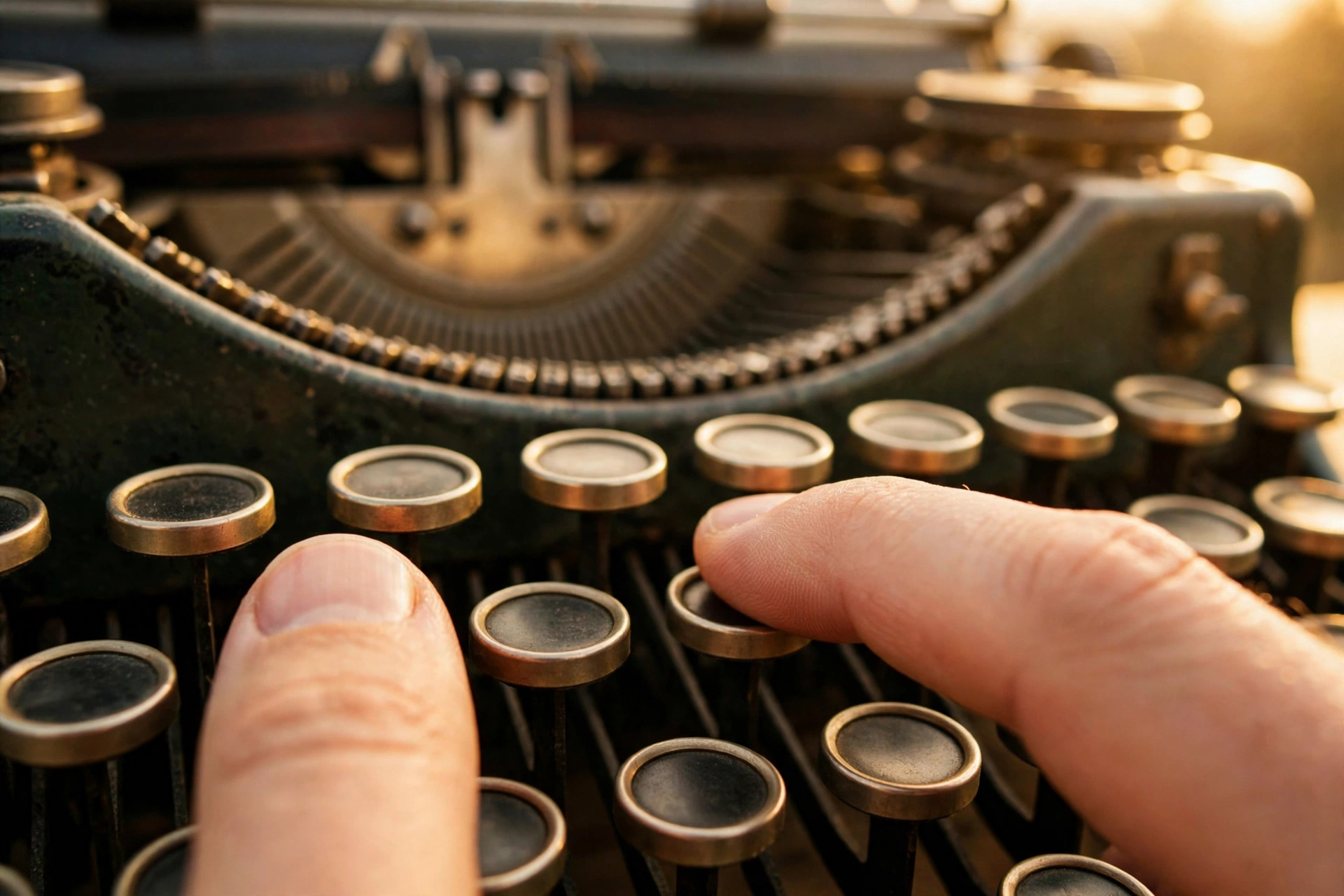
And it wasn’t quiet, polite tapping like a laptop. Oh no. Typewriter keys needed force. You had to strike them the way you’d strike a piano key — from the fingers, with conviction. Typists developed strong fingers like pianists, and desks had a little bounce to them after a few years of faithful service. The whole machine shook with every sentence. You felt your words happening.
There was even a hierarchy of sound. A fast, confident typist — ninety words a minute — sounded like a burst of pure certainty. A slow beginner, hunting and pecking with two fingers, sounded like a dripping faucet. Drip. Drip. Drip. And somewhere in between was the rest of us: fast enough to be proud, slow enough to make mistakes.
Every generation has its soundtrack. Ours just happened to be mechanical — the same era that gave us rotary phones with their long, tangled cords.
The Ding of the Carriage Return
But the sound that lives in every memory — more than the clacking — is the ding.
You’d be flying along, words pouring out, and then you’d feel the carriage getting heavy on the left. That little warning bell would ring — ding! — telling you the end of the line was near. You had about five characters left. Five. Then you grabbed the carriage lever on the left side and gave it one glorious, violent shove.
SWISH-CLUNK.
The whole carriage — the heavy roller holding your paper — would fly back across the machine and slam home with a sound so satisfying it should have been illegal. The paper advanced one line. You were ready to go again. It was the original “new line” command, and it felt like something. Like you’d completed a whole unit of thought.
The ding was the original notification sound. Everything on your phone today is just a pale echo of it.
How to Slam a Carriage Like You Meant It
There was technique to it, you know. A timid little push made the machine sigh and the next line start unevenly. A proper slam — arm from the elbow, a flick of the wrist at the end — sent the carriage home with authority. Every office had at least one person whose carriage returns you could hear from the next room, and everyone respected them a little bit for it.
Kids in typing class would show off. Teachers would pretend not to notice. And that ding — that little bell — became the most comforting sound in the world. It said: you’re making progress. Keep going. Another line down.
Typewriter Typing Class: ASDF JKL;
If you went to school in the seventies, eighties, or early nineties, there was no escaping it: typing class. A room full of heavy, battleship-gray machines, a teacher with a strict streak, and the sacred home row: ASDF JKL;
Left hand on A-S-D-F, right hand on J-K-L-semicolon. Thumbs hovering over the space bar. Eyes on the chart, never on your hands — never! “Your hands are not your friends,” the teacher would say. “Your fingers know where they’re going. Trust them.” And then the drills began. “A-a-a-a-space. S-s-s-s-space.” The whole class in unison, thirty machines clattering the same letter over and over, like a marching band of mediocrity slowly turning into musicians.
I’ll be honest — it felt like torture at the time. “The quick brown fox jumps over the lazy dog,” typed a thousand times until the sentence haunted your dreams. But then something magical happened around week six: you looked up from the keys for the first time and kept going. Your fingers knew the way. It was like learning to ride a bicycle — suddenly you didn’t need to look down anymore.
Some of us never got fast. Some of us stayed hunt-and-peck lifers forever, eyes glued to the keyboard. But typing class gave everyone the same gift: it made the machine disappear. You stopped thinking about the keys and started thinking about the words. That’s when a typewriter became an instrument.
And yes — if this takes you back to school days in general, you’ll want to revisit our trip through old-school days of chalkboards, lunchboxes, and classroom memories.
Mistakes You Couldn’t Delete
Here’s the thing about a typewriter that the delete-key generation will never fully understand: there was no undo.
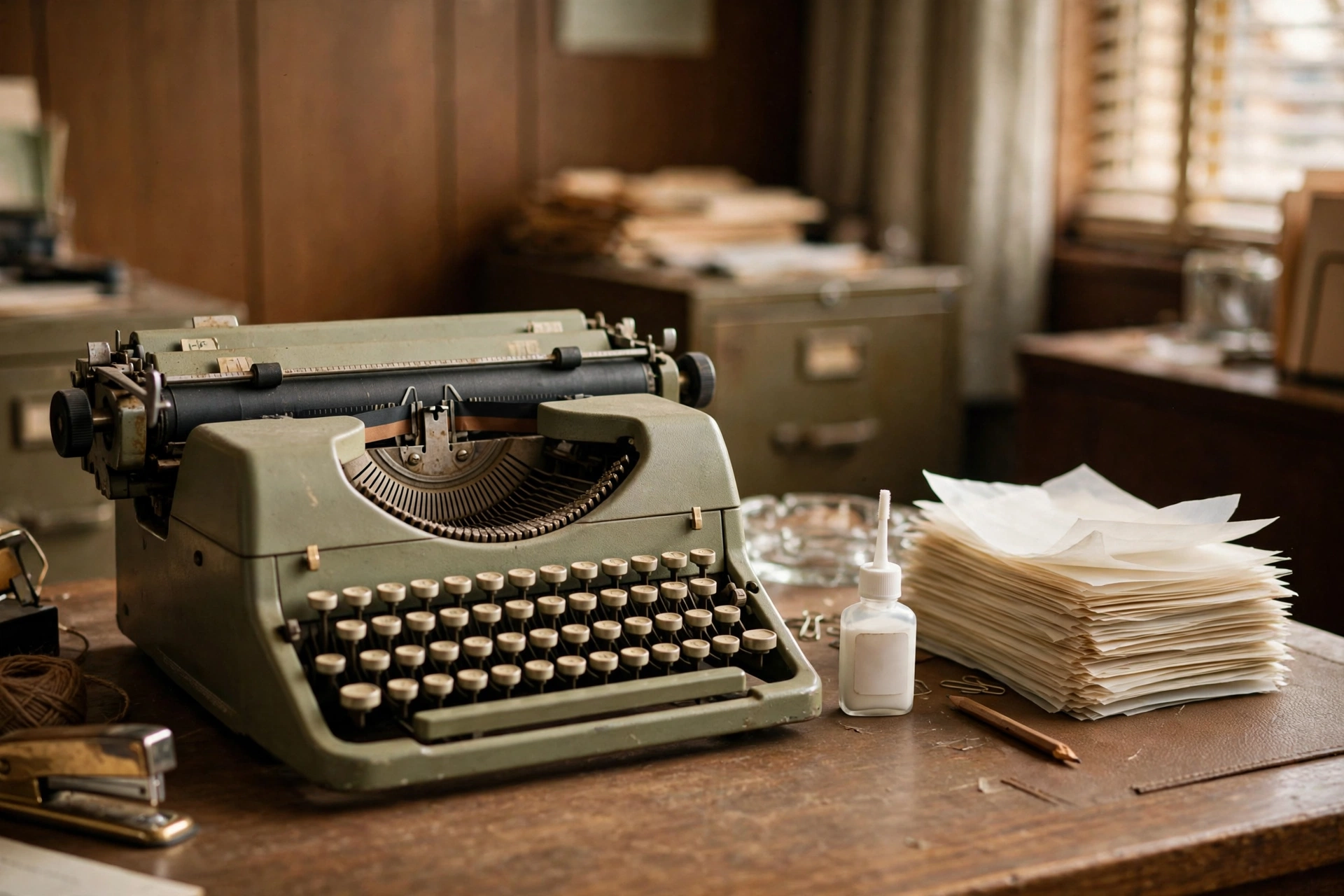
You hit the wrong key, and that letter was on the paper. In ink. Forever. Your only options were: retype the entire page, become a master of the eraser (which chewed holes in thin paper and left pink crumbs everywhere), or reach for the little bottle sitting on every desk in America.
White-Out. Liquid Paper. The smell of it — that sharp, chemical, oddly sweet odor — is burned into the memory of everyone who ever typed a term paper at midnight. You painted it over the mistake with the tiny brush, blew on it like it was a wound, waited for it to dry, then rolled the carriage back and typed over it. Most of the time it worked. Sometimes the dried patch flaked off at the worst possible moment. It was a gamble every single time, and we took it without blinking.
And the woman who invented it? Her story is better than any movie. In 1951, Bette Nesmith Graham was a secretary at a bank in Dallas, Texas, struggling with her electric typewriter. She had watched painters cover their mistakes on a canvas instead of erasing them, and she thought — why not do that with typing? She started mixing white tempera paint in her kitchen blender, pouring it into nail-polish bottles, and selling it to fellow secretaries under the name “Mistake Out.” She renamed it Liquid Paper in 1956, and in 1979 she sold the company to Gillette for $47.5 million.
Yes — that kind of millionaire. From kitchen-blender paint. And if her son’s name sounds familiar — Michael Nesmith — that’s because he was in The Monkees. One of the most famous pop fortunes of the sixties was funded, in a roundabout way, by the little bottles we used to hide our typos. You can’t make this stuff up.
And yet, for all the White-Out in the world, the typewriter taught us something no software ever could: think before you type. There was no safety net. Every sentence was a little leap of faith. It made our words careful. It made them mean something.
Carbon Copies, Onion Skin, and the CC in Your Email
Now, for the younger readers — the ones who hit “CC” on emails every day without a second thought — here’s a delightful secret: you are speaking typewriter.
CC stands for “carbon copy,” and it is a leftover from the days when making a copy of a letter meant sandwiching a sheet of carbon paper between two sheets of typing paper. You’d type once, and the pressure of the keys would push ink through the carbon paper onto the sheet below. One original, one carbon copy — and sometimes, if you pressed hard enough and the stars aligned, a third faint copy that looked like a ghost of the original.
That is literally why your email has a CC field. A “blind carbon copy” — BCC — was a copy slipped to someone without the main recipient being told, exactly like adding an extra carbon sheet into the stack for the boss’s eyes only. The paper is gone, but the language survived. A hundred years from now, people might still CC each other without ever having touched a piece of carbon paper. That’s how deeply the typewriter carved itself into how we communicate.
Why “CC” Is Never Leaving Your Inbox
Language holds onto things that matter. We still “dial” phones and “tape” shows and “roll down” car windows. The typewriter handed the digital world some of its oldest vocabulary, and that tells you everything about how central these machines once were. They weren’t gadgets. They were infrastructure.
And then there was onion-skin paper — the whisper-thin, almost translucent sheets people used for those second and third copies. It felt like tissue paper’s serious older cousin. Typing on it was terrifying, because the slightest mistake showed up three times over. But a neat stack of crisp onion-skin copies, edges perfectly aligned, was one of the great small satisfactions of office life.
The Ribbon and the Inky Fingers
Let’s talk about the ribbon, because nobody else will, and it deserves its moment.
The ribbon was a long strip of inked fabric — usually black on one half, red on the other, with a little switch on the machine to change colors — spooled between two reels inside the typewriter. Every keystroke lifted the ribbon between the typebar and the paper for a fraction of a second. And when your print started looking pale and tired, it meant the ribbon was dying.
Changing a ribbon was a rite of passage. You popped open the cover, lifted out the old spools, and threaded the new ribbon through a maze of tiny guides — and no matter how careful you were, you ended up with black ink on your fingers. It was a law of nature. You could scrub for two days and it would still be there at your fingertips, announcing to the world: this person types for a living.
There was a smell to fresh ribbon ink — rich and oily and industrial. Mixed with the machine oil and the paper dust, a typewriter had its own perfume. Kids who grew up with a parent who typed at home know exactly what I mean. You walked into that room and knew work had been done there. It smelled like effort.
Later came the fancier ribbons — film ribbons that printed crisper, and “correctable” ribbons that let you lift a mistake right off the page with a special key. People thought that was magic. And honestly? It kind of was. But by then the typewriter’s days were numbered, and the ribbon’s greatest trick turned out to be its last.
The IBM Selectric and Its Spinning Golf Ball
Then came the machine that changed everything — and didn’t even have the decency to have moving typebars.
In 1961, IBM introduced the Selectric, and offices collectively gasped. Instead of a basket of little metal arms swinging up to strike the paper, the Selectric had a chrome-plated ball — the “typeball,” which everyone promptly nicknamed the golf ball — that spun, tilted, and struck the ribbon at lightning speed. It didn’t just type. It danced. By 1986, more than 13 million Selectrics had been made and sold, and the line had captured around 75 percent of the U.S. business market for electric typewriters. It wasn’t just popular. It was the office.
The genius of the golf ball was that you could swap it. Different typeball, different typeface — right in the middle of a document. Want a script font for the heading? Pop the ball off, snap a new one on, keep going. It was like changing fonts before “fonts” were a word normal people used. In 1961, it felt like the future had arrived early.
The Selectric also had a different rhythm. Since there was no heavy carriage flying back and forth — the paper stayed put while the typeball zipped across — the machine purred instead of clattered. It was the sound of the modern office: smooth, fast, electric. Secretaries who’d spent years wrestling with manuals sat down at a Selectric and felt like they’d been handed a sports car.
And the lineage stretches back even further — to 1873, when E. Remington and Sons began producing the first commercially successful typewriter, designed by Christopher Latham Sholes. His machine gave us the QWERTY keyboard we still use today, and he even coined the word “typewriter” itself. It’s a long, wonderful road from that first clunker to IBM’s spinning golf ball — if you want the full story, read the histories of the IBM Selectric and the Sholes and Glidden typewriter.
Love Letters and Term Papers, One Key at a Time
But strip away the history and the technology, and what do you have left? This: the typewriter was where feelings went to become permanent.
Term papers, hammered out at 2 a.m., fueled by coffee and panic, every page a small battle against the clock and the ribbon and the White-Out bottle. College students of a certain age can still feel the ache in their forearms from a thirty-page paper. You didn’t just write it. You endured it. And when you pulled that final page out of the carriage — clean, no mistakes, margins lined up — it felt like holding a trophy.
And the love letters. Oh, the love letters.
There is no romance in a text message. There never was. But a love letter typed on a machine — with a few corrections painted over, with the letters striking a little unevenly where your hands were shaking — that was real. Someone sat down, rolled in a sheet of paper, and committed. No delete key meant no smoothing your feelings into something safer and less honest. What you typed was what you meant, typos and all. People kept those letters for fifty years. They kept them in shoeboxes and cedar chests and the backs of drawers, and they pulled them out and read them and teared up a little, the way you do.
A typed letter had weight. You could feel the impressions of the keys on the back of the page, like braille for the heart. Try getting that from an email.
Every letter was a commitment.
“There was no delete key. There was only confidence — or White-Out.” That could be the epitaph for a whole era. An era when words cost something — time, effort, ink, thought. When making a mistake meant starting over, and getting it right meant you really meant it.
The typewriter is gone from our desks, but it’s not gone. It’s in your email’s CC field. It’s in the QWERTY keyboard under your thumbs right now. It’s in the word “typewriter” itself, still describing what we do when we press these little keys — even though nothing strikes paper anymore.
So here’s my question for you, and I really want to hear this one: do you remember the first thing you ever typed on a typewriter? Was it a term paper, a love letter, your name typed over and over until the teacher said stop? And what did it sound like — that clack, that ding, that slam? Tell me in the comments. Let’s hear the music of those machines one more time.