90s mall culture Gave Us Our First Taste of Freedom
The automatic doors hissed open on a Friday night and the whole universe changed in one step. One second you were standing in a cold parking lot with your parents’ car pulling away; the next, you were inside a glowing, buzzing, pretzel-scented world that belonged entirely to kids like you. That’s what 90s mall culture really was. Not shopping. Not the stores. It was the first place we ever got to be ourselves without any grown-ups hovering around.
Think about it for a second. Close your eyes and go back. The fountain is splashing at center court, and somebody’s little brother has just thrown a penny in and made a wish. Sunlight — or that weirdly warm skylight light — spills across the polished tiles. Somewhere to your left, the arcade is rattling out its electric symphony of bleeps and explosions. To your right, the food court smells like it’s trying to hypnotize you: sugar, grease, warm dough, and that unmistakable frothy sweetness of an Orange Julius. Every sense you own is firing at once, and you haven’t even done anything yet.
There was no texting your friends to coordinate. There were no phones at all, really. The plan was always the same, and it was beautifully simple: meet at the mall. Your mom dropped you off at six, your dad picked you up at nine, and the three hours in between were the most independent you’d ever felt in your life. You’d meet “by the fountain” because everything happened by the fountain — it was the sun of our little solar system, and every orbit passed through it.
And here’s the thing nobody tells you about growing up: freedom isn’t really about money or cars or staying out late. When you’re thirteen, freedom is a wide open corridor with a Wetzel’s Pretzels on one end and a Sam Goody on the other, and nobody checking your watch. The mall taught us how to be social before “social” meant a screen. You learned how to spot your crush from fifty feet away. You learned which friend would loan you a dollar for tokens and which one never paid you back. You learned the fine art of window shopping — walking into Spencer Gifts, giggling at the lava lamps, and walking out without buying a single thing.
The Food Court: Where Every Smell Told a Story
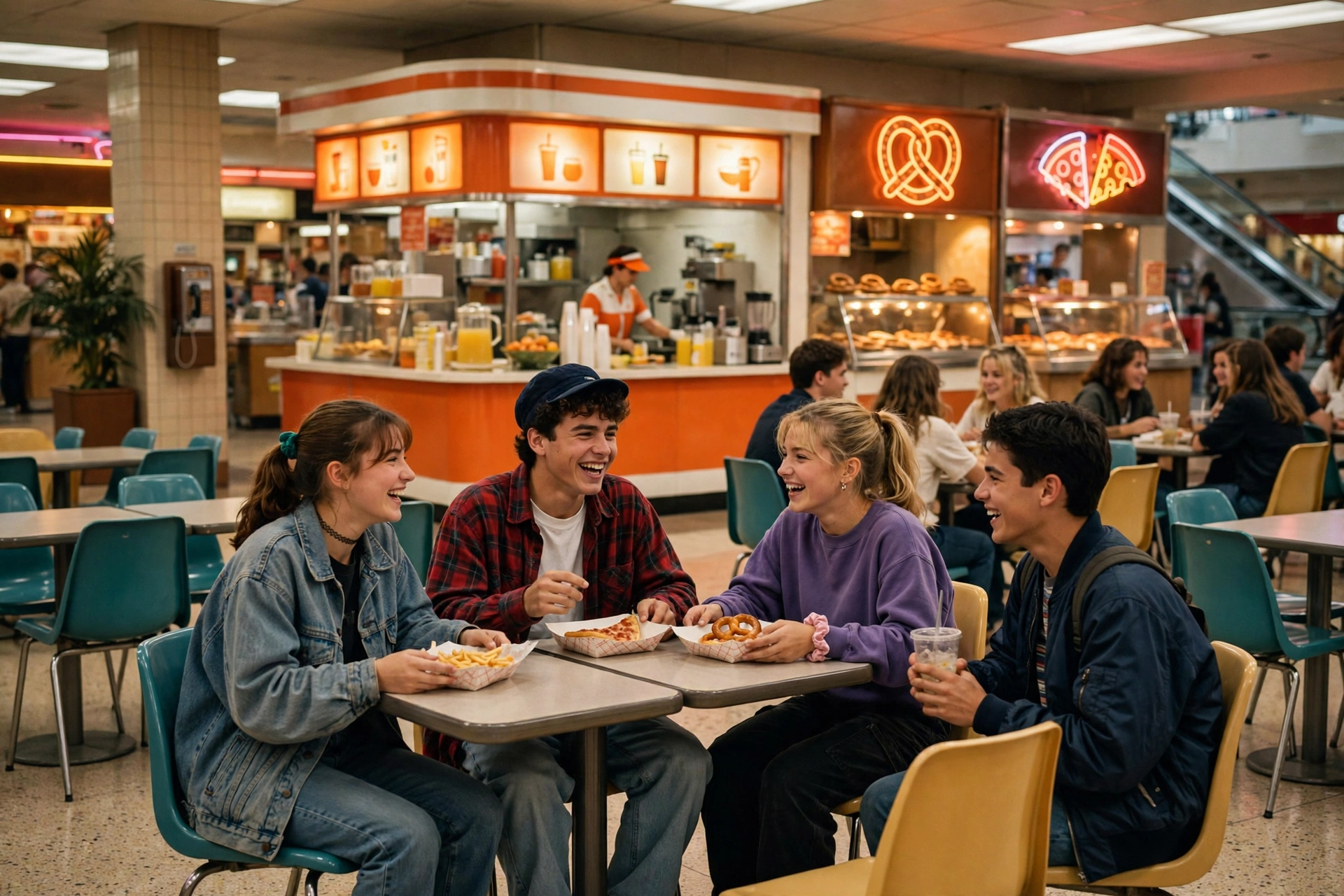
You could navigate the entire food court with your nose. Honestly, you could walk in blindfolded and still find your way to your favorite stand. The food court was our first restaurant district, our first buffet of choices, our first moment of standing in front of a glowing menu board with five crumpled dollars and the weight of a truly important decision on your shoulders.
The tables were always slightly sticky. The chairs were those molded plastic ones in teal or mustard yellow that made a loud scraping sound every time you stood up. Groups of teenagers claimed entire table clusters for hours, nursing one tray of fries like it was a five-course meal, talking about absolutely nothing and everything. Nobody rushed you. The security guard might stroll past, but he wasn’t kicking you out — not until closing, when the lights flickered and the whole crowd let out a collective groan that echoed off the tile.
Orange Julius and the Frothy Cup of Happiness
Let’s talk about the Orange Julius stand, because it deserves its own monument. You’d see that orange-and-white counter from across the food court, glowing like a little sunset, and your feet just went there on their own. The drink itself was something magical — frothy, creamy, impossibly orange, and colder than anything had a right to be. It tasted like summer vacation in a cup, like the exact opposite of homework.
Ordering one felt like a small ceremony. The blender roared behind the counter, the employee in the paper hat poured that foamy orange cloud into a clear cup, and the first sip through the straw was pure, fizzy-sweet relief. A regular Julius cost a couple of bucks, which meant even a kid with birthday money could afford the luxury. You’d carry it around the mall like a trophy, condensation dripping down your wrist, feeling like the main character of your own Friday night.
And it wasn’t just the taste — it was the ritual. Orange Julius was the pre-arcade fuel, the post-pretzel dessert, the thing you grabbed when you were meeting someone and wanted something to hold so your hands weren’t awkward. Some drinks are just drinks. The Julius was a personality trait.
Wetzel’s Pretzels, Sbarro Slices, and the Great Cookie Debate
A few steps down from the Julius counter, the air turned buttery and salty, and you knew: pretzel territory. A Wetzel’s Pretzels stand was basically a scent trap. You’d smell that warm, twisted dough from the second floor and be powerless. The plain salted one was the classic, but the cinnamon sugar version was the stuff of legends — soft, chewy, coated in a crackly sugar crust that got all over your fingers and your shirt and you didn’t care one bit.
Then there was the pizza question. Sbarro’s slices were enormous — honestly, one slice was the size of a dinner plate, dripping with cheese, served on a flimsy paper plate that immediately went translucent from the grease. You’d fold it in half like a New Yorker, even if you’d never been within five hundred miles of New York, because that’s what the cool kids on TV did. And for dessert? The Mrs. Fields cookie debate could split a friend group in half: chocolate chip purists versus the white-chocolate-macadamia rebels, arguing like it was a court case while chocolate melted down their chins.
The beautiful part was the math. A slice, a pretzel, and a Julius could be had for less than the cost of a movie ticket, and you’d stretch that feast across three hours of wandering. The food court taught us budgeting before we knew what budgeting was. “The food court was our first restaurant without adults,” as my friend used to say — and she was right. We tipped nobody, we waited on ourselves, and we felt like royalty doing it.
The Arcade Corner: Quarters Were Our Currency
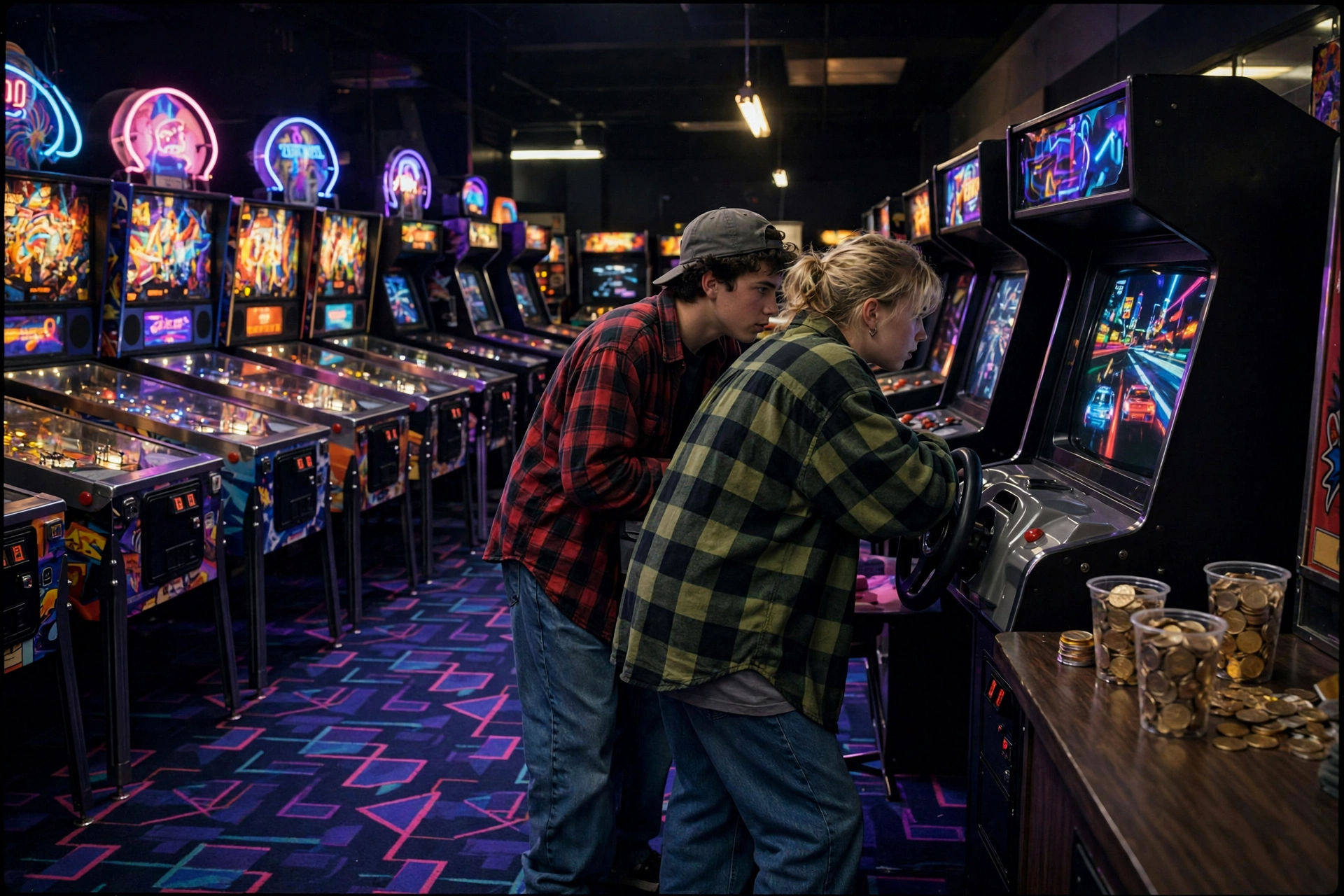
Tucked into a dark corner of the mall — or sometimes glowing like a neon cave right in the middle of everything — the arcade was the beating heart of every Friday night. You didn’t walk into an arcade so much as you were pulled in by the noise: a wall of electronic sound, pinball bells, digital explosions, and the roar of a crowd gathered around one cabinet. The carpet was always that wild geometric pattern that hid a thousand spilled sodas, and the whole room pulsed with a blue-purple glow that made everything feel like the future.
Quarters were the only currency that mattered. You’d hit the change machine and watch your dollar bill vanish and come back as four silver coins, and each one felt like a tiny lottery ticket. Some kids fed them into racing games, leaning their whole body into the plastic steering wheel like it actually steered something. Some kids lined up for the fighting games, where a crowd would gather behind the two players and the whole corner would go quiet during the final round and then explode. The token cup kids — the ones with a plastic cup overflowing with tokens from the mall’s big arcade — were basically royalty.
Pinball, Racing Games, and the Roar of the Crowd
The pinball machines lined the walls like chrome-plated guardians, their backglass art glowing, the flippers waiting. A good pinball player had a technique — the gentle nudge, the perfectly timed save — and watching a master at work was better than most movies. Meanwhile, the racing cabinets were full-body experiences: you’d climb into a sit-down machine, grip the wheel, stomp the pedals, and for three minutes you were a race car driver, with your best friend shouting directions from the passenger side of the seat.
What nobody admits now is how much of it was about watching, not playing. You’d burn through your quarters in twenty minutes, and then you’d spend the next hour leaning against a cabinet, watching the older kids play, learning their moves, cheering when someone beat the final boss. The arcade was a theater, a casino, and a clubhouse all at once. And when your last quarter disappeared into a machine, you didn’t feel broke — you felt like you’d spent it on the best possible thing.
Friday Nights: The Mall Was Our Social Network
Before anyone had a profile page, we had the loop. Every mall had one: the full circuit, past every storefront, around the fountain, through the food court, and back again. You’d walk the loop a dozen times a night, and that was the whole point. Each lap was a chance to run into someone — your crush, your rival, your best friend’s older sibling who you were convinced was the coolest person alive. Walking was the algorithm. The loop was the feed.
The rituals were sacred. You got dropped off and immediately checked who was already there. You did the first slow lap to take inventory: who’s here, who’s with who, what’s the energy tonight. You bought one thing — a pretzel, a Julius, a pack of tokens — and made it last. You ended up at the food court tables eventually, because everyone did, and the conversations there were the kind you still remember decades later: who liked who, which teacher was unfair, what movie you had to see this weekend. No filters, no likes, no screenshots. Just talking, loud and unguarded, with your elbows on a sticky table.
There was a whole fashion show happening on the loop, too. Flannel shirts tied around waists. Baggy jeans that pooled over chunky sneakers. Chokers, scrunchies, backward caps. You’d see someone in a new Hot Topic band tee and know exactly what it meant — they were into that music, they were one of those kids, and you filed it away for future conversation. The mall was how you learned who people were before anyone had a bio.
And then came the announcement. You know the one — the lights flickering, the voice over the speakers, the great collective sigh of a hundred teenagers being told the night was over. “The mall is now closing.” Parents were already idling at the curb. You’d do one last frantic lap, say your goodbyes by the fountain, and climb into the car smelling like pretzels and arcade carpet, already replaying the whole night in your head on the ride home. We didn’t need social media. The mall had a fountain, a food court, and Friday night — and that was enough.
Sam Goody, Spencer Gifts, and the Stores That Raised Us
The stores were the backdrop, but what a backdrop. Every mall had the same glorious lineup, and you loved them all for completely different reasons. The Gap was where you stared at jeans you couldn’t afford yet. Hot Topic was where you bought your identity, one band tee at a time. KB Toys was where you pressed your face against the display case and memorized prices you’d beg for at Christmas. Each store was a chapter, and you read them all in order, every single Friday.
Sam Goody: Where Albums Became Adventures
Sam Goody was a temple. You’d walk in and the first thing that hit you was the wall of new releases — rows and rows of CDs in those long cardboard boxes, album art screaming for your attention. The listening stations were the real magic: you’d put on the giant headphones, press play, and sample an entire album before spending a dime. Choosing which CD to buy with your saved-up allowance was a decision of genuine gravity. You’d stand there for forty-five minutes, holding two albums, doing mental math, asking your friend’s opinion like you were choosing a college.
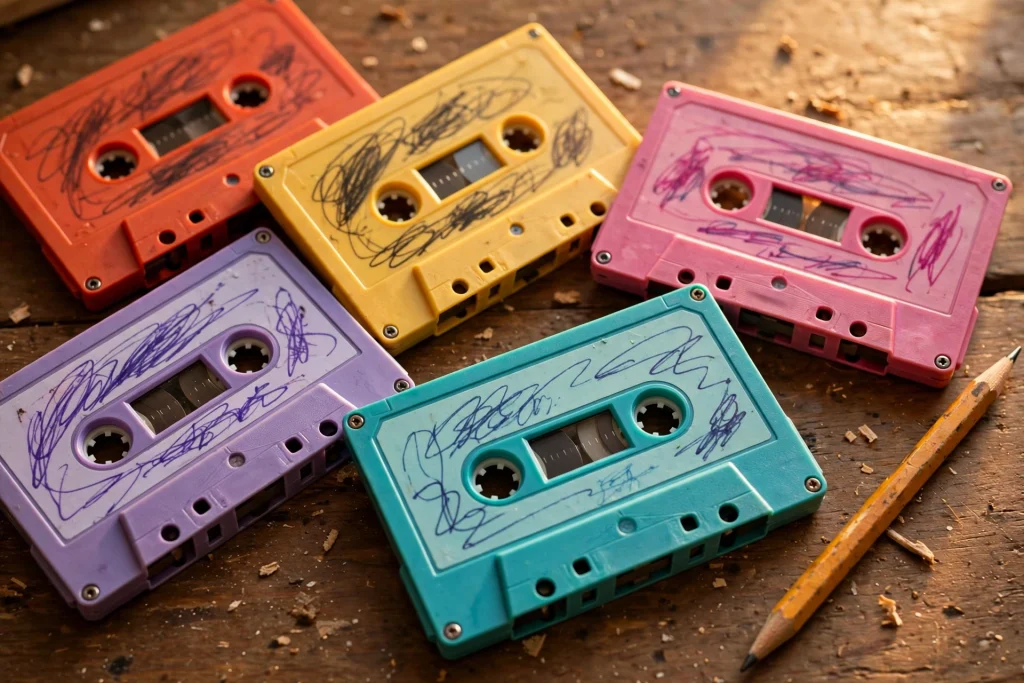
Bringing that CD home was a whole second ritual — unwrapping it, reading every line of the liner notes, and loading it into your portable CD player or dubbing your favorites onto a cassette for the Walkman you carried everywhere. Sam Goody didn’t just sell music; it sold the ceremony of discovering it. Flipping through those bins taught a whole generation how to dig — how to find the weird stuff, the hidden gems, the album nobody else knew about yet.
Spencer Gifts, KB Toys, and the Window-Shopping Circuit
Spencer Gifts was the store your parents pretended not to notice. You’d walk in giggling, past the lava lamps bubbling in the window, past the blacklight posters and the prank gadgets, daring each other to touch the weird stuff. It was equal parts fascinating and scandalous, which is exactly why every teenager on earth loved it. You didn’t need to buy anything — the browsing was the entertainment.
And KB Toys? That was pure childhood in a storefront. Action figures lined up like little plastic armies, board games stacked to the ceiling, and that one display case with the thing you wanted more than oxygen. If you grew up collecting the toys of the decade, you already know the feeling — it’s the same rush we talked about in our piece on 90s toys like Tamagotchis and Beanie Babies, except this was the moment before you owned them, when wanting was the whole game. Window shopping wasn’t a consolation prize in the 90s. It was the sport itself.
Why We Still Miss It (and Always Will)
Here’s the honest truth: a lot of those malls are gone now. Some are half-empty, echoing buildings with shuttered storefronts and a fountain that’s been dry for years. The internet has whole photo collections of “dead malls,” and looking at them feels like flipping through a yearbook of a friend who moved away. The Orange Julius in your hometown might be a phone repair kiosk now. The arcade corner might be a dentist’s office. Time does what time does.
But the feeling never left. That’s why shopping malls of that era live so large in our memories — they weren’t really about shopping at all. They were about being young in a place that was built for wandering. The mall was the last great third place for teenagers: not home, not school, but ours. A whole glowing world where the biggest decision was pretzel or pizza, where your friends were always one lap away, where Friday night stretched out in front of you like it would never end.
If you grew up in the middle of all this, you know exactly which mall I’m talking about — yours. The one with the fountain, the food court, the arcade corner that ate your quarters. So here’s my question for you: what was your mall ritual? Were you a Julius kid or a pretzel kid? Did you rule the racing games or were you a pinball purist? Drop your story in the comments — because the best part of 90s mall culture was always the people, and that part never closed.
Pingback: Old Photo Booth Memories: Four Photos, One Childhood