You remember the sound, don’t you? That soft swish as the heavy curtain slid shut, and suddenly the whole noisy mall was gone — the food court chatter, the arcade bells, your mom calling your name. Just you, your best friend, and a little buzzing box promising four tiny black-and-white photos. Those old photo booth memories still live somewhere between your ribs, don’t they? That small private world behind the curtain was one of the happiest places on earth, and all it asked of you was a dollar and a goofy smile.
I swear, nothing in my whole childhood delivered joy quite as fast as a photo booth did. You’d walk up to that squat little machine, slide in your coins with the confidence of a stockbroker, and pull the curtain closed like you were starting your own private movie. Click. Whirr. Flash. And then the hardest wait of your young life began.
Old Photo Booth Memories Start With a Coin and a Curtain
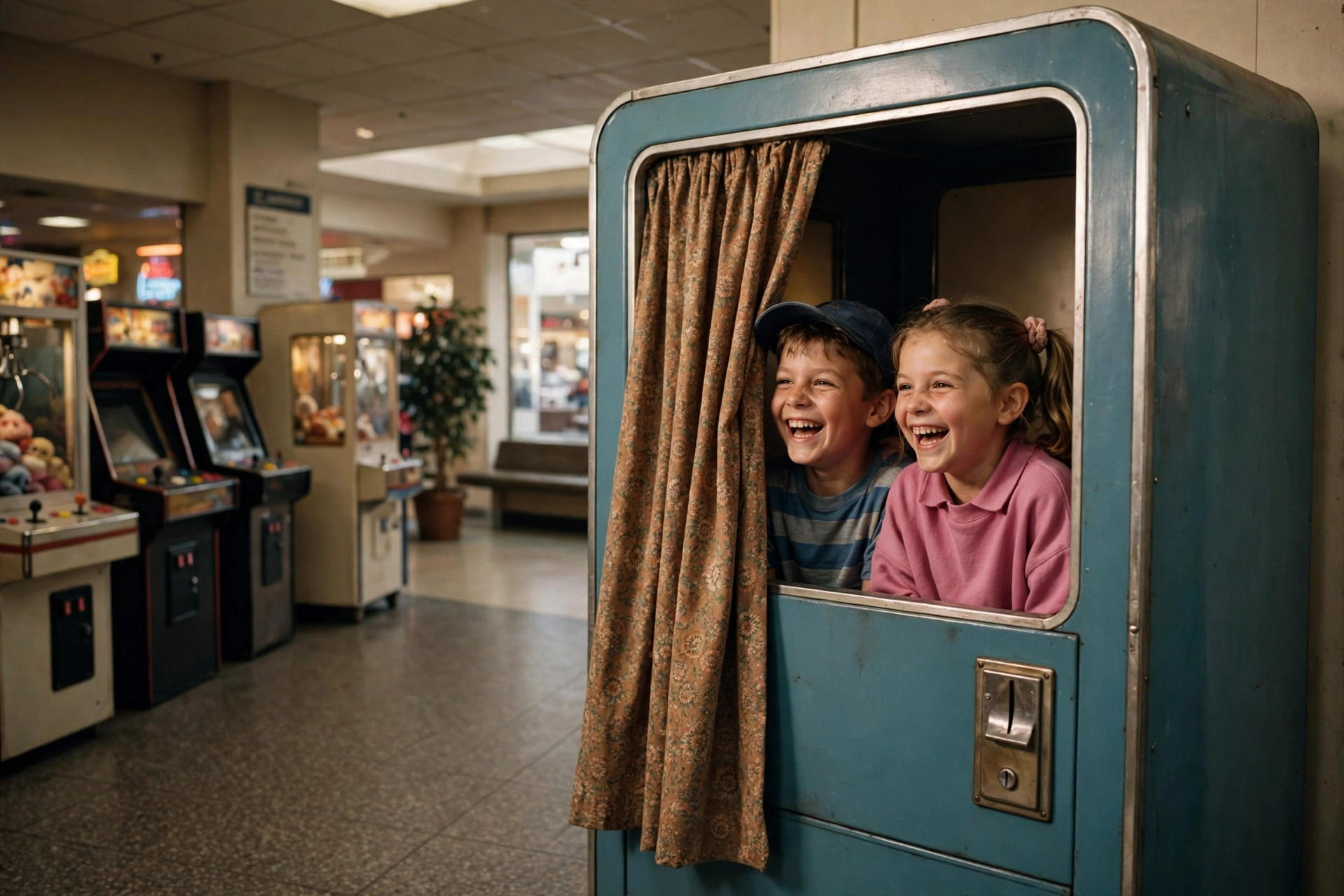
Let’s be honest — the booth itself was barely a booth. It was a coffin with a curtain, a cramped wooden box where the stool was always too low and the ceiling was always too close. But the moment that curtain closed, you were royalty. You had privacy. You had control. You had the power to look as ridiculous as you wanted with absolutely no parents watching.
And the money! Back in the day, the going rate was about a dollar — some machines took quarters, the fancy ones wanted two bucks. Think about that for a second. For the price of a candy bar, you walked away with a strip of photos you could actually hold, tear in half, and hand to someone you loved. Kids today pay a dollar for a phone app that puts cat ears on their forehead, and they think they’ve bought something. Honey, we bought four little squares of ourselves, chemically burned into paper, and we carried them around for years.
Do you remember the ritual? First you’d shake the coins in your fist, listening to that metallic jingle like it was a promise. Then the heavy clunk-ka-ching as they dropped into the slot. A red light blinked. The camera gave a mechanical cough. And the countdown began — that little light above the lens telling you to get ready, then flash, then the agonizing pause before the next one. Four photos. Four chances to get it right. And you almost never got it right, which was the entire point.
How a 1925 Broadway Wonder Became the Mall’s Favorite Corner
Here’s a piece of history worth knowing, because it makes those strip photos feel even more precious: the whole photo booth craze started with a man named Anatol Josepho, a Russian immigrant who set up his invention, the Photomaton, on Broadway in New York City in September 1925. You can read the story of Anatol Josepho’s 1925 Photomaton — for twenty-five cents, people got a strip of eight sepia photos developed right there in about eight minutes. Crowds lined up around the block. Two years later, Josepho sold the North American rights for a cool million dollars.
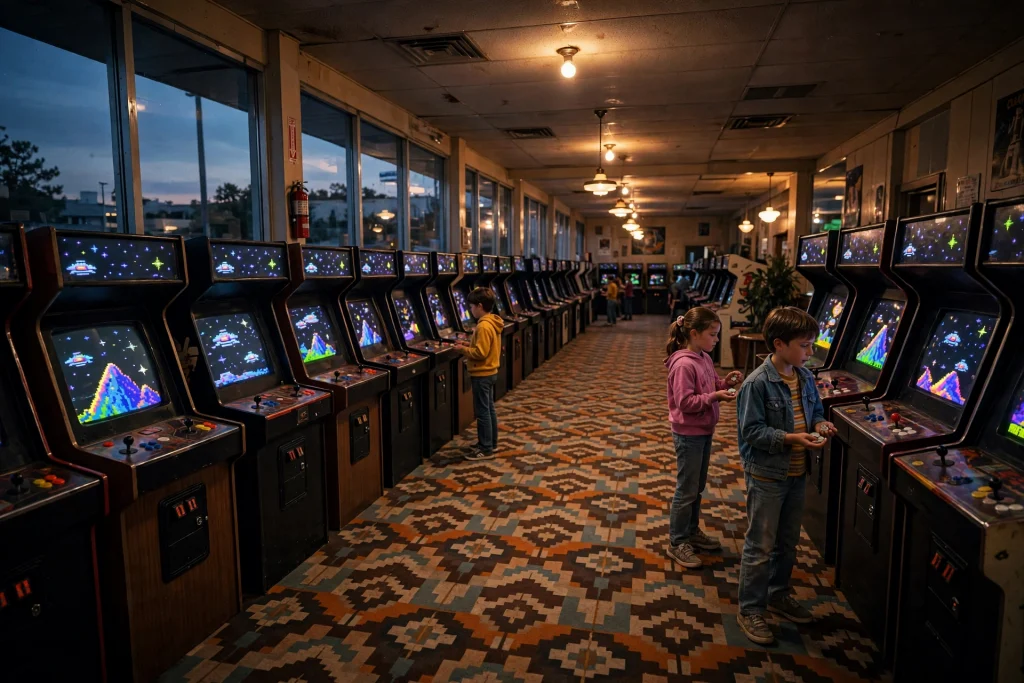
It took a few decades, but by the time we were kids, those booths had found their perfect home: the shopping mall. They stood near the arcade, or by the movie theater entrance, or in that weird quiet hallway by the bathrooms — little beacons of fun wedged between those classic mall hangouts we all lived in on weekends. A hundred years after Josepho’s invention, as a century of the analogue photobooth celebration reminds us, the machine outlasted nearly every other mall fixture. The record store closed. The arcade faded. But the photo booth? It kept clicking.
From Eight Sepia Photos to Four Black-and-White Frames
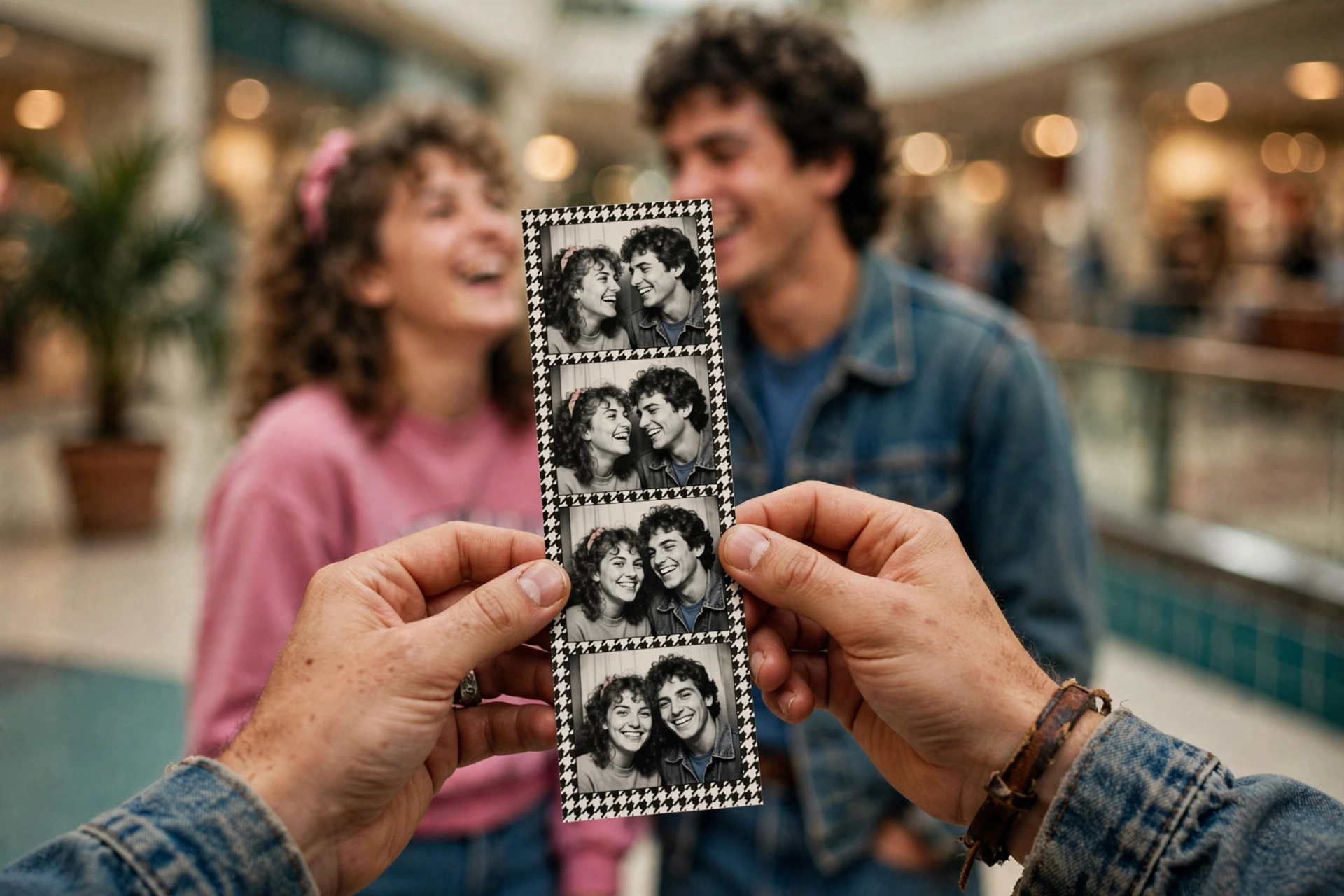
Josepho’s original strips held eight photos. The booths we knew squeezed out four — usually black-and-white, sometimes that dreamy sepia. Four felt perfect, honestly. Eight would have been exhausting; four was just enough to tell a tiny story. Frame one: you look normal. Frame two: somebody cracks a joke and it falls apart. Frame three: total chaos. Frame four: you try to recover and fail completely. Every strip was a four-panel comedy in miniature.
The Goofy Pose Hall of Fame
Was there ever a documented case of a kid walking into a photo booth and just sitting still and smiling politely for all four photos? I don’t believe it. The curtain closed and every single one of us turned into a comedian. There were the classics: crossed eyes, puffed cheeks, tongue out, fingers pulling at the corners of your mouth. Some kids brought props — a friend’s sunglasses, a hat snatched from a sibling, a plastic lei from somebody’s birthday party.
And then there was the great sport of cramming. How many friends could you fit inside a photo booth built for two people? Three was comfortable. Four was an achievement. Five was legend. You’d stack yourselves like cordwood — one on the stool, two kneeling, one leaning in from behind the curtain, somebody’s arm appearing out of nowhere. The strip would come out and you’d spend ten minutes pointing at the jumble of faces, laughing until your stomach hurt. That, right there, was the whole magic. No filter, no editing, no deleting the bad ones. Whatever the booth captured was permanent. You kept the strip. You loved the strip. The strip went into your wallet or your diary or got stuck to your bedroom mirror with a blob of toothpaste because you were out of tape. That’s why these old photo booth memories outlast every app we’ve ever downloaded — they were earned, not edited.
We paid a dollar to look ridiculous, and honestly? It was the best money we ever spent.
The Waiting Game (and the Smell Nobody Mentions)
Can we talk about the wait? Because that ninety seconds between the last flash and the strip sliding out of the slot was genuinely the longest ninety seconds of childhood. You’d stand there, shoulder to shoulder with your friend, peering into the little delivery window like it owed you money. The machine would hum and gurgle. Something inside was wet — you could hear it — and that faint chemical smell would drift out, sharp and vinegary, the smell of film developing in the dark.
That smell meant something was being made. Not uploaded. Not generated. Made. Your photos were being born in a warm chemical bath inside a box in the mall, and nobody in the history of the world ever described it better than a kid did: “It smells like the pictures are cooking.” They were. And when that thin strip of paper finally slid out, still warm and slightly damp, you held it by the edges like a scientist handling something radioactive. You didn’t want your fingerprints on it. You wanted it perfect.
The first thing you did was hold it up to the light. The second thing you did was laugh — loud, public, no-shame laughing, right there in the middle of the mall. The third thing you did was immediately want to go again. The machine had you. You were a customer for life.
First Kisses, First Dates, and the Strips We Kept Hidden
Let’s get real for a minute, because photo booths weren’t just about goofy faces with friends. They were about feelings — big, scary, wonderful feelings that needed somewhere safe to happen.
Think about it: a first date at the mall. You’re thirteen, your heart is doing something medically concerning, and somebody suggests the photo booth. The curtain closes. It’s dark and small and private and suddenly you’re closer than you’ve ever been. One of the four frames catches you looking at each other — not at the camera, at each other — and that one frame becomes the most important object you own. You know exactly the frame I mean.
Generations of teenagers learned how to be brave inside those booths. Strips got tucked into lockers, pressed between yearbook pages, slid inside a folded love note. Some of them are still out there, thirty or forty years later, in shoeboxes in attics — four little black-and-white squares where two kids are grinning like the world belongs to them. In a lot of those frames, it kind of did.
And here’s the thing that makes me soft every time I think about it: those photos were never posed for anyone else. Nobody was going to see them except you two. No audience. No likes. No comments. Just a private little record that this happened — you, me, that Saturday, that mall, that curtain. In a world that photographs everything now, that kind of privacy feels almost sacred.
The Strips That Became Time Machines
Fast forward twenty, thirty, forty years. You’re cleaning out a drawer — the junk drawer, the one that holds everything — and there it is. A little strip of paper, curled at the edges, slightly faded. Four tiny faces looking back at you. And just like that, you’re not in your kitchen anymore. You’re fourteen. The mall smells like pretzels and floor wax. Your best friend is beside you, laughing at nothing, and the curtain is closing.
That’s the real superpower of those strips. Our phones hold fifty thousand photos we’ll never look at again. A photo booth strip held four — and you looked at those four forever. You memorized every frame. You could describe them with your eyes closed. The one where he’s mid-blink. The one where she’s laughing so hard her eyes are shut. The one where you’re both doing something stupid with your hands that you can’t even explain anymore.
A photo strip never needed a filter. It had the truth.
Coins, Budgets, and the Serious Economics of Being a Kid
Every kid had a photo booth budget strategy, and don’t pretend you didn’t. Some of us saved allowance for it all week. Some of us pooled money — three friends, a dollar each, and then you’d argue about who got the strip. (There was only ever one strip, which was either a design flaw or a genius business decision. Probably both.) The smart kids learned to fold the strip and tear it carefully down the middle so everybody got two frames. The generous kids gave the whole strip to their best friend. The sentimental kids kept it and thirty years later it’s the thing they show their own kids.
There was real strategy in the order of photos, too. The experienced among us knew: frame one is your “safe” photo — the one you’d be okay with your mom seeing. Frames two through four were for anarchy. And if you were with a crush, frame four was the brave one, the one where you tried to look casually cool and ended up looking like you’d just been stung by a bee. We all have that frame. We all remember that frame.
It was also one of the first purchases of childhood that was purely about joy. Not candy you ate and forgot, not a toy you’d break by Thursday. A photo booth strip was joy you could keep. You’d slip it into your pocket next to your penny candy and corner store memories, and it stayed with you long after the candy was gone.
Why Our Phones Can’t Do What That Booth Did
I’ll say the quiet part out loud: the selfie is not the photo booth. Not even close. A selfie is you, performing, for an audience, with a delete button. A photo booth was you, being, with witnesses. The camera didn’t care about your angle. There was no preview screen to check. You committed to the moment and lived with what came out, and that lack of control was exactly what made these old photo booth memories honest.
The booth also forced you to be together. You couldn’t take a photo booth picture alone unless you really wanted to, and almost nobody did. The booth was a group activity. It pulled your friends in close — physically close, shoulders touching, breathing the same warm chemical-smelling air — and that’s something a phone screen has never managed to replace. Proximity was the whole point.
And there was the object itself. A printed strip you could tear, trade, tape to a mirror, slip into a wallet, press into a yearbook, mail in a birthday card. Photos used to be things — things with edges and warmth and fingerprints — and photo booths were the fastest way a kid could turn a moment into a thing. We didn’t realize it at the time, but we were holding the future in our hands. We just called it Saturday.
One Last Pose Before the Lights Go Out
Most of those old booths are gone now, and I won’t pretend that doesn’t sting a little. Some malls still have them — retro corners, vintage markets, the odd stubborn machine humming in a hallway — and whenever I see one, my heart does a little jump. The curtain’s a little faded. The price went up. But the sound is the same. That soft swish. That little red light. That ninety seconds of glorious, giggling suspense.
If you ever get the chance to step into one again, do it. Pull a friend in. Spend the money. Make the faces. And when the strip slides out warm and damp and slightly smelling of chemicals, hold it by the edges like it’s something precious — because it is. Somewhere out there, a drawer still holds four little squares of you being happy. Isn’t that worth everything?
So now I want to hear your story, because I know every single one of you has one. Where did you find your photo booth — the mall, the arcade, the boardwalk? Who was crammed in there with you? And be honest: do you still have the strip? Check that drawer. Check that shoebox. Then come back and tell me what the four frames showed, and whether you’re still laughing at frame three.