There was a sound that could bring an entire household to attention. Not a doorbell, not a phone ringing — a soft, electric click followed by that unmistakable gray glow. If you grew up in the late eighties or early nineties, you know exactly what I mean. NES games weren’t just entertainment; they were a full-blown cultural event that played out on living room carpets across the world, one blinking red light at a time.
Before the NES arrived, home video games were practically a punchline. The industry had crashed so hard in 1983 that retailers were scared to even stock game consoles. Then this humble gray box from Japan showed up, and within a few years it had sold tens of millions of units and completely rewired what kids did after school. I remember the first time I saw one in action — a neighbor’s older brother had it, and half the kids on the block would just sit there, silent, watching Mario bounce across the screen like it was the moon landing.
The Ritual of the Cartridge
Nothing about playing the NES was instant. There was no download, no update, no loading bar you could stare at while scrolling your phone — because there were no phones to scroll. Playing a game was a ceremony, and every kid knew the steps by heart.
First, you’d slide the cartridge out of its sleeve — that little cardboard dust cover was practically sacred. Then came the inspection. You’d hold it up to the light, tilt it, squint at the gold contacts like a jeweler appraising a diamond. Was there dust? Of course there was dust. There was always dust. Which meant it was time for the most universal troubleshooting technique in gaming history: the blow.

We all did it. Everyone. You’d cup the cartridge in both hands and blow into it with the focused determination of a trumpet player, even though — and this is the funny part — engineers will tell you blowing on cartridges probably didn’t help at all. It might have even made things worse. But it didn’t matter. The ritual was the ritual.
Sometimes you’d blow, slide it in, press power, and get that dreaded blinking red light. So you’d pull it out, blow again (harder this time), slide it in at a slightly different angle, press down the cartridge tray with a satisfying clunk, and pray. When the title screen finally appeared in all its 8-bit glory, the relief was physical. You’d earned it.
And then there were the kids who had the “special technique.” Every neighborhood had one. The kid who swore you had to insert the cartridge halfway, then slam it the rest of the way. The kid who blew on it while holding it upside down. The kid whose uncle worked at a game store and said you should clean the contacts with a pencil eraser — which, honestly, was the one trick that actually worked. We were basically performing folk magic, and we were completely serious about it.
From Arcade Quarters to Living Room Carpets
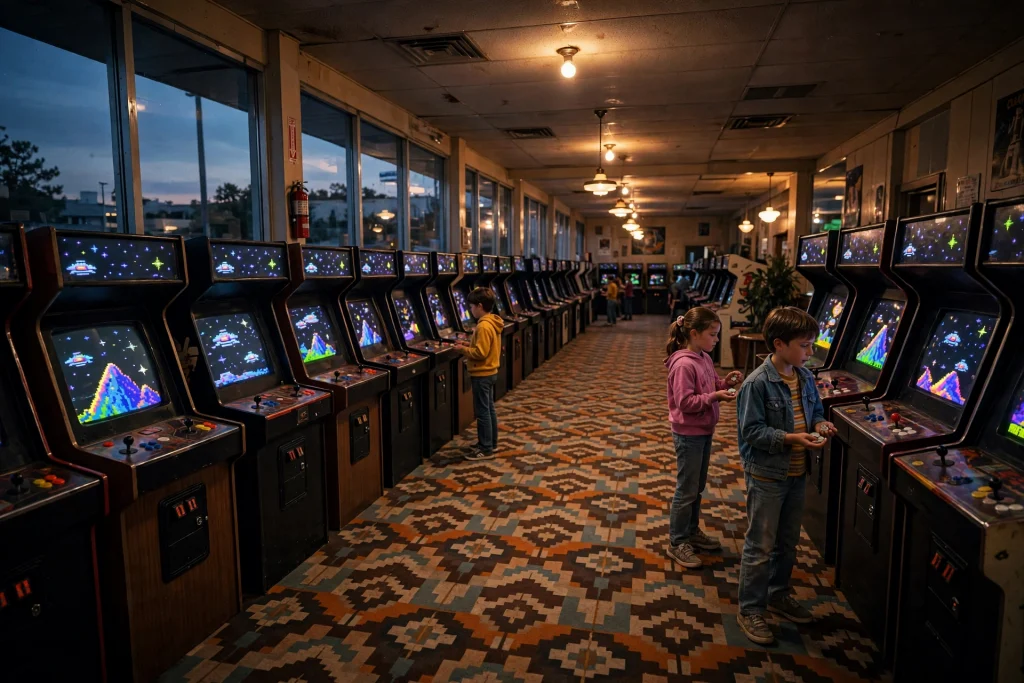
Here’s what made the NES such a revolution: it took the arcade and put it in your house. Before this, if you wanted the good games, you needed quarters and a ride to the mall. Arcade culture was glorious, but it was also expensive and inconvenient. The NES changed the economics of fun overnight. One cartridge cost about the same as a big arcade trip, but you could play it a thousand times.
The games themselves were designed to last. Super Mario Bros. wasn’t just a game — it was a geography lesson in a fantasy kingdom that lived inside a plastic rectangle. Kids drew maps of World 1-1 on notebook paper. They argued about warp zones on the playground with the intensity of scholars debating ancient texts. “Did you know you can go over the top of the level?” someone would whisper, and it would spread through the school like wildfire. Secrets were currency. The kid who knew where the hidden 1-up was in World 3-1 had genuine social status.
And the difficulty! Oh, the difficulty. Modern games hold your hand, give you tutorials, autosave every thirty seconds. NES games looked at your tears and said, “Get good.” Battletoads. Ninja Gaiden. Ghosts ‘n Goblins — a game so hard that beating it once wasn’t even enough; you had to beat it twice to see the real ending. We didn’t have the internet to look up walkthroughs. We had Nintendo Power magazine, passed around at school until the pages fell out, and the sacred Nintendo hotline, which some kids actually called (on their parents’ phone bill, which was a whole other adventure).
The Games That Defined Us
Every NES kid had their Mount Rushmore. Super Mario Bros. 3 was the masterpiece — the one that felt like a movie, with its stage-play aesthetic and that unforgettable moment when the Koopalings stole the wands. The Legend of Zelda was the mystery — a gold cartridge that came with a battery inside so your progress would save, which felt like actual sorcery. You’d write down passwords for Metroid on the back of your hand. Tetris was the addiction — that falling-block music still lives in the brainstem of everyone who played it, and don’t pretend you don’t hear it right now.
And then there were the weird ones, the games that only make sense in retrospect. Duck Hunt, which came bundled with the system and required you to sit exactly the right distance from the TV or the light gun wouldn’t work — and that dog. That laughing dog. An entire generation shares a specific, primal rage toward a pixelated cartoon dog, and honestly, it’s one of the purest forms of human bonding I know.
The Couch Was the Original Multiplayer Server
Online gaming is a marvel, but it never replicated what happened on that couch. The NES was built for togetherness in a way that’s hard to explain to someone who grew up with headsets. Two controllers, one TV, and a living room full of opinions.

The rules of couch multiplayer were unwritten but absolute. Player One was whoever owned the console — that was non-negotiable. If you died, you passed the controller. If you were winning too much, everyone suddenly needed a snack at the same time.
And if you were playing a game like Contra with the Konami Code (up, up, down, down, left, right, left, right, B, A, start — every kid knew it, and if you didn’t, you do now), you were basically a wizard. Thirty lives. Thirty! It felt like cheating the universe.
The best moments weren’t even in the games — they were around them. The collective groan when someone died at the final boss. The eruption when someone finally beat a level that had tormented the whole group for weeks. The negotiations: “If you let me try the next level, I’ll give you my dessert.” The betrayals: “You said one more try, that was three!” Siblings fought wars over whose turn it was, and parents developed a sixth sense for the exact moment to walk in and say the words every kid dreaded: “Dinner’s ready. Pause it.” You can’t pause an NES game mid-level without consequences, Mom. There are no save states. This is real life.
The Weekend Ritual
Saturday had a rhythm, and the NES was the drumbeat. You’d wake up early — earlier than school days, which tells you everything about priorities — and the morning belonged to cartoons. But the afternoon? The afternoon belonged to the gray box. Friends would show up unannounced, because that’s how it worked then — you just knocked on doors until you found someone whose parents said yes. “Can he come out to play?” really meant “Can he come over and watch me play Ninja Gaiden while offering unsolicited advice?”
There were marathons. Oh, there were marathons. The sleepover was the ultimate gaming event — a sacred overnight session where the goal was to stay up as late as humanly possible, fueled by pizza and soda, taking turns until someone’s eyes literally couldn’t stay open. The kid who fell asleep first would wake up to find the game paused and everyone else still going, and the shame of it would fuel an entire week of playground jokes. These weren’t just gaming sessions. They were rites of passage.
And let’s talk about rentals, because the video rental store was the NES kid’s library. Friday night, you’d walk those aisles — Blockbuster, or whatever local shop your family used — and the wall of game cartridges behind the counter was like a treasure vault. You got the game for the weekend. Just the weekend. Which meant you had roughly 48 hours to beat the entire thing, and the pressure was exquisite. Some of my most intense gaming memories aren’t from games I owned; they’re from rentals I had to finish by Sunday night. Nothing sharpens your focus like a deadline.
Why NES Games Still Matter
The NES sold over 60 million units and is widely credited with reviving the entire video game industry — those are the facts, and you can read them on Wikipedia’s NES page. But the numbers don’t explain why grown adults still get misty-eyed over a gray box. The explanation is simpler: the NES was there during the years when everything felt possible. It was the backdrop of childhood friendships, sibling rivalries, rainy Saturdays, and summer afternoons that stretched forever.
That’s why the retro gaming revival isn’t just nostalgia marketing. When people buy a NES Classic or download an emulator, they’re not really buying a product — they’re buying a ticket back to a carpet in a living room, cross-legged, controller in hand, with their best friend beside them and the whole afternoon ahead. The graphics were blocky. The sound was bleeps. And it was perfect.
So here’s to the blinking red light, the blown cartridges, the warp zones, and the laughing dog. We didn’t know it then, but we were living through the moment video games grew up — and we got to be kids right alongside them.
Pingback: Floppy Disks: When the Save Icon Was a Real Thing