The Tinkle of the Bell on the Shop Door
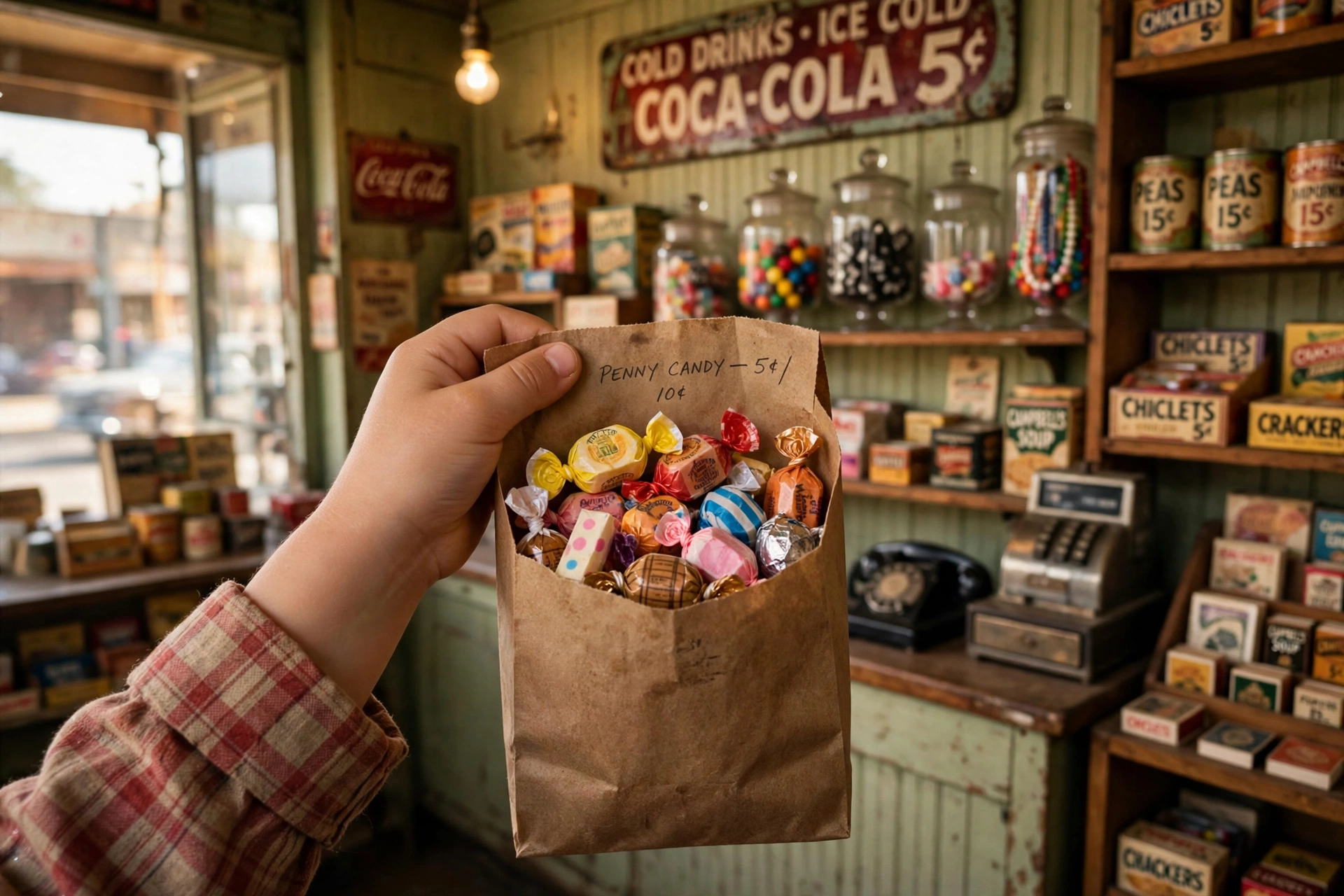
There are sounds from childhood that live in your bones, and one of mine is the little brass bell above the corner store door. You’d skid your bike to a stop on the hot pavement, shove the screen door open with your shoulder, and that bell would tinkle — tinkle-tinkle — and the shopkeeper would call out without even looking up, “Hey there, sugar, come on in.” And just like that, the whole world shrank down to the sweetest three feet of glass in your life: the penny candy counter.
Do you remember how the whole place smelled? It wasn’t just one smell. It was layers. The dusty sweetness of the wooden floor boards. The sharp sugary perfume of a freshly opened box of Pixy Stix. And underneath everything, that faint waxy smell of red wax lips and wax bottles, the ones you chewed for the sweet syrup inside and then kept chewing the wax like you were doing something genius. I don’t know about you, but I can still smell it. One whiff and I’m eight years old again, standing on tiptoes in front of those glass jars, a sweaty coin clutched so tight in my fist that it left a round green smudge on my palm.
We didn’t call it “shopping.” Nobody said, “I’m going shopping.” We were going to the store. And going to the store was an event. It was a mission. It had a budget — the coins in your pocket — and it had a strategy — get the most happiness per penny. We took this very seriously. You had to. You only had so many chances, and you never, ever wanted to be the kid who wasted a whole nickel on one thing when you could have had six different things.
A Nickel Was a Real Budget
Here’s something today’s kids won’t believe: there was a time when a single nickel could make you feel rich. A genuine nickel — that little silver coin — could buy you a small paper bag of penny candy so stuffed you couldn’t fold the top down. And we were mathematicians about it. We’d stand there in front of the counter doing serious arithmetic in our heads, deciding between quantity and quality.
“If I get the Tootsie Roll, that’s two cents, and then I can get three of the root beer barrels, and then — wait, how many do I have left? One cent? Okay, give me the little Mary Jane.”
We said sentences like that out loud, with total confidence, while the shopkeeper waited patiently. There was no rush. Time didn’t work the same way inside the corner store. Outside it might be 1975 or 1985 or 1992, but inside, it was always exactly right now, and right now was delicious.
And the sodas! A glass bottle of soda, ice cold, cost five or ten cents, and you drank it right there, or you brought the bottle back for the deposit. We were the original recyclers, people. We’d hunt empty bottles in ditches and behind garages like they were buried treasure, because two cents a bottle meant two more pieces of candy.
Tell me that isn’t the smartest business plan an eight-year-old ever invented. My brother and I once cashed in a whole wagon load of bottles — our grandfather’s old radio wagon — and walked out of the store like we’d just robbed a bank. The man behind the counter laughed so hard he gave us each an extra piece of bubble gum on the house. To this day I think that was the best financial transaction of my life.
Have you ever stopped to think about what those prices taught us? We learned math. We learned patience. We learned how to decide. That little penny candy counter was our first classroom in how the world worked, and the tuition was payable in pennies.
The Great Penny Candy Hall of Fame
Now, every neighborhood had its own rotation, but there are certain names that will stop any room of grown adults in their tracks. Mention one of these at a dinner party with people over forty and watch what happens. Everyone leans in. Everyone smiles. Everybody has a story.
The Legends We All Knew
Bazooka Joe bubble gum. That little pink-and-blue package with the tiny folded comic strip inside — and yes, we all read every single one, and we all knew the comics were terrible, and we all loved them anyway. The Bazooka bubble gum flavor itself hit you like a sugar truck in the first thirty seconds — intense, glorious — and then settled into a chew that lasted just long enough to argue with your best friend about whose bubble was bigger. We blew bubbles until our jaws ached, and nobody — nobody — threw away the comic before reading it.
Then there was the Tootsie Roll, dense and chocolatey and lasting longer than it had any right to, and the Mary Jane, that molasses-and-peanut-butter taffy that pulled your fillings loose and glued your molars together. You chewed a Mary Jane like a job. It was work. Worth it, but work. And Necco Wafers — those chalky, pastel discs that half of us adored and the other half pretended to adore because they were always there, in the jar, reliable as rain. The wintergreen one was the best and I will not be taking questions.
The Wild Ones
But the true treasures were the weird ones. The candy that didn’t taste like candy was supposed to taste. Pixy Stix — a paper straw full of pure colored sugar that we did NOT pour into a glass of water like the package said. Oh no. We tore the end off with our teeth and tapped that sugar directly onto our tongues, head tilted back, eyes closed, like it was the finest thing on earth. It was, in a way. It was pure joy in powdered form, and our mothers could always tell we’d had some because our tongues were stained neon for hours.
Pop Rocks arrived later and broke our brains completely. Candy that crackled and popped in your mouth? It felt like science fiction. We’d pour a whole packet on our tongues and stand there frozen, giggling, while the candy fizzed and snapped. Somebody always claimed the combination of Pop Rocks and soda would make your stomach explode — a legend passed down from older siblings who had absolutely no evidence and complete confidence. We believed it. Of course we believed it. That’s what made it fun. (For the record: the candy was just pressurized with carbon dioxide gas. No stomach explosions were ever reported. Though I suspect a few of us came close.)
Candy necklaces were wearable art — you walked around the neighborhood looking like a prize fighter’s trophy, then ate your jewelry one bead at a time over the course of an afternoon. And wax bottles, those little wax vessels filled with syrup, were a two-stage experience: first the candy, then you chewed the wax like bubble gum until the flavor was gone and you were chewing plain wax in public without a care in the world.
And yes — there were candy cigarettes. They were simply a product of their era: chalky white candy sticks with a red-dyed tip, sold in a little cardboard pack made to look like the real thing. Kids of that generation remember them mainly for the ritual of it — the unwrapping, the fake “smoke” of powdered sugar when you blew on them. Looking back now, it’s clear why they don’t exist anymore, and that’s honestly a good thing. They’re part of the memory, like dial-up tones and Saturday morning cartoons — a marker of a different time, not something worth bringing back.
What made all of it magical was the choosing. Nobody handed us a pre-wrapped assortment of penny candy. We pointed — “That one. And that one. No, that one.” — and the shopkeeper fished our choices out of the glass jar with a little scoop or a pair of tongs, and dropped them into a tiny brown paper bag that crackled when he folded it. That bag was the most valuable object in the world for the next hour of your life.
The Clinking Symphony of the Soda Cooler
Off to the side of the counter sat the metal soda cooler — one of those big sliding-top chests with cold water inside, and the bottles standing in neat rows, frosty and dripping. You’d slide the lid open and the cold air would wash over your hands, and for a moment you’d just stand there, frozen, staring at all those glass bottles: root beer, cream soda, orange, grape, cola. The caps were real metal that you popped off on the opener bolted to the side of the cooler, and the hiss that followed was the sound of summer itself.
Glass bottle soda tasted different. I’ll argue this with anyone. It wasn’t just colder — it was better. Maybe it was the glass. Maybe it was the ice bath instead of a refrigerator. Maybe it was that you were drinking it sitting on the curb outside the store with your best friend, legs swinging, penny candy in your lap, and the whole afternoon stretching in front of you with absolutely nothing to do. That’s a flavor you can’t bottle. Ironically.
And the bottle had to come back. That was the deal. You either drank it in front of the store and handed the bottle over, or you paid the deposit and brought it back later. Which meant the bottle was also a promise — a reason to come back. The store understood something about customer loyalty that marketing departments spend millions trying to rediscover: give the kid a reason to return, and they’ll come back every single day. We’d return the bottle, get our deposit, and immediately convert it into more penny candy. It was a perfect circle. An economy of joy.
There was also an art to drinking from the bottle. The little gulp-hiss of air as the liquid went down. The way you’d hold it up to the light afterward to see if there was one last sip hiding at the bottom. The satisfying clink when you set the empty bottle in the crate by the door. That crate, full of empties, was the sound of a good day.

The Person Behind the Counter
Here’s the thing we didn’t understand as kids, but we feel it now: the corner store wasn’t really about the penny candy. It was about the person who sold it to you.
Every neighborhood had theirs. Ours was a woman who everyone called by her first name, and she knew every kid within a mile by name, too. She knew who was saving up for the big chocolate bar. She knew which kid liked the sour ones and which one would trade half their bag. She knew when to say, “That’s a good choice, honey,” and when to gently steer a kid toward a better deal — “Now listen, that one’s two cents, but those three there are a penny each, and they’re bigger.”
She also knew the secret that every great shopkeeper knew: sometimes you let the kid’s coins be a penny short. You just did. You looked at those hopeful, dusty-kid eyes, and you said, “Well, since you’re such a good helper, I’ll let it slide this time.” And that kid never, ever forgot it. There are grown adults walking around right now who still remember the name of the person who let them slide on a penny, because in that moment, that person was a hero.
The store was also the neighborhood’s newsroom. Kids reported in from other streets. Who got a new bike. Whose dog had puppies. Who was throwing a party. The shopkeeper heard it all, nodded wisely, and kept scooping penny candy. In a world without group chats, the corner store counter was the original social network, and the membership fee was a nickel.
And when the store closed — most of them are gone now, replaced by convenience chains and self-checkout kiosks — it didn’t just take the penny candy jars with it. It took the bell. It took the frosty bottles. It took that particular feeling of being known by the person across the counter. You can buy any candy you want online today, delivered tomorrow, but nobody’s going to lean over the counter and tell you that’s a good choice, honey. Nobody online knows your name.
What We Carried Home (and What We Can’t Go Back To)
The best part of the penny candy run was the walk home. That’s where the real ceremony happened. You’d peel open the paper bag — it always made that particular crackle — and you’d lay everything out on the curb, or on your front steps, or on the grass, and you’d eat in a specific order. Everyone had an order. The good stuff first, or the good stuff saved for last? This was a serious philosophical question among eight-year-olds, and the answer said a lot about who you were.
Some of us traded. Trading was its own art form, with its own rules, its own marketplace, its own scandals. “I’ll give you two root beer barrels for one Mary Jane.” “Deal — but I get to pick the barrels.” Friendships were tested at the curb-side penny candy exchange, and mostly they survived. Mostly.
And then it was gone. The bag was empty. Your tongue was a suspicious color. Your jaw was tired. And you’d look at the coins you had left — maybe none, maybe a penny you’d saved — and you’d start planning tomorrow’s run. Because the store would still be there tomorrow. The bell would still tinkle. The penny candy jars would still be full. The future was guaranteed to be sweet.
That’s what I miss the most, I think. Not just the penny candy — though heaven knows I miss the candy — but the certainty. The certainty that a nickel was enough. That the afternoon was yours. That the best things in life really did come in small brown paper bags, one penny at a time.
They say you can never go home again. But maybe that’s not quite true. Maybe you can — for a second — when the memory is sweet enough. So tell me: what was your corner store? What was the penny candy you always bought first? And who was the person behind the counter who knew your name? I’d love to hear it. Because somewhere out there, a little brass bell is still tinkling, and it’s ringing for all of us. And if this took you back, share it with someone who used to stand on those tiptoes beside you — you know, the way we’d always trade our favorite snacks and play with the toys that defined our whole childhood.
Pingback: Classic Diner Memories: Coffee, Chrome and Jukebox Magic
Pingback: Sunday Comics Memories: The Sacred Funny Pages of Childhood
Pingback: Old Photo Booth Memories: Four Photos, One Childhood
Pingback: Baseball Card Collecting Memories: Wax Packs & Spokes
Pingback: County Fair Carnival Memories: The Magic of Summer
Pingback: Trick or Treating Memories: The Best 70s & 80s Halloween Nights