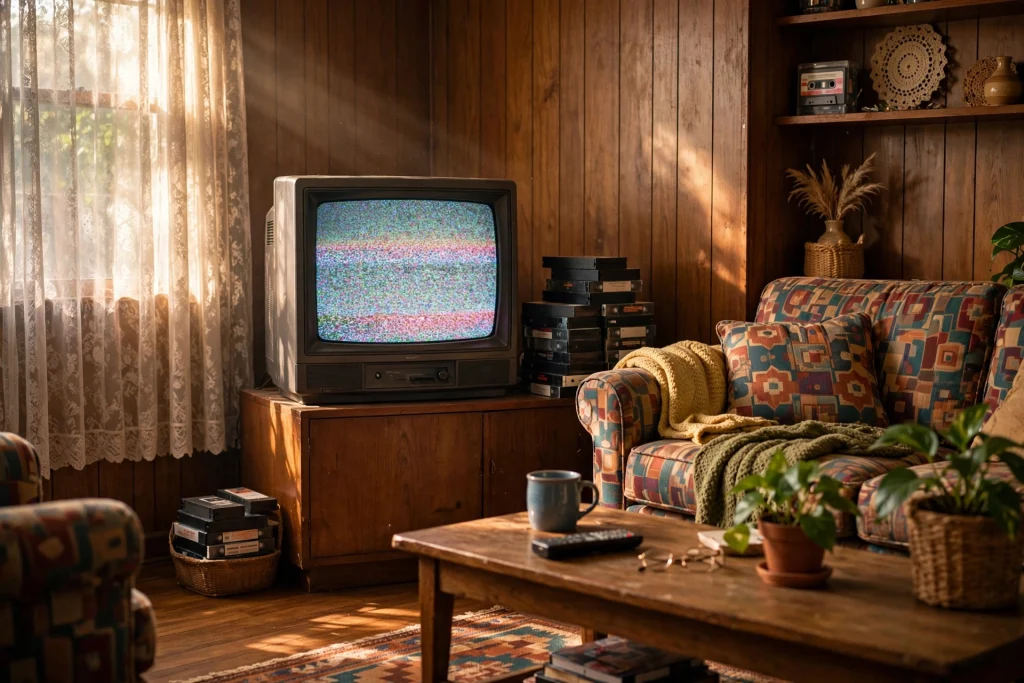
Do you remember the sound? That soft, grainy hiss filling the living room while someone stood by the TV, one hand on the rabbit ears, slowly rotating them like a safecracker. “Little more… a little more… STOP! Hold it right there. Don’t move.” And you’d freeze, hand stuck to the antenna, while the whole family watched the snowy screen melt into a picture of Saturday morning cartoons. That was the magic of old TV antennas, and honestly, nothing about television today feels quite like that.
There were no remotes at first. There were no menus, no signal meters, no “recalibrate your smart TV” pop-ups. There was just you, your family, and a pair of metal rods that somehow pulled invisible pictures out of thin air. It sounds ridiculous when you say it out loud. But to a kid growing up in the 70s, 80s, or 90s, those rabbit ears were nothing short of miraculous.
The Rabbit Ears Era: When Old TV Antennas Ruled the Living Room
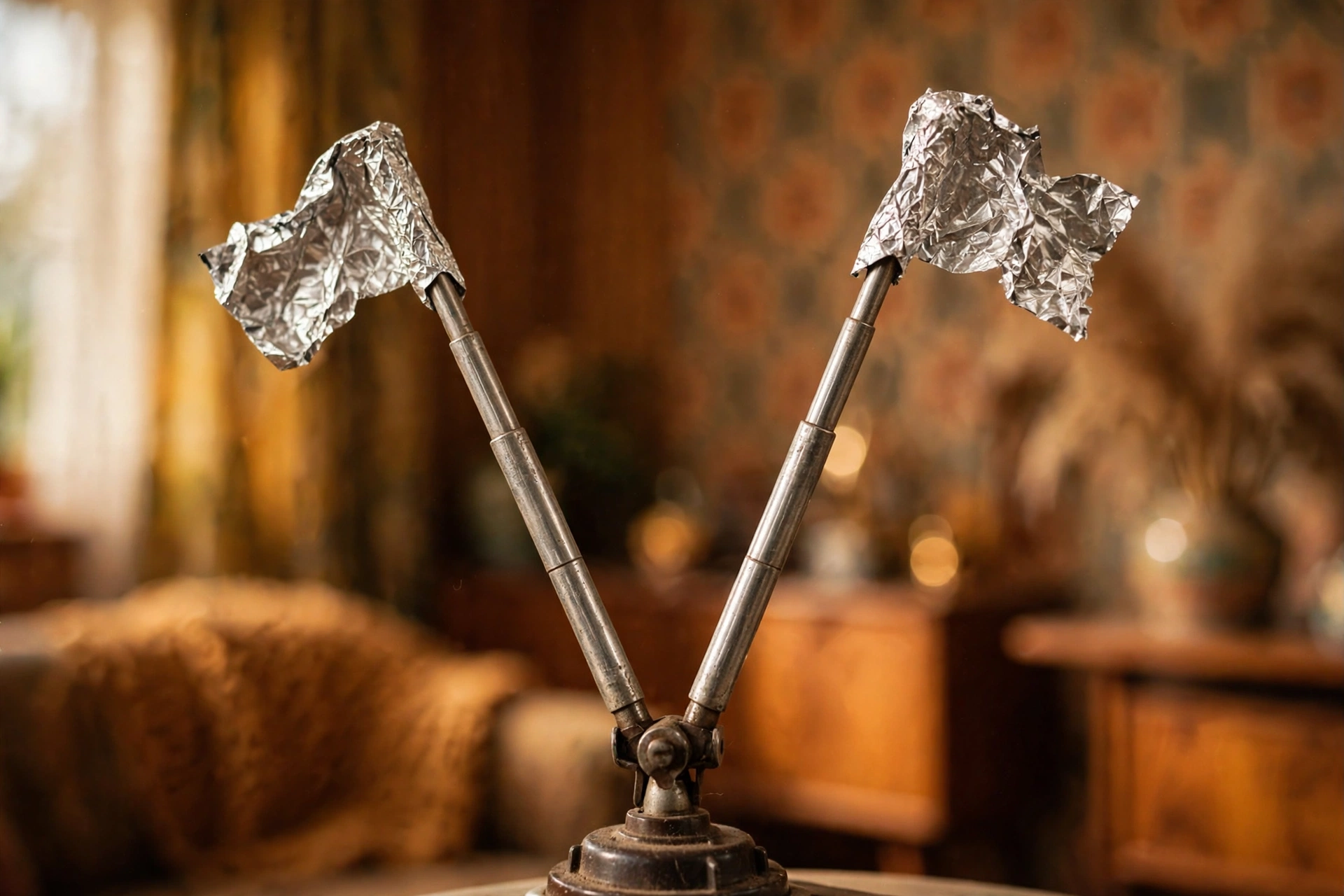
Nearly every television set of that era wore the same crown: two silver telescoping rods sticking up from the top, usually in a V shape, mounted on a little swivel base. They were called rabbit ears because that’s exactly what they looked like, and the name stuck so hard that even now, decades later, everyone knows what you mean when you say it.
The ritual of adjusting them became second nature. If the picture was snowy, you spread the ears wider. If it flickered, you brought them closer together. If one channel came in fine but another was a blizzard, you developed a mental map: Channel 4 liked the ears pointing toward the window, Channel 9 wanted them nearly flat. Some households had it down to a science so precise that the kids could set up the evening news faster than some people today can find the right HDMI input.
And then there was the trick everybody’s family knew, the one that felt like secret knowledge passed down through generations: tin foil. A crinkled sheet of aluminum foil wrapped around each antenna tip like a little homemade flag, and suddenly the picture would clear up. Did it really work? Sometimes, a little — it could genuinely help the rods pick up a signal by giving them more surface area. But half the time it was pure superstition and showmanship. Didn’t matter. The foil went on anyway, and it stayed on, silver and crinkled and slightly embarrassing, and we loved it.
Every Antenna Had a Personality
Here’s the thing nobody talks about enough: every set’s antennas behaved a little differently. Your neighbor’s identical TV might pull in a channel yours couldn’t, or vice versa. Some sets were touchy, needing constant adjustment. Others were forgiving, locking onto a picture and holding it through storms. People talked about their antennas the way they talked about their cars. “Ours gets a great picture but the left ear keeps slipping.” You’d nod knowingly, because you understood. You lived it.
The Tin Foil Trick and Other Kitchen Wizardry
Let’s be honest for a moment: wrapping old TV antennas in tin foil was only the beginning. Once a family went down the path of homemade reception fixes, there was no limit to the creativity. Some people hung wire hangers off the rabbit ears to extend them. Others ran a strip of foil from the antenna to the window, like the signal would follow the trail. I once saw a family tape a metal whisk — an actual kitchen whisk — to the top of their TV, and they swore the picture was perfect during the football game.
Was any of this scientifically sound? Well, the basics were real enough. Television broadcasts traveled through the air as radio waves, and an antenna’s job was to catch them. Bigger metal surfaces could genuinely catch more signal, which is why the foil and hangers sometimes did help a little. But a lot of it was luck, placement, and the weather. What made it special wasn’t the physics. It was the creativity — the whole family becoming amateur engineers on a Saturday afternoon, convinced that this time, this arrangement of foil and wire would finally give us a ghost-free episode.
The Foil Look Became a Status Symbol
There’s a strange nostalgia attached to how it looked. Crinkled foil on antenna tips became such a universal sight that it showed up in movies and sitcoms as shorthand for “working-class family home.” It meant your family was doing what it took. It meant you’d rather wrap your TV in kitchen supplies than pay for cable, and there was a quiet pride in that. Nobody was ashamed of the foil. If anything, a clean, foil-free set of rabbit ears just looked… less loved. Less lived-in.
Dad on the Roof: The Great Outdoor Antenna Adventures
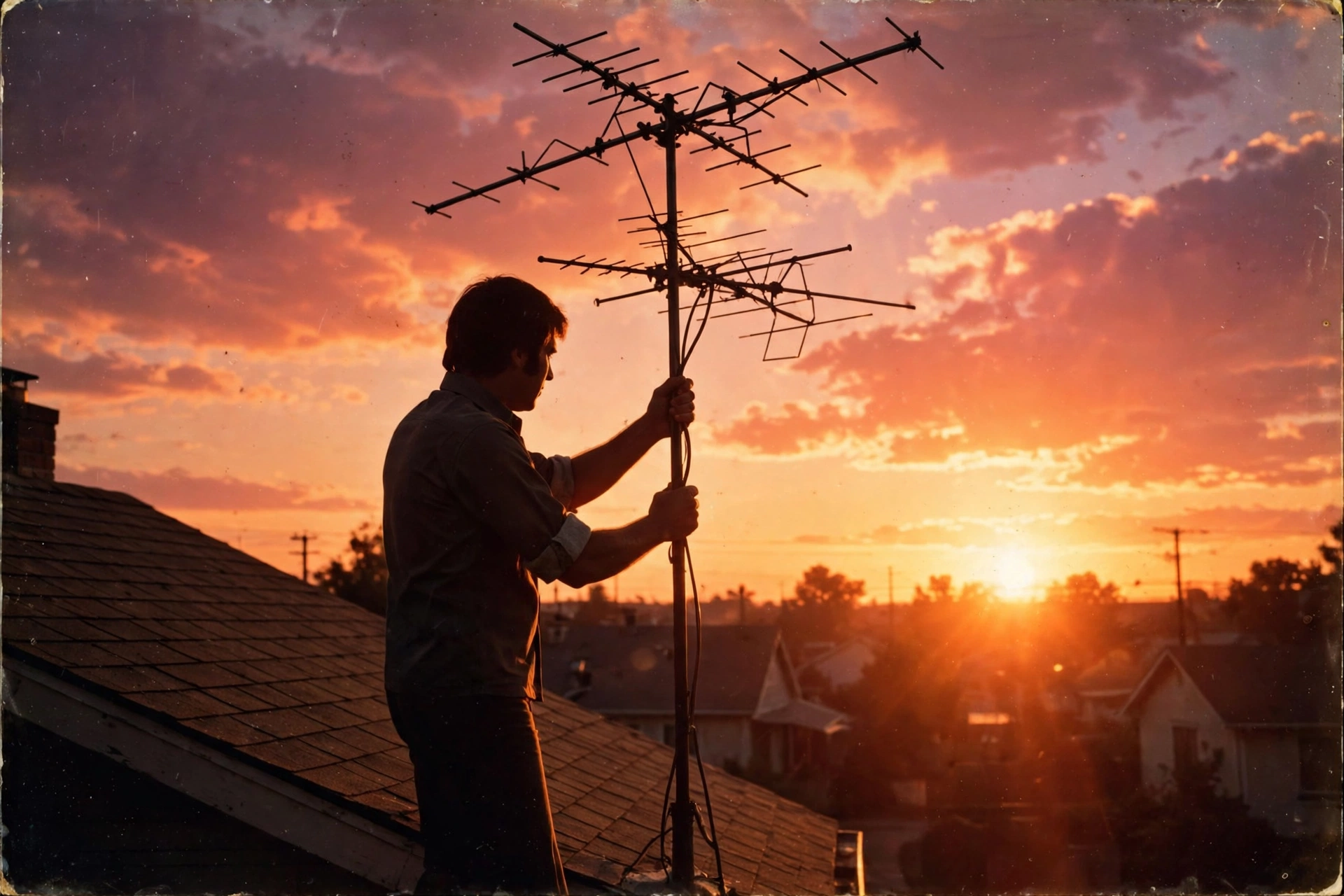
But indoor rabbit ears were only half the story. Plenty of families had the big outdoor antenna — a tall metal mast on the roof or chimney, with all those horizontal elements spread out like the skeleton of some strange aluminum bird. If you grew up in a house with one, you remember the silhouette against the evening sky. It was a badge of the neighborhood. Every street had them, rows of antennas tilting slightly this way and that, like trees in a metallic forest.
The outdoor antenna meant better reception, but it came with its own legendary ritual. When the picture went bad, someone — usually Dad — had to go up on the roof and turn it. This was a whole production. One person stood outside, sometimes holding a ladder, shouting “HOW’S THAT?” while someone inside yelled back “WORSE! TURN IT BACK!” The antenna would rotate a few degrees, the person inside would judge the picture, and the cycle would repeat until someone gave up or the game started.
There are people who can still hear it: Dad’s voice drifting down from the roof, Mom’s voice carrying out the window, and the rest of the family stuck inside as human signal meters. “A little to the left… no, YOUR left… okay, stop, stop, STOP! It’s perfect. Don’t touch it.” And somehow it stayed perfect until the next windy night, when the whole thing would start all over again.
Storms, Pigeons, and Antenna Peril
Outdoor antennas had enemies. Wind was the biggest one — a strong gust could twist the mast just enough to ruin reception, and you’d know instantly because the picture would roll, snow, or dissolve into wavy lines. Lightning was the scary one; unplugging the TV during a thunderstorm wasn’t just advice, it was practically a law of the house. And then there were pigeons. Entire flocks seemed to regard rooftop antennas as luxury seating, and their comings and goings could jiggle the mast just enough to send someone up the ladder again.
Getting Up to Change the Channel
Here’s a sentence that will make younger people laugh: we were the remote control. There was no channel changer from the couch. The TV had a big dial — sometimes two dials, one for VHF channels 2 through 13 and one for UHF, which barely anyone bothered with — and every channel change meant getting up, walking over, and twisting it with a satisfying chunky clunk. If you wanted to flip between two shows, you got your steps in.
That dial was a small masterpiece of design, though. It had weight. It clicked. Each channel had its own detent, and you could feel the mechanism engage as you landed on a number. You learned the channels by feel: a half-turn for the network you watched, a full rotation for the independent station with the cartoons. And changing channels was never casual. You committed to the change. Nobody channel-surfed the way people scroll now — you’d stand there, mid-room, waiting through the static to see if anything good was on, and then you’d either sit back down or twist again.
And of course, whoever was closest to the TV became the designated channel changer. “You’re right there — put on the other one.” Kids learned early that proximity to the set was a liability. Some of us developed the fine art of walking to the TV, changing the channel, and immediately wandering far, far away so we wouldn’t be asked again.
The Sounds of the Signal: Static, Hiss, and That Beautiful Clearing Picture
The soundtrack of old TV antennas deserves its own section, because it was unforgettable. Between channels lived pure static — a grainy, roaring snow that filled the screen with flickering white dots and hissed like a seashell held to your ear. We all remember the exact texture of that static. Some kids found it oddly soothing; others couldn’t stand it.
But the most beautiful sound was the transition: that moment when you got the antenna just right and the snow began to melt away, the picture resolving out of the grain like a photograph developing in a tray. The hiss would drop, color would bloom in, and the whole room would exhale. “There it is! Don’t touch it!” It felt like a small miracle every single time, even though it happened every day.
There was also the ghost effect — a faint double image of the picture, slightly offset, like the actors had shadows following them around. That meant the signal was bouncing off buildings or hills and arriving twice. You could live with a little ghosting; it was only when the ghosts started their own show that you went back to the rabbit ears. And every once in a while, during strange atmospheric conditions, you’d pick up a station from impossibly far away — a channel from another state drifting in for a few minutes, then gone. Kids in the era of family TV nights would talk about these “mystery channels” for days.
How Those Magic Rods Actually Worked
So what was really happening when Dad rotated the rooftop antenna or you fiddled with the rabbit ears? The explanation is simpler and more amazing than most of us realized as kids. Television stations broadcast their shows as radio waves, sent out from a tall transmitter tower. An antenna — whether it was a pair of rabbit ears or a rooftop mast — was essentially a net for catching those waves. When the metal rods were pointed toward the transmitter, they caught more of the signal, and the TV turned it back into a picture. When they pointed away, the picture dissolved into snow.
The rabbit ears were a type of dipole antenna, one of the simplest and oldest antenna designs. Those two rods were cut to roughly the right length to resonate with the frequencies TV channels used. It’s worth a quick look at how a dipole antenna actually works — the design is elegantly simple, which is why it showed up in millions of living rooms. The bigger outdoor antennas added more elements and a reflector to focus the reception, which is why they pulled in a clearer picture. The television antenna in its various forms was one of those everyday objects built on genuinely clever physics, and nobody needed to understand any of it to use one.
But here’s the beautiful part: you didn’t need the science. The feedback loop was instant and visual. Bad picture, wiggle the antenna, picture gets better. It was the most intuitive piece of technology many of us ever used. No manual, no tutorial, no firmware update. Just a kid, a pair of metal rods, and the sky.
Why the Weather Mattered So Much
One detail that always fascinated kids: the picture changed with the weather. Rain could make it worse. Certain calm evenings made it mysteriously better. Lightning made everything crackle. This wasn’t imagination — broadcast signals genuinely interact with the atmosphere, and weather, temperature layers, and even sunspots could bend or boost a signal. Sometimes you’d get a crystal-clear channel that was usually terrible, and the whole family would marvel at it like it was a gift from the sky. In a way, it was.
Why Old TV Antennas Belonged to the Whole Family
Think about what television is like today. Everyone has their own screen, their own account, their own headphones. Watching something together is almost a scheduled event. But the era of old TV antennas was the exact opposite: the TV was the warm center of the house, and making it work was a family effort.
Someone held the antenna. Someone else called out when the picture cleared. Someone went to the roof. Someone got up to change the channel. Someone held the flashlight during the storm when Dad checked the mast. Nobody was a passive viewer. The television belonged to the whole household in a way that’s hard to explain to anyone who grew up with streaming, and the antenna was the symbol of that togetherness.
There’s something about the imperfection that bonded people, too. A flawless stream asks nothing of you. A snowy picture asked everything: patience, teamwork, creativity, and just enough stubbornness to keep twisting until the picture came in. Those small victories — the cleared-up ballgame, the Saturday cartoon marathon rescued by foil — felt earned. They were little shared triumphs, the kind that turn into family stories told for decades.
What We Lost When the Antennas Came Down
Eventually, cable arrived, then satellite, then streaming. The antennas came down from roofs, disappeared into attics, or were tossed in a garage cleanout. The picture got perfect and effortless. You could watch anything, anytime, from anywhere in the house. And objectively, it’s better. Nobody would trade a 4K stream for a snowy broadcast with ghost images.
But something subtle went with those antennas. The ritual. The togetherness. The little burst of joy when the static cleared and the picture bloomed onto the screen. The patience it taught — waiting through the snow to see if the show would come in, accepting that sometimes it wouldn’t, and that was okay. It’s no wonder the 90s feel like home to so many of us — the whole decade was built from small, shared rituals exactly like these.
And the quirkiness. The foil flags. The whisk taped to the rabbit ears. Dad’s silhouette on the roof at sunset, turning the mast degree by degree while the family judged from the living room. These weren’t bugs in the system. They were the system. They were the parts we actually remember — not the shows, necessarily, but the effort it took to see them.
“Hold it right there. Don’t move.” Four words that could silence a whole living room. How many modern technologies can say that? There was a kind of trust in that moment — trust that the person holding the antenna would stand perfectly still so everyone else could enjoy the show. Try to picture that today: someone voluntarily freezing in place, arm extended, for the good of the group. It happened every day, in millions of homes, without anyone thinking twice. That alone deserves to be remembered.
The Sky Was the Signal
There’s one last image I can’t shake. Evening, some summer night, the whole street quiet. Every house has an antenna on the roof, all those metal shapes against the fading light. And inside each house, families gathered around glowing screens, pictures beamed through the air for free, caught by rods of metal and a little bit of aluminum foil. It sounds like science fiction. But it was just an ordinary Tuesday.
Do we miss the static? Probably not. But we miss what came with it: the patience, the teamwork, the shared victories, the dad on the roof, the foil on the ears, the clunk of the dial, the way the whole family held its breath while someone turned, turned, turned… and then the picture cleared, and everyone cheered like we’d won something. Because in a way, we had.
What do you remember most about the antenna days? Was it the tin foil on the rabbit ears, a dad or grandpa braving the roof, or the long walk across the room to change the channel? Tell us your best antenna memory in the comments — the weirder and funnier, the better. And if you still have a photo of your family’s foil-decorated TV, share it. Some of us would love to see that beautiful, crinkled silver again.