Before you ever heard it, you felt it. That rapid flap-flap-flap-flap echoing down the street, growing louder as your best friend rounded the corner, grinning like he had just wired his bike with a motor. He hadn’t. He had done something better. He had clipped a baseball card to his spokes.
If you grew up anywhere near the 1950s, 60s, 70s, or 80s, that sound unlocks a whole world. Because baseball card collecting memories were never really about the cards — not at first, anyway. They were about the bike ride to the store, the weight of a fresh wax pack in your palm, the smell of bubble gum powder, and the feeling that the next tear of the wrapper might change everything. This is a walk back through all of it: the packs, the gum, the shoeboxes, the trades, the heroes on cardboard, and the sound that made a ten-dollar bike feel like a Harley.
The Sound That Announced Summer
Think about it for a second. How many sounds from childhood can you still hear, decades later, as clearly as a song on the radio?
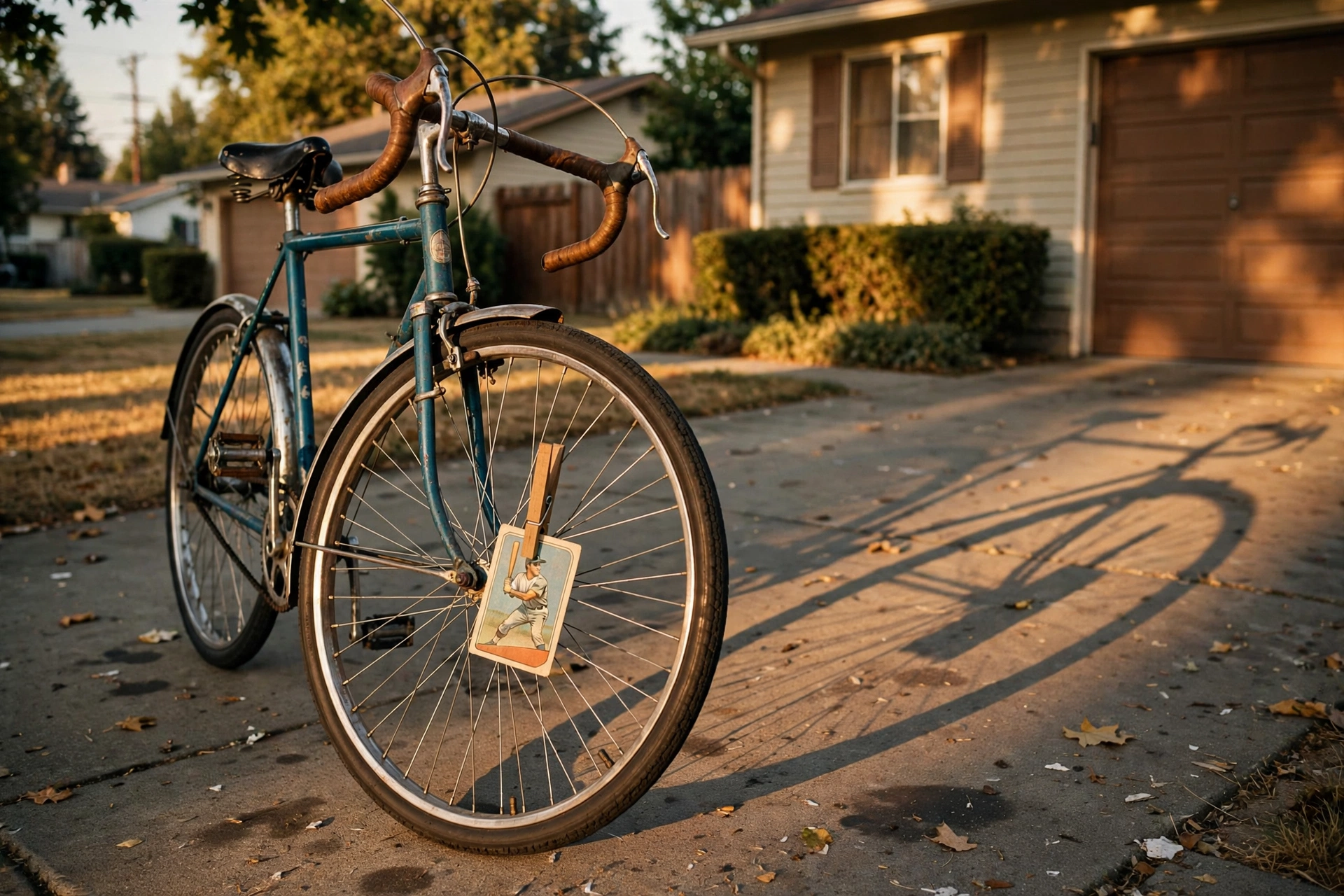
The ice cream truck’s warped little tune. Screen doors slamming. And the unmistakable brrrrap of a playing card — or, if you were living right, an actual baseball card — flapping against bicycle spokes as a kid tore down the street.
It was the sound of summer arriving, and it was also the sound of pure economics in action. Because the card you clipped to your spokes was always, always one you could afford to lose. It was a “double” — a duplicate you’d already pulled two or three times, usually of a guy batting .211 for a last-place team. Nobody ever put a card they loved in the spokes. That was the first rule, and everybody knew it without being told. The spokes ate the commons and spared the heroes.
We used wooden clothespins stolen from the laundry line, which meant every now and then somebody’s mom would come out to hang the sheets and find her clothespin supply mysteriously depleted. The card would get ragged at the edges, the colors would fade in the sun, and eventually it would disintegrate into a papery buzz that rattled until the whole thing gave up. Then you’d pick another victim from the shoebox and start again.
Was it wasteful? Oh, completely. Would we do it again? In a heartbeat.
A Nickel, a Wax Pack, and the Pink Slab
Every baseball card memory worth having starts the same way: at a counter.
Maybe it was the corner store with the bell on the door, the five-and-dime downtown, or the drugstore where the card rack spun in lazy circles next to the comic books. You’d walk in with your allowance burning a hole in your pocket — a quarter, a dollar if it was a birthday week — and there they’d be: the wax packs, lined up in their little cardboard display box, each one a sealed promise.
Here’s the thing younger collectors sometimes miss. Back in 1952, when the whole modern hobby really got going, a penny bought you one card and a stick of gum in a wax wrapper, and a nickel got you five cards plus the gum. The packs didn’t cost much because they weren’t supposed to. They were supposed to move. Kids were supposed to buy them the way they bought candy — constantly.
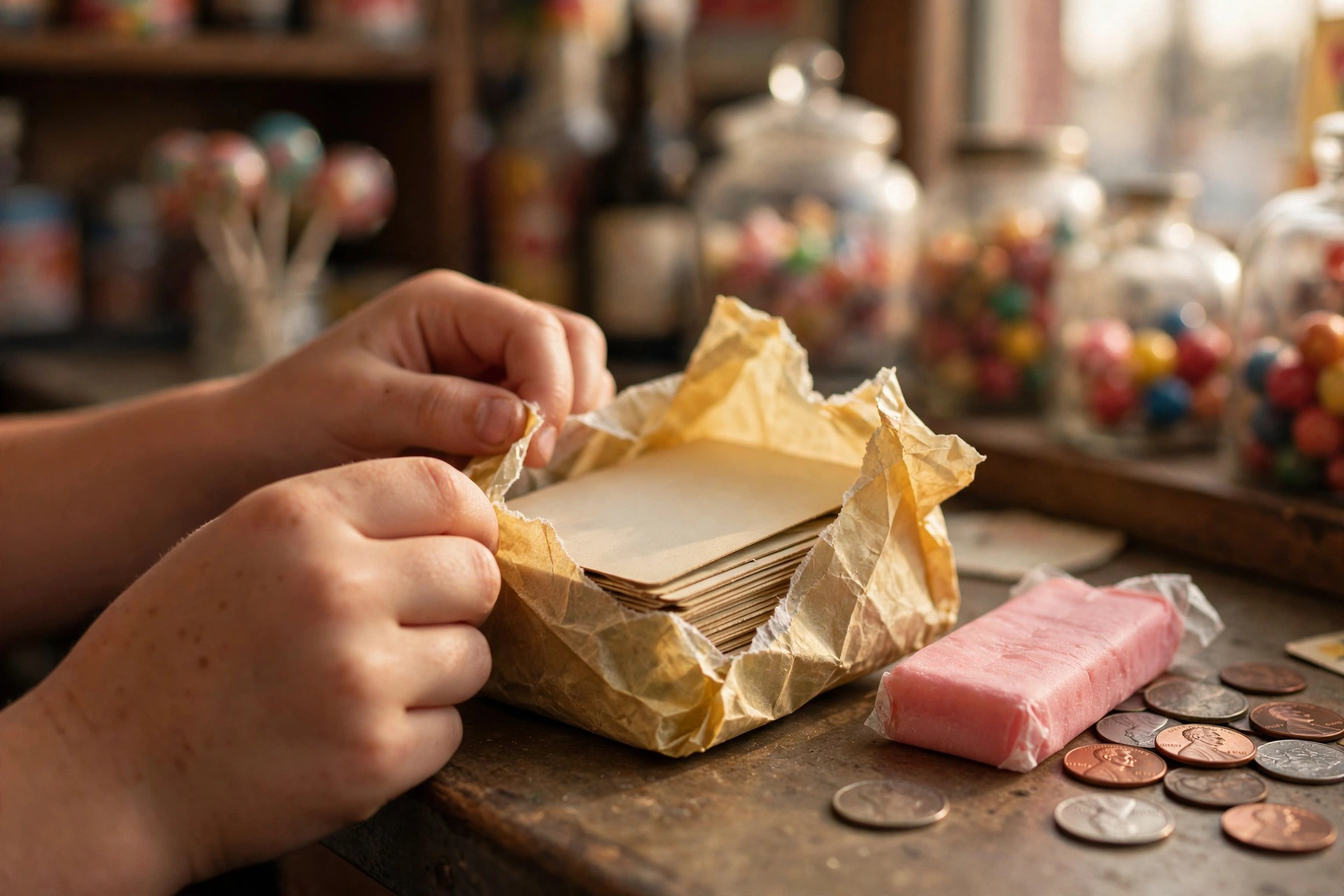
And the wrapper itself was half the experience. Wax paper. Not plastic, not foil — actual crinkly wax paper with the team’s colors and some kid-magnet artwork printed on it. There was a technique to opening it, and everybody had their own. Some kids peeled the seam gently, saving the wrapper flat like it mattered. The rest of us just ripped straight down the middle, because the suspense was physically unbearable.
And then — the pink slab. Flat, hard as a hockey puck, dusted with white powder, sitting right on top of the cards. That was the gum. It tasted like pink for about eleven seconds, then turned into a tasteless wad of sweetened rubber. And we chewed every single piece like it was the point of the whole enterprise.
Here’s a truth worth sharing: the gum stained the cards. A damp pink ghost of itself would bleed right through the wax paper onto the top card of the stack, leaving a little sugary scar that collectors decades later would groan about. Topps kept putting that stick of gum in every pack for forty years anyway — right up until 1992, when the gum finally disappeared from baseball packs. Why did they keep it so long? Because kids like us demanded the whole ritual. The pack wasn’t complete without the slab. It was like a prize and a warning in one.
Some afternoons you’d open three packs at once and chew three slabs at the same time, stacking them like pink bricks, blowing bubbles the size of your head while you sorted cards on the sidewalk. Your jaw ached. Your teeth stuck together. It was glorious.
That trip to the counter — the bell, the spinning rack, the crinkle of the wax — is part of the reason the ritual of buying wax packs at the corner store lives in the same warm part of the brain as everything else we loved about those streets.
The Shoebox, the Rubber Band, and the Bicycle
So where did all those cards live? Not in plastic sleeves. Not in binders with nine-pocket pages — those came later, when the hobby got serious and a little corporate. In the golden age of actually being a kid, your collection lived in a shoebox.
Not just any shoebox. A specific one. The good ones had the team name written across the side in fat marker letters, and the inside smelled like gum dust and cardboard and summer. You’d flip through them standing up, fanning the stack with your thumb like a deck of cards at a poker table, and the whole box had a soft, broken-in feel from being opened a thousand times.
And the rubber bands. Oh, the rubber bands. We bound our cards in thick stacks with rubber bands stretched so tight they bit into the edges of the top and bottom cards. Decades later, grown men would wince when appraisers pointed at those indented grooves and said the words “rubber band damage” like a doctor delivering a diagnosis. But at the time? The rubber band was the official seal of a serious collector. Your stack was YOUR stack. It had tension. It had commitment.
There was also the sorting system, and every kid’s was sacred and incomprehensible to outsiders. Some of us went alphabetical. Some went by team. Some sorted by position, or by “guys I like” and “everybody else.” I knew a kid who kept his entire collection in order of batting average, highest to lowest, and would re-sort the whole box every time the newspaper printed new stats on Sunday. It took him all afternoon. He wouldn’t have traded that ritual for anything.
And then there were the cards that never made it into the box at all — the ones destined for the spokes, tucked in back pockets, traded at recess, or flicked against the schoolyard wall in games of “closest to the wall wins.” The shoebox was the treasury. The pocket was the wallet. And the spokes were, well, the spokes were where a card went to become a legend.
Reading the Back Like It Was Scripture
Here’s a memory test. Close your eyes and picture the back of a baseball card from your childhood.
Got it? The gray-brown cardboard, the tiny type, the little grid of numbers stretching back season by season — G, AB, R, H, HR, RBI, AVG — and then the short biography paragraph that told you where the player was born, how tall he stood, and what he did before the majors. For a lot of us, that was the first statistical table we ever learned to read. Before spreadsheets. Before report cards mattered. There were kids who couldn’t do long division but could tell you a man’s slugging percentage off the top of their head.
The backs turned us into tiny baseball professors. We’d memorize the biographies of guys we’d never seen play and argue about them like scholars. “He hit .301 with 27 homers in ’78 — what do you mean he’s washed up?” We said things like “washed up” at age nine. We had opinions about on-base percentage before we had opinions about music.
And then came the trading. The glorious, cutthroat, handshake-sealed economy of the schoolyard.
Every trade was a negotiation worthy of a boardroom. You’d fan out your doubles — always doubles, never the crown jewels — and your friend would fan out his. There was posturing. There were walk-aways. There were legendary moments when somebody pulled a card from the very bottom of their stack, the one they’d been hiding, and the whole circle of kids gasped. A trade wasn’t official until both parties said the words, and once it was done, it was DONE. No take-backs. That was the law.
Some trades haunt people to this day. Ask any group of middle-aged collectors about the worst trade they ever made as a kid and watch the room go quiet, then erupt. Everybody has one. The future Hall of Famer dealt away for a guy with a cooler mustache. The rookie card swapped for a whole stack of commons that felt like a fortune at the time. We learned about markets, regret, and the cruelty of hindsight before we were old enough to drive.
Trading wasn’t the only way cards moved between kids. There were the playground games — flipping cards to see whose landed closest to the wall, “tops” and “bottoms” called in the air, whole stacks changing hands in a single recess. Some schools banned card games outright because the hallway economy got too intense. When your principal has to outlaw your hobby, you know you’ve built something real.
Cards were just one of the treasures of kid life back then — part of the same universe as all our other childhood collections, the comics and the toys and the things we organized, traded, and argued about with total seriousness.
The Legends Behind the Cardboard
Most of us didn’t know it as kids, but we were participating in a story that started decades before we were born — one with genuine legends, lost treasure, and a mystery that still makes collectors’ eyes go wide.
Let’s start at the beginning, because the beginning is wilder than you’d guess. The Topps Chewing Gum Company was founded in 1938 by four brothers — Abram, Ira, Philip, and Joseph Shorin — and it was, at first, exactly what it sounded like: a gum company. The cards came later, and they came as a trick. In 1950, Topps started packing trading cards with gum to sell more gum. The cards were the sidekick. Then the sidekick ate the whole show.
In the autumn of 1951, a 28-year-old World War II veteran named Sy Berger sat down at his kitchen table in Brooklyn with graphic artist Woody Gelman and designed what would become the 1952 Topps set — 407 cards with a color portrait on the front and stats and a biography on the back. It was a landmark: the first set that looked like the baseball cards we know today. And it was built, top to bottom, to make kids buy more bubble gum.
Here’s the part that still stings. The 1952 cards were released in series across the season, and by the time the final high-numbered series arrived, kids had moved on to football. The late-series cards sold terribly. Topps was stuck with warehouses full of them — including Mickey Mantle’s first Topps card, #311 — and, legend has it, loaded the surplus onto a garbage scow and dumped them into the Atlantic Ocean off the Jersey Shore. Nobody at the time had the faintest idea what those cards would one day be worth. In August 2022, a 1952 Topps Mickey Mantle in near-mint condition sold for $12.6 million, making it the most expensive sports card ever sold at the time. Let that sink in: cardboard that was once trash on a barge is now worth more than most houses on the street where you grew up.
You can read the full Topps story — the gum empire, the kitchen-table design session, the ocean dumping — and it reads like a movie nobody would believe if it were fiction.
But the true ghost story of the hobby is older than Topps. It’s the T206 Honus Wagner.
Between 1909 and 1911, the American Tobacco Company printed its famous T206 set — 524 players, tucked into cigarette packs — and Honus Wagner, the Pittsburgh Pirates shortstop known as “The Flying Dutchman” and widely considered one of the greatest players who ever lived, wanted no part of it. The commonly told story is that Wagner didn’t want kids buying tobacco to get his card; others say it was about money. Whatever the reason, production of his card was halted almost immediately, and only somewhere between 50 and 200 ever reached the public.
That scarcity turned a little piece of cardboard into the most famous card in the world. As early as 1933, collector Jefferson Burdick listed it at $50 in his American Card Catalog — an enormous sum during the Depression, and the highest value of any card listed. Over the decades the Wagner kept climbing: in August 2021, one sold at auction for $6.6 million. Kids who’d never heard of Honus Wagner the ballplayer grew up knowing the name Honus Wagner the card. It became the hobby’s Holy Grail, the one card everybody dreamed about finding in a grandparent’s attic.
The details of the T206 Honus Wagner legend — the halted printing, the disputed reasons, the record-shattering sales — are the closest thing baseball cards have to a creation myth.
And here’s the beautiful part: when we were kids, hunched over our shoeboxes, we didn’t need to know any of this. But somewhere in the back of our minds, we felt it. We felt that these little rectangles connected us to something bigger and older than ourselves. Every pack was a lottery ticket to history.
When the Wax Went “Junk”: Baseball Card Collecting Memories of the Boom Years
Now we have to talk about the era that nearly broke the hobby’s heart — and the era most of us actually lived through.
The late 1980s. Baseball cards exploded. What had been a kid’s pastime became a full-blown craze: card shows in every hotel ballroom, price guides treated like stock tickers, adults buying unopened boxes by the case and stashing them in closets like retirement accounts. Newspapers ran stories about cards as investments. Speculators piled in. And the card companies — Topps, Donruss, Fleer, and newcomers like Score and the premium upstart Upper Deck — did what companies do when they smell money. They printed. And printed. And printed.
The numbers were staggering. In 1987 alone, Fleer reportedly produced around 1.8 billion cards for its flagship set, and its rivals were right there in the billions too. Packs that once held a handful of cards ballooned to 18, 25, even 36 cards apiece. The industry called it a golden age. Collectors today call it something else: the Junk Wax Era, roughly 1987 to 1994, when overproduction flooded the market so completely that most cards from those years are worth pennies today.
The Bubble That Buried the Backyard
The cruelest irony of the boom was the logic behind it. Everybody was told that cards were valuable if you kept them perfect — so everybody kept everything perfect. Nobody put cards in their spokes anymore. Nobody flipped them against walls. Millions of pristine, untouched sets sat in closets, which meant the very act of “preserving value” destroyed scarcity, which destroyed the value. It’s the purest lesson in supply and demand a kid could ever get, taught by cardboard.
The era finally deflated in the mid-90s — the 1994 players’ strike drove hordes of collectors away, and the market collapsed under its own weight. Attics across America are still full of the evidence: long white cardboard storage boxes, packed tight with ’88 Donruss and ’90 Fleer, worth less than the boxes they came in.
The Few That Survived
But here’s the thing the cynics miss: not everything from the boom was junk, and the era produced at least one genuine icon. In 1989, Upper Deck — the new premium brand with the glossy photos and the hologram on the back — put a fresh-faced young Seattle outfielder named Ken Griffey Jr. on card #1 of its very first set. That card became the defining rookie card of a generation. While the commons around it sank to near-worthlessness, the Griffey rookie in top condition became the one card from the era that everybody still wants — proof that even in the most overprinted years in hobby history, magic could still slip through the presses.
And honestly? The junk wax years gave us something the valuable years never could: permission to be kids with our cards again. When the investment dream died, what was left was the original dream — the pack, the gum (while it lasted), the trade, the spokes. The hobby went back to being fun, which is what it had been all along for the kids who never cared about the price guide in the first place.
The Price Guide Pages We Wore Thin
Speaking of the price guide — let’s pour one out for Beckett.
When Beckett Baseball Card Monthly hit the scene in the 1980s, it changed everything. Suddenly every card had a number next to it, printed in black and white: this is what your cardboard is “worth.” Kids who had been trading on gut feeling and playground reputation now had data. We’d flip to the back pages the way stockbrokers check the ticker, running our fingers down the columns, doing mental math on our shoeboxes.
“Dude. DUDE. Your Griffey books at eighty bucks.”
The monthly arrival of the new Beckett was an event. Somebody’s older brother would get it first, and the news would ripple through the neighborhood like a trade rumor. Prices up, prices down. A hot rookie would spike and every kid on the block would suddenly be “looking for” that guy, offering lopsided trades with straight faces. A veteran in a slump would crater, and his cards would quietly migrate from the shoebox to the spokes pile.
Looking back, the price guide did something strange to the hobby. It made the cards feel important — like real assets, like something adults took seriously. For a kid, there was a thrill in that: the thing you loved had a whole magazine, a whole economy. But it also planted the seed of the investment mania that would nearly smother the fun a few years later. The numbers were exciting right up until they became the whole point.
The kids who survived the boom with their love of the hobby intact were the ones who never stopped checking the price guide last — after they’d already decided which cards they loved. The binder might say a card was worth a quarter. The kid knew it was priceless. The kid was right.
Why the Cards Still Make Us Smile
Here’s what I keep coming back to. Strip away the millions — the $12.6 million Mantle, the $6.6 million Wagner, the graded slabs in bank vaults — and what are we left with?
A sound. A smell. A feeling.
The flap-flap-flap of the spokes. The crinkle of wax paper. The powdery pink slab that tasted like eleven seconds of heaven. The weight of a shoebox on your lap on a rainy Saturday. The back-of-the-card biography of a man you’d never meet, memorized like a prayer. The handshake after a trade that felt like signing a treaty.
Baseball cards were one of the first things that taught us how to want something, how to wait for something, how to take care of something — and how to let go of something, when the right trade came along or when a double was just begging to become the loudest bike on the block. They taught us statistics before school made numbers boring. They taught us negotiation before we’d ever heard the word. They gave a bunch of kids who couldn’t afford much a whole economy of their own, denominated in cardboard and sealed with a handshake.
And maybe that’s why, decades later, grown adults still get a little misty-eyed at a card show, still feel their pulse quicken at the sight of a wax box, still can’t resist fanning through a stranger’s commons box at a flea market “just to look.” We’re not looking for a card. We’re looking for the kid who used to look for cards.
“The gum stained the cards, and not a single one of us cared — we were millionaires.”
“Every card in the spokes was a card we were willing to spend — and we spent them like kings.”
“Nobody’s retirement was funded by a shoebox of ’87 Topps. But every kid who owned one got rich in summer.”
So here’s my question for you, and I mean it: what’s the one card you still wish you had back? The one that got away — to the spokes, to a lopsided trade, to your mom’s legendary spring cleaning? Tell me the story. Because somewhere out there, somebody else is still thinking about that exact same card, and they’d love to know they’re not alone.