THUD. That was the sound that started everything — the heavy slap of the brand-new Yellow Pages landing on your doorstep once a year, wrapped in thin plastic like a birthday present nobody asked for and everybody used. These yellow pages phone book memories hit hardest if you grew up in the 80s or 90s: for decades, that giant book was the internet before the internet, parked on top of the fridge, waiting patiently for the day the sink leaked, the TV broke, or someone in the family needed a plumber before Sunday dinner turned into a disaster.
Think about it for a second. There was no search bar. No autocomplete, no star ratings, no “people also searched for.” There was just you, a kitchen table, a stack of paper thin enough to see your hand through, and a finger that was about to do a whole lot of walking. And somehow — somehow — it worked. Every single time.
So pour yourself something warm, settle in, and let’s flip this thing open one more time. Do you remember the weight of it? Do you remember the ritual? Because once we start, I promise you’ll remember all of it.
The Thud on the Doorstep
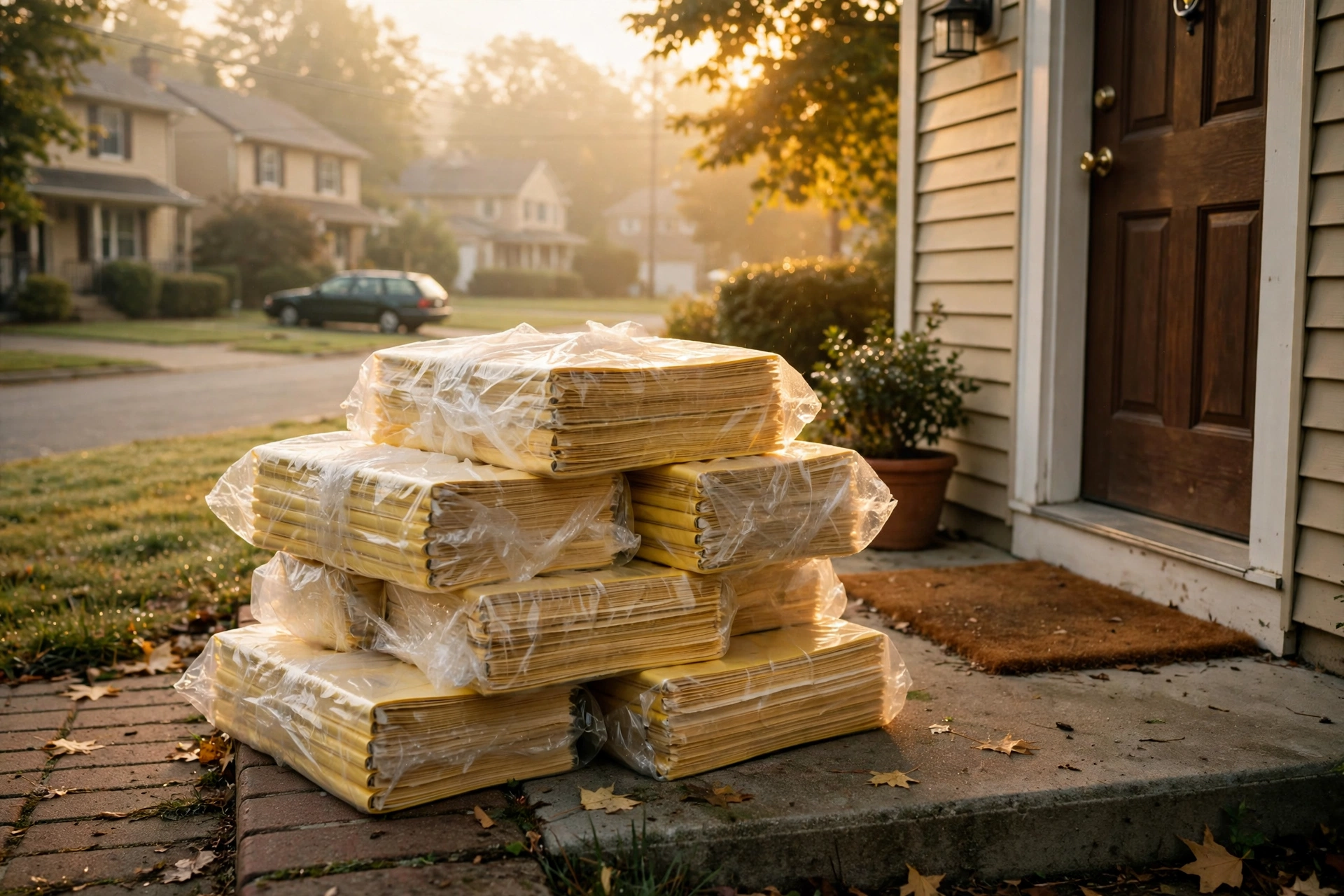
Delivery day had its own weather. You’d come home from school, or open the front door on a quiet morning, and there it was — a pale, plastic-wrapped brick sitting on the porch, sometimes the size of a throw pillow, sometimes closer to a small suitcase. It was never mailed to you. Nobody ordered it. It just arrived, like a seasonal migration, once a year, every year.
Getting it inside was a two-handed job. Kids would drag it across the kitchen floor with the plastic squeaking under their palms, and somewhere a parent would call out the traditional warning: “Careful with that!” Like it was a baby. Like it was precious. And honestly? It was. That book was about to hold every phone number in town — every restaurant, every mechanic, every dentist, every pizza place that delivered after nine.
Here’s what I remember most: the old one went straight into the recycling pile, no ceremony at all. One day it was the family’s most-used object, the next day it was yesterday’s phone book, stacked by the door with the newspapers, destined for the curb. We replaced the internet every twelve months and never once thought that was strange. That was just how life worked. The new one smelled like fresh ink and clean paper. The old one smelled like the kitchen.
The Doorstop That Lived on Top of the Fridge
Every house had its spot. For most of us, it was the top of the refrigerator — up there with the cereal boxes that didn’t fit in the cabinet and the fancy dishes nobody was allowed to touch. The phone book claimed that shelf like it owned it. It was too big for the junk drawer (obviously), too important for the bookshelf, and too thick for anything except the flattest surface in the house.
And what a brick it was. Thick city editions could run to thousands of pages. You didn’t carry the Yellow Pages — you hauled it. Kids used it as a booster seat at the table. Teenagers used it to press flowers. It propped open doors. It held up wobbly table legs. It was the original multi-tool, and its real job — finding phone numbers — was almost incidental to how it served the household.
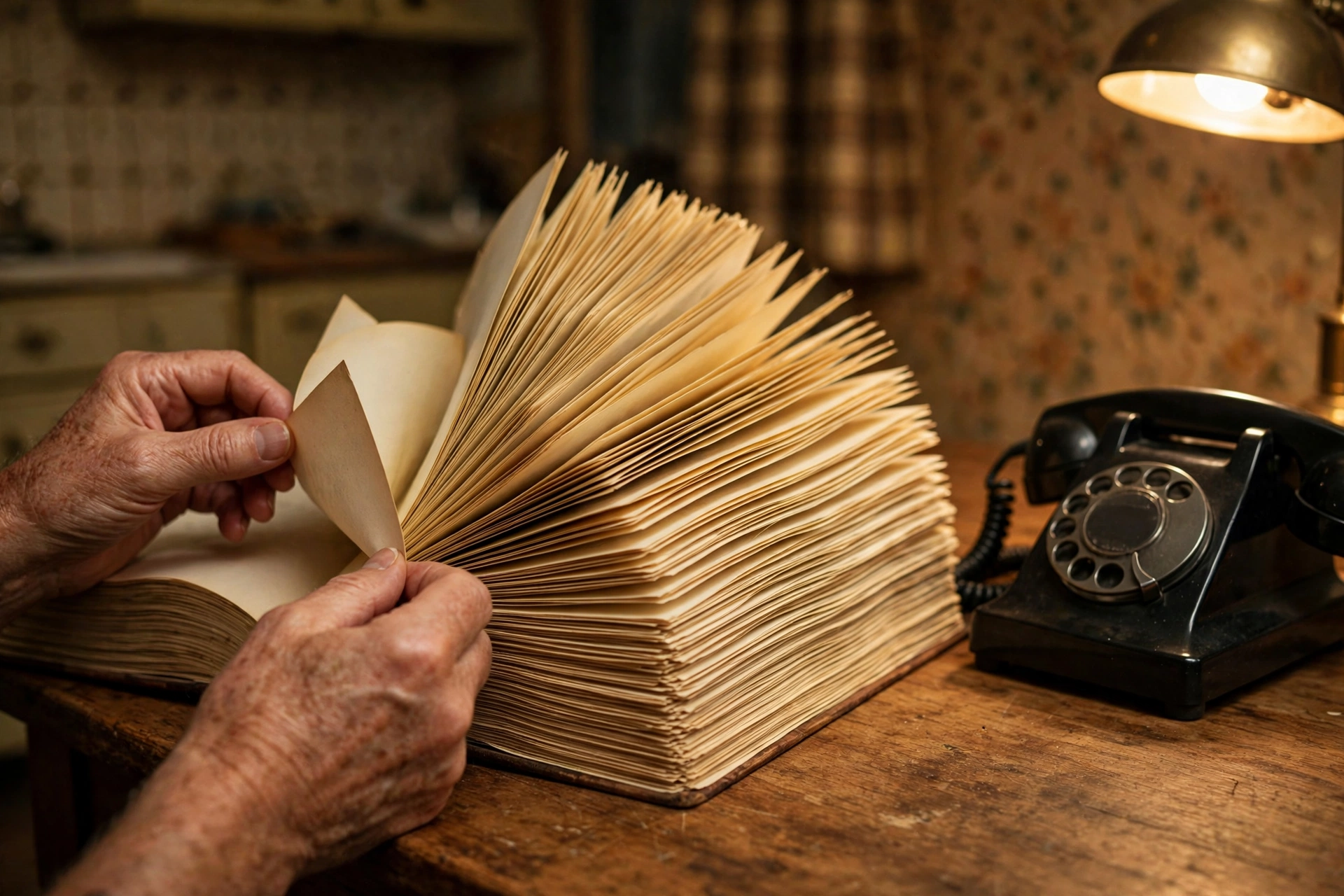
The pages themselves deserve a moment of respect. They were tissue-thin, the cheapest paper money could buy, with a whisper of a texture under your fingertips and ink that would smudge if your hands were even slightly damp. You had to turn them gently, almost like you were handling butterfly wings. And the smell — a dusty, warm, papery smell that said everything is in here somewhere, you just have to find it.
“Let Your Fingers Do the Walking”: Yellow Pages Phone Book Memories of the Great Search Ritual
The slogan was everywhere. On the cover, on TV commercials, on the side of delivery trucks: Let your fingers do the walking. It was one of the most famous advertising lines in history — a national campaign that, according to the advertising archives, debuted in January 1962 on the Bell Telephone Hour and helped push Yellow Pages revenue to an all-time high the following year. You can read about the famous campaign’s debut in 1962 and the jingle that followed: “Let your fingers do the walking in the Yellow Pages. Read the ads. Learn the facts. Find it fast.”
And honestly? The slogan told the truth. Searching the Yellow Pages was a physical, whole-body experience. You licked a fingertip — everyone did, don’t pretend you didn’t — and started flipping with the big black category letters as your guideposts. PLUMBERS. PIZZA. AUTO REPAIR. Each category was its own little neighborhood, and you walked through it one page at a time until the name you needed appeared like a friend waving from a crowd.
The AAA Trick: How Businesses Named Themselves to Be First
Because listings ran in alphabetical order, the top of every category was a battlefield — and the cleverest businesses fought dirty. Why do you think half the plumbers in town were named “AAA Plumbing”? Or “A-1” this and “Aardvark” that? Nobody was actually named Aardvark. Those business owners knew that being listed first meant getting the first call, and the first call meant the job. It was the original search engine optimization — except instead of keywords and backlinks, it was alphabet soup.
And the display ads were the big leagues. A full-page ad with a bold border, a hand-drawn mascot, a coupon clipped to the corner — that was the 1980s equivalent of the number-one search result. Businesses paid serious money for those spots, and they sweated every detail, because for an entire year, that one page was their whole storefront. No website. No social media. Just that page, seen by everyone in town who ever flipped past it.
The Ritual: How a Lookup Actually Worked
Here’s how it really went down, step by step, the way millions of households did it for generations. First, somebody announced the need — “We need an electrician” — and somebody else, usually the one sitting closest to the kitchen, was dispatched to fetch the book. Thump: it hit the table. Then came the flip, the scan, the fingertip trailing down the column while you compared names, checked the little service descriptions (“24-hour service!” “Licensed and bonded!” “Free estimates!”), and maybe — just maybe — recognized a name from a neighbor’s recommendation.
Then you picked up the rotary phone with its long cord and busy signals, stretched it as far into the hallway as it would go for privacy, and dialed. Sometimes the line was busy. Sometimes nobody answered and you tried the next name on the list. It was slow. It was clumsy. And yet it had something today’s five-star review systems can never quite reproduce: you chose a person, not an algorithm’s favorite. The choice felt like yours.
The Hand-Drawn Ads That Built Small Businesses
Before the internet, the Yellow Pages was the playing field — and it was the only field. For a small business, a good listing was the difference between a full appointment book and an empty shop. The ads were glorious: hand-lettered headlines, cartoon plumbers winking at you, phone numbers printed so big you could read them from across the room. “Call now!” they shouted. “Same-day service!” “Serving the community since 1974!”
There’s something deeply touching about that world. The Yellow Pages trusted local businesses in a way the modern internet never has. You weren’t competing with a giant chain’s marketing department in another state — you were competing with the other three plumbers on page 412, and the one with the friendliest-looking ad usually won. It was commerce at human scale, and it kept main streets alive.
The origin story of the whole thing is almost too perfect: the concept reportedly dates to 1883, when a printer in Cheyenne, Wyoming ran out of white paper and printed a telephone directory on yellow paper instead — and the first official Yellow Pages book followed in 1886, printed by Reuben H. Donnelley. Over a century later, the United Kingdom’s version was still rolling off the presses — it ran for 51 years there, with the final editions delivered in Brighton in 2019. A book that lasted longer than most marriages. A book that outlived entire technologies. Let that sink in.
The White Pages, the Coupons, and the Fold-Out Map
The Yellow Pages never traveled alone. It came bundled with the White Pages — the residential listings, names and numbers of actual neighbors — and that thin, plain sibling had its own strange power. Remember prank calls? Remember finding your crush’s number before the internet existed, hands shaking, rehearsing what you’d say? The White Pages made all of that possible. It was social media with paper cuts.
And the extras! Oh, the extras. Coupons perforated along the back pages — two-for-one pizza, free oil change with any service, ten percent off your first dry cleaning. Emergency numbers printed on the inside cover, where panic could find them. The area code map that reminded you how big your world was. Some editions had restaurant guides, school calendars, even first-aid instructions. It wasn’t just a directory. It was a survival kit with a spine.
When the Book Stopped Coming
The ending came slowly, and then all at once. One year the book was thinner. The next year it arrived and sat on the porch for a week before anyone bothered to bring it inside. Someone in the house would say, “Do we even need this anymore?” and nobody had a good answer, because Google had quietly taken the job — no thud, no plastic wrap, no annual ceremony at all.
The recycling piles told the story. Every spring, doorsteps across the country sprouted little mountains of brand-new, still-wrapped phone books that nobody had asked for and nobody wanted. They sat in the rain. They got kicked aside. Delivery drivers left them like fossils of a world that had moved on while nobody was watching. Eventually the books stopped coming altogether, and the top of the fridge — that sacred shelf — stood empty for the first time in decades.
Did you mourn it? Most of us didn’t, not right away. We were too busy marveling at how fast we could find a plumber now. But here’s the thing about convenience: it doesn’t leave room for ritual. And rituals, it turns out, were doing quiet work we never noticed — teaching kids the alphabet by category, giving bored afternoons a destination, making the whole town feel like it fit inside one book you could hold.
What Google Never Gave Us Back
Let’s be fair: Google is faster. Nobody disputes that. But speed was never the point of the Yellow Pages — discovery was. When you flipped to “Restaurants,” you didn’t just find the place you were looking for. You didn’t just find the place you were looking for. You found five places you’d never heard of, with names that made you laugh and ads that made you curious. You’d point at one and say, “We should try that place sometime,” and then you did. That was the algorithm: boredom plus curiosity plus paper.
The book also belonged to everybody equally. No accounts. No passwords. No tracking. A kid with a quarter for the payphone and a question had exactly the same access as the richest person in town. There was something deeply democratic about a book that showed up free on every doorstep, year after year, asking nothing in return except that you let your fingers do the walking.
And it lived in the same world as the boombox era — the era of physical things that did one thing beautifully. The boombox played music you could hear three houses away. The phone book answered questions you could ask from the kitchen table. Everything had weight. Everything had a place. Everything was real in a way that’s hard to explain to anyone who’s never licked their finger to turn a page.
So here are the truths I’m taking with me. We didn’t search the internet — we searched the kitchen, and the answer was on top of the fridge. That’s not a joke; it’s a whole philosophy of life in one sentence. And this one: every business had a chance back then — you just needed a good name, a good ad, and a lot of A’s at the start of it. Try fitting that kind of optimism into a search results page.
Now It’s Your Turn: What’s Your Phone Book Story?
The last Yellow Pages I ever touched sat in a hallway drawer for years after it became useless, like a retired champion nobody had the heart to throw out. I finally recycled it one spring afternoon, and I swear I felt a little twinge — the same twinge you get saying goodbye to anything that served you well. Because that book did serve us well. It found our plumbers. It settled our arguments. It gave every small business in town a fighting chance.
Google tells you everything. The Yellow Pages trusted you to find it. And maybe that’s what I miss most: the trust. The book never watched me, never sold my data, never nudged me toward the highest bidder. It just sat there, thousands of pages thick, and waited for me to need it.
So now I want to hear from you. What was your family’s spot for the phone book — top of the fridge, hallway drawer, somewhere weirder? Did your business, or your parents’ business, ever run a display ad in it? And do you remember the last time you actually flipped through one before the internet took over? Drop your story in the comments. Let’s give this giant yellow book the send-off it never got.
Pingback: Sears Christmas Catalog Memories: Our Holiday Wish Book