The sky went purple first. Then, one by one, the bulbs along the midway flickered on — a thousand little suns strung between wooden poles — and the whole fairground lit up like somebody had shaken a jar of fireflies. If you grew up anywhere near a small town, you know that exact moment. These are my county fair carnival memories, and I’d bet my last strip of ride tickets they’re yours too.
The fair only came to town once a year. That was the whole deal. It didn’t need more than a long weekend to fill an entire summer, because the waiting was half the fun. The flyers pinned to the grocery store corkboard. The smell of sawdust drifting over the fairground fence while the crews set up. The way your stomach did a little flip when you saw the Ferris wheel rising piece by piece against the evening sky, a little taller than it had looked in your head all year.
And then opening night arrived, and for four or five glorious days the ordinary field at the edge of town turned into another planet. A planet that smelled like diesel, funnel cake, and cut grass. A planet where grown-ups loosened their wallets and kids suddenly had one glorious, ridiculous power: the power to choose exactly how to spend the one perfect week of summer.
Why County Fair Carnival Memories Start With the Ferris Wheel
You could hear it before you could see it. That slow, rhythmic creak as the wheel turned — metal on metal, patient as a grandfather clock — carried all the way across the parking lot. Every kid at the fair knew that sound. It was the heartbeat of the whole place.
The Ferris wheel was always the tallest thing for miles. In towns where nothing was taller than the water tower, that glowing circle of lights owned the night sky. It was the first thing you pointed at from the car window, and the last thing you stared at over your shoulder when your parents finally dragged you toward the exit.
A Quick Bit of Wheel History
Here’s the thing most of us never knew as kids: the Ferris wheel we were riding had a spectacular origin story. The original wheel was designed and built by a Pittsburgh bridge builder named George Washington Gale Ferris Jr. as the centerpiece of the Midway at the 1893 World’s Columbian Exposition in Chicago. It stood 264 feet tall, opened to the public on June 21, 1893, and carried 36 passenger cars that could hold 60 people each. A ride cost 50 cents — real money back then. If you want the full details, read the remarkable story of the original 1893 wheel. Knowing it was born at a World’s Fair makes it feel even more right that every little county fair on earth still raises one.
The Top of the Wheel Belonged to Us
Getting on was its own ceremony. The attendant would swing the little car around, unlatch the chain, and you’d climb in and sit down fast, because the seat was still warm from whoever had just gotten off. Then the chain clanked shut and the wheel groaned and started to move, and suddenly you were rising.
There was a specific moment — right at the top — when the wheel would stop to load more people and your car would just hang there, swaying gently. And for maybe thirty seconds, you owned the entire town. You could see the lit-up midway below you like a toy village. The dark fields beyond. Your street, your school, the water tower with its red blinking light. Everything you knew, shrunk down to a model, and you were floating above it.
It was the closest thing to flying most of us would ever get. And there, at the top, with your best friend beside you and the whole glowing fair spread out underneath, you understood something without having words for it: this was as good as life gets. This exact feeling. Bottled in thirty seconds at the top of a Ferris wheel.
Shareable moment: At the top of the wheel, the whole town belonged to you — for thirty seconds, you were flying, and nothing else in the world mattered.
Midway Games: Three Rings for a Dollar of Hope
The midway was a gauntlet of temptation, and every booth had a barker with a voice like a carnival trumpet. “Three rings for a dollar! Step right up! Everybody wins!” Nobody won. Well, almost nobody. That was the beauty of it.
You’d stand there with your crumpled bills and your little string of tickets, doing math no school could ever teach you. Do I spend three dollars on the ring toss, where the rings bounce off those glass bottles like they’re coated in butter? Or the milk bottles, stacked in that pyramid, where the softball somehow always finds a way to knock down two and leave one wobbling? Or the balloon darts, where the darts were just dull enough to make you feel robbed and just sharp enough to keep you trying?
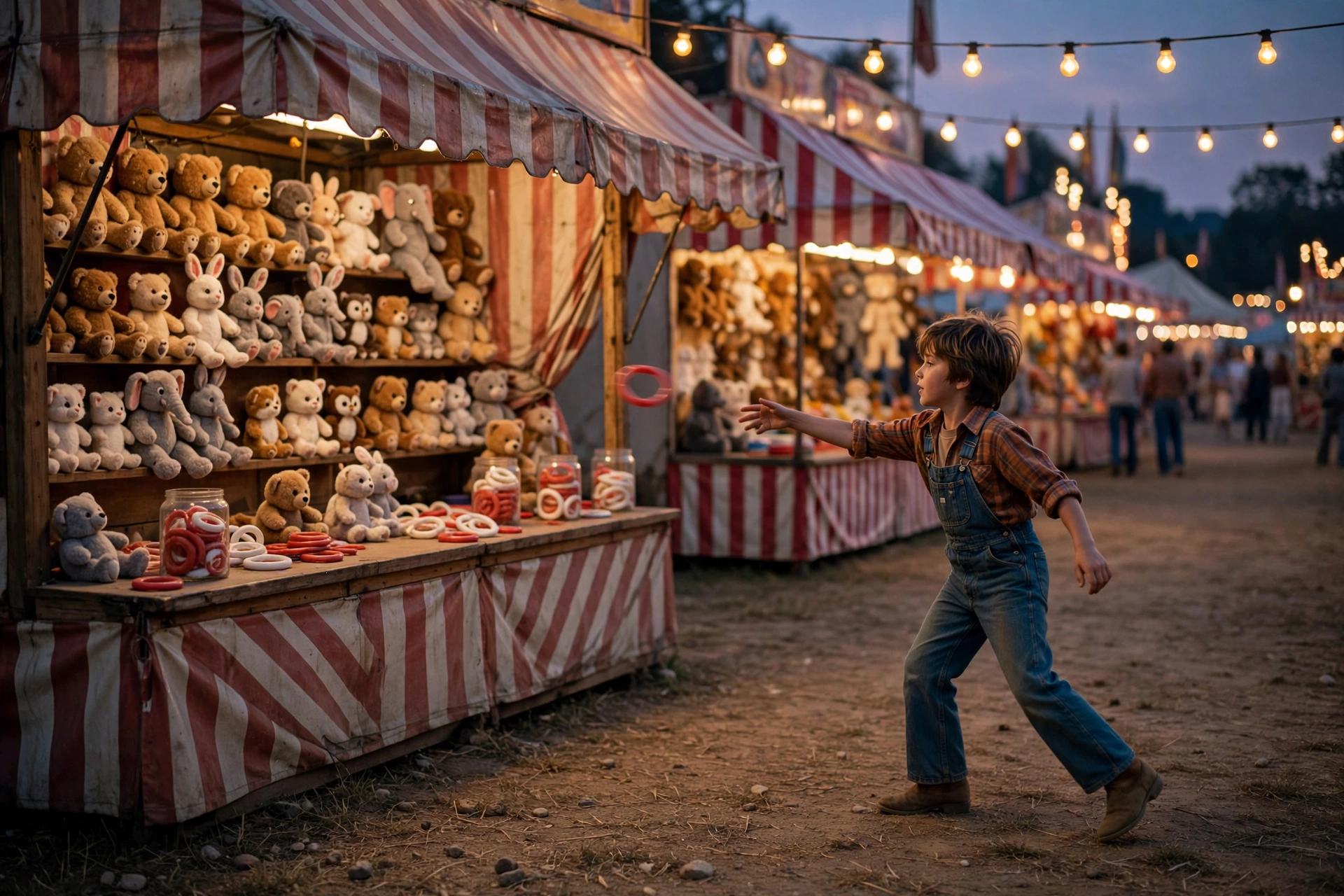
My personal nemesis was the ring toss. You’d watch the kid ahead of you toss his rings with total confidence, and they’d hop and skitter across the bottle tops like startled frogs. Then it was your turn, and you’d line up the shot with the concentration of an Olympic archer, and the ring would catch the rim, spin around it twice in the most heartbreaking tease imaginable, and pop off. The booth guy would shrug like he’d seen it a million times. He had.
But here’s what nobody tells you about the midway: it wasn’t really about winning. It was about almost winning. That almost is what kept the line long. And every once in a while — once in a beautiful while — somebody actually did it. Some kid would sink that ring, and the whole crowd would gasp, and the barker would hand over a giant stuffed bear, and that kid would walk down the midway like a champion, carrying a prize bigger than his torso, while every other kid watched with pure, burning envy. That was advertising money couldn’t buy.
I spent what felt like a fortune on those games, and I have exactly one stuffed animal to show for it — a lopsided purple dog I named after the booth guy who gave it to me out of pity. Honestly? Worth it. The way we used to stretch every dollar of fun money back then reminds me of spending allowance money at the corner store, where a handful of change could buy a whole afternoon of happiness.
Shareable moment: The midway wasn’t about winning — it was about almost winning. And almost was always enough to try one more time.
Cotton Candy: Spun Sugar, Sticky Fingers, Pure Joy
There was a smell that meant the fair had truly begun, and it was sugar spinning in hot air. You could catch it from the parking lot — sweet, warm, faintly burnt around the edges — and it would pull you forward like a cartoon character floating after a pie cooling on a windowsill.
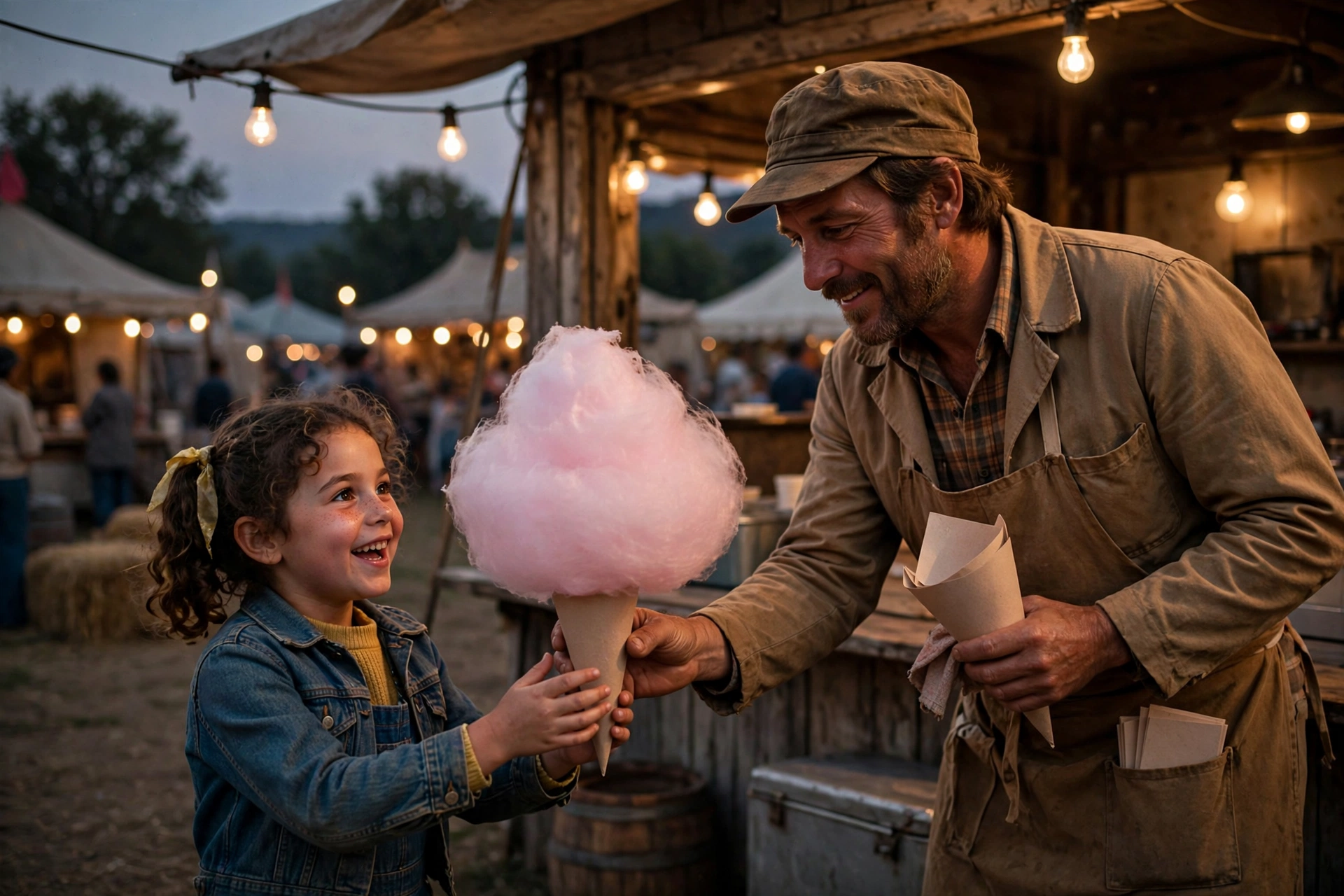
The cotton candy stand was theater. The vendor would take a paper cone, spin it through the cloud of pink floss gathering in the big metal bowl, and build you a confection the size of a pillow. It looked impossible. It looked like weather. A little pink cloud, handed to you on a stick, dissolving on your tongue the instant you touched it.
And then came the sticky. Oh, the sticky. Within minutes your fingers were glazed, your lips were glazed, and there was a fine sugary film on everything you’d touched since. Your face, somehow, was the stickiest part of you. Mothers would sigh the deep sigh of mothers everywhere and produce a damp napkin, but you both knew it was hopeless. Sticky was the price of admission to this particular joy, and nobody was asking for a refund.
The best part? The color choice. Pink or blue. This was a decision with real stakes when you were eight. Pink tasted like pink — whatever that was, some warm vanilla-berry magic. Blue was mysterious, electric, slightly wild. Some kids were pink kids and some kids were blue kids, and you could tell a lot about a person by their choice. I was a pink kid. My sister was blue, and we defended our positions with the passion of rival sports fans.
Here’s a fact that still delights me: machine-spun cotton candy was invented in 1897 by a Tennessee dentist named William Morrison, working with a confectioner named John C. Wharton. A dentist! They introduced it to a wide audience at the 1904 World’s Fair in St. Louis, where it was called “Fairy Floss” and sold 68,655 boxes at 25 cents each. The name “cotton candy” came later, from a 1921 patent. You can read the surprisingly sweet history of cotton candy and its journey from fairground novelty to the pink-and-blue clouds we remember.
There’s something poetic about a dentist inventing the stickiest treat at the fair. It’s like he knew exactly what he was doing — creating the one sweet that would guarantee him customers for life.
The Smell of Summer: Funnel Cakes and Everything Fried
If the cotton candy stand was the fair’s perfume, the food row was its full, glorious, unapologetic feast. You’d walk down that row and the air got thicker with every step — powdered sugar, hot oil, grilled onions, caramel, butter, more butter, and something on a stick that you couldn’t identify but absolutely had to try.
The funnel cake was king. Watching one being made was half the pleasure: the vendor would pour batter through a funnel in looping ribbons into hot oil, and it would puff and crisp into a golden, lacy disc. Then came the blizzard of powdered sugar, the little paper plate, and that first bite — crispy outside, soft inside, sugar dusting your shirt like the first snow. You ate it with your hands. There was no dignified way to eat a funnel cake, and that was the point.
And the corn dogs! The corn dogs were architectural marvels — a perfect cylinder of golden batter on a stick, with that little line of mustard you’d squeeze down one side. Then there were the caramel apples, shiny as Christmas ornaments, that would glue your jaw shut in the most delightful way. Saltwater taffy. Snow cones in paper cones that leaked blue syrup down your arm. Fresh-squeezed lemonade in those waxy cups, so tart it made your eyes water.
Fair food had rules, and every kid knew them. Rule one: you eat standing up. Rule two: napkins are decorative. Rule three: whatever you eat at the fair stays at the fair — meaning your stomach would be a churning science experiment by the time the Tilt-A-Whirl spun you around, and that was a risk you accepted as part of the deal.
And nobody — nobody — left without something sweet for the road. The summer treats of childhood all seemed to converge at the fair: it was like the ice cream truck, the corner store, and the best backyard barbecue had all decided to throw one party together, and you were invited.
Shareable moment: Sticky fingers were the price of admission to summer’s best show — and nobody ever asked for a refund.
Livestock Barns and 4-H Ribbons: The Fair’s Other Heart
Here’s what separated a county fair from a traveling carnival: the barns. Walk past the midway’s neon and noise, follow the smell of hay instead of hot oil, and you’d find the quieter half of the fair — rows of stalls where 4-H kids stood beside their cows and sheep and pigs with a look of fierce, shining pride.
Those kids had been working toward this week for months. They’d raised those animals from spring, fed them, groomed them, walked them, worried over them. And now here they were, leading a thousand-pound steer around a sawdust ring while a judge in a straw hat studied every inch of it. The barns smelled like hay and leather and warm animals, and the whole place hummed with a different kind of excitement than the midway — deeper, steadier, earned.
The 4-H connection runs deep in fair history. The youth program began around 1900, with early clubs forming in the first years of the century — A.B. Graham started one of the pioneering youth programs in Clark County, Ohio, in 1902 — and by the 1910s these clubs were a fixture at county fairs across rural America, where young people exhibited livestock, crops, and home projects they’d raised and built themselves. Some county fairs go back even further; a few have been running since the 1800s. That continuity is part of the magic — kids showing cattle in sawdust rings the same way their grandparents did.
I never raised a show animal. But I stood at those rail fences and watched kids my age do it, and I understood, even then, that this was serious in a way the ring toss was not. When a girl no older than me won a blue ribbon for her heifer, the way she hugged that animal’s neck — that was real. That ribbon meant mornings and evenings and weekends. It meant responsibility. And the fair honored it, right there in the sawdust, in front of everybody.
The exhibition halls had their own quiet glory too. Tables of prize-winning pies with lattice crusts like artwork. Jars of pickles and preserves in jewel colors, lined up like a sunset. Quilts that must have taken a year of evenings. The biggest pumpkin you’d ever seen in your life, sitting there like a orange planet. Every ribbon pinned to every entry was a small town’s way of saying: look what we made.
The Rides That Thrilled and Terrified Us
Beyond the wheel, the midway’s real chaos lived in the spinning rides. The Tilt-A-Whirl, with its little cars that spun on their own axis while the whole platform whirled — the one ride guaranteed to rearrange your funnel cake. The Octopus, whose arms rose and fell while your car spun at the end of each one, a ride that seemed designed by someone who held a grudge against stomachs everywhere.
The Scrambler was the social ride. You went on with a friend, and the two of you would be smashed together by centrifugal force, laughing so hard you couldn’t breathe, arms pinned to your sides. It was the ride where friendships got sealed. If you could survive the Scrambler together, still laughing, you were friends for life.
And the swings — the chain swings — might have been the most beautiful ride at the fair. A central tower, chains fanning out, and you in a little seat, rising higher and higher as it spun, until you were flying in a wide circle with the night air rushing past your face. From the ground it looked like a blooming flower of lights. From a swing, it felt like being a bird.
Every fair had the one ride the bigger kids talked about in low voices. The Zipper. The one that flipped you upside down in a cage. You’d watch it go around, watch the cages tumble end over end, and your stomach would drop just looking at it. Some years you’d be brave enough. Some years you’d watch from the fence and tell yourself — and everyone else — that you were “saving your tickets.” Nobody believed you. It was fine.
Bumper cars deserve their own paragraph, because bumper cars were democracy. No skill required, no height of bravery, just a steering wheel that barely steered and permission — glorious, sanctioned permission — to ram your friends. Parents who would never let you bump into anyone in real life would cheer as you T-boned your little brother into the wall. The whole pavilion smelled like ozone and rubber, and the floor sparked under your wheels, and for three minutes the world made perfect sense.
The Last Night, and Why It Never Really Ended
The last night of the fair had a feeling all its own. You could sense it in the air — the barkers’ voices a little hoarse, the crowds a little thinner, the lights somehow a little more precious because you knew they’d be gone by morning. You’d spend your last tickets carefully, like the final coins in a treasure chest, trying to squeeze one more ride, one more game, one more everything out of the evening.
And then came the walk to the car. Past the midway, now half-dark, with the crews already starting to take things down. Past the barns, quiet. And you’d turn around for one last look at the Ferris wheel, still turning against the night sky, and make a promise to yourself: next year. Next year you’d be taller, braver, richer in tickets. Next year you’d win the giant bear. Next year you’d ride the Zipper.
Here’s what I’ve learned, all these years later: the fair never really ended. It’s still there, every time I catch the smell of spun sugar or hear a distant carnival calliope or see string lights glowing over a backyard at dusk. The fair didn’t last a week — it lasted all year, in our heads, in the waiting and the remembering. That’s the real trick the county fair pulled on us. It sold us four days and gave us a lifetime.
So here’s my question for you, and I genuinely want to know: what’s your strongest county fair memory — the ride, the food, the game, the moment — and who were you with? Was it the top of the Ferris wheel at dusk? The sticky pink cloud of cotton candy? The ring that almost — almost — landed? Drop it in the comments. I have a feeling our memories are going to rhyme in the best possible way.