The crunch of dry leaves under your sneakers. A screen door slamming somewhere down the block. Cold air on your cheeks, the smell of candle wax and somebody’s fireplace drifting over the rooftops. If you’re like me, your trick or treating memories don’t start with a calendar date. They start with a feeling — a buzzing in your chest on the afternoon of October 31st that whispered, tonight is the night.
Halloween in the 70s and 80s wasn’t an event you attended. It was a mission you trained for all month. You knew which house gave out the full-size bars and which street the big kids said was “picked clean” by seven. And when the sun finally dropped, you burst out the front door, and the whole world smelled like autumn and possibility.
So let’s walk those streets again. The leaves are waiting.
Table of Contents
The Pillowcase: Where Our Trick or Treating Memories Begin
Nobody serious carried a little plastic pumpkin bucket. Buckets were for toddlers. Real trick-or-treaters carried one of two things: a brown paper grocery bag with the handles folded down, or — the mark of a true professional — a pillowcase.
The pillowcase was genius, and every kid knew it. It held three times what a bag could hold. It draped over your shoulder like a bandit’s sack when it got heavy. And it had a beautiful, honest arc to the evening: you left the house with it flat and weightless, and you came home dragging it behind you, listening to the candy shift and settle inside like treasure in a storybook. My mother used to safety-pin a little tag inside mine with my name on it, which I thought was deeply embarrassing at the time and now strikes me as the sweetest thing in the world.
And yes, it got heavy. Gloriously, arm-achingly heavy. By nine o’clock your shoulder was numb and your fingers were sticky — but there was always one more street in you. Always one more street.
There was strategy involved, too. The best crews had a route, and the route was sacred. Down Maple first because Mrs. Henderson gave out the good stuff early and ran out by eight. Skip her neighbors — fruit! On Halloween! Then the long loop past the cul-de-sac, where the houses were bigger and the candy was, in kid-logic, automatically better. The crown jewel was the Full-Size House. Every neighborhood had exactly one. A full-size candy bar house was worth more than a treasure map — and everybody knew exactly where X marked the spot.
Ben Cooper Costumes: The Sweaty Mask Era
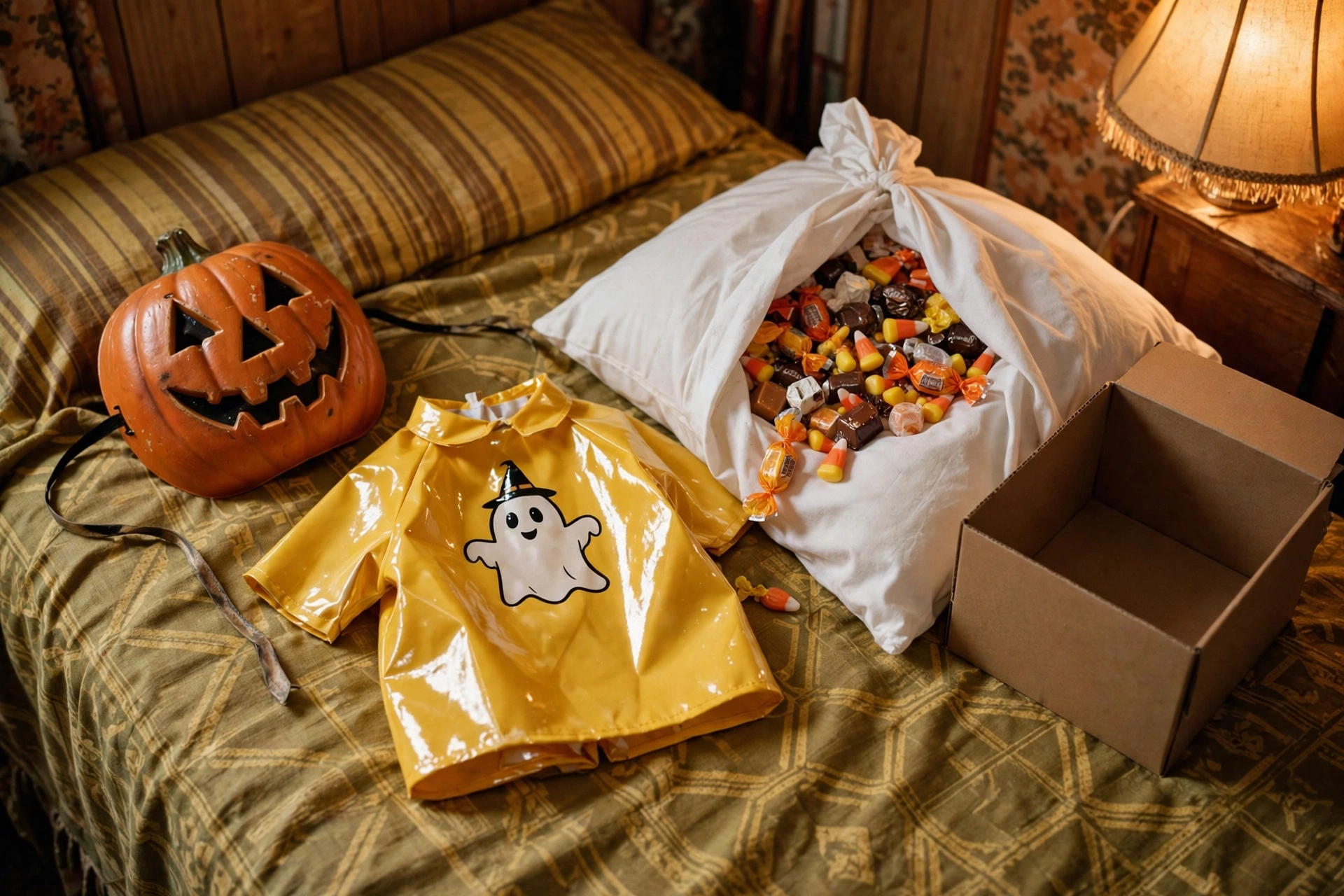
Before the pillowcase, though, there was the costume — and in the 70s and 80s, that meant one thing for millions of American kids: a thin cardboard box from the drugstore with a plastic mask and a vinyl smock inside.
Ben Cooper, Inc. ruled Halloween for decades. Founded in Brooklyn in 1937 — the Wikipedia history of Ben Cooper, Inc. traces the whole rise and fall — the company became one of the three biggest Halloween costume makers in the country, and its cheap plastic masks and vinyl smocks were, for a whole generation, simply what a Halloween costume was: the mask, held to your head by a thin rubber band, and a crinkly smock with the character’s picture printed right on the front.
And here’s the part nobody tells you until you’ve lived it: those masks were miserable. Gloriously, hilariously miserable. Within ten minutes your face was a sauna, your breath fogged the eye holes, and the rubber band pulled your hair. The smock rustled like a bag of chips and stuck to your sweaty shirt. But you didn’t care. You were Batman. The box had spoken.
The character on the box mattered enormously. Ben Cooper was famous for getting the hottest characters onto shelves fast — Spider-Man in 1963, Batman in 1964, and by the 70s the boxes tracked pop culture like a seismograph: Star Wars heroes, the Sesame Street crew, astronauts, even rockers like KISS. Show up as a 1977 C-3PO and you were royalty for a night.
Of course, half of us didn’t even get the box. Mom’s homemade costumes were their own art form — a bedsheet ghost with slightly uneven eye holes, a witch hat from the five-and-dime, a hobo costume of dad’s old clothes and a burnt-cork mustache. Honestly? Those were the best ones. You could actually breathe in a sheet.
Porch Lights On Meant Somebody Was Waiting
Here’s a rule every kid in the 70s and 80s knew in their bones: porch light on, they’re expecting you. Porch light off, keep walking.
The porch light was the original bat-signal: on meant candy, off meant keep walking. Nobody had to explain it. It was just understood, the way everybody understood that you said “trick or treat!” in unison at the door and “thank you!” on the way out, even with your mouth already full.
And the doors themselves were half the show. Screen doors banging shut behind you. Jack-o’-lanterns on the stoop with real candles guttering inside — actual fire, making the carved faces dance in the wind. The smell of a blown-out match followed you down the walkway.
Some houses went all out even then. The spooky house on the corner with dry-ice fog and a recorded witch cackle. The old man who made you reach into a box of “eyeballs” (peeled grapes — you knew it, and you screamed anyway). The lady who made every kid do a twirl before she’d drop candy in the bag, and you did it, because her candy was worth it. These people were neighborhood legends.
And the grown-ups were out there with us, in their own way. Dads stood at the end of driveways with coffee mugs, chatting and keeping a loose eye on the swarms of ghosts and pirates flowing past. Moms stayed home to work the door, rationing the good candy. It was a block party disguised as a holiday — the whole neighborhood awake, and the whole neighborhood in on it together.
The Candy We Still Dream About
Let’s talk about the haul. Because the candy wasn’t like today’s candy — or rather, the rules weren’t like today’s.
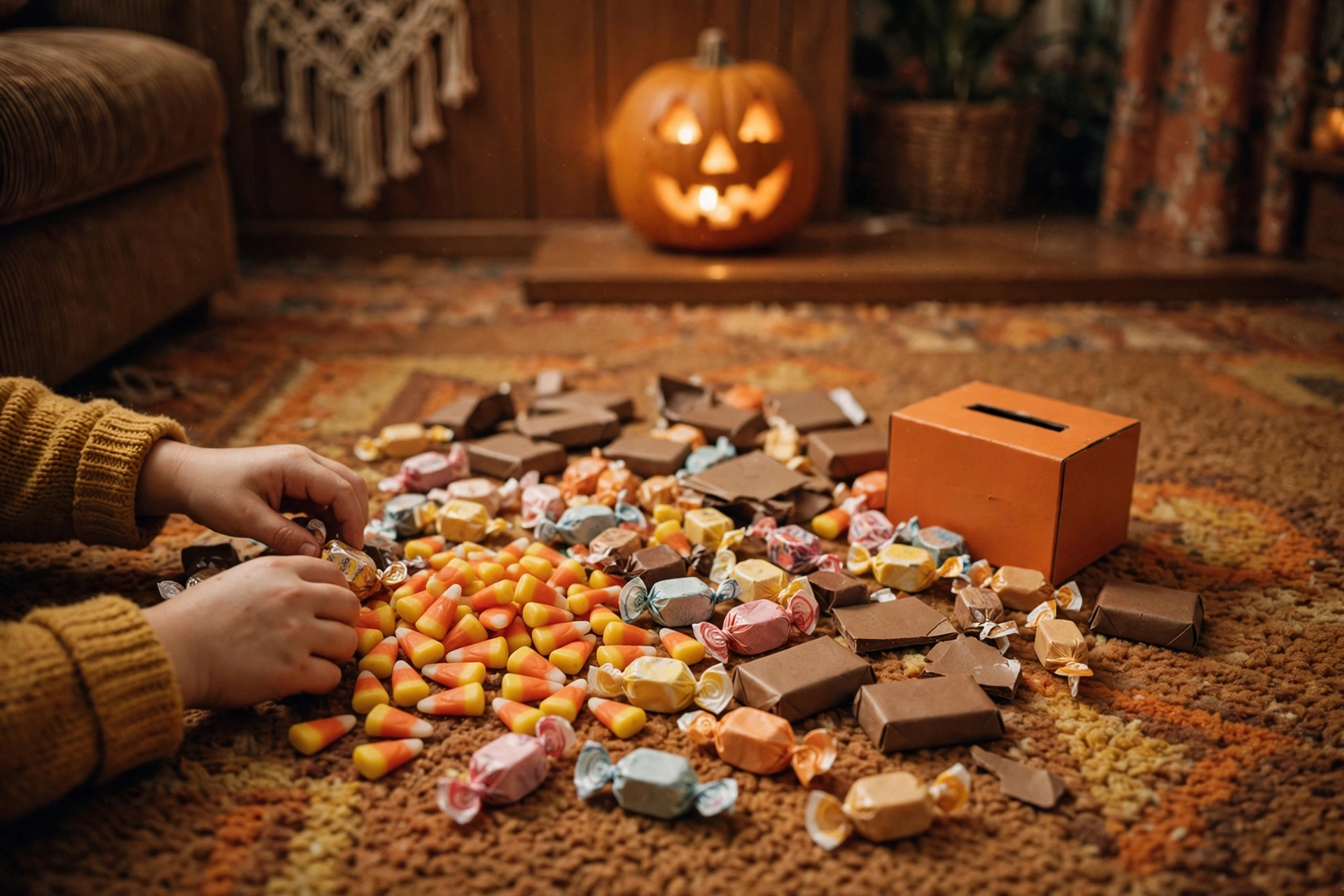
First of all, full-size candy bars were a real thing that real houses gave out, and finding one in your pillowcase felt like winning the lottery. You’d get home, dump everything on the living room carpet, and sort it into piles with the seriousness of a bank teller. The full-size bars went in the vault pile, the good chocolate went in the trading pile, and at the bottom sat the sad little boxes of raisins, which nobody traded for and everybody’s mom claimed to love.
But oh, the variety. Pixy Stix, those paper straws of pure sugar that turned your tongue blue. Necco Wafers, chalky and pastel, that you either loved fiercely or used as poker chips. Mary Janes and Bit-O-Honey, the peanut-buttery taffy that could pull a loose tooth clean out (a feature, not a bug, when you had a wiggly one). Wax bottles of sugary syrup. Candy corn, which started arguments then and starts arguments now. Smarties. Pop Rocks — basically fireworks for your mouth. And the great divider: candy apples and popcorn balls from the houses that made their own, sticky and glorious and completely unthinkable today.
The sorting ritual was sacred. Siblings negotiated trades with the intensity of stockbrokers — “three Smarties and a Mary Jane for that Snickers” — while Dad wandered through to “inspect” a handful for “safety” and ate the best pieces. Every family had this dad. Every dad denies it to this day.
And if this walk down candy lane has your sweet tooth aching, you’re not alone — the nostalgia doesn’t stop at Halloween. The penny candy at the corner store was where most of us learned the economics of sugar, and a decade later we’d be trading it all for 90s snacks like Dunkaroos and Gushers. Different decade, same sugar rush.
Popcorn Balls, Homemade Cookies, and the Little Orange Box
Here’s something that would baffle a kid today: back then, homemade treats weren’t suspicious. They were the jackpot.
The popcorn ball house was a destination. Somebody’s grandmother spent all afternoon making them — sticky spheres of popcorn and caramel, wrapped in wax paper, still faintly warm when they hit your bag. The caramel apple house. The house with frosted sugar cookies shaped like pumpkins. You knew exactly which kitchens they came from, because they were your neighbors’ kitchens.
It was a different kind of trust — the kind that only exists where everybody knows everybody. And honestly? Those homemade treats are the ones we remember most. I can still taste a popcorn ball from forty years ago better than the candy bar I had last week. There’s something about food made by a neighbor’s hands that a factory wrapper can’t touch.
And then there was the little orange box. If you grew up in the 70s or 80s, you remember it: the small orange donation box some kids carried next to their pillowcase, collecting coins for UNICEF. Trick-or-Treat for UNICEF started on Halloween night in 1950, when a Philadelphia mother named Mary Emma Allison sent kids door to door with decorated milk cartons instead of just candy bags. That first night they collected seventeen dollars. Over the decades, those little orange boxes have raised well over a hundred million dollars for children around the world. Think about that: the same night we were hauling home pillowcases of sugar, millions of kids were also hauling home hope for somebody else. We didn’t fully get it at the time. We get it now.
Where Did All of This Even Come From?
It’s funny — we never asked as kids. We just assumed Halloween had always been this way: costumes, doors, candy, done. But the road to our pillowcases is about two thousand years long.
From Samhain Bonfires to Soul Cakes
Halloween’s roots stretch back to Samhain, the ancient Celtic festival marking the end of the harvest on October 31st, when people lit bonfires and wore disguises against wandering spirits. Centuries later, Christians folded their own traditions into the season: in England, poor folks would go “souling” on All Souls’ Day, receiving pastries called soul cakes in exchange for prayers for the dead. In Scotland and Ireland, young people went “guising” — dressing in costume and earning treats of fruit, nuts, or coins by singing a song or telling a joke first. Sound familiar? The “trick” before the treat is older than any of us.
How America Turned It Into Our Night
Irish immigrants carried these customs across the Atlantic in the 1800s. By the early 1900s, Halloween in America was getting rowdy — pranks were the main event — and one theory says organized trick-or-treating caught on in the 1930s partly to channel that energy into something friendlier. World War II put things on pause (sugar rationing), but the postwar baby boom brought it roaring back: by 1951 trick-or-treating was in the Peanuts comic strip, and in 1952 Disney released a “Trick or Treat” cartoon starring Donald Duck. If you want the full story, HISTORY’s story of how trick-or-treating became a Halloween tradition traces the whole winding path, from Celtic bonfires to suburban doorbells.
The Scare That Changed Halloween in the 80s
Now, I have to be honest about something, because the 80s weren’t all popcorn balls and porch lights. There was a shadow over Halloween, and if you were a kid then, you felt it — even if you didn’t understand it.
It started with a real tragedy. In 1974, an eight-year-old Houston boy named Timothy O’Bryan died on Halloween night after eating a cyanide-laced Pixy Stix. Police uncovered the terrible truth: the poison hadn’t come from a stranger — his own father had tampered with the candy, hoping to collect life insurance. The father was eventually executed for the crime. It was a horrifying story, and the news media watered its seed of fear for years.
Then, in September of 1982, came the Chicago Tylenol murders — seven people killed by cyanide-laced painkillers. It had nothing to do with Halloween, but the timing, just weeks before October 31st, fused the two stories in the public imagination. Some hospitals offered to X-ray Halloween candy. States passed tampering laws. Ben Cooper watched its costume sales collapse that October as frightened parents kept kids home — the company later joined other manufacturers in publishing a booklet of safe ways to celebrate the holiday.
Here’s the part that matters: the great stranger-danger candy panic was, for the most part, a myth. In 1985, a sociologist named Joel Best at the University of Delaware studied thirty years of alleged Halloween candy poisonings and couldn’t find a single confirmed case of a child being killed or seriously hurt by a stranger’s tampered treat. Most of the reported cases turned out to be hoaxes. The fear was real. The danger, from strangers at least, essentially was not.
But the scare changed Halloween anyway. Homemade treats — the popcorn balls, the caramel apples, the cookies — started disappearing, replaced by factory-sealed candy parents could inspect. The X-ray machines faded, but the era of the homemade treat never fully came back. A panic built on a myth took something genuinely sweet from us. Still: the pillowcases stayed full, the porch lights stayed on, and we kept going out. Kids are resilient like that.
Why Those Nights Still Glow
So why do we still talk about it? Why does a fifty-year-old get misty-eyed over a pillowcase?
I think it’s because Halloween night was the one night of the year when the whole world felt like it was built for kids. Not adapted for kids, not tolerated for kids — built for them. The streets belonged to us. The neighbors were waiting for us. Strangers smiled at us. For a few hours, the adult world rearranged itself around our joy, and we ran through it with sticky hands and fogged-up masks, completely sure that this — this exact feeling — was what happiness was.
We didn’t need a step counter. We walked the whole neighborhood for candy and called it the best night of the year. You went out when the streetlights came on and came home when the pillowcase got too heavy to carry, and somewhere in between you lived an entire adventure.
The costumes are long gone — the masks cracked, the smocks tore, the rubber bands snapped, and Ben Cooper itself was bought out in the early 90s. But the feeling is still there, every October, when the air turns cold and the leaves start to crunch. You can see it in the way we linger over the Halloween aisle, buying full-size bars “for the trick-or-treaters” and then eating three of them ourselves.
We can’t go back to those streets. But we can remember them — and we can tell the stories, so the kids ringing our doorbells now know they’re part of something older and sweeter than they realize.
Now it’s your turn. What’s the one treat you still think about — the one house, the one candy, the one costume — that no Halloween since has ever quite matched? Tell us in the comments. I have a feeling the stories are going to be delicious.
Pingback: Fall Back Memories: The Extra Hour & Dark-by-Dinner Evenings