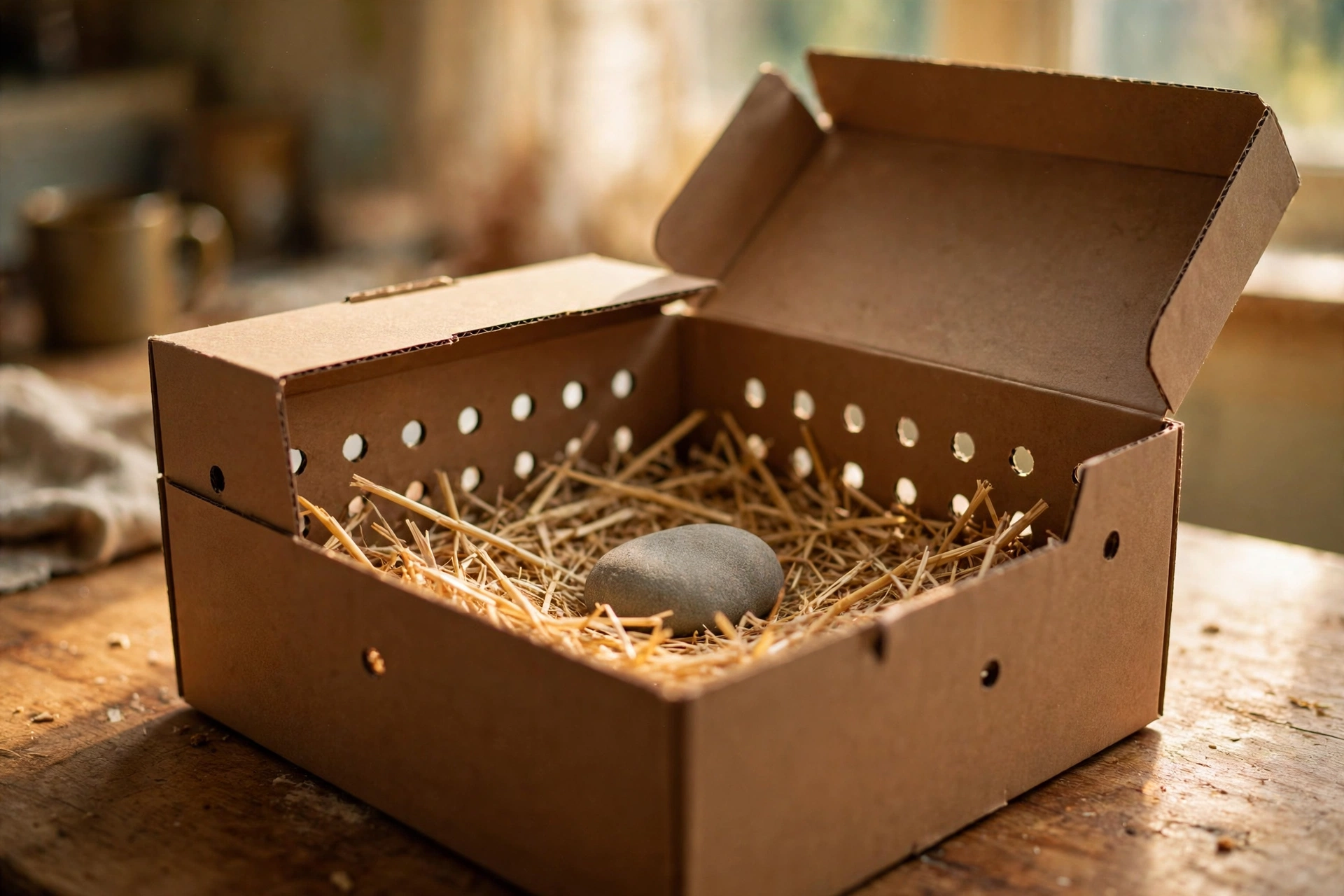
Close your eyes and picture this. Christmas morning, 1975. You shake the present and it doesn’t rattle — it thumps. One solid, satisfying thump. You tear off the wrapping paper, lift the lid, and there it is: a cardboard pet carrier with little air holes punched in the sides, and inside, curled up on a golden bed of straw like it owns the place, sits a rock. A plain, smooth, gray rock. And you? You’re thrilled. Absolutely delighted. That’s the pet rock craze for you — the silliest six months America ever lived through, and maybe the happiest.
I wasn’t there for that Christmas — I was born years later — but I grew up hearing about it the way kids hear about moon landings. My uncle had one. He kept it on his dresser for years, this ordinary stone in its little straw nest, and he talked about it the way other men talk about their first car. When I finally asked him what was so special about it, he just shrugged and grinned. “Kid,” he said, “you had to be there.” So this one’s for everyone who was there, and for the rest of us who wish we had been.
Christmas Morning 1975: A Box With Holes in It
Let’s set the scene properly, because the scene is half the story. It’s December 1975. The country is tired — gloomy headlines, a long hangover from a rough decade — and under millions of Christmas trees sits a gift that makes absolutely no sense. Parents watch their kids open it. Kids watch their parents try not to laugh. Because inside that carefully wrapped package is a smaller box, a cardboard pet carrier complete with breathing holes, and nestled in the straw, one smooth gray stone with a printed 32-page manual explaining how to take care of it.
The genius — and there was real genius in it — was that everyone was in on the joke. Nobody opened a Pet Rock feeling tricked. The box had air holes, for crying out loud. Air holes, for a rock. The whole thing was a wink, and in the winter of 1975, America really, really needed a wink. Kids named their rocks. They carried the boxes around like lunch pails. They asked for a second one so the first wouldn’t get lonely. I’m not making that up — that actually happened, in living rooms all across the country.
And the price? Three dollars and ninety-five cents. Say it out loud: three ninety-five. For a rock you could have picked up in your own backyard for free. My grandmother, who grew up during the Depression and could stretch a dollar until it begged for mercy, took one look and said, “Well, at least it won’t eat.” She had a point. The rock never needed feeding, never needed walking, never chewed a shoe. It never barked, never shed, never died — and that was exactly the point.

A Bar in Los Gatos: Where the Pet Rock Craze Was Born
Every great fad has an origin story, and this one starts the way all the best stories start: in a bar. One night in 1975, in Los Gatos, California, an advertising copywriter named Gary Dahl was having drinks with friends when the conversation turned, as it always does, to pets. Everybody had a complaint. The feeding, the walking, the vet bills, the chewed-up furniture, the mess on the carpet. On and on it went.
And Gary Dahl — broke, funny, and, as he later admitted, a self-described “quasi dropout” living in a little cabin — listened to all of it and announced that his pet gave him no trouble at all. Why? Because, he said, he had a pet rock.
His friends laughed. But Dahl didn’t stop thinking about it. That’s the part I love. Most of us have had a funny idea over drinks and forgotten it by morning. Dahl went home and turned his into a business plan. He didn’t have the money to launch it himself, so he talked two colleagues into investing. Then he bought a load of smooth Mexican beach stones for about a penny apiece. The actual “pet” cost roughly one cent — and he was about to sell it for three dollars and ninety-five cents.
The Joke That Wouldn’t Stay a Joke
Here’s what separated Dahl from every other guy with a bar-napkin idea: he understood that the rock wasn’t the product. The joke was the product. He told People magazine in 1975, “People are so damn bored, tired of all their problems. This takes them on a fantasy trip — you might say we’ve packaged a sense of humor.” Read that again. He didn’t say he’d packaged a rock. He’d packaged a sense of humor. For $3.95, America bought permission to laugh at itself.
Dahl introduced the Pet Rock at a San Francisco gift trade show in August 1975, and the orders poured in. Retailers got it instantly. This wasn’t a toy you had to explain — one look at the box and you were either laughing or reaching for your wallet, and usually both.
What $3.95 Actually Bought You
So what did your three ninety-five get you? Let’s unwrap it together, the way millions of kids did that Christmas. First, the box: a custom cardboard pet carrier with ventilation holes punched into it — as if the rock inside needed to breathe. Then the bedding: a fluffy nest of excelsior, that wood-shaving straw stuff, which made the whole unboxing feel official. And then, nestled in the middle like a jewel, the rock itself: a smooth, round, gray stone about the size of an egg, cool and heavy in your palm.
But wait — there’s more. Every Pet Rock came with an official instruction manual: The Care and Training of Your Pet Rock, a 32-page booklet written by Dahl himself, full of deadpan jokes that treated the stone like a living, breathing animal. It explained, in the most serious tone imaginable, how to teach your rock to “sit” and “stay” (spoiler: it already knew how), how to house-train it (place it on old newspapers; it would know what the paper was for), and what to do if it seemed “excited” when you took it out of the box. Parents read it aloud at the dinner table. Families howled. The manual was the real product — the rock was just the excuse to sell it.
Think about the craft in that for a second. Dahl’s biggest expense wasn’t the rocks — those were pennies. It was cutting and manufacturing the boxes. The straw was nearly free. For the first print run of the booklets, he reportedly piggybacked the job onto a client’s printing order and trimmed the copies himself, late at night, by hand. That’s not a corporation launching a product. That’s a guy in a cabin with scissors and a dream.
Six Months of Madness: How the Pet Rock Craze Took Over America
The numbers still make my head spin. In roughly six months — from that August trade show through the Christmas season of 1975 — Dahl sold around a million and a half Pet Rocks at just under four dollars each, clearing something like ninety-five cents of profit on every single one. Do the rough math and you get a broke copywriter turned millionaire in half a year, selling stones. Newsweek would later call it “one of the most ridiculously successful marketing schemes ever,” and honestly, that might be underselling it.
How did it get so big, so fast? Television helped — the rocks turned up on The Tonight Show, and once Johnny Carson’s audience was laughing about it, every newspaper in the country wanted a piece. But the real engine was simpler: it was a gift. Christmas was coming, and everybody needed something for the uncle who has everything, the coworker you barely know, the impossible-to-shop-for kid. The Pet Rock was cheap, funny, and impossible to get wrong. You couldn’t buy the wrong size or the wrong color. It fit every stocking and every budget. It was the perfect white-elephant gift before “white elephant” was even a phrase most people used.
And it spread the way all the great fads spread — person to person, laugh to laugh. It belongs in the same breath as the great toy fads like Tamagotchi and Beanie Babies that would sweep the country decades later: a simple idea, a perfect moment, and a whole nation deciding at once that yes, this is hilarious, and yes, we’re all doing it. Offices had them on desks. Teachers confiscated them. The whole country was laughing about the same ridiculous thing at the same time.
Why It Worked: The Psychology of a Perfect Joke
I’ve thought about this a lot, because on paper it shouldn’t have worked at all. A rock! But 1975 was a heavy year, and heavy years make people hungry for light things. The Pet Rock asked nothing of you — no batteries, no assembly, no skill, no commitment. It was pure play, and it was communal: the fun wasn’t owning the rock, it was watching someone else open the box. Every unboxing was a little performance, a shared laugh. The Pet Rock wasn’t a pet. It was a punchline you could gift-wrap.
The Crash: By Spring 1976, Nobody Wanted Rocks
All fads die, and this one died fast. By February 1976, barely two months after the Christmas peak, the rocks were being discounted. The joke had been told. Once you’d seen one Pet Rock, you’d seen them all — there was no version two, no accessory pack, no reason to buy another. Dahl tried to revive the magic with a Bicentennial edition, a rock with an American flag painted on it for the country’s 200th birthday, but lightning didn’t strike twice. The audience had moved on.
There was another problem, too: you can’t really own an idea as simple as “a rock in a box.” Dahl had the trademark on the name, but nothing stopped copycats from putting their own stones in their own boxes, and plenty of them did. The market flooded with imitators, the novelty drained away, and just like that, the craziest retail stampede of the decade was over. Six months up, six weeks down. That’s the lifecycle of a perfect fad — bright, brief, and gone before you can get tired of it.
It wasn’t all smooth afterward: Dahl’s original investors sued him over their share of the profits, and a court ruled in their favor — a six-figure judgment. Success comes with paperwork. But still: the man sold a million and a half rocks. That’s a dinner-party story for life.
What Gary Dahl Did After the Rocks Stopped Selling
So what do you do after you’ve sold a million rocks? If you’re Gary Dahl, you live. He traded his old Honda for a Mercedes and moved into a house with a swimming pool. He opened a bar back in Los Gatos — a saloon, because of course he did — and later ran a sailboat brokerage. He went back to advertising, the trade he’d never really left. He wrote a book called Advertising for Dummies. He even won the Bulwer-Lytton Fiction Contest in 2000, a prize that honors deliberately terrible opening sentences to novels, which tells you everything you need to know about the man’s sense of humor. He never matched the Pet Rock’s success — his later inventions, like a kit for breeding your own “desert,” never caught fire — but then again, how do you top a million rocks?
Dahl passed away in 2015 at 78, and the obituaries all said the same thing: whatever else he did, he would always be the Pet Rock guy. The New York Times’ obituary of Gary Dahl called the whole thing “a craze to rival the Hula-Hoop, and even less explicable,” which might be the loveliest epitaph a novelty-toy inventor could ask for. You can read the full story of how it all happened in Wikipedia’s Pet Rock article — the bar, the boxes, the six wild months, all of it.
Here’s the detail that gets me, though. Years later, Dahl admitted the brainstorm had been a mixed blessing — that the fame brought him more headaches than he’d bargained for, and that he sometimes wondered if life would have been simpler without it. I believe him. But I also think about the millions of families laughing around Christmas trees in 1975, and I figure it was worth it. Not every legacy has to be serious to be real.
Why We Still Smile When Somebody Says “Pet Rock”
Fifty years later, the phrase is still in the dictionary of American life. Say “pet rock” to anyone over forty and watch their face change — the eyebrows go up, the grin spreads, and suddenly they’re telling you about theirs. The neighbor’s kid who painted eyes on his. The teacher who kept one on her desk as a “class pet” that never needed feeding on weekends. The dad who still has his in the garage, in the original box, straw and all, and won’t let anyone throw it away. These aren’t just memories. They’re heirlooms now.
There’s a lesson tucked inside the silliness. The Pet Rock reminded a tired country how to be delighted by nothing — no screen, no batteries, no complicated instructions. Just a rock, a box, a joke, and the people you love laughing with you. Maybe the plain gray stone had it right all along.
It sits there on the shelf of history next to all our other beloved fads — the hula hoops and the mood rings, the family game nights with classic board games that needed nothing but a table and each other. Every generation gets one perfect, ridiculous thing that makes no sense and total sense at the same time. For the mid-seventies, it was a rock. And honestly? They chose well.
So here’s my question for you, and I really want to know: did you ever own a Pet Rock — the real one, in the box with the air holes? Or did your mom just hand you a rock from the garden, tell you to name it, and call it close enough? Tell me your story in the comments. And if you’ve still got yours sitting on a shelf somewhere, straw nest and all… honestly, I’m a little jealous.
Pingback: CB Radio Memories: 10-4 Good Buddy, 70s Craze
Pingback: Lite Brite Memories: Pegs, Light, and Glowing Art