Close your eyes and picture a toy aisle in 1997. The fluorescent lights hum overhead, the shelves are a riot of bright plastic and cardboard, and somewhere between the action figures and the board games, a kid is tugging on their mom’s sleeve, whispering the magic words: “Everyone at school has one.” If you grew up in the 90s, you already know what came next — the begging, the bargaining, the birthday lists written in careful pencil, the Christmas morning sprints down the hallway. 90s toys were not just things you owned. They were currency, identity, and proof that you belonged.
It is hard to explain to anyone who wasn’t there just how seriously kids took their toys. This was the last great decade of analog childhood — before smartphones and tablets rewired playtime — when a beeping plastic egg could hold an entire classroom hostage and a bean-filled plush bear could spark near-riots at toy stores. The decade gave us digital pets, collectible plagues, playground trading economies, and commercials so catchy you can still sing them thirty years later.
So let’s dig through the toy box of memory together. Dust off the Tamagotchi, line up the Beanie Babies, and take one more spin through the golden age of play — the decade when toys ruled the world, and every kid in America knew it.
Table of Contents
The Decade That Turned Play Into an Obsession
The 1990s were a perfect storm for the toy industry. Cable television was in millions of homes, Saturday morning cartoons were appointment viewing, and toy companies had figured out something powerful: sell the story, and the toy sells itself. Every major hit of the decade arrived wrapped in a television commercial, a cartoon tie-in, or a playground rumor that spread faster than any marketing campaign ever could.
Ask anyone who was there and they’ll tell you — owning the right toy mattered. Not in a shallow way, but in the deep, tribal way of childhood. The kid with the newest release was royalty for a week. The kid with a rare variant was a legend. Toy fads moved through schools like weather systems: sudden, intense, and gone before you knew what hit you. One month it was milk caps, the next it was digital pets, and God help you if you were still talking about last month’s craze.
What made 90s toys different from what came before was the sheer scale of the mania. The decade coincided with the rise of big-box toy stores, warehouse clubs, and 24-hour news coverage that turned shopping shortages into national stories. A toy wasn’t just popular — it was a phenomenon, a headline, a line around the block before Christmas.
Tamagotchi: The Beeping Egg That Raised a Generation
In 1996, a small Japanese company called Bandai released a keychain-sized plastic egg with a tiny pixelated screen, three buttons, and one big idea: what if your toy was alive? The Tamagotchi hatched a digital creature that needed feeding, cleaning, playing, and — most memorably — discipline. Ignore it for too long and it would beep in the middle of math class, slowly starving in your backpack while you sat there, helpless, pretending the sound was coming from someone else’s desk.
Kids across America became overnight parents. Recess conversations sounded like parenting support groups: “Mine’s a teenager now,” someone would announce proudly, while another kid mourned a digital pet that had passed away during a weekend sleepover. Teachers confiscated them by the dozen — some schools banned them outright, which only made them cooler.
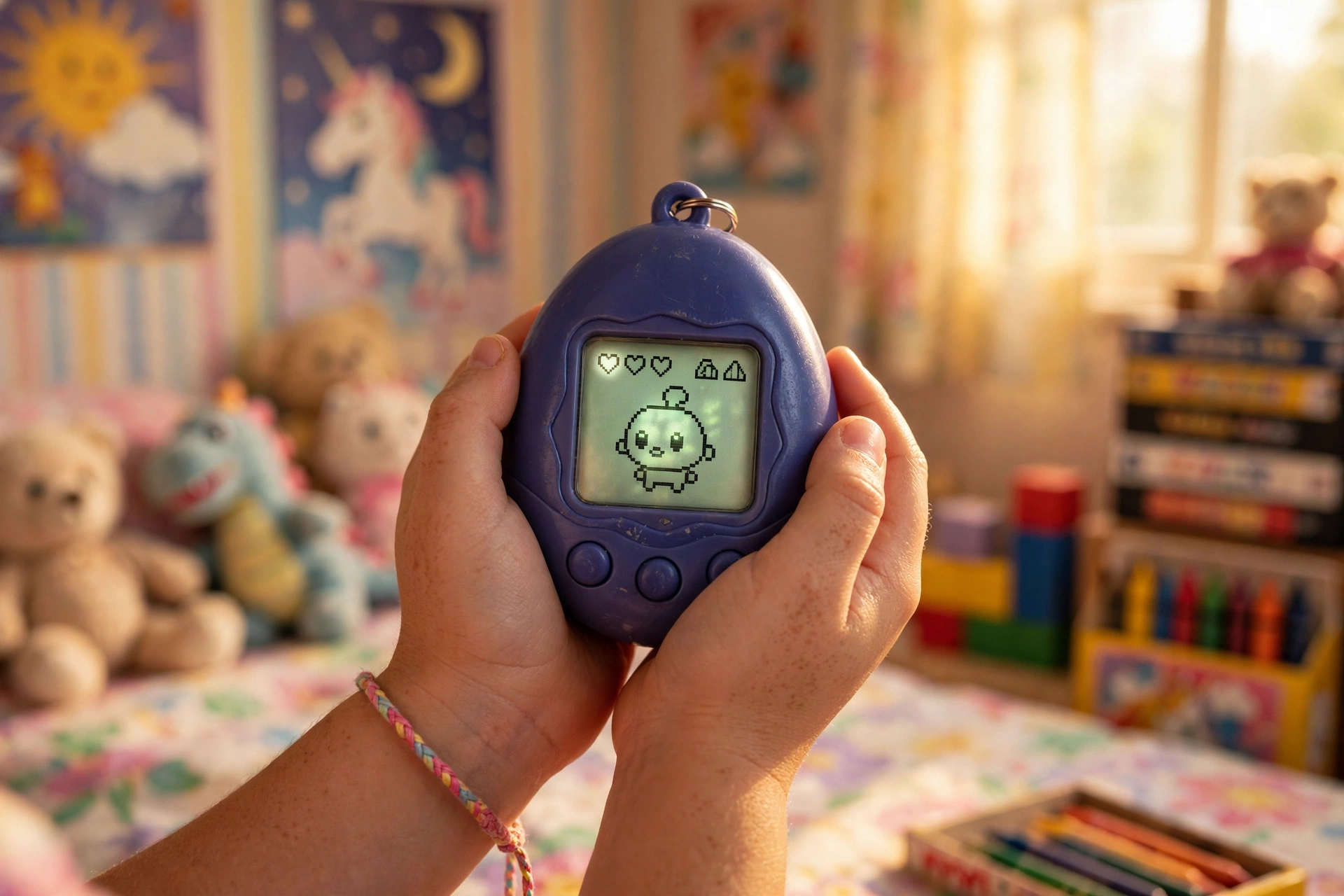
The genius of the Tamagotchi was how real it felt. The little blob on that gray-green screen wasn’t impressive by any technical standard, but the emotional bond was genuine. It needed you. It beeped for you. And when you did everything right, it grew, evolved, and eventually left — a tiny digital life cycle that taught an entire generation about responsibility years before any of them had a real pet or a real deadline.
The craze peaked in 1997, with imitators flooding the market — Giga Pets, Nano Pets, and countless knockoffs that beeped just as loudly. But the original Tamagotchi remained the gold standard, the one that started it all. Decades later, re-releases keep selling out, because nostalgia is a powerful thing — and because somewhere inside every 90s kid is a tiny voice that still hears that beep.
Why It Worked
The Tamagotchi succeeded because it merged two things kids loved: technology and caretaking. It was futuristic enough to feel like a gadget and needy enough to feel like a pet. It also created shared experience — everyone was raising their creatures at the same time, comparing growth stages, trading tips, and mourning losses together. It was social media before social media existed, compressed into a plastic egg.
Beanie Babies: The Plush Toys That Broke Grown Adults
If the Tamagotchi was a kid phenomenon, Beanie Babies were something stranger: a kid phenomenon that adults hijacked completely. Ty Inc.’s small, under-stuffed plush animals — filled with plastic pellets instead of traditional stuffing so they sat and posed like real animals — were supposed to be simple, affordable toys. What they became was one of the wildest speculative bubbles in history.
The formula was diabolical in its simplicity. Ty deliberately “retired” certain designs, creating artificial scarcity. Each Beanie came with a heart-shaped tag bearing a name, a birthday, and a little poem — and collectors learned that the tag’s condition mattered as much as the toy. Mint condition with a pristine tag? That was the holy grail. A creased tag could cut the “value” in half, at least according to the price guides that sprang up like mushrooms.
By the late 90s, the mania had escaped childhood entirely. Grown adults were lining up at toy stores, fighting over shipments, and paying hundreds — sometimes thousands — of dollars for rare Beanies like the Princess Diana memorial bear or the royal-blue Peanut the Elephant. People treated them as investments, stashing them in plastic cases and safety deposit boxes, convinced they were buying the next generation’s retirement fund.
Kids, meanwhile, just liked the cute animals. There was a sweet irony in it: children played with their Beanies — dragging them through mud, loving them threadbare — while adults kept theirs in climate-controlled darkness. Ask anyone who was there: the kid whose bear was missing an eye and half its stuffing was usually having more fun than the collector with the sealed display case.
The Bubble and the Aftermath
Like all bubbles, this one popped. By the early 2000s, the secondary market collapsed, and those “retirement funds” turned out to be bags of beans. But here’s the thing: the toys themselves never stopped being charming. The mania faded, but the affection remained — and today, a generation that once fought over tags now buys Beanies for their own kids, minus the investment delusions.
The Playground Crazes Nobody Saw Coming
Beyond the two giants, the 90s produced a conveyor belt of fads that burned bright and fast. These were the crazes that lived and died on the playground, powered entirely by kid-to-kid transmission.
Pogs and the Milk-Cap Economy
It started with cardboard milk caps from Hawaii and somehow became a global obsession. Pogs — those little printed discs — spawned an entire playground economy. Kids carried tubes of them, traded them like stocks, and played “slammer” games where you could win or lose your collection in a single lunch period. Schools banned them. Parents couldn’t understand them. Kids couldn’t get enough of them.
Yo-Yos, Slap Bracelets, and Gak
The decade loved a comeback: the yo-yo returned with ball-bearing axles and neon colors, turning every schoolyard into a trick competition. Slap bracelets went from fashion accessory to banned item in record time after a few snapped and scratched someone. And then there was Gak — Nickelodeon’s gloriously gross slime that made fart noises and stretched into impossible shapes. It stained everything it touched, and kids adored it for exactly that reason.
These fads shared a pattern: cheap, collectible, tradable, and just annoying enough to adults that owning them felt like a small rebellion. That was the secret sauce of 90s playground culture — the toys that drove teachers crazy were always the ones kids loved most.
Polly Pocket, Mighty Max, and the World in Your Pocket
One of the decade’s most brilliant ideas was miniaturization. Polly Pocket — the tiny doll in a compact that opened into a whole world — turned purses and pockets into playsets. Girls carried entire mansions, malls, and amusement parks in their backpacks, and the tiny scale made everything feel secret and precious.
Boys got their answer in Mighty Max: pocket-sized playsets full of monsters, traps, and horror-movie scenarios that fit in a jacket pocket. The Doom Zones were gloriously gruesome little dioramas — a haunted house, a spider’s lair, a shark’s mouth — each one a self-contained adventure you could take anywhere.
The appeal was obvious: these were toys that went where you went. On car trips, at grandparents’ houses, in the back of the classroom — your whole world, folded up small enough to hide in your hand. For kids of divorced parents, long commutes, or boring waiting rooms, pocket toys were nothing short of salvation.

The Electronic Revolution: Game Boy and Beyond
No tour of 90s toys is complete without the gray brick that changed everything. The Nintendo Game Boy, released in 1989 but truly dominant through the 90s, put an entire arcade in your hands. Tetris alone sold the system to a generation; Pokémon, arriving in 1998, turned it into a cultural earthquake.
Remember the accessories? The magnifying-glass light attachment that never quite worked, the link cable that let you battle friends, the chunky battery packs that made the whole thing weigh as much as a brick. It didn’t matter. Kids played Game Boy under blankets with flashlights, on long car rides, in waiting rooms — anywhere, everywhere, all the time.
The Game Boy mattered because it was the first toy that truly belonged to you alone. Board games needed opponents. TVs needed the living room. The Game Boy needed four AA batteries and your imagination. It was the beginning of personal, portable entertainment — the ancestor of every smartphone game kids play today.
Talkboy, Skip-It, and the Gadget Shelf
The decade also gave us the Talkboy tape recorder — made famous by a certain holiday movie about a kid left home alone — which let you record and slow down your voice to hilarious effect. Skip-It turned a ball on a string into a counting craze. HitClips squeezed 60 seconds of your favorite song into a tiny player. None of them lasted, but all of them are remembered fondly — because in the 90s, even the flops were fun.
Why 90s Toys Still Rule the Retro Market
Walk through any vintage toy fair today and you’ll see it: grown adults — the same kids who begged for these things in 1997 — now paying serious money for mint-condition Tamagotchis, first-run Beanies with perfect tags, and sealed boxes of Pogs. The retro toy market is booming, and 90s toys are its beating heart.
Why? Partly it’s scarcity — so many of these toys were played with, broken, and thrown away that surviving examples are genuinely rare. Partly it’s the design: 90s toys were colorful, tactile, and gloriously weird in ways that modern, screen-based toys rarely match. But mostly, it’s emotional. These were the toys of the last fully analog childhood, and owning one again feels like holding a piece of a simpler time.
The reissue market proves the point. Tamagotchi re-releases sell out. Polly Pocket got a modern revival. Even Beanie Babies keep coming back in new lines. Toy companies know what they’re doing: they’re not selling plastic and plush. They’re selling the feeling of being eight years old on Christmas morning — and that feeling, it turns out, never goes out of style.
If the 90s felt like a golden age of childhood itself, the toys were a big part of why — they were the props in a decade-long adventure that an entire generation shared. There’s a reason so many of us still feel like the 90s were home: everything we touched, played with, and begged for was part of one continuous, technicolor memory.
The Magic Was Never Really in the Toy
Here’s the truth that took thirty years to become clear: the toys were never the point. The point was the trading at lunch, the begging that actually worked, the Christmas morning chaos, the friend who let you play with their Game Boy on the bus. The toys were just the excuse — the real magic was the shared experience of being a kid at the exact same time as millions of other kids, all obsessed with the same beeping egg, the same bean-filled bear, the same cardboard discs.
That’s why the story of Beanie Babies still fascinates people who never owned one, and why Tamagotchi re-releases make headlines. These weren’t just products; they were cultural moments — the kind that define a generation and keep echoing decades later.
So the next time you see a Tamagotchi at a flea market or a bin of Beanie Babies at a garage sale, pick one up. Feel the weight of it. Listen for the beep. And remember the kid you were — the one who knew, with absolute certainty, that everyone at school has one, and that your life would simply not be complete without it. That kid was right about one thing, at least: those really were the golden days of play.
And if you ever spent your afternoons outside instead of in the toy aisle, you probably remember the street games and playground adventures just as fondly — or the Saturday morning cartoons that sold half these toys in the first place.
Where to Find 90s Toys Today: A Collector’s Field Guide
If this trip down memory lane has you itching to hold a piece of the past, here’s the good news: 90s toys are everywhere once you know where to look. Flea markets, estate sales, and vintage toy shops are treasure troves of 90s toys, from dusty Game Boys to bins of Beanie Babies. Online marketplaces have made tracking down specific 90s toys easier than ever, though prices for rare 90s toys in mint condition can be eye-watering.
Pingback: Classic Board Games: The Family Game Nights We Still Miss
Pingback: Old School Days: Chalkboards & Metal Lunchboxes
Pingback: Penny Candy: Remember When a Nickel (5 Cents) Bought a Bag Full of Happiness? The Lost Magic of Penny Candy and the Corner Store
Pingback: Unbelievable Pet Rock Craze: 1975's Craziest Toy Fad
Pingback: Toys 'R' Us Memories: The Geoffrey the Giraffe Days
Pingback: View-Master Memories: Amazing Click Through 3D Childhood
Pingback: Etch A Sketch Memories: Draw, Shake, Start Again
Pingback: Lite Brite Memories: Pegs, Light, and Glowing Art