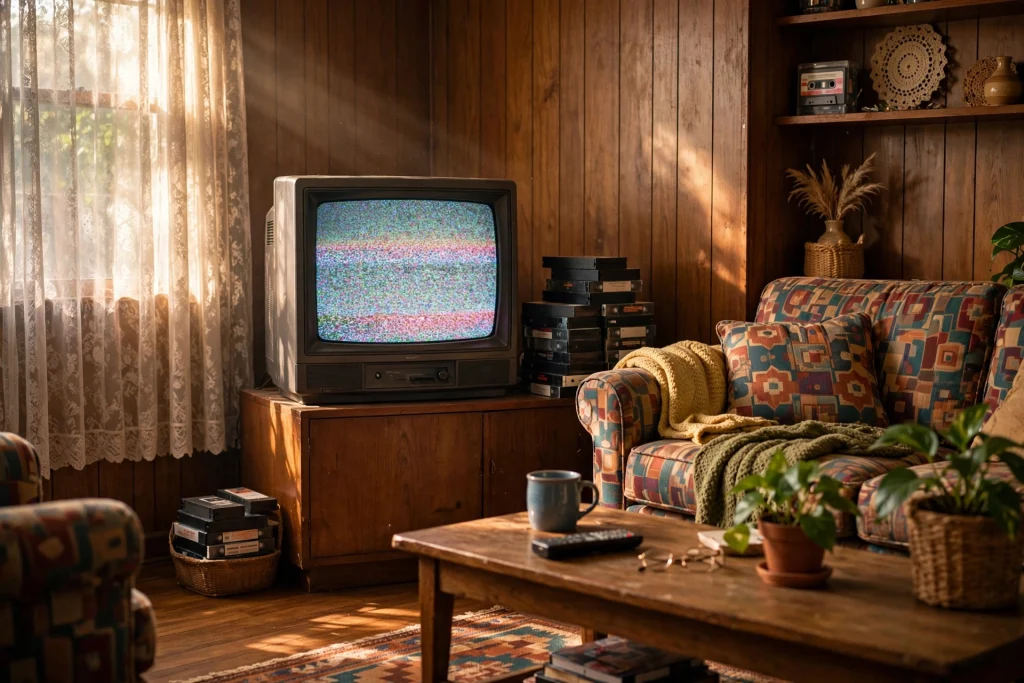
The doors opened, the bass hit your chest, and the whole world went neon. Step through the entrance of a roller skating rink on a Friday night in the nineties and you entered a different universe — one where the floor was a giant wooden oval, the ceiling wore a mirror ball like a crown, and everything glowed. The carpet in the lobby was loud enough to hurt your eyes, the air smelled like popcorn and rented leather, and somewhere behind the counter a DJ was already talking over the opening bars of the next song. For a couple of hours and the price of admission, you were untouchable.
Ask anyone who was there and they’ll tell you: the roller skating rink wasn’t just a place. It was a rite of passage. It was where you learned to be brave on eight wheels, where birthday parties became legends, where the shy kids found their speed and the confident ones found their audience. Long before social media turned every outing into content, the rink offered something better — a dark room, loud music, and a crowd of kids all moving in the same direction, laughing at the same falls, chasing the same feeling.
The rinks peaked decades ago, yet their glow hasn’t fully dimmed. The neon, the disco balls, the all-night skates — they live on in memory with a warmth that no new entertainment quite matches. This is a trip back to the place where childhood did laps until midnight.
Walking Into a Neon Universe
Every roller skating rink had its own geography, but you could navigate any of them blindfolded after one visit. The entrance led into a carpeted lobby with that unmistakable pattern — swirls and lightning bolts in colors that only existed in the eighties and nineties. To one side, the rental counter, where a wall of quad skates waited in rows like soldiers. To the other, the snack bar, glowing with fluorescent light and promising nachos, slushies, and candy that your parents would never buy at home. Beyond it all, through wide doorways, the floor itself: a vast polished oval ringed by a low wall, lit by black lights, strobes, and the slow-turning mirror ball hanging from the ceiling.
The atmosphere was engineered for euphoria. The lights dimmed as the music rose. Laser dots crawled across the carpet while colored spotlights swept the floor. When the DJ killed the white lights and the black lights took over, white shoelaces and bright T-shirts glowed like they were radioactive, and the whole roller skating rink looked like the inside of a jukebox. The aesthetic owed everything to the decade that built it — the same neon-soaked 80s culture that lit up arcades and mall food courts had found its purest expression here, under one spinning ball of mirrors.
There was a beautiful democracy to the roller skating rink floor. Nobody cared what sneakers you wore or what your grades were. On skates, everyone started equal — wobbly, grabbing the wall, laughing at themselves. The low barrier to entry was the whole point. You didn’t need to be an athlete to belong. You just needed to be willing to fall down in front of people and get back up, and the music made even the falling feel fun.
Quad Skates: The Four-Wheel Freedom Machine
Before inline skates took over in the mid-nineties, the king of the roller skating rink was the quad skate — four wheels in a rectangle, a chunky rubber toe stop on the front, and a boot that laced up the ankle like a little leather fortress. The classic rental pair was a white or tan boot, scuffed by a thousand previous skaters, with wheels in colors that screamed under black light. Strap them on and your feet became a vehicle. You didn’t walk to the roller skating rink floor; you rolled, and the rolling changed everything about how the night felt.
The rental counter was a ritual all its own. You handed over your shoes — the ultimate act of trust — and received your size in return, sometimes after a negotiation with the kid behind the counter who insisted your street shoe size translated directly to skate size. Then came the lacing: tight enough to hold, loose enough to breathe. Veterans knew to double-knot. Beginners learned the hard way, one lace at a time, sitting on those long carpeted benches while the music thumped through the wall.
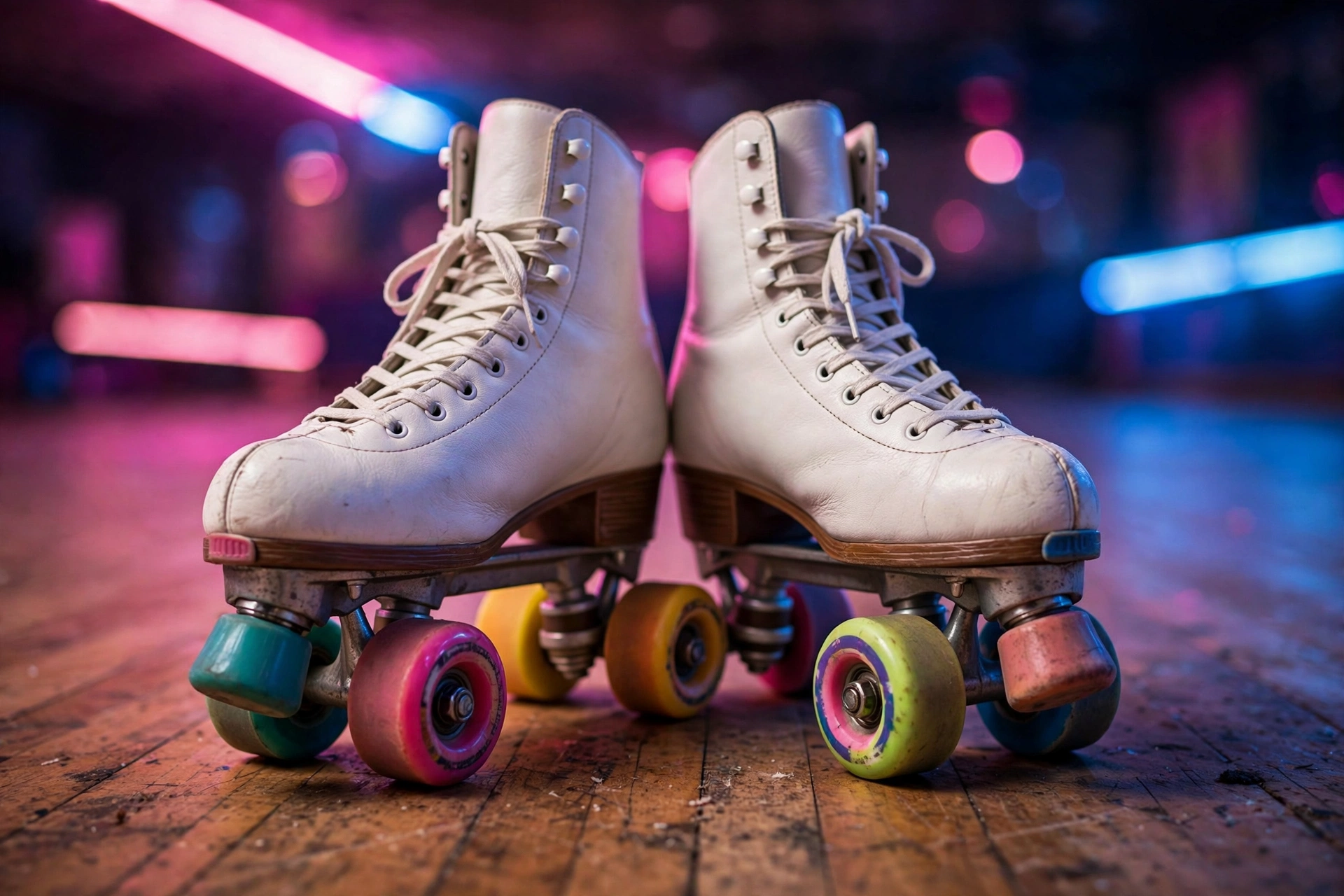
Owning your own skates was a status symbol, and the serious rink kids had them — custom boots, colored wheels, sometimes even pom-poms dangling from the laces. The stopper was the skater’s secret weapon: drag it to stop, use it to pivot, and if you were really good, to launch into the little hop-turns that made beginners stare. Learning to stop without grabbing the wall was the rink’s first real graduation. The second was skating backwards. The third was the limbo, but we’ll get to that.
The physics of quads made the rink what it was. Four wheels gave you stability that a single blade never could, which meant the floor filled with kids who would never have dared an ice rink. The toe stop made stopping intuitive. The wide wheelbase made turning forgiving. The whole design said: come on in, the falling won’t be that bad. And it usually wasn’t — though the bruised knees told their own stories on Monday morning.
The Wall Was Everyone’s First Friend
Every beginner’s journey started the same way: one hand glued to the padded wall, inching along like a climber on a cliff face. Nobody judged. The wall was crowded with first-timers, and the veterans zoomed past with a nod of encouragement — or at least a sympathetic grin. Letting go of the wall was the rink’s defining act of courage, and the moment you did it, the whole floor seemed to cheer.
There was even etiquette to it. You skated in the designated direction — always — and the fast lane ran on the outside while beginners hugged the inside. Cross-traffic was frowned upon. Cutting across the floor during a couples skate was a rookie mistake you’d only make once, because the DJ would announce it to the entire building.
Disco Skating and the Soundtrack of Saturday Night
The roller skating rink was, at its heart, a dance floor on wheels, and the music made it. The DJ booth sat high above the floor like a captain’s bridge, and the DJ was a minor celebrity — the voice of the night, the keeper of the vibe. Between songs came the announcements: birthday shout-outs, the rules of the next game, the sacred call of “all skate” that sent everyone pouring onto the floor. The playlist was a time capsule: disco anthems bleeding into funk, funk into pop, pop into whatever the current radio hits were, all of it chosen for one quality — skatesability.
Certain songs belonged to the roller skating rink the way the floor belonged to the skaters. Up-tempo tracks with a driving beat turned the whole oval into a rolling parade. Slow songs transformed it into something else entirely — the lights dimmed to a romantic glow, and couples skate began, which was exactly as thrilling and terrifying as it sounds if you were twelve. The disco ball earned its keep during those numbers, scattering a thousand points of light across the floor while the mirror tiles turned every skater into a constellation.
The themed nights were legendary. Disco skate nights, oldies nights, backwards skate nights, all-night skates that ran until the small hours — each had its own crowd and its own energy. The all-night skate was the holy grail: doors open late, music loud, pizza at midnight, and the understanding that you’d be exhausted at school on Monday and it would be worth it. These nights turned a local roller skating rink into a temporary city of kids, united by wheels and volume.
The DJ Ran the Whole Show
Forget the manager — the DJ was the real authority. The DJ decided when the floor opened, when the games started, and whose birthday got the spotlight. A good DJ could read the room like a book: speeding up the tempo when energy dipped, dropping a slow song when the couples needed their moment, and knowing exactly when to unleash the limbo stick. The best DJs had catchphrases, regulars who requested songs by name, and the power to clear the floor with a single announcement.
The games the DJ ran were the night’s punctuation marks. The hokey pokey on skates. The dice game, where numbered skaters got eliminated round by round. The four-corners game, with everyone scrambling to a corner when the music stopped. These weren’t sophisticated entertainment, and that was the point — they were simple, physical, and hilarious, and they turned a crowd of strangers into a single laughing organism.
Limbo Contests, Speed Skates and Rink Glory
No roller skating rink tradition was more sacred than the limbo. The DJ would drag out the pole — or sometimes just a broomstick — and the floor would clear in anticipation. How low could you go? On skates, bent nearly double, rolling under a bar that dropped lower with every round, while the crowd chanted and the music pulsed. The winners weren’t always the most athletic kids; they were the ones with no fear of falling, the ones willing to fold themselves in half at speed for glory. Limbo champions were rink royalty, remembered for weeks.
Then there were the speed skates — the fastest kids, crouched low, flying around the oval in a blur while everyone else pressed against the wall to watch. Speed skating on quads was its own art: the low stance, the crossover turns, the way the best skaters seemed to barely touch the floor. Races settled playground hierarchies more definitively than any argument. The kid who won the speed skate on Friday night walked different on Monday morning.
For the truly devoted, there was artistic skating — the rink’s quiet elite. Some rinks hosted figure-skating-style clubs that practiced jumps, spins, and choreographed routines on quad skates, competing in regional and national events. Watching an artistic skater land a jump on four wheels, in a sequined outfit, under a disco ball, was to understand that this whole culture had depths most casual skaters never suspected. The rink contained multitudes.
The Snack Bar and the Arcade Corner
Every roller skating rink needed a refueling station, and the snack bar delivered. The menu was a greatest-hits of nineties kid cuisine: nachos with the neon cheese that defied all laws of dairy, giant pretzels with salt you could see from across the room, slushies in colors not found in nature, and pizza by the slice that tasted better than it had any right to — probably because you’d earned it with an hour of skating. The snack bar was also neutral territory: skates off (or at least, wheels parked), everyone equal, everyone sticky.
The economics were simple and brilliant. Admission got you in the door, but the snack bar was where the rink made its money — and kids spent theirs freely, because rink nachos were a food group. Birthday parties got their own tables, decorated with paper tablecloths and plastic cups, where the cake would arrive after the skating session. The smell of the snack bar — butter, sugar, and hot plastic — is one of the most reliable time machines in existence. One whiff of artificial cheese and you’re twelve again, skates unlaced, feet aching in the best way.
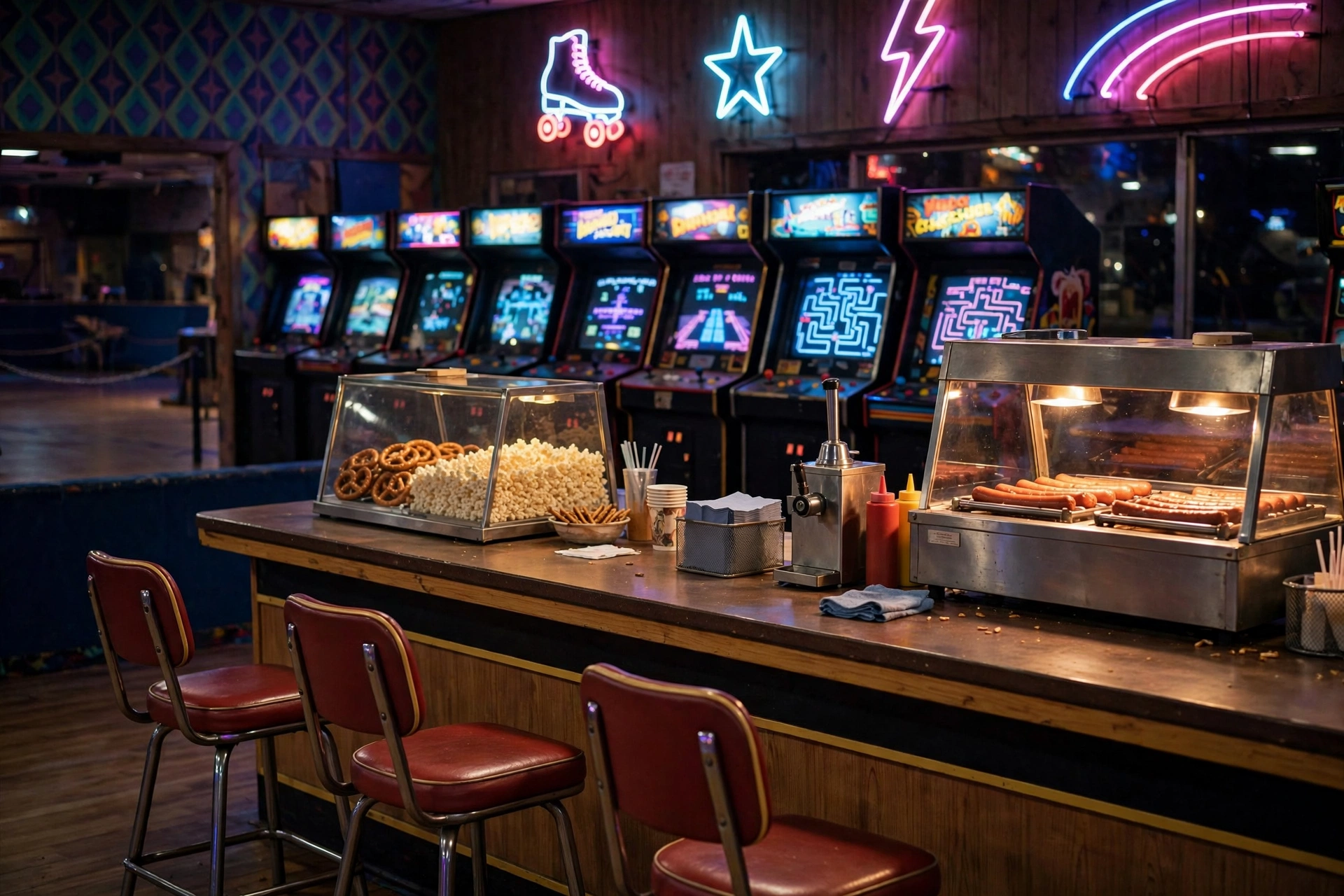
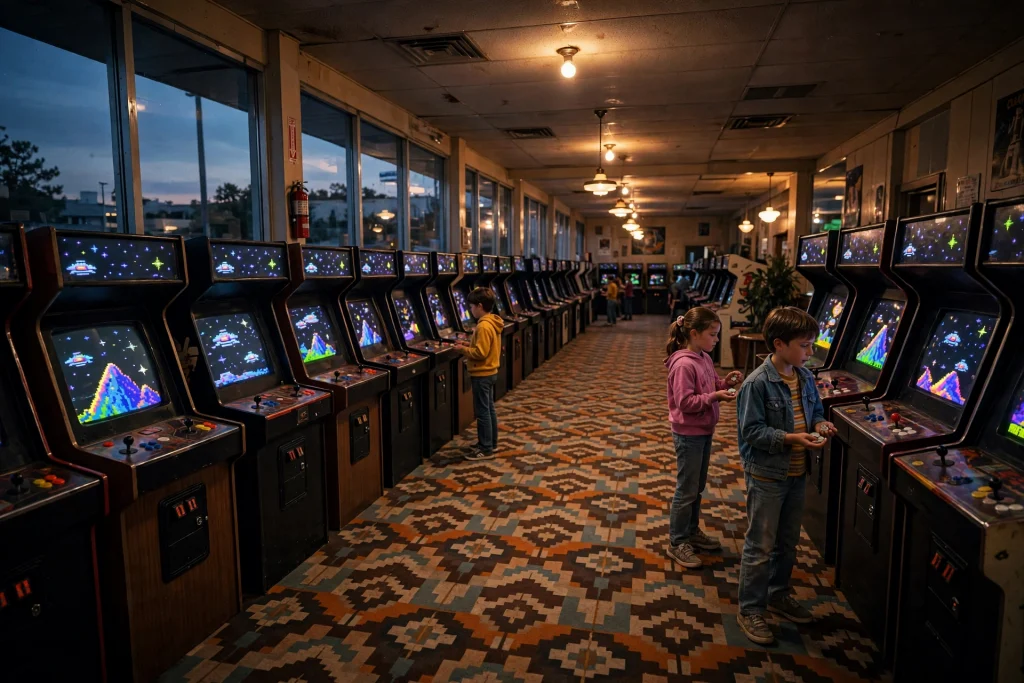
And then, tucked in a corner or lining a hallway, the arcade machines — glowing sentinels of the rink’s second economy. While your feet recovered, your quarters went to work. The arcade corner was the rink’s waiting room and its afterparty: a place to cool down, show off at a different kind of game, and kill time while your parents were late for pickup. The machines hummed the same electronic hymn as every childhood hangout of the era, a reminder that the nineties ran on tokens and high scores as much as it ran on wheels.
The carpet in the arcade corner told its own story — worn flat by a million skates rolling over it, sticky in places best not examined. Nobody cared. The whole rink was gloriously, unapologetically a little grimy, and that was part of the charm. It wasn’t a theme park; it was a clubhouse. The scuffs on the floor, the initials carved into the benches, the permanent smell of popcorn in the curtains — these were the patina of a thousand perfect nights.
Birthday Parties on Wheels
If you grew up in the eighties or nineties, you attended a roller skating rink birthday party. Probably several. The formula was perfected to a science: the birthday kid got a crown or a sash, the group got a reserved table, the DJ gave a booming shout-out, and everyone got cake after the skate session. The invitations went out at school, the RSVPs were a social barometer, and the party itself was two hours of glorious chaos.
The birthday skate had its own rituals. The birthday kid led a special lap while everyone clapped. Sometimes the DJ let them pick a song. The cake — always from the rink’s own kitchen or a bakery box in the back — was cut at the party table while skates dangled off feet too tired to stand. Then came the goody bags, and the slow, happy migration to the parking lot where parents idled in station wagons. It was the default celebration of a generation, as standard as the cake itself.
What made rink parties special was that they solved the hardest problem of kid parties: keeping everyone entertained. No awkward lulls, no forced games in a living room. The floor did the entertaining. Even the kids who didn’t know the birthday kid well had a great time, because the rink belonged to everyone. Parents loved it for the same reason — drop off, pick up, done. The rink was the original turnkey party venue, decades before the concept had a name.
What You Wore Mattered
Rink fashion was its own language. The serious skaters had the look down: high socks, shorts or stirrup pants, and the brightest T-shirt they owned — because under black light, brightness was currency. Neon ruled. Day-glo laces, fluorescent wristbands, and light-up accessories turned skaters into moving constellations. The whole aesthetic was a cousin of the bold 80s and 90s fashion that defined the era — color as confidence, brightness as belonging.
And then there were the girls with the pom-poms on their skates, the boys with their caps worn backwards, the kids who’d clearly planned their rink outfit for a week. The mirror ball didn’t care about labels, but the kids did — and the rink was a runway as much as a racetrack. Looking good while wobbling was a skill in itself.
Why the Roller Skating Rink Faded — and Why the Feeling Never Left
The golden age of the roller skating rink ran roughly from the seventies through the nineties, with the disco era of the late seventies giving the culture its defining look — the mirror balls, the light shows, the Saturday-night-fever energy on eight wheels. Thousands of rinks operated across America at the peak, and the business model was beautifully simple: cheap admission, skate rentals, snack bar profits, and birthday parties every weekend. For a while, it seemed like the rinks would last forever.
They didn’t, quite. The rise of home entertainment — video games, cable TV, and eventually the internet — gave kids competing ways to spend a Friday night. Inline skates shifted the culture outdoors, to skate parks and bike paths. Real estate pressures closed beloved local rinks, and each closure felt like a small death in its town — the kind mourned in newspaper features and reunion Facebook groups. If you want the full history of how the sport grew from nineteenth-century rinks to the disco era and beyond, the roller skating entry on Wikipedia traces the whole arc.
But here’s the thing about the rinks: they never fully died. They adapted. Adult skate nights brought back the grown-up kids of the eighties and nineties, now skating to throwback playlists with their own children wobbling beside them. Roller derby gave the sport a fierce new identity. The pandemic years sparked a genuine roller-skating revival, with skate sales surging and rinks reporting packed floors of nostalgic millennials. The disco ball, it turns out, was just waiting for its cue.
And the feeling never needed a revival, because it never left. It’s still there in every dark room with a mirror ball, in every song that makes your feet move before your brain catches up, in every birthday party where the kids are having too much fun to check a phone. The roller skating rink taught a generation something simple and lasting: joy is better shared, music is better loud, and the best nights are the ones where everybody’s moving in the same direction. Lace up, let go of the wall, and roll. The floor is still waiting.