Fashion is a time machine you can wear, and no decades prove it like the eighties and nineties. These were years when clothes didn’t whisper — they announced, loudly and proudly, exactly who you were. Neon screamed from windbreakers. Shoulder pads turned silhouettes into architecture. Denim went everywhere, with everything, all at once. Looking back at 80s and 90s fashion is like flipping through a yearbook written in fabric: every trend is a timestamp, every outfit a memory you can almost touch.
What made these decades special wasn’t just the boldness — it was the democracy of it. Fashion wasn’t handed down from runways to the masses; it bubbled up from music videos, sitcoms, playgrounds, and malls. Kids invented trends by raiding closets and swapping accessories. A generation dressed itself in real time, making it up as it went along, and the results were gloriously, unapologetically much.
Ask anyone who lived through it about their most regretted outfit, and watch them light up before they even answer. The regret is real, but so is the affection. These were clothes with personality — loud, experimental, and completely unafraid. In an era of minimalist wardrobes and algorithm-approved aesthetics, there’s something almost rebellious about remembering when getting dressed was an act of joyful excess.
Neon: The Eighties Wore Highlighter Colors
The eighties didn’t do subtle, and neon was the proof. Electric pink, acid green, blazing orange — colors so bright they seemed to vibrate. Athletic wear led the charge: windbreakers in retina-searing hues, leg warmers in clashing brights, headbands that matched nothing and everything. The gym-to-street pipeline was wide open, and everyone walked through it daily.
Neon wasn’t just a color choice; it was a philosophy. The decade believed in visibility, in standing out, in being seen from across the parking lot. Muted tones were for people who’d given up. If your outfit didn’t require sunglasses indoors, were you even trying? The aesthetic matched the era’s soundtrack — the synth-heavy, big-chorus energy of eighties culture — and its optimism: the future was bright, so you’d better dress like it.
The science of it was simple: new synthetic dyes and fabrics made colors possible that hadn’t existed in clothing before, and the decade used them all at once. Looking at photos now, the neon era seems almost psychedelic — but at the time, it just looked like Saturday. Everyone glowed a little. That was the point.
Shoulder Pads: Architecture You Could Wear
Somewhere in the mid-eighties, shoulders started migrating outward. Shoulder pads — foam inserts that turned every blazer into a linebacker’s uniform — became the defining silhouette of the decade. Women’s power suits borrowed the broad-shouldered authority of menswear. Men’s jackets got boxier. Everyone’s frame got bigger, bolder, more present.
The look was about power, consciously or not. The eighties were the decade of the career woman, the power lunch, the corner office — and the clothes armored their wearers for the part. Big shoulders meant business. They photographed dramatically. They turned a hallway walk into a runway moment. Even teenagers got in on it, with oversized blazers swiped from parents’ closets becoming ironic-cool long before irony was the default.
Like all strong silhouettes, shoulder pads eventually became a punchline — but that’s the fate of anything truly distinctive. The decades that play it safe are forgotten. The decades with shoulder pads get documentaries. There’s a lesson in there about commitment: the eighties committed to the bit, all the way to the deltoids.
Denim Everything: The Fabric That Ate the Wardrobe
If the eighties belonged to neon, the nineties belonged to denim — and not just jeans. Denim jackets. Denim shirts. Denim skirts, denim vests, denim overalls, denim-on-denim in defiance of every rule the eighties had established. The Canadian tuxedo stopped being a joke and started being a lifestyle. If it could be made of denim, someone was wearing three of them at once.
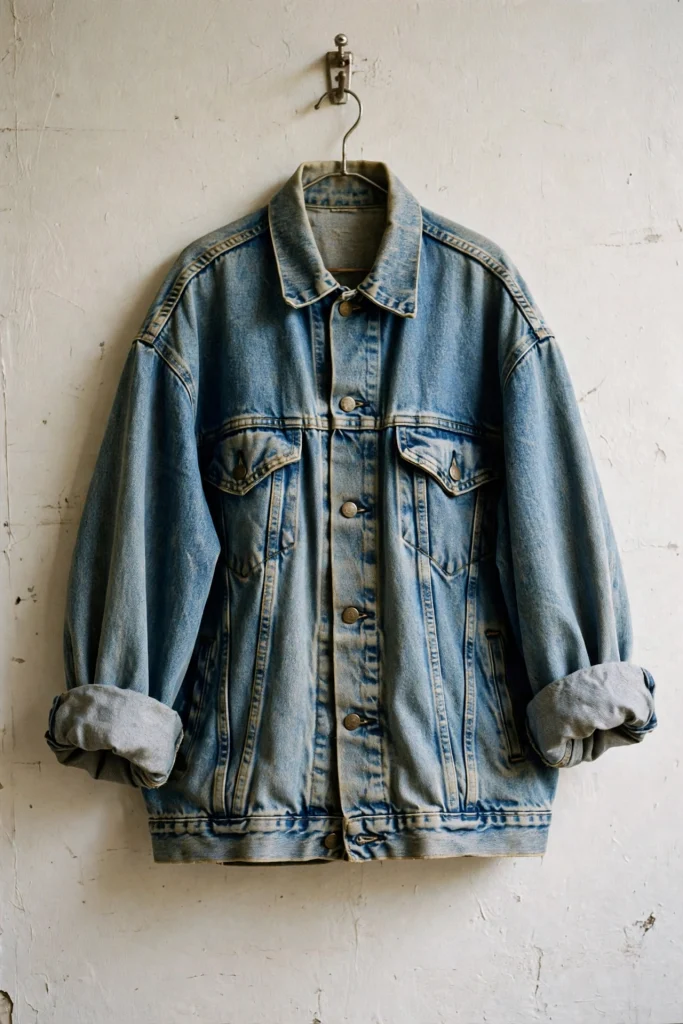
The denim jacket was the era’s true uniform. Oversized, stonewashed, sleeves rolled to the elbow — it went with everything and belonged to everyone. It was customized with pins, patches, and embroidery; it was borrowed, lent, and never quite returned. A good denim jacket aged like a story, each fade mark a chapter. Ask anyone who had one, and they can still describe it: the weight, the fit, the exact shade of blue.
Overalls deserve their own verse in this hymn. Worn with one strap undone — always one strap undone, a styling choice so universal it might as well have been law — they were the official uniform of carefree youth. They were practical, comfortable, and effortlessly cool in the way only the nineties could manage: trying hard to look like you weren’t trying at all.
The Flannel Chapter
No tour of nineties fashion is complete without flannel. Tied around waists, layered over tees, worn open over everything — the flannel shirt was the grunge era’s flag, and it flew everywhere. It was thrift-store chic before thrifting was cool: cheap, comfortable, and perfectly calibrated to signal that you cared about music more than appearances (while looking great doing it).
Flannel’s genius was its versatility. It dressed down anything, warmed up everything, and looked good rumpled — which, for teenagers, was the whole point. It was rebellion you could buy for four dollars, and a generation did.
Scrunchies, Slap Bracelets, and the Accessory Explosion
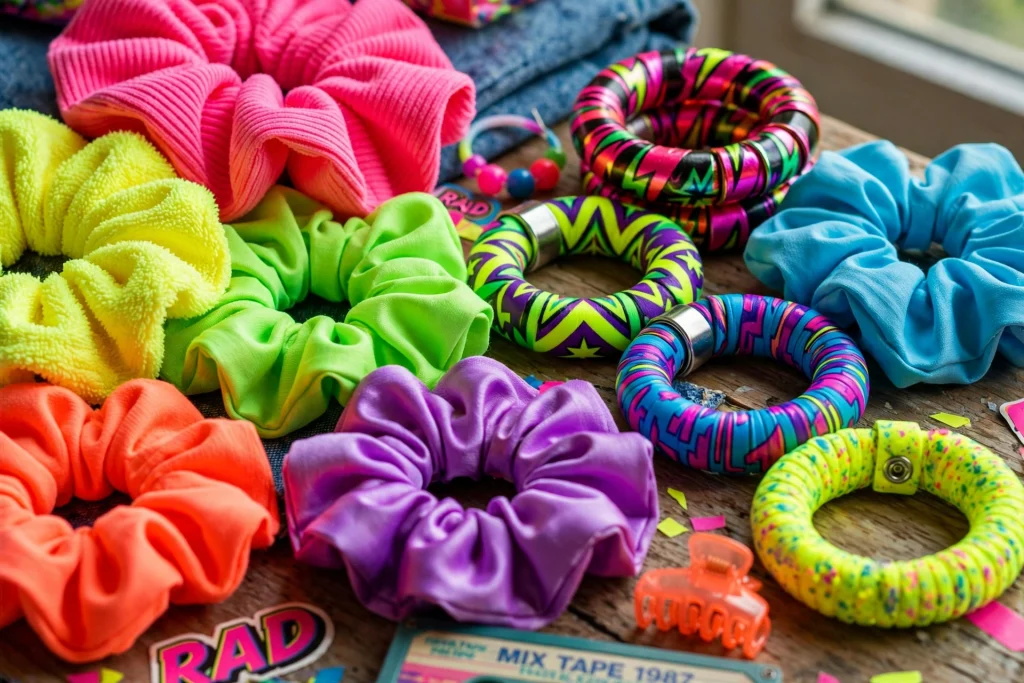
The decades’ real playground was accessories. Scrunchies — those fabric-covered elastic hair ties — came in every color and pattern imaginable, worn on wrists as much as in hair. They were practical, pretty, and collectible, the rare accessory that was genuinely useful. A wrist stacked with scrunchies was a fashion statement and a backup plan.
Slap bracelets were pure playground currency: straighten the ruler-like band, slap it on your wrist, and physics did the rest, curling it into a bracelet with a deeply satisfying thwack. They were banned in some schools (allegedly over safety, really over the irresistible urge to slap them on everything), which only made them more desirable. Every kid wanted the full set.
The accessory list ran long: jelly shoes in translucent candy colors, friendship bracelets woven in study hall, chokers — the thin black tattoo-style bands that ringed a million necks — bucket hats, tiny backpacks worn as purses. Music videos were the catalog: the rock anthems of the era came with looks worth copying, and teenagers copied them faithfully. Each accessory was cheap, each one was expressive, and together they let teenagers build entire identities from mall-kiosk parts. It was fashion as collage, and everyone was an artist.
Windbreakers and Tracksuits: Athleisure Before It Had a Name
Decades before “athleisure” entered the dictionary, the windbreaker ruled. Those swishy, rustling nylon jackets — in color-blocked panels of teal, purple, and black — were the sound of the era as much as the look. You could hear someone coming down the hallway before you saw them. The swish was the soundtrack of the nineties school corridor.
Tracksuits completed the picture: matching tops and bottoms in velour or nylon, worn everywhere except actual tracks. They were comfort as fashion, sportiness as lifestyle. The look said you could break into a sprint at any moment — even if the most athletic thing you did all day was sprint to the TV for the commercial break. It didn’t matter. The tracksuit was a vibe, and the vibe was effortless.
The Mall Was the Runway
You can’t understand the fashion without the place where it was bought: the mall. On Friday nights and Saturday afternoons, teenagers descended on shopping centers the way earlier generations had descended on dance halls. The mall was social life with a food court — and the clothing stores were its galleries. Window shopping was a competitive sport, and the mannequins were the trend forecasters.
Every mall had its hierarchy of stores, and everyone knew the map by heart. There were the anchor department stores where parents shopped, and then the junior sections and specialty shops where teenagers actually lived. The fitting room was a theater: friends waited outside while you modeled, delivering verdicts with brutal honesty. Yes. No. Maybe with different shoes. Shopping was never solo — it was a group expedition, and the spoils were displayed like trophies.
The catalogs mattered too. Those thick, glossy mail-order books that arrived seasonally were pored over like sacred texts, pages dog-eared, outfits circled in pen. Ordering by mail took weeks, which made the arrival of a package feel like Christmas. And for families far from big malls, the catalog was fashion — the only window into what everyone else was wearing, studied carefully and imitated with whatever the local stores carried.
Sales were events. The after-Christmas sales, the back-to-school rush — these were the fashion calendar’s high holidays. Everyone knew the best stuff went fast, and the early bird got the windbreaker. There was strategy involved: which store first, what size to grab, how to convince a parent that this one jacket was a genuine necessity. A generation learned negotiation not in business school but in the junior department, making the case for acid-wash.
Hair Was Half the Outfit
You can’t discuss the fashion without the hair, because in these decades, hair was fashion. The eighties went big — perms, teased volume, bangs with structural ambitions. Hairspray was a load-bearing material. The higher the hair, the closer to heaven, went the saying, and a generation took it as engineering guidance.
The nineties countered with its own icons: the layered cut everyone asked for by a sitcom character’s name, the middle part, the butterfly clips, the frosted tips that caught the light in school hallways. Hair was identity, tribe, and billboard all at once. Changing your hair meant changing your whole presentation — and teenagers changed it constantly, with drugstore dye and borrowed straighteners and endless experimentation.
And then there were the tools of the trade, which were fashion objects in their own right. The crimping iron that turned straight hair into zigzag art. The banana clip that gathered everything into a fanned cascade. The endless varieties of gel, mousse, and spray — a whole chemistry set devoted to defying gravity. Bathroom counters were laboratories, and every morning was an experiment. Some experiments failed spectacularly, and those failures are preserved in school photos that remain, to this day, extremely funny.
Why 80s and 90s Fashion Keeps Coming Back
Here’s the thing about 80s and 90s fashion: it never really left. The trends cycle back every twenty years like clockwork, and the current revival — the baggy jeans, the tiny sunglasses, the windbreakers, the scrunchies on wrists — is just the latest orbit. What was once regretted is now curated. The thrift stores are full of the exact jackets people donated in embarrassment a decade ago, now priced as treasures.
The revival makes sense. These decades dressed with joy — with color, with risk, with a willingness to look ridiculous in pursuit of looking great. Modern fashion often feels optimized, focus-grouped, safe. The eighties and nineties were none of those things, and that’s exactly why they endure. They remind us that clothes are supposed to be fun.
The 1990s in fashion are now studied like art history, which would have horrified the teenagers living it — they were just getting dressed. But that’s how it works: the everyday becomes the iconic once enough time passes. The windbreaker swishes on. The denim fades beautifully. And somewhere, in a drawer or a yearbook, the scrunchie collection waits for its next comeback — which, given the cycle, should be any day now.
So here’s to the decades that dressed loud. To the neon, the pads, the denim, the flannel. To the accessories that jingled and swished and slapped. To the mall trips, the catalog circles, and the fitting-room verdicts. Getting dressed used to be an adventure shared with friends — and for anyone who was there, the photos prove it was worth every single regretted outfit.
Pingback: Roller Skating Rinks: 7 Magical Neon Nights, Disco Balls & All-Night Skates