Close your eyes for a second and listen. There’s a hiss of static, a sharp crackle of the speaker, and then a voice floats out of the dark: “Breaker breaker one-nine… anybody got their ears on out there?” If your chest just tightened a little, welcome home. These CB radio memories are for everyone who ever twisted a squelch knob at midnight just to feel a little less alone in the world.
For a few wild years in the middle of the 1970s, millions of ordinary Americans lived a secret second life on the airwaves. Accountants by day became “Night Owl” by night. Housewives chatted with truckers rolling through three states away. Kids begged their parents for a radio the way kids today beg for a phone. It was chaotic, it was crackly, and honestly? It was magic.
So pour yourself some coffee, turn the volume up in your memory, and let’s ride back down the highway to the decade when everybody had a handle and nobody was a stranger for long.
It Started With a Crackle: A Night I’ll Never Forget
I was maybe twelve the first time I held a CB microphone, and my hand was shaking so badly I nearly dropped it. It was a warm summer night in 1976, and my dad’s friend Harlan had his base station set up on a workbench in his garage — a big silver box with a glowing dial, a desk mic on a stand, and a power supply that hummed like it was alive. The whole garage smelled of motor oil and cut grass, and through the open door you could hear crickets going absolutely wild.
“Go ahead, say somethin’,” Harlan said, grinning. So I pressed the button, and the little red light blinked on, and every word I’d planned evaporated. What came out was something like, “Uh… breaker… this is… uh…” Harlan laughed so hard he had to sit down. Then he leaned in and said, calm as anything, “This here’s Short Stack, lookin’ for a radio check on one-nine. Anybody copy?” And just like that — psshhk — a voice came back out of nowhere: “Short Stack, you got the Mud Duck out of Tulsa, and you’re comin’ in loud and proud, good buddy.”
I can still feel that moment in my stomach. Somewhere out there in the dark, a real person — a truck driver crossing Oklahoma — had heard me. Not on a telephone. Not through the mail. Through the air. I was hooked before the static even faded.
Hold onto that feeling — the story of how CB radio took over America is even wilder than that night in Harlan’s garage.
How the CB Craze Took Over America
Here’s the thing most people forget: CB radio wasn’t new in the 70s. It had been around since the 1940s, quietly serving truckers, farmers, and hobbyists — a practical tool for folks who needed to talk across distances. If you’re curious about the technical side, here’s a good plain-English explanation of what CB radio actually is and how it works.
So what lit the fuse? Two words: the oil crisis. When the 1973 energy crisis hit, gas lines snaked around blocks and fuel was suddenly precious. Then the government imposed a nationwide 55 mph speed limit, and truckers — many paid by the mile — watched their paychecks shrink with every slowed-down hour. Their answer was already bolted under their dashboards. They used their CBs to find stations that still had fuel, to warn each other about speed traps, and to organize convoys and protests. The radio went from a tool to a lifeline to a movement, almost overnight.
And the rest of America was watching. Solid-state electronics had made the radios smaller, cheaper, and easier to install — no engineering degree required. Suddenly they were stacked to the ceiling at RadioShack, Sears, and every truck stop on the interstate. Dads mounted them under the dash of the family station wagon. Teenagers saved up lawn-mowing money for handhelds. At its peak, roughly 1975 to 1978, it felt like everybody was on the air — crowded, crackly, rowdy, and the most fun you could have sitting still.
When “Convoy” and the Silver Screen Made It a Phenomenon
Then pop culture grabbed the whole thing and turned the volume to eleven. In 1975, a novelty record by C.W. McCall called “Convoy” — a spoken-word CB conversation between truckers with the unforgettable “Rubber Duck” leading a thousand-truck convoy — shot to number one. You couldn’t escape it. Grocery stores, school buses, barbershops: everywhere you went, somebody was drawling “pig pen, this here’s the Rubber Duck.” Kids who had never seen a semi-truck up close were suddenly fluent in trucker talk.
And just when the fever might have cooled, 1977 delivered Smokey and the Bandit. Burt Reynolds grinning behind the wheel of that black Trans Am, Jerry Reed riding shotgun, Jackie Gleason bellowing as the sheriff — the whole movie ran on CB chatter, and it turned truckers into folk heroes. It was the same mid-70s wave of pure fun that gave us the pet rock craze: silly, joyful, and impossible to resist. If you want the full timeline of films, songs, and shows that rode the wave, the history of the CB craze reads like a greatest-hits album of the decade.
The Secret Language of the Airwaves
Learning CB lingo felt like being handed the password to a secret club. You didn’t just talk on a CB — you performed a whole character. “Breaker breaker” was how you politely elbowed your way into a conversation. A “smokey” was a police officer, and a “bear in the air” meant a helicopter was watching the highway. The “front door” was the lead vehicle in a convoy, the “back door” brought up the rear, and when somebody told you to “put the hammer down,” you’d better believe they meant go. Asking “got your ears on?” simply meant: are you listening, friend?
Everyone was in on it together — a grandmother in Ohio and a trucker in Texas spoke the same language, absorbed through the speaker like lyrics to a song you never meant to learn.
Ten-Codes: “10-4” and Friends
The ten-codes were the backbone of it all, and honestly, “10-4” might be the most famous two syllables of the entire decade. It meant OK — message received and understood — and people started saying it in real life, at the dinner table, on the playground, everywhere. Then there was “10-20” for your location (“what’s your twenty?”), “10-33” for an emergency, and the wonderfully discreet “10-100,” which was the polite fiction everyone used for a bathroom break. You didn’t need a license to learn them. You didn’t even need a radio. If you were alive in 1976, you knew the codes the way kids today know texting abbreviations — by pure cultural osmosis.
Handles: Who Were You on the Air?
But the real genius of CB culture was the handle — your on-air nickname, your alter ego, the person you got to be when the red transmit light blinked on. “Silver Fox.” “Night Owl.” “Cotton Picker.” “Mud Duck.” Choosing your handle was a sacred ritual. It said everything about who you were — or who you wished you were. Shy people became bold. Ordinary folks became legends, at least across a fifteen-mile radius.
And it wasn’t just regular folks playing the game. Even the First Lady got in on the fun — Betty Ford’s CB handle was reportedly “First Mama.” The beloved cartoon voice actor Mel Blanc sometimes signed on as “Bugs” or “Daffy,” doing the voices for delighted strangers over the Los Angeles airwaves. Think about that for a second: you could be driving home from work, key up the mic, and end up chatting with Bugs Bunny himself. What a time to be alive.
Channel 19: The Trucker’s Highway in the Sky
Of the 40 channels on the dial — expanded from the original 23 in 1977 to handle the crush of new users — one channel mattered more than all the rest: channel 19. That was the trucker’s channel, the living, breathing pulse of the American highway. Tune in at any hour and you’d hear the real-time news of the road: where the smokies were sitting, which weigh stations were open, where the coffee was hot and the pie was fresh. It was traffic reports, weather warnings, and comedy club rolled into one, broadcast by people who lived their lives at 55 miles an hour.
Channel 9, meanwhile, was sacred ground — reserved for emergencies and roadside assistance. Everybody knew it, everybody respected it, and woe to the joker who tied it up with nonsense. That was one of the unwritten rules of the road, and the community enforced it with surprising fierceness.

Some nights, when the atmospheric conditions were just right, voices would skip in from impossibly far away — a phenomenon called “skip” that could bounce a signal hundreds of miles. You’d be sitting in your driveway in Ohio and suddenly you’re chatting with somebody in Florida, both of you marveling at the miracle of it. And the friendships were real. CB clubs sprang up in every town, holding “coffee breaks” — parking-lot meetups where handles finally got faces — and members traded QSL cards like baseball cards, little postcards confirming, yes, I heard you, and you were loud and proud.
The Gear We Loved
Let’s talk about the radios themselves, because oh, the gear. The Cobra 29 was the king of the dashboard — chrome face, big glowing channel display, that satisfying mechanical clunk of the channel selector. RadioShack’s Realistic Navaho base stations turned dens and garages into command centers. Midland made rugged little handhelds you could clip to your belt. Every radio had its personality, and every owner had opinions about theirs that they would defend like family honor.
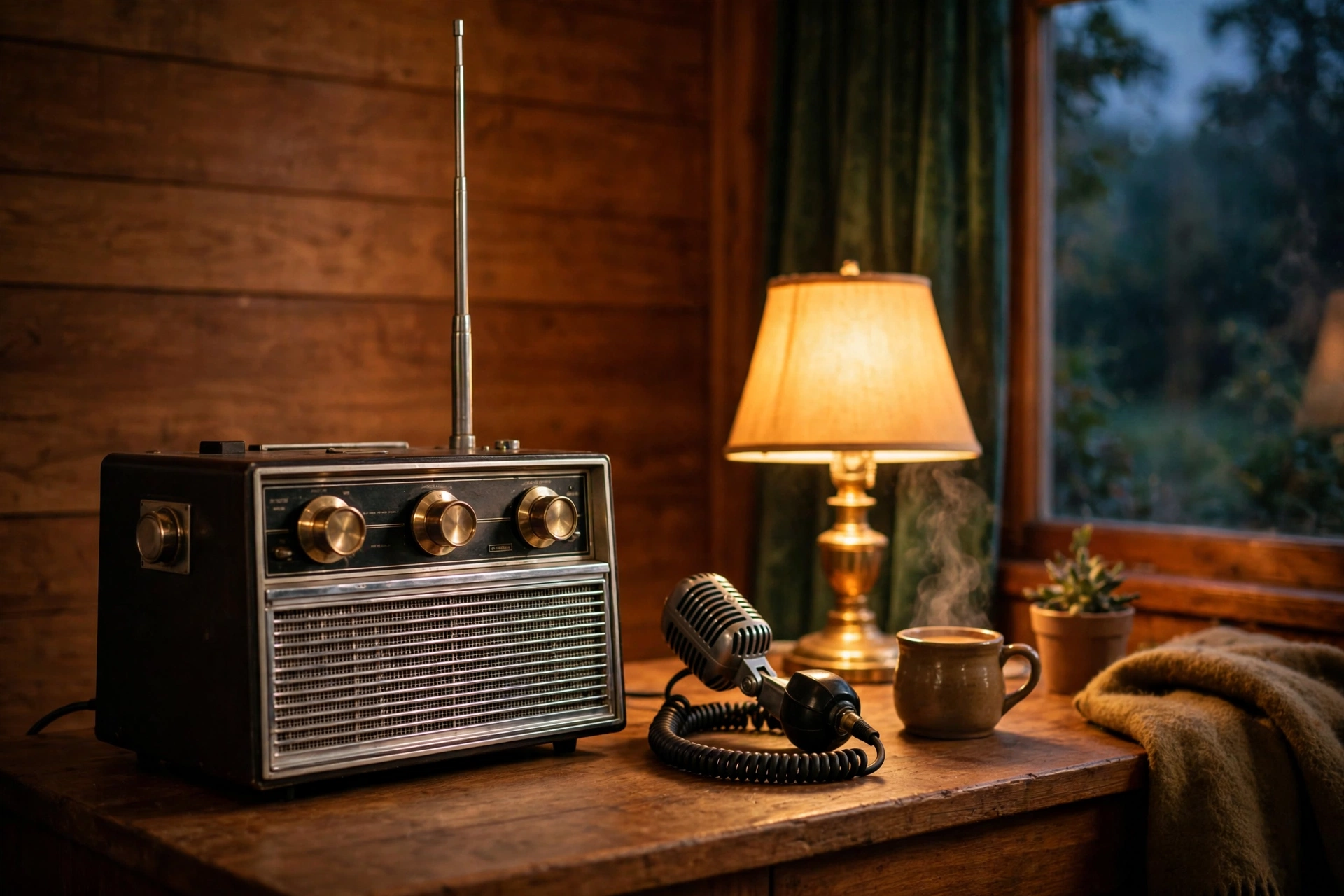
And then there was the ritual of tuning in. You’d twist the squelch knob until the roaring static melted into silence — and that first voice emerging from the quiet felt like a magic trick, every single time. RF gain, delta tune, the little red transmit light — we all fancied ourselves virtuosos. Technically, you were supposed to have an FCC license — fill out a form, pay a small fee — but by the height of the craze, hardly anyone bothered, and the requirement was eventually dropped in the early 1980s. The airwaves belonged to everybody, and everybody knew it.
The Antenna Farm on the Roof
You could spot a CB household from a block away: the antenna gave it away every time. The holy grail was the 102-inch stainless steel whip — nine feet of gleaming metal that turned every sedan into a porcupine and every teenager into the coolest kid on the street. Magnetic mounts slapped onto trunks in seconds. Big rigs ran twin “co-phased” antennas like horns. Serious operators owned SWR meters and spent entire Saturdays “tuning” their setups, chasing that perfect signal, bragging about how far they were “getting out.”
Of course, all that radiated power had consequences. More than one dad in America had to sheepishly apologize to the neighbors when his late-night transmissions ghosted through their television sets — voices from channel 19 bleeding into the evening news. It was annoying, it was occasionally expensive, and looking back, it was completely hilarious. The whole neighborhood knew when you were on the air. There was no hiding it. There was no wanting to hide it.
Why Our CB Radio Memories Still Matter
Here’s the thought that stops me cold every time: CB radio was social media before social media existed. Millions of strangers, talking to strangers, taking turns on a shared channel, helping each other out — no profiles, no followers, no likes, no algorithms deciding who got heard. Just voices in the dark, and the radical idea that a stranger’s voice was worth answering.
Before Facebook, there was channel 19 — and everybody had a handle. Read that again. We didn’t have followers back then. We had good buddies. And I’d argue we were richer for it.
Think about what it taught us. Patience — you waited your turn, because only one person could talk at a time. Manners — “breaker” etiquette kept the chaos friendly. Trust — you took directions from a disembodied voice at 2 a.m. and somehow always found your way. And imagination: every voice painted a picture, and your mind filled in the rest. On those same Friday nights when the disco era was lighting up the dance floor, a different kind of electricity was humming across the highways — quieter, cracklier, and just as alive.
Nothing gold stays: the channels got crowded, the novelty wore off, and the cell phone changed everything. But the truckers never really left — plenty still monitor channel 19 for road conditions and speed traps, the original purpose alive and well. The craze faded; the culture survived in the static.
Keep the Channel Open: What Was Your Handle?
The dashboard is quieter now. The big whip antennas have mostly come down, the base stations have gone silent, and Harlan’s garage is just a garage again. But some nights, when the house is still and the world feels a little too big, I swear I can still hear it — that hiss, that crackle, that voice out of the dark asking if anybody’s got their ears on.
So here’s my question for you, good buddy, and I genuinely want to know: what was your handle back in the day? And if you never had one — what would you have picked? Do you still remember your favorite ten-code, the one that slipped into your everyday speech and never quite left? Drop it in the comments below, and if this ride down memory lane brought back a voice you thought you’d forgotten, share it with the one friend who’d remember it too. That’s a big 10-4… and we’re clear.