Close your eyes for one second. The lights drop, a single spotlight finds the mirror ball, and suddenly a thousand tiny stars are exploding across the walls, the ceiling, your best friend’s grin. Some memories fade politely with time. Disco era memories don’t fade — they sparkle, they thump, and they absolutely refuse to sit down.
If you were there, you know the feeling before you even heard the music: that thump in your chest as you walked toward the club doors, the smell of hairspray and possibility in the air. And if you weren’t there? Lucky you — because tonight, we’re going back together. Put on your imaginary platform shoes. The dance floor is waiting.
The Night the Mirror Ball First Hit You
I was too young to be inside the clubs when disco ruled the world, but I grew up in the glow of it. My older sister had this whole ritual every Saturday night, and I used to sit on the edge of her bed just watching like it was a TV show. Hot rollers clinking in the bathroom. A satin shirt — always satin, always unbuttoned one button more than our mother approved of. And the platform shoes. Oh, those platform shoes. She’d stand in front of the mirror turning sideways, checking the silhouette, and then she’d do this little shoulder move — half dance, half confidence — and float out the door.
That’s the thing about the disco years. Getting ready was part of the night, not the boring part before it. You didn’t just show up to a disco. You arrived.
And then there was the mirror ball itself. Every club had one, hanging there like a small moon, and here’s what nobody tells you about it: it was the most democratic light ever invented. Rich, poor, shy, loud — under a spinning mirror ball, everybody looked like they belonged in a movie. A thousand little reflections scattered across the room, and for a few hours nobody was ordinary. That’s not nostalgia talking. That’s physics and glitter, and it worked every single time.
Disco Era Memories: Where This Music Was Born
Here’s something a lot of people get wrong: disco wasn’t manufactured in some record company boardroom. It was born on real dance floors, in real neighborhoods, by real people who needed a place to move.
The roots go back to the late 1960s and early 1970s, rising out of the club scenes in Philadelphia, Baltimore, and New York City. The sound drew on Philadelphia soul and funk, and it grew up in venues where Black, Latino, and Italian American dancers were already building something electric together. Disco started as the people’s music — music for the dance floor, by the dance floor. You can read the full story of disco’s roots and see just how deep those roots go, from French discothèques to the packed lofts of Manhattan.
What made it different from everything before it? Disco didn’t ask you to sit and appreciate it. It didn’t care about your taste in poetry or your opinion on guitar solos. It had one job: get you moving. And it did that job better than anything that came before or since.
The Philadelphia Sound That Started It All
Before the mirror balls and the white suits, there was Philadelphia — and Philadelphia gave disco its velvet. The city’s soul records of the early 70s were lush in a way pop music had never been: sweeping string sections, horns that soared, basslines that walked with total confidence. Orchestras. Actual orchestras, playing dance music! When those arrangements met a relentless four-beat pulse, something new was born. It sounded expensive. It sounded romantic. It sounded like Saturday night wearing its best clothes. That Philly DNA — the strings, the drama, the sweep — stayed in disco’s bloodstream all the way to the end.
The Beat That Would Not Let You Sit Still
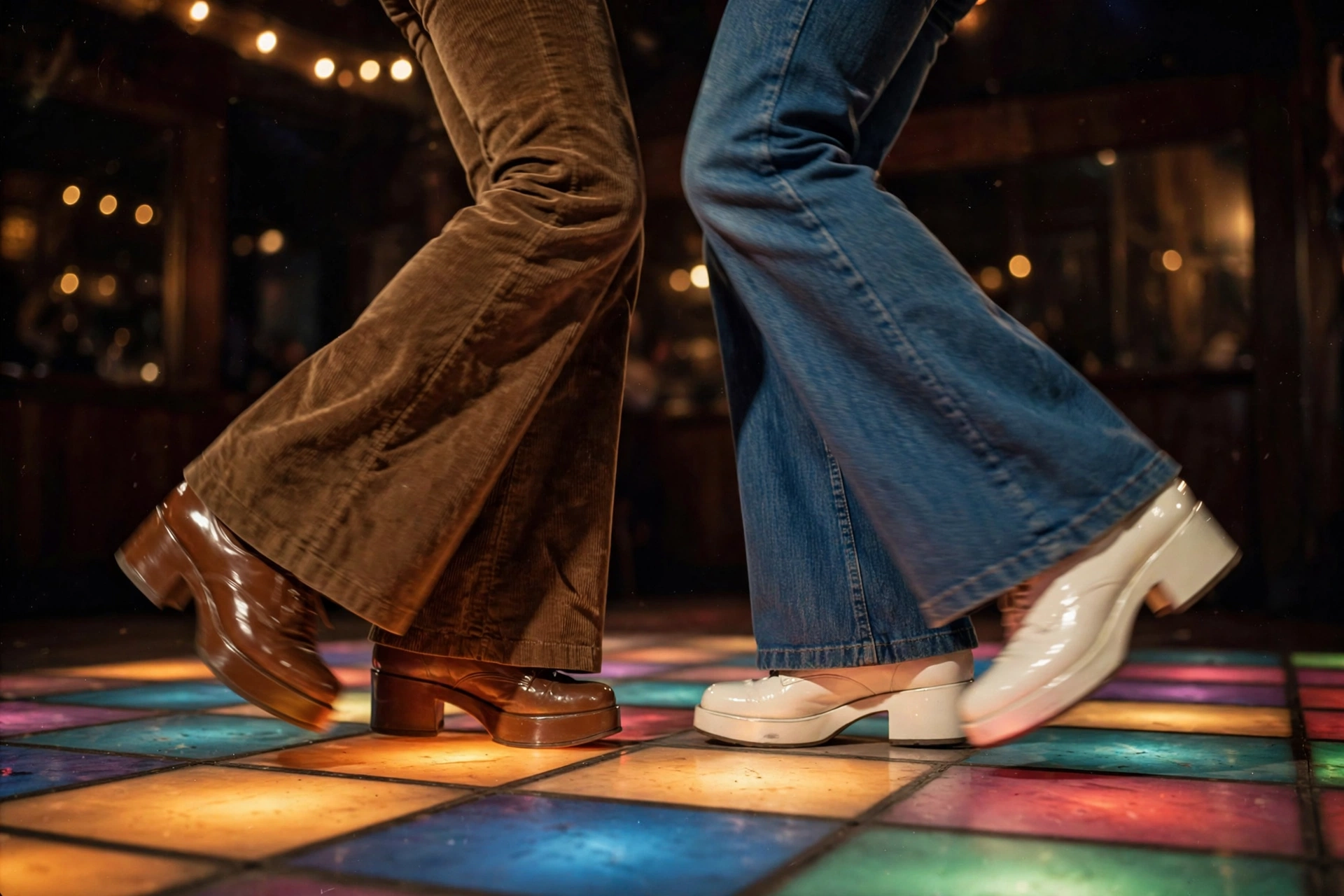
Let’s talk about the beat itself, because it deserves its own paragraph, maybe its own parade. Four-on-the-floor: the bass drum hitting on every single beat, steady as a heartbeat. Under it, a bassline that didn’t just support the song — it drove it, it flirted with it, it practically danced on its own. Add shimmering hi-hats, chicken-scratch guitars, and those soaring string sections, and you had a sound engineered for one purpose: nobody stands still.
And the songs got longer on purpose. A clever DJ named Tom Moulton figured out that three-minute singles were cutting the magic short, so he pressed dance tracks onto 12-inch vinyl — the maxi single — giving dancers extended grooves that could build and build. DJs went from background wallpaper to the heroes of the night, mixing one record into the next so the floor never emptied. By 1979, America had somewhere between 15,000 and 20,000 disco clubs. Let that number sink in. Your town probably had one. Your parents probably had stories about it.
Then came the dances, and oh, were there dances. The Hustle. The Bump. The Busstop. You didn’t need lessons — you needed a partner, a little rhythm, and the willingness to look gloriously silly for the first two songs. By the third song, you were a regular.
Rock asked you to listen. Disco asked you to move — and it did not take no for an answer. Not everybody converted, of course. Plenty of folks kept their denim jackets and their guitar solos, and honestly, the classic rock anthems of that generation still deserve their own spotlight. But even the rockers had to admit: when that bassline kicked in, their feet got ideas.
Saturday Night Fever Changed Everything
Then came December 1977, and one movie turned a subculture into a worldwide fever. Saturday Night Fever — directed by John Badham, starring a 23-year-old John Travolta as Tony Manero, a Brooklyn hardware store clerk who was nobody by day and a king by night — took the disco scene and beamed it into every suburb on earth. The story itself came from a mostly fictional 1976 magazine article by Nik Cohn about Brooklyn nightlife, but the feeling was real enough that millions recognized it instantly.
And the music! The Bee Gees’ soundtrack became one of the best-selling soundtrack albums of all time, and suddenly those falsetto harmonies were the sound of the planet. The film was such a cultural landmark that in 2010 the Library of Congress selected it for preservation in the National Film Registry. That’s not just a hit movie. That’s history deciding something mattered.
What the film really did was give everyone permission. You didn’t have to be cool to dance. You didn’t have to be from the city. Tony Manero was a working-class kid with a dead-end job, and on Saturday night he was royalty. Every viewer with an ordinary life and an extraordinary Saturday night saw themselves in him. That’s why the fever spread.
The White Suit Everyone Copied
Let’s be honest: half of us remember the suit before we remember the plot. That white three-piece polyester suit, flared trousers, black shirt underneath — Travolta’s strut down the Brooklyn sidewalk in the opening scene became the single most imitated walk of the decade. Overnight, every dance contest, every wedding reception, every school disco had at least one guy in white polyester doing the finger-point. The suit was a costume, sure, but it was also a promise: tonight, you get to be somebody.

Studio 54 and the Velvet-Rope Dream
No tour of disco era memories is complete without the most famous nightclub that ever existed. Studio 54 opened its doors on April 26, 1977, at 254 West 54th Street in Midtown Manhattan — a former opera house turned CBS television studio, reborn as a disco palace by Steve Rubell and Ian Schrager. It was only open in its legendary original form for a few short years, closing in 1980 after its owners were convicted of tax evasion. But what years they were.
Inside, it was pure theater: balconies, dramatic lighting, theme parties that cost fortunes, and a dance floor where movie stars, artists, and regular kids from Queens all moved to the same beat. Outside, it was a different kind of theater — the velvet rope, and Steve Rubell himself deciding who got in and who went home. Getting past that door became the era’s ultimate status symbol. Bianca Jagger famously celebrated her birthday there by arriving on a white horse, and that single image — glamour, absurdity, joy — pretty much summed up the whole club.
The Door Everyone Wanted to Get Past
Here’s the secret about the velvet rope: it made the music matter more. When getting inside was hard, the dance floor felt earned. People who made it past the door danced like they’d won something — because they had. And for the millions who never got near 54th Street, every local disco became its own little Studio 54. The rope was velvet, but the dream was universal.
The Voices You Still Hum in the Shower
Every era has its voices, and disco’s voices were unforgettable. The Bee Gees — three brothers whose harmonies became the very definition of the sound — carried Saturday Night Fever and half the decade’s dance floors on those soaring falsettos. Say what you want about disco; nobody ever accused those harmonies of being boring.
Then there was Donna Summer, the undisputed queen, whose 1977 track “I Feel Love” — built with producer Giorgio Moroder around a pulsing Moog synthesizer — sounded like the future arriving early. People forget how radical that was: one of the first disco records driven by a synthesizer, pointing straight toward the electronic dance music of decades to come.
And the Village People — the costumes, the joy, the unapologetic fun of it all. Their anthems turned every dance floor into a party where everybody was in on the joke and everybody belonged. You didn’t need to know the words (and we will not be printing them here — go listen instead). You just needed to be there when the chorus hit and the whole room moved as one.
The Night Disco Got Blown Up — Literally
Every golden age has its dramatic ending, and disco’s was almost too on-the-nose to believe. On July 12, 1979, Chicago’s Comiskey Park hosted a baseball doubleheader between the White Sox and the Detroit Tigers — and between the games, a local DJ named Steve Dahl staged a promotion called Disco Demolition Night. Fans got in for 98 cents if they brought a disco record to be destroyed. A crate of collected vinyl was blown up on the field.
What happened next became legend: around 50,000 people had packed the stadium, far more than expected, and thousands stormed the field after the explosion. The chaos was so bad the field couldn’t be used — the White Sox had to forfeit the second game to the Tigers. Thirty-nine people were arrested. You can read what really happened that night at Comiskey Park, because the details are wilder than any summary.
After that night, disco’s chart dominance in America faded fast through the early 1980s. But here’s what the record-burners missed: you can blow up vinyl, but you can’t blow up an idea. Disco lived on in Europe through the 80s, and its DNA — the four-on-the-floor beat, the DJ as artist, the 12-inch remix — became the foundation of house music, hip-hop, and modern dance-pop. The demolition made the headlines. The music made the future.
The Glitter Never Really Left
So where did it all go? Nowhere. That’s the beautiful truth. The mirror ball never actually came down — it just moved. It’s at every wedding reception where the DJ drops a 70s set and three generations hit the floor at once. It’s in every revival, every sample, every young artist who discovers that a four-on-the-floor beat still does exactly what it did in 1977. Disco didn’t die; it just changed clothes and slipped into the neon-soaked 1980s, and then into everything after.
You can box up the vinyl, but you can’t box up the feeling. That’s the real lesson of the disco years: joy is a renewable resource. A generation that had lived through hard times decided, collectively, that Saturday night belonged to them — to the music, to the lights, to each other. They dressed up, they showed up, and they danced like the week didn’t matter. Because for a few hours, it didn’t.
Nobody “used to” dance. In the disco era, dancing was the whole point of the evening — and honestly, maybe it still should be.
So here’s my question for you, and I genuinely want to know: where were you the first time a mirror ball caught the light? Were you on the floor, or watching from the edge of somebody’s bed like I was, waiting for your turn? Tell me in the comments — what song still gets you on your feet, no matter how old you swear you’ve gotten? Because disco era memories were never meant to be kept to yourself. They were meant to be shared, preferably at full volume, preferably with someone you love grabbing your hand and pulling you onto the floor.