Close your eyes and think of the 1980s. What do you see? Probably a wash of hot pink and electric blue, a synthesizer melody you can’t quite shake, and hair that defied every law of gravity. For anyone who grew up then, 1980s culture wasn’t just a backdrop to childhood — it was the main event, loud and glittering and impossible to ignore. And if you missed it the first time around, don’t worry. The decade is having such a second act right now that you can practically smell the hairspray from here.
I was thinking about this the other day while scrolling past yet another neon-filtered photo online. Why does this particular decade refuse to fade? The fifties had their rock and roll, the sixties had their revolution, but the eighties — the eighties had attitude. It was the decade that walked into the room and announced itself. No decade before or since has looked, sounded, and dressed quite like it. So let’s take a walk back through it, shall we? Dust off your leg warmers. We’re going in.
The Neon Glow: How 1980s Culture Learned to Shine
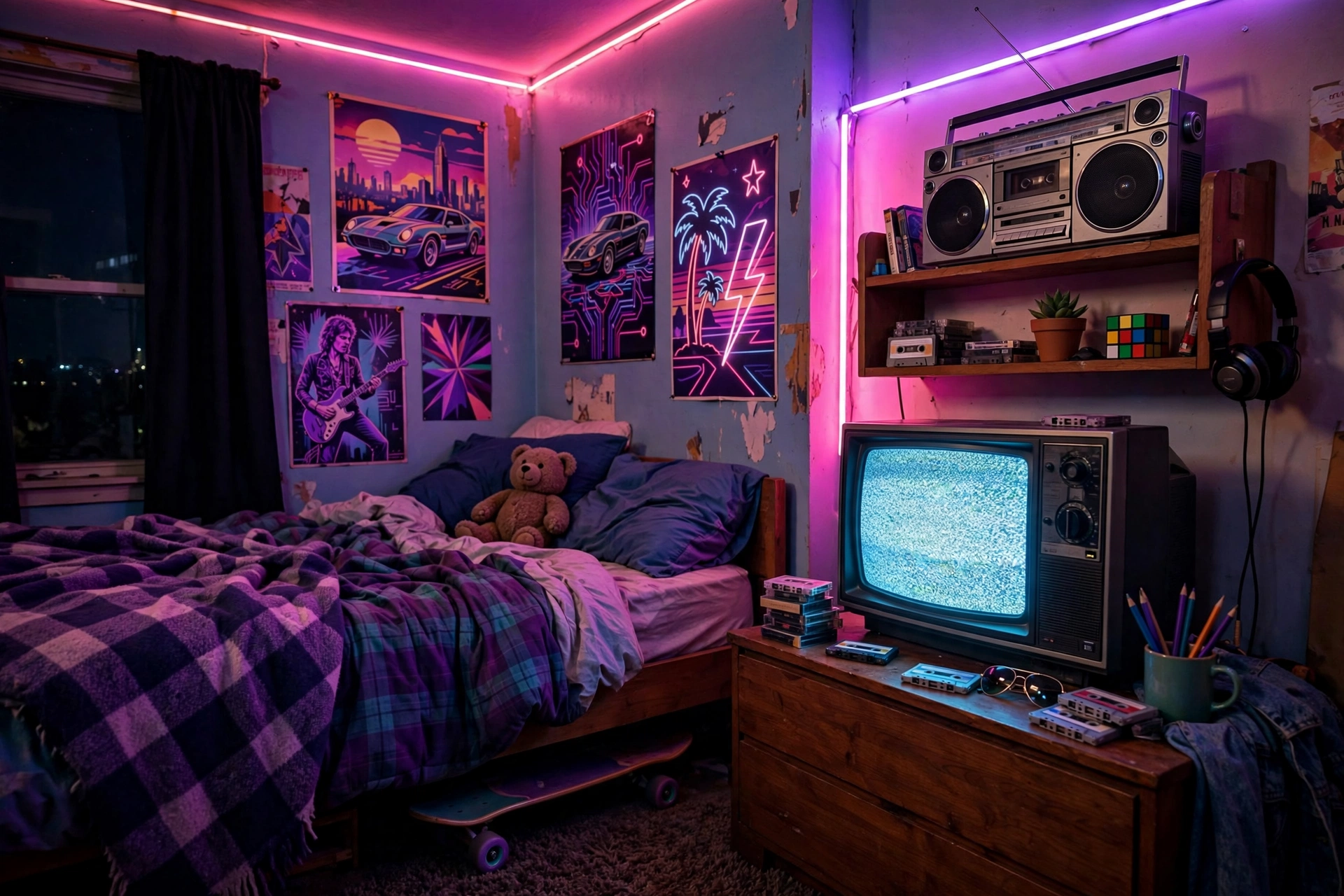
Here’s something nobody talks about enough: the eighties looked different from every decade that came before. Turn on any movie from 1985 and the colors practically leap off the screen. Neon pinks, electric greens, chrome blues. City streets bathed in glowing signs, mall food courts lit like landing strips, roller rinks pulsing with blacklight. It was as if someone had found the brightness dial on the whole world and cranked it all the way up.
Where did it come from? Partly technology — neon signage was cheap and everywhere — and partly pure confidence. The eighties believed the future was going to be amazing, so everything looked like the future was supposed to look. Sci-fi movies showed us laser grids and digital skylines, and everyday life started copying the movies. Kids’ bedrooms got glow-in-the-dark stars on the ceiling. T-shirts changed color in the sun. Even sneakers came in colors that could be seen from space.
Honestly, I think there’s a reason the neon look is back in such a big way. When life feels uncertain, people reach for the decade that wasn’t uncertain about anything. The eighties promised us that tomorrow would be bigger, brighter, and louder. Who doesn’t want a little of that energy right now?
Big Hair, Bigger Shoulder Pads: Fashion That Refused to Blend In
Let’s address the hair first, because we have to. If you lived through the eighties with hair, that hair was tall. Teased, sprayed, moussed, and sometimes literally held up with wire. Getting ready for a night out took forty-five minutes and half a can of hairspray, and nobody thought that was strange. The bigger the hair, the closer to fabulous — that was simply the rule.
And the clothes? Oh, the clothes. Shoulder pads so wide you had to turn sideways to get through doorways. Leg warmers worn with everything, including things that made no sense at all. Acid-wash jeans, members-only jackets, oversized blazers in pastel colors, sweatshirts with the neckline cut out. Every mall in America was a runway show where the models were teenagers with too much confidence and not enough supervision.
The Fitness Craze Dressed the Part
One thing that always makes me smile: in the eighties, you couldn’t just exercise. You had to look like you were exercising, preferably while wearing neon leotards and leg warmers, preferably to a thumping beat. Aerobics videos sold millions. People who had never run a day in their lives owned sweatbands. Fashion and fitness merged into one glorious, spandex-clad spectacle, and honestly? It was kind of wonderful. Nobody felt silly. Or if they did, the hairspray had already gone to their heads.
Statement Pieces Everywhere
What I love most about eighties fashion is that it was intentional. Nobody dressed in the eighties by accident. The ripped sleeves, the fingerless gloves, the jelly bracelets stacked halfway up the arm, the sunglasses worn indoors — every choice said something. It said: look at me. It said: I’m not blending in today, or any day. Compare that to today’s quiet, muted wardrobes and you start to understand why the decade keeps calling us back. It gave everyone permission to be a little bit extra.
Synths, Stars, and MTV: How the 80s Changed Music Forever
Okay, deep breath, because this is where the decade really shows off. Music in the eighties didn’t just change — it got a complete new wardrobe, a new attitude, and a television channel of its own. When MTV launched in 1981, it did something radical: it made seeing the music as important as hearing it. Suddenly every band needed a look, a concept, a video that would make you stop channel-surfing. You can read more about the decade’s wild energy on the 1980s overview page, but the short version is this: the decade turned pop stars into visual artists overnight.
And the sound! The synthesizer went from a weird gadget in a lab to the backbone of pop music. Those shimmering keyboards, those drum machines that hit like cannon fire, those bass lines that could rattle your windows. One minute you were listening to a power ballad with a guitar solo that lasted forever, the next you were dancing to an electronic beat that sounded like it came from the year 2085. The range was staggering, and radio stations played all of it side by side.
Here’s what made it special, though. The eighties understood that music was joyful. Even the sad songs had huge choruses you could sing with your arms in the air. Pop stars smiled. Concerts were spectacles with pyrotechnics and costume changes. When you bought a record — and yes, we bought actual records, or at least their younger cousin, the tape, which I wrote about in my piece on cassette tapes and analog hacks — you didn’t just get songs. You got an entire world to step into.
Does any of it hold up? Listen, some of those productions are gloriously over the top. The gated reverb on those drums alone could level a building. But that’s the point. The eighties never did anything halfway. If you’re going to make a pop song, make it the biggest pop song. If you’re going to make a music video, make it a mini-movie. The whole MTV generation grew up believing that entertainment should be spectacular, and honestly, they weren’t wrong.
Blockbusters and Box Office Magic: The Movies of the 80s
Can we just agree that the eighties produced an absurd number of movies people still love? I’m not talking about a few good ones. I’m talking about a run of films so beloved that studios are still making sequels to them forty years later. Adventure stories about kids on bikes chasing treasure. A teenager who goes back in time and has to make sure his parents fall in love. A friendly alien hiding in a suburban garage. Comedy, sci-fi, fantasy — the decade did it all, and it did it with practical effects, real stunts, and stories with actual heart.
What made eighties movies different? For one thing, they trusted kids. So many of the biggest hits were about young people going on adventures while the adults were either absent or clueless. That was catnip for every kid watching. You didn’t just watch the movie; you imagined yourself in it, riding that bike, holding that flashlight, being the hero. I remember walking out of the theater after one particular adventure film and being genuinely disappointed that my street didn’t have a single buried treasure in it. My friends and I spent that whole summer digging holes in the backyard. Sorry, Mom.
Then there were the comedies — fast-talking, quotable, endlessly rewatchable. The kind of movies where the whole family ends up shouting the funny lines at the screen. The eighties practically invented the modern blockbuster comedy, and it also gave horror fans a whole shelf of creative, campy classics to argue about. The decade understood something important: going to the movies was an event. You stood in line, you bought the popcorn, and for two hours the real world could wait outside.
The Television Glow: 80s TV Shows We Grew Up With
Before streaming, before binge-watching, before a hundred channels and nothing on — there was appointment television, and the eighties were its golden age. Families planned their evenings around their favorite shows. If you missed an episode, you missed it, and you’d spend the next day at school getting the plot explained to you by whoever had watched. Spoilers traveled by word of mouth, and cliffhangers were genuine events.
The lineup was incredible. Prime-time family dramas with theme songs you can still hum. Action shows with impossibly cool heroes and cars that could practically talk. Sitcoms that ran for years and became part of the family furniture. Cartoons on weekday afternoons that sold a truly heroic amount of toys. Every kid had opinions about which shows were the best, and those opinions were defended with the seriousness of international diplomacy.
There’s a warmth to eighties television that I think we lost somewhere along the way. The episodes were self-contained — you could drop in anywhere and catch up in two minutes. The lighting was bright. The laugh tracks were unapologetic. And the theme songs! Nobody writes theme songs like that anymore. If you can name a show from the description of its opening credits alone, you grew up in the right decade.
The Mall Was Our Social Network
Here’s a memory I bet a lot of you share: Friday night, no plans, so you went to the mall. Not to buy anything, necessarily. The mall was just where you went. It had everything a teenager could want — the food court, the music store where you could listen to albums on headphones, the arcade tucked in the corner (arcades deserve their own article, but let’s just say the mall ones were sacred ground), and the fountain in the middle where everyone agreed to meet.
The mall was the original social network. You didn’t text your friends to ask where they were; you just showed up and walked laps until you found them. Three laps around the food court was basically a status update. Couples held hands past the pretzel stand. Groups claimed benches like territory. Parents dropped you off at noon and picked you up at five, and nobody worried, because the mall was safe and everybody’s parents did the same thing.
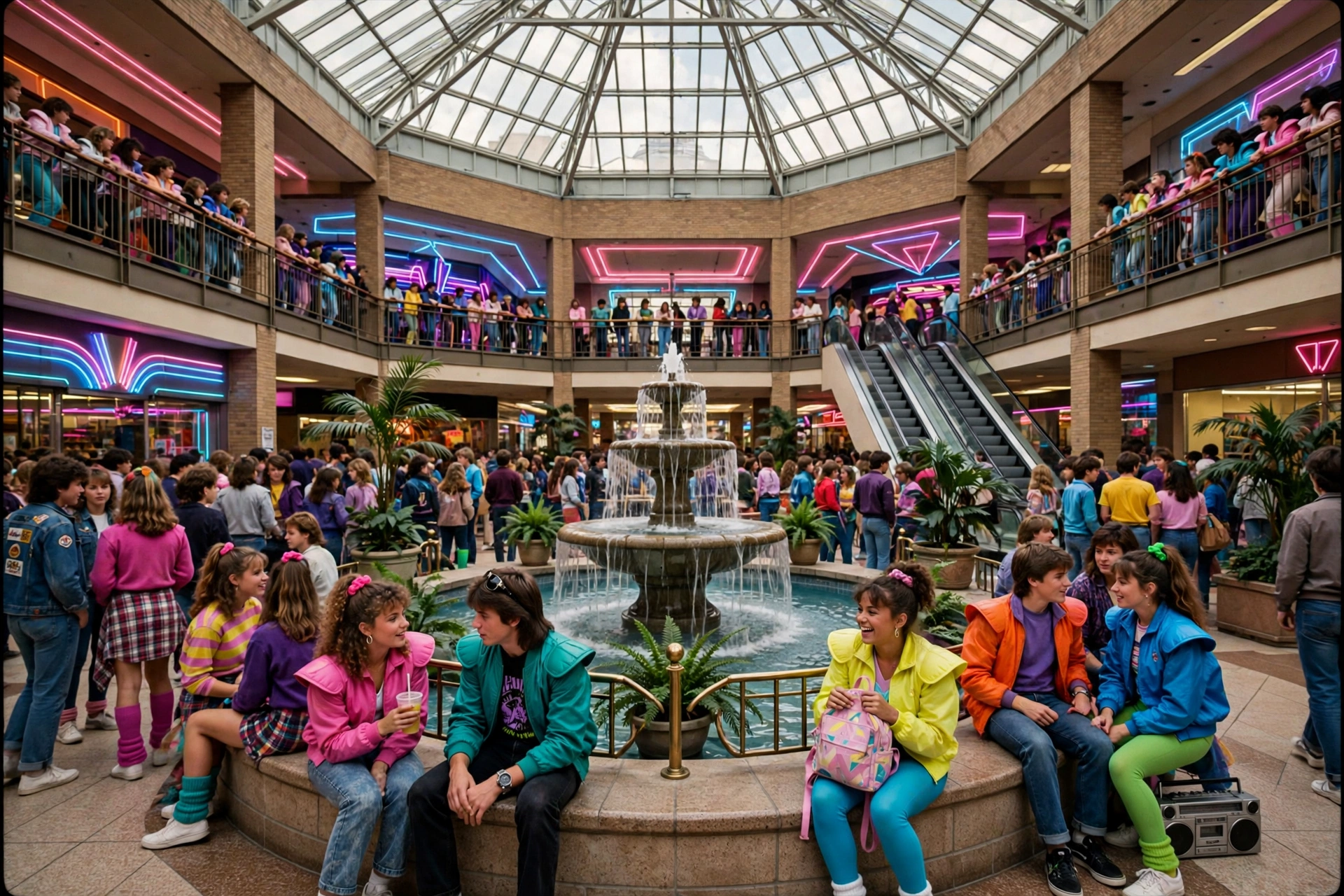
Walking through a mall today feels like visiting a ruin of that era — half the stores are empty, the fountain’s been paved over. But close your eyes and you can still hear it: the echo of footsteps on tile, the murmur of a hundred conversations, the distant electronic jingle of the arcade. The mall taught a whole generation how to hang out, how to people-watch, how to be young in public. That’s not nothing. That’s a whole education.
Gadgets, Gizmos, and Toys From Tomorrow
The eighties loved gadgets the way kids love birthday presents. Everything was new, everything was exciting, and everything beeped. The personal stereo let you carry your music in your pocket for the first time — a revolution I still think about when I see people annoyed that their streaming app buffered for half a second. We carried cassettes, people. Plural. In a bag. And we were thrilled about it.
Then came the video game consoles that turned living rooms into arcades, the camcorders the size of small suitcases that let families film their own home movies, the answering machines that let you screen your calls like a celebrity. Even the toys were technological marvels — talking dolls, transforming robots, handheld electronic games with red LED screens that you played until your thumbs went numb. Every Christmas morning in the eighties felt like the future had arrived early.
What strikes me now is how physical it all was. You inserted the cartridge. You blew on it first, obviously — everyone did, and it worked, don’t let anyone tell you otherwise. You rewound the tape with your finger. You adjusted the tracking on the VCR until the picture stopped rolling. Technology demanded your participation. It wasn’t seamless, and that was the fun of it. You felt like you were operating a machine, not just tapping glass.
Why the 80s Refused to Whisper
So why does this decade still matter? Why are kids who were born in 2010 wearing vintage band tees and watching shows set in 1985? I think it’s because the eighties offered something rare: pure, unfiltered optimism. The future looked bright. Technology was going to save us. The music was going to lift us. The movies were going to thrill us. The whole decade was a promise that life could be big and bright and fun.
Was it all perfect? Of course not. No decade is. But nostalgia isn’t about pretending everything was flawless — it’s about remembering how things felt. And the eighties felt like Saturday morning with no plans, like the opening chords of your favorite song, like the moment the theater lights went down. If you want to compare notes on how later decades carried that torch, my piece on why the 90s feel like home picks up right where this one leaves off.
The eighties refused to whisper because whispering never changed anyone’s life. Shouting — in neon, in synths, in shoulder pads and guitar solos and blockbuster finales — that stays with you. Decades come and go, but the ones that turn the volume all the way up? Those are the ones we never stop hearing. So here’s to the neon, the big hair, and the decade that dared to be unforgettable. It worked.
Pingback: 80s and 90s Fashion: The Boldest Retro Trends
Pingback: Roller Skating Rinks: Neon Nights, Disco Balls & All-Night Skates