There was a time when taking a photograph was a small act of faith. You pointed the camera, pressed the button, heard the little mechanical whirr — and then you waited. Not seconds. Not minutes. Days. Sometimes a full week. And when the pictures finally came back, you discovered what you’d actually captured: maybe magic, maybe a blurry brown smudge with someone’s thumb in the corner. There was no screen on the back of the camera to check. No delete button. No do-overs. Every single shot cost real money, and the roll only held so many.
For a whole generation, this was simply how photographs worked. The camera was a box of mysteries. The film inside it was precious cargo. And the week between pressing the shutter and holding the prints was filled with a particular kind of anticipation that no instant preview has ever replaced. Ask anyone who grew up then about the sound of a film rewind crank, and watch their face soften. They remember it the way you remember a song from childhood — not as a fact, but as a feeling.
This is the story of film photography: the discipline of twenty-four shots, the ritual of the photo lab envelope, and the strange, wonderful surprises hiding inside it.
Twenty-Four Shots and Not One More
The number defined everything. Twelve, twenty-four, or thirty-six — that was your entire allowance, printed right on the little cardboard box. Film photography ran on scarcity, and the twenty-four-exposure roll was the standard currency of family life. Every press of the shutter spent one. There was a tiny counter window on top of the camera ticking down like a countdown to something, and everyone in the house understood the rule: you did not waste shots.
Kids learned arithmetic from film before they learned it in school. A birthday party meant budgeting. Two for the cake, one for the presents, one for the group — and whatever you did, you saved a few for whatever might happen later, because something always happened later. A whole summer afternoon of street games and playground adventures might earn exactly one frame: the group shot at the end, everyone sweaty and grinning. Parents had a phrase for it, delivered with the gravity of a bank manager: “Don’t waste the film.” It ranked right up there with “don’t leave the fridge open” and “turn off the lights.”
And because there was no delete, every shot was a commitment. You couldn’t fire off eleven versions of the same moment and pick the best one. You lined it up, held your breath, and clicked — once. For the truly important moments, people took two. Not eleven. Two. The second one was insurance against blinking, and everyone called it “one for safety,” as if they were pilots running a checklist. It was part of the whole unhurried rhythm of life in the 1990s, when everything moved a little slower and nobody expected anything instantly.
The scarcity created a strange etiquette. Nobody asked to “see the picture” after you took it, because there was nothing to see. The photo existed only as a latent image, an invisible ghost on a strip of plastic, waiting for chemistry to reveal it. You took the shot and then you simply… trusted. It is hard to overstate how different that feels from today. Photographs weren’t taken; they were launched, like messages in bottles, toward a future self who would open them a week later and find out what had actually happened.
Buying Film Like Buying Treasure
Film was sold everywhere and treated like gold. The drugstore, the supermarket, the camera shop — they all had the spinning rack or the locked glass case, rows of little yellow-and-red Kodak boxes and green Fuji ones standing at attention. Choosing film was a small ceremony of its own. Did you want 200 speed or 400? The faster film handled dim living rooms better but cost more. Were you shooting a sunny beach day or a candlelit birthday? Regular folks mostly grabbed whatever was on sale and hoped for the best, the way people do with most household decisions.
The boxes were small and oddly satisfying: a cardboard sleeve sliding off a black plastic canister with a gray cap, inside of which the film leader peeked out like a tongue. The standard 35mm cartridge — the workhorse of home photography for decades — held a ribbon of light-sensitive plastic wound tight as a secret. People kept spare rolls in the refrigerator, tucked between the butter and the leftovers, because somebody’s uncle who “knew about photography” had said the cold preserved the chemicals. Whether it truly helped or not, half the refrigerators in the country contained at least one roll of film slowly chilling next to the ketchup.
Kodak owned the mythology. Their commercials — those warm, golden montages of graduations and first steps — practically invented the idea that a photograph was a “moment” worth preserving, and the jingles from those old TV ads still live rent-free in a generation’s head. Buying film felt like buying the promise of memory itself. You weren’t purchasing plastic and chemicals. You were purchasing the future ability to prove that this day had happened.
Loading the Roll Without Ruining It
Loading film was a rite of passage with genuine stakes. You opened the back of the camera — that satisfying little pop — laid the cartridge in its chamber, stretched the film leader across to the take-up spool, made sure the sprocket holes caught the tiny teeth, and closed it all up with a click that either meant success or a week of blank frames. There was no confirmation. No “film loaded successfully” message. You advanced a frame or two, watched the rewind knob turn as you wound (proof the film was actually moving), and prayed.
Every family had at least one legendary disaster: the roll that wasn’t actually threaded, the vacation documented on thirty-six frames of nothing. The discovery came a week later at the photo counter, in front of strangers, which only sharpened the lesson. Loading film taught a generation to do things carefully the first time, because there was no undo. It was craftsmanship disguised as an errand.
The Week-Long Wait
Then came the strangest part by modern standards: the waiting. A finished roll went into a little paper envelope — you filled out your name, your phone number, checked a box for single or double prints — and dropped it at the drugstore counter or the photo lab. The envelope went into a bin. The bin went… somewhere. And you went home with nothing but a claim ticket and a week of wondering.
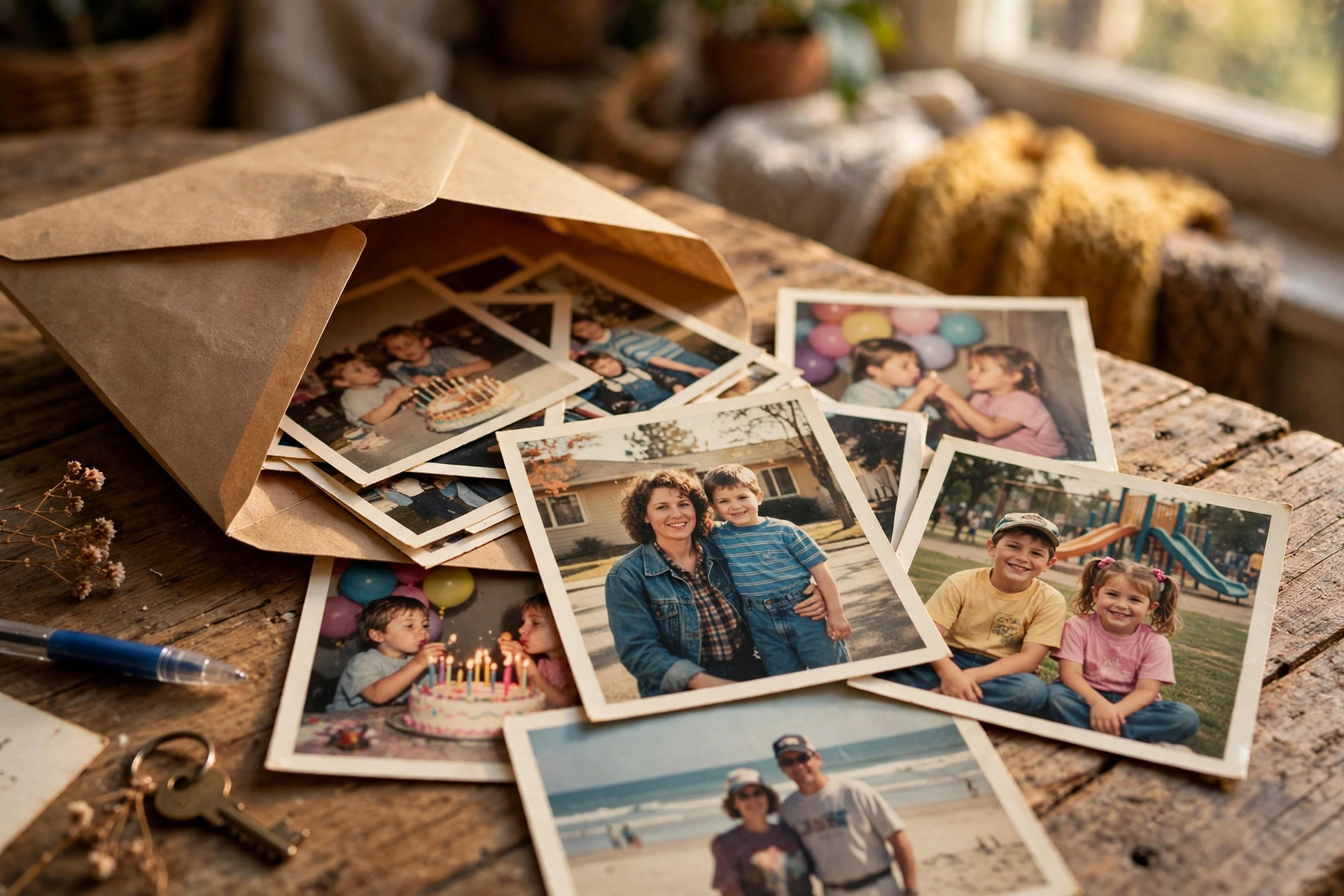
That week had its own texture. You’d forget what was on the roll, and then remember in a rush — oh, the zoo trip is on there, and the school play, and that weird sunset. Photographs arrived as messages from a slightly younger self. By the time the prints came back, the moment was already a memory, and seeing it again felt like opening a time capsule you’d buried only days earlier. Nobody talks about it much, but the delay was part of the pleasure. Anticipation is a seasoning, and film photography served every meal with a full week of it.
Kids would pester their parents — are the pictures ready yet, are they ready yet — with the same energy they brought to Christmas morning. Picking up the envelope became a minor family event. You didn’t tear it open in the parking lot (okay, some people did). You waited until you were home, gathered around the kitchen table, because whatever was inside was about to become the official record of the last few weeks of your life.
The Envelope of Truth
And then: the reveal. You slid out the stack of glossy 4×6 prints, and with them the long ribbon of negatives in their waxy sleeve — the actual originals, the film itself, transformed. Flipping through the prints was a ceremony of mixed emotions. There were the keepers, sharp and glowing. And then there was everything else: the doubles, printed twice because someone checked the wrong box; the blurry ones, where the camera had moved at exactly the wrong instant; the ones where a thumb — someone’s thumb — loomed in the corner like a pale moon; the family portrait where Dad’s head was elegantly cropped out of existence.
Nobody threw the bad ones away immediately. That was the rule nobody stated but everyone followed. You kept them all, because you’d paid for them all, and because even the failures were evidence. The blurry photo of the dog was still the dog. The thumb photo still proved you’d been at the beach. A typical roll yielded maybe five or six genuinely good pictures out of twenty-four, and those five or six were treasured because they were rare. Scarcity made the good ones glow brighter.
The Darkroom, Where Magic Happened in the Dark
Behind the counter, somewhere you never saw, was the darkroom — a place that sounded like pure sorcery to a kid. A room with no light except a deep red safelight. Trays of chemicals that smelled sharp and strange. An enlarger like a small lighthouse, projecting your negative big onto paper, and then — the moment every photography student described with reverence — the blank paper going into the developer tray and the image blooming up out of nothing, like a ghost surfacing in dark water.
Schools with photography clubs treated the darkroom like a sacred space. You signed up for time slots. You learned not to open the door when the red light was on, lest you ruin someone’s prints and earn a lifelong enemy. The whole process felt alchemical: light, silver, chemistry, patience. It gave photographs an aura of having been made, not just taken. Even if you never set foot in one, knowing the darkroom existed lent every print a little mystique, the way knowing bread is baked makes a loaf feel more real than something extruded from a machine.
Red Eyes, Washed-Out Faces, and the Thumb of Doom
Film photography had a signature look, and it was gloriously imperfect. Red-eye turned every indoor flash photo into a gathering of tiny demons — pupils glowing crimson, everyone looking faintly possessed at Thanksgiving dinner. The flash itself was merciless: faces bleached white in the foreground while the background fell into blackness, a phenomenon known to every family as “the flash photo,” delivered with a sigh. Mirrors were a mortal enemy. Anyone who took a flash photo facing a mirror got a perfect portrait of a blinding white explosion.
Then there were the happy accidents. The double exposure, when the film didn’t advance properly and two moments melted into each other — a birthday cake superimposed over a parking lot, Grandma’s face drifting across a sunset. The light leak, when the camera back wasn’t quite sealed and a ribbon of orange bled across the frame like a wound in reality. The accidental panorama of a finger. Photographers today pay good money for filters that fake exactly these flaws. An entire aesthetic industry now exists to recreate, digitally, the mistakes that film made for free.
And the thumb. The thumb deserves its own paragraph. Somehow, in an era when everyone knew how to hold a camera, thumbs appeared in photographs with supernatural frequency — the photographer’s own thumb, pressed against the lens in the excitement of the moment, immortalized as a fleshy eclipse in the corner of the frame. It happened to professionals. It happened to grandparents. It was the universal signature of the amateur era, and finding one in the envelope was always good for a laugh at the kitchen table.
The Disposable Camera Era
Just when you thought film couldn’t get more casual, the disposable camera arrived: a chunky plastic rectangle, pre-loaded with twenty-seven shots, a little winding wheel that clicked with each frame, and a flash button you held down until the whine climbed to its peak. It cost a few dollars. You used it, you dropped the entire camera at the photo lab, and a week later you got prints. The camera itself was sacrificed to the process, which felt wonderfully decadent.
Disposables conquered the school field trip. Teachers bought them in bulk and handed them out like treasure maps: document the museum, document the bus ride, do not waste shots on your friends making faces — advice that was universally ignored within minutes. The results were gloriously chaotic: twenty-seven frames of bus windows, half a dinosaur skeleton, someone’s lunch, and three genuinely lovely shots nobody expected. For kids who’d never been trusted with the family camera, the disposable was freedom in plastic form.
They were perfect for the job because nobody cared if they got dropped, rained on, or sat on. The photos had a distinctive look — a little soft, a little flash-harsh, unmistakably candid — that now reads as the visual signature of the late 90s and early 2000s. You can spot a disposable-camera photo the way you can spot a song from a certain summer: the colors, the grain, the slight tilt of someone who was laughing while they pressed the button.
Weddings Ran on Disposables
For a stretch of years, nearly every wedding reception had a disposable camera on each table, tied with a ribbon, with a little note: please take pictures! The logic was beautiful — the professional photographer would get the formal shots, and the guests would capture everything else: the real party. What the couples actually received, a week later, was a box of envelopes containing the unfiltered truth of their reception.
Some of it was gold: the flower girl mid-spin, grandparents slow-dancing, the best man’s toast caught at its funniest second. Some of it was… documentary. The dance floor at midnight. Uncle somebody’s thumb. Twenty shots of the centerpiece. Couples would spread hundreds of prints across the living room floor and laugh until it hurt, sorting the keepers from the evidence. It was crowdsourced photography before the word existed, and it worked precisely because nobody was performing for a screen. There was no screen. There was only the moment, and the faith that the moment would develop.
The Album Was the Archive
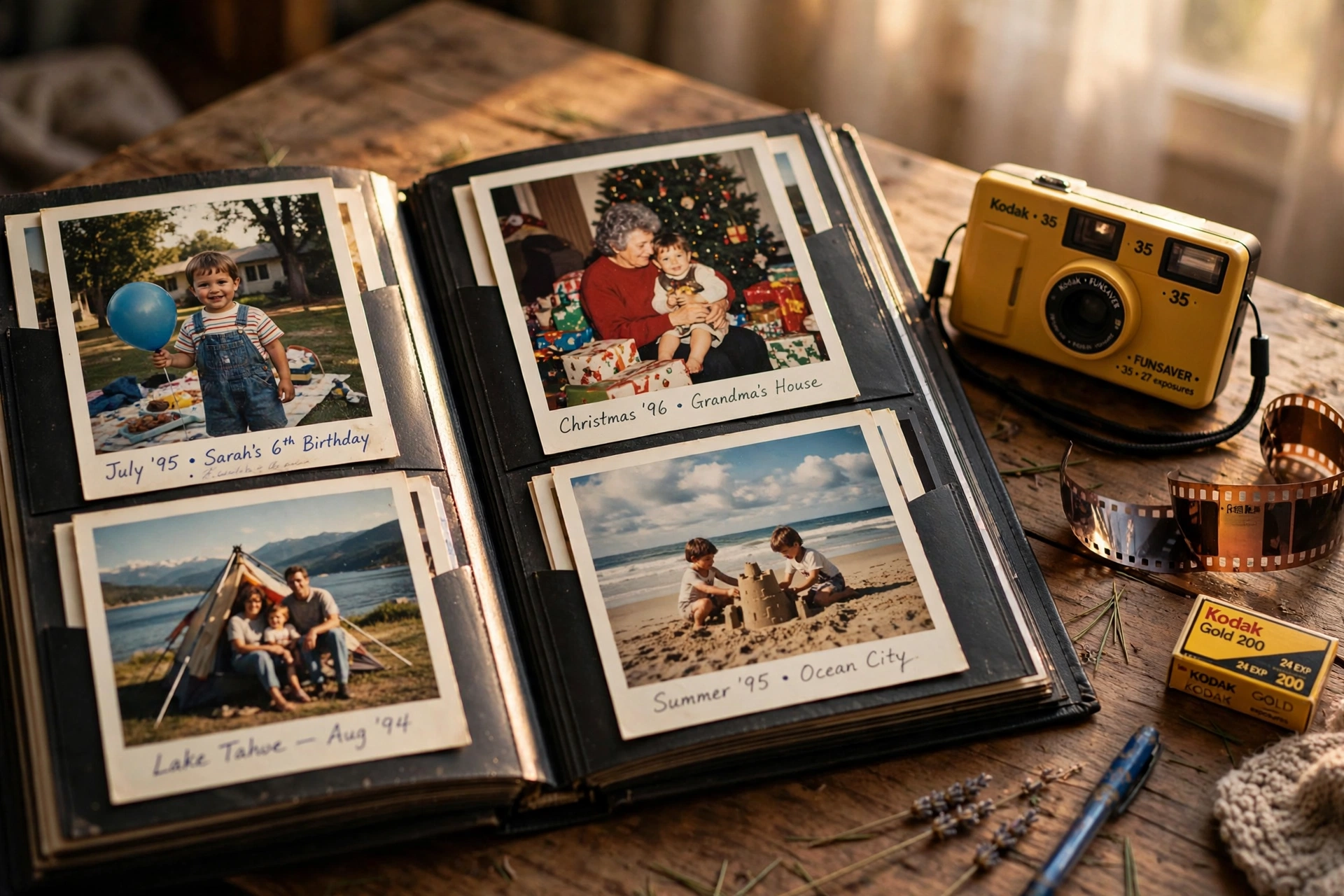
All those envelopes of prints had to go somewhere, and that somewhere was the photo album — an object that sat on the coffee table or the bookshelf with the quiet authority of a family bible. The good albums had sticky pages under clear plastic sheets, and arranging photos in them was a winter-evening project: peeling, placing, smoothing, writing little captions in the margins in a parent’s careful handwriting. “Sarah’s 7th birthday.” “Beach, summer ’94.” The captions mattered. They were the metadata of the analog age, written in ink.
There was always a hierarchy. The good album, the one shown to guests, held the keepers. The shoebox in the closet held everything else — the doubles, the blurry ones, the thumb photos — and honestly, the shoebox was often more fun. Albums were curated; shoeboxes were honest. Families across the country had both, and both were treated as precious, because every print had cost money and every print was, in a very literal sense, irreplaceable. There was one negative. One set of prints. No cloud backup. No copies. If the house flooded, the photos were gone, and everyone understood this the way you understand that fire burns.
Kids grew up knowing exactly where the albums lived. Bored on a rainy afternoon? Pull down the heavy book and travel: there was Mom with enormous hair at her wedding, Dad impossibly young holding a fish, the house before the renovation, the dog before the gray muzzle. The photos didn’t move or play sound, but they didn’t need to. They were proof — proof that these people had been young, that this day had happened, that you had once been small enough to sit in that particular lap. It is no accident that the family album felt sacred. It was the only copy of the past anyone had.
Slides, Projectors, and the White Bed Sheet
Then there was the deluxe format: slides. Little cardboard-mounted squares of film, loaded into a circular carousel tray that clicked with deeply satisfying precision. When the relatives came over, someone hung a white bedsheet on the living room wall, killed the lights, fired up the projector — which sounded like a small aircraft taking off — and subjected the room to two hundred vacation slides. Click. “That’s the Grand Canyon.” Whirr-click. “That’s also the Grand Canyon, different angle.”
It was, by any objective measure, tedious. It was also wonderful. The slides glowed. Projected six feet wide in a darkened room, an ordinary snapshot became cinema: the colors saturated, the grain visible, the moment enormous. Kids sprawled on the carpet would groan theatrically and then, twenty minutes in, find themselves genuinely absorbed, watching their parents’ honeymoon unfold larger than life. The projector’s fan blew warm air across the room. The tray clicked. Somewhere in the stack there was always one slide loaded upside down, and the room would erupt. It was home entertainment before home entertainment, and it ran on patience — the audience’s and the photographer’s both.
What Digital Took Away
Digital arrived the way most revolutions do: first as a novelty, then as a flood. The early digital cameras were clunky and expensive, their photos small and slightly smeary, and film loyalists scoffed. Then the quality caught up. Then the phones absorbed the camera entirely. And within a few short years, the entire economy of the photograph inverted: pictures went from scarce and costly to infinite and free. The week-long wait collapsed to zero. The envelope of prints became a camera roll of thousands.
Nobody would trade it back — that’s the honest truth, and nostalgia shouldn’t pretend otherwise. Digital photography is a miracle. It lets grandparents video-call into birthdays. It lets a kid in a small town photograph the stars. It costs nothing to try, which means everyone can learn, experiment, and play. The old system was expensive, slow, and wasteful in its own way. Let’s not romanticize the thumb photos too much.
But something real was lost in the trade, and it’s worth naming. Intention, for one. When every shot costs money, you look longer before you press the button. You compose. You wait for the moment instead of machine-gunning through it. Patience, for another — the week-long wait taught a generation that some good things can’t be rushed, a lesson that feels almost rebellious now. And surprise: the genuine, stomach-flipping surprise of opening an envelope and discovering what you’d actually captured, including the glorious failures.
There’s a quieter loss, too. The average phone today holds tens of thousands of photos, and most of them will never be looked at twice. They sit in the cloud, unprinted, uncaptioned, unvisited — a vast archive nobody curates. The film era produced fewer photographs, but nearly every one was seen: held in hands, passed around a table, argued over, laughed at, tucked into an album or a shoebox with care. Scarcity forced attention. Every print earned its place in someone’s hands because someone had paid for it, waited for it, and chosen to keep it.
Maybe that’s the real nostalgia here — not for the chemicals or the red-eye or the week of waiting, but for the attention those constraints demanded. Film photography made every picture a small event: the buying, the loading, the shooting, the waiting, the reveal, the album. It slowed the whole business of memory down to a human pace. And in an age of infinite images, there’s something quietly radical about the idea that a photograph used to cost something — money, yes, but also care, patience, and faith.
So here’s to the twenty-four shots. To the drugstore envelope and the claim ticket. To the blurry ones and the thumb in the corner and the red-eyed demons at Thanksgiving. They weren’t perfect. That was the point. Every one of them was proof that someone had been there, had cared enough to spend one of their precious frames, and had waited a whole week just to see.