Before music lived in the cloud, it lived in a little plastic box. A box with two reels, a ribbon of brown tape, and a whole secret language of tricks that an entire generation knew by heart. Ask anyone who grew up with cassette tapes, and watch their eyes light up at one particular phrase: the pencil trick.
It sounds like a joke to anyone born after the year 2000. But there was a time when the most important tool in a music lover’s collection wasn’t an amplifier or a speaker — it was a standard yellow No. 2 pencil, rescued from the bottom of a school bag. With it, you could rewind a tape faster than the player, save your batteries, and look like you knew something about the world. And honestly? You did.
Here is the story of the little cassette — and all the beautiful, fragile, funny rituals that came with it.
The Pencil Trick: Everyone’s Favorite Analog Hack
Let’s start with the legend. The reels inside a cassette had toothed centers, little hexagonal or six-pointed holes that looked suspiciously like they were made for something other than the player’s spindle. And they were. Slip a pencil into one of those holes, and suddenly you had a manual rewind crank. Spin it with your fingers — or jam it between your palms and rub back and forth like you were starting a campfire — and the tape would spool back onto the reel with a satisfying soft whir.
Why did everyone do it? Two reasons. First, rewinding in a Walkman or a portable boombox chewed through batteries at an alarming rate. Batteries were expensive, and nobody wanted to waste a fresh set of AAs just to hear side one again. Second, the deck’s rewind motor was brutal. It yanked the tape at high speed, and if the tape was old, stretched, or just unlucky, that violence could snap it, tangle it, or warp it. The pencil was gentle. The pencil respected the tape.
There was also something deeply satisfying about it. In an era before anyone talked about mindfulness, spinning a pencil through a cassette was a small act of analog care — slow, deliberate, a little bit meditative. You could feel the resistance change as the reel filled up. You learned, by touch, when to ease off so the tape wouldn’t bunch up. Kids across the country developed strong opinions about the ideal pencil: not too thick, not too thin, definitely not one of those fat beginner pencils. A plain wooden school pencil was perfect, and the fact that it doubled as a rescue tool gave it a second life long after the homework was done.
The Anatomy of a Little Plastic Miracle
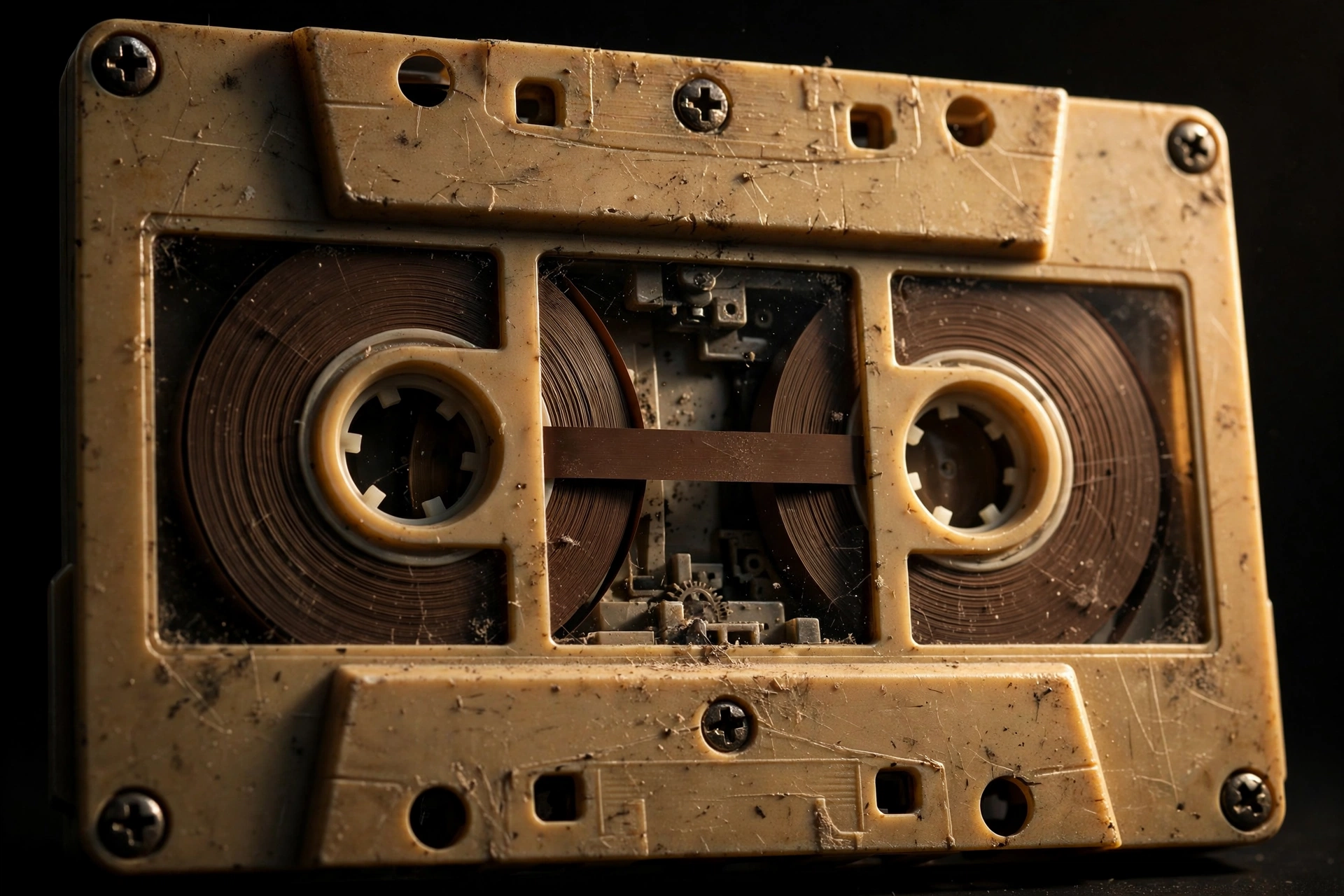
Hold a cassette up to the light and take a good look, because for all its simplicity, it was a genuinely clever piece of engineering. Two reels. A thin ribbon of magnetic tape, only about an eighth of an inch wide, coated in iron oxide. A little felt pad pressed against the tape to keep it in contact with the player’s head. A few tiny screws holding the shell together. That’s it. That was the entire device that carried people’s entire music collections.
The A-Side and the B-Side
The cassette was a two-faced friend. Flip it over and there was a whole second act waiting. The tape played in one direction on the A-side; when it ran out, you physically turned the thing over — that lovely clunk as it seated into the deck — and the B-side began. Some players had “auto-reverse,” a feature that flipped the playback direction on its own, and it felt like pure sorcery the first time anyone saw it work.
But the manual flip was a ritual in itself. It meant getting up. It meant handling your music like an object, turning it over in your hands, reading the little handwritten label you’d made. It meant music had a midpoint, a built-in intermission, a moment where you decided: do I keep going, or do I start over?
Those Tiny Screws and the Felt Pad
Look closely at the shell and you’d see the little screws — usually four or five of them — and the faint outline of the internals. The felt pad, barely bigger than a grain of rice, was one of those details you only noticed once someone pointed it out, and then you could never unsee it. It kept the tape pressed flat against the playback head, and when it wore out or fell off, the sound went thin and wobbly. Seasoned tape owners learned to spot a dead felt pad the way a mechanic spots a worn belt. It was one more piece of maintenance in a hobby that was basically maintenance with music attached.
When the Deck Ate Your Tape: The Rescue Operation
Every cassette owner has this story, and every version goes the same way. You’re listening along, everything is fine, and then — a sound like fabric tearing. A horrible crinkling. The music slows, warps, dies. You hit eject with your heart in your throat, and there it is: a bird’s nest of brown ribbon spilling out of the cassette shell, tangled around the deck’s capstan and pinch roller like it has personal grievances.
The panic was real. This wasn’t a file you could re-download. This might be the only copy of a mixtape someone spent three weeks assembling, or an album you saved up for months to buy. Losing it meant losing it forever.
So began the rescue operation, performed with the steady hands of a surgeon and the vocabulary of a sailor (mumbled under the breath, of course). The technique: eject the tape, gently tease the loose ribbon free, and then — the pencil again — slowly, patiently wind the slack back onto the reel. If the tape was creased, you pressed it flat with a fingernail. If it was twisted, you untwisted it, millimeter by millimeter. The whole household would fall silent. Someone might offer to hold the cassette steady. It was a team effort, and when the last of the ribbon finally disappeared back into the shell and the reels turned smoothly again, the relief was enormous.
Sometimes the rescue failed. The tape snapped, and then came the emergency surgery: a tiny piece of transparent tape spliced across the break, trimmed carefully so it wouldn’t jam the mechanism. It usually worked, with one small quirk — every time the splice passed the playback head, you’d hear a soft tick. For years afterward, you’d know exactly where the scar was. It became part of the song.
Recording Off the Radio: The Original Music Piracy
Long before streaming, long before downloads, there was the boombox and the radio — and a generation of kids who turned recording songs into a high-stakes sport.

The setup was simple: a cassette in the deck, the radio tuned to the station that played the hits, and one finger hovering over the red RECORD button like a sprinter in the blocks. The DJ would announce that the next song was coming up, and the tension was unbearable. You had to hit record at exactly the right moment — too early and you’d get the DJ’s voice trailing off over the intro, too late and you’d miss the first glorious seconds.
And the DJ always talked over the intro. Always. It was practically a law of nature. You could have a perfect recording going, the song of the summer captured in full, and then the DJ’s voice would slide in over the last chorus to announce the weather. These imperfections weren’t flaws; they were fingerprints. Years later, hearing a song on clean digital audio could feel strangely wrong, like the DJ’s voice had been part of the arrangement all along.
There were rules to this game, passed down like folklore. Never record over a tape you cared about without checking the label first. Use the little tabs — snap them off and the deck couldn’t record over the tape, a built-in “do not erase” switch. If you regretted it, a piece of tape over the hole undid the protection. Everyone knew this. It was common knowledge, the way everyone today knows how to skip an ad.
Tape Hiss: The Soundtrack’s Soundtrack
Here’s something the digital age struggles to explain: cassette tapes hissed. A soft, constant shhhhhhh underneath everything, most noticeable in the quiet moments before a song started and in the pauses between tracks. By every technical measure, it was a defect. And yet.
For a whole generation, that hiss became part of the experience of music itself. It was the sound of anticipation — the split second between pressing play and the first note, filled with that warm static, like the tape was clearing its throat. Cheap tapes hissed more. Well-worn tapes developed their own particular texture of hiss, and you could tell your tapes apart by ear. The hiss told you this was real, this was physical, this was happening in your hands right now.
Modern musicians actually pay money to recreate it. Lo-fi producers layer artificial tape hiss over digital recordings to capture warmth that the original format gave away for free. There’s a lesson in there somewhere about how the imperfections we try to engineer out of things are sometimes the things we end up missing most.
Passing Tapes Around: Dubbing and Handwritten Labels
Dubbing: The Copy Machine of the Analog Age
Then there was the dual-cassette deck — the holy grail of teenage music culture. Two slots, one button labeled DUBBING or HIGH-SPEED COPY, and suddenly you could duplicate an entire album in minutes. Lend a friend your tape on Monday, get it back with two new ones on Friday. Whole social economies ran on dubbed cassettes.
Each generation of copying degraded the sound a little — the hiss got harsher, the highs got duller, like a photocopy of a photocopy. A third-generation dub of an album was a fuzzy, underwater ghost of the original. But nobody cared. The music was still there, the songs still worked, and the tape still carried the handwriting of whoever made it for you. A fifth-generation copy of a rare live bootleg was treasure, hiss and all.
This was also how mixtapes multiplied. One perfect mixtape could become ten, passed hand to hand through a school or a neighborhood, each copy a little more worn and a little more loved. The history of the mixtape and the history of the cassette are really the same story — the story of music you could hold, copy, and give away.
The Handwritten Labels: Every Tape Was a Tiny Artwork
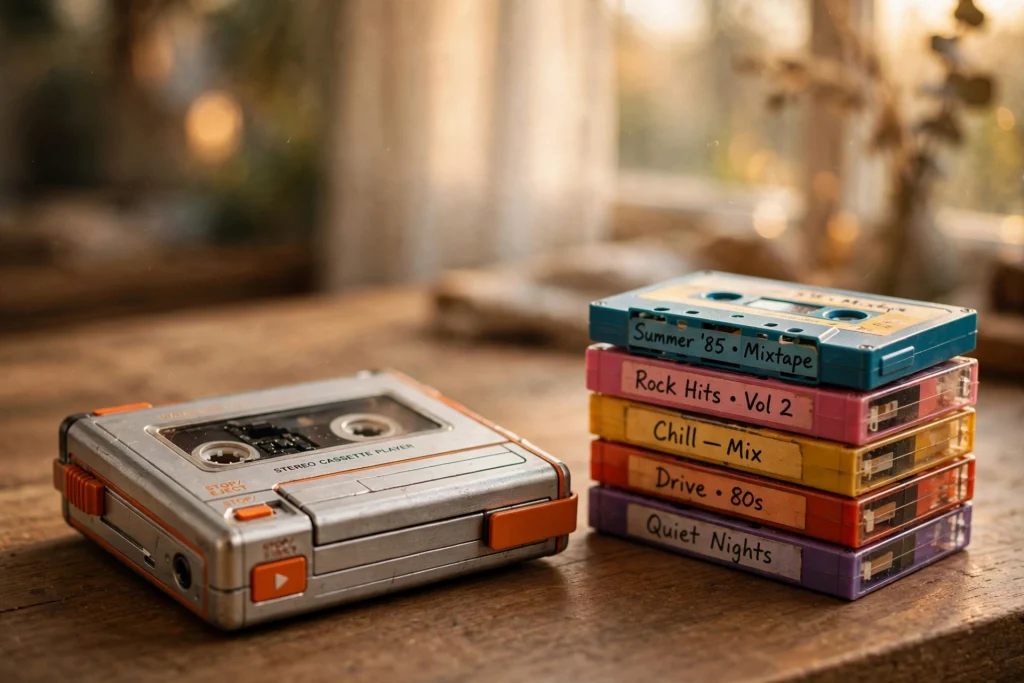
Blank cassettes came with little paper inserts — the J-card — folded to fit inside the plastic case. And those blank white lines were an invitation. Ask anyone who grew up then about their tape collection, and they’ll remember the handwriting more than the tracklists.
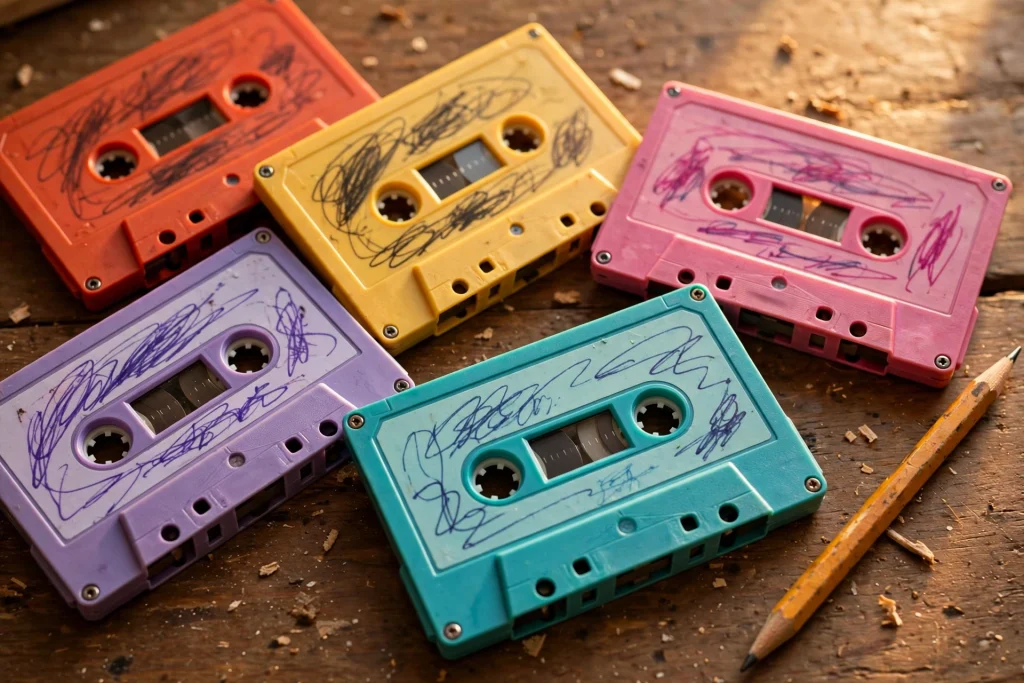
Some people wrote in careful block letters. Some developed elaborate systems: color-coded pens, tiny genre symbols in the corner, the date of recording in the margin. Some drew doodles — lightning bolts, band logos copied freehand, borders of intricate patterns filled in during boring phone calls. A shelf of cassettes was a gallery of its own, every spine a little piece of its owner’s personality on display.
The labels told stories. Crossed-out song titles where a recording hadn’t worked. “DO NOT TAPE OVER!!!” in aggressive capitals, sometimes underlined three times. A name and a date that marked the tape as a gift. You could read a person’s whole musical autobiography just by scanning their shelf — the phases, the obsessions, the friend who introduced them to the band that changed everything.
Step back and consider what owning music meant in the cassette era. It meant shelf space. It meant alphabetizing — or not alphabetizing and knowing exactly where everything was anyway. It meant a tape left on a car dashboard in summer could warp into a wobbly mess, because heat was the enemy and everyone learned that lesson exactly once. It meant the ribbon could stretch, the case could crack, the label could peel.
Music had weight. A box of sixty tapes was heavy. Moving house meant packing them like dishes. And because each one was a physical object you’d handled, labeled, rescued, and rewound with a pencil, they accumulated meaning in a way a playlist simply doesn’t. You didn’t just own the songs; you owned the object, the history, the scars. That mixtape with the splice tick at 2:14 wasn’t just music — it was a memory with a soundtrack.
Portability was the cassette’s superpower, and it arrived on the shoulders of the Walkman and the boombox. Suddenly music left the living room. It went on buses, on walks, on school trips. The boombox on the shoulder became an icon of an era — a declaration that your music went where you went.
The CD Arrives, and Something Quietly Vanishes
The compact disc arrived promising perfection: no hiss, no tangles, no rewinding, no flipped sides. Just pristine digital sound and the magical ability to skip to track seven instantly. And it delivered. The CD was, by every objective measure, better.
But something went with the hiss. The rituals — the pencil, the rescue operations, the finger hovering over the record button, the handwritten labels — didn’t transfer to the new format. You didn’t need a pencil for a CD. You didn’t dub CDs for friends the same way (well, eventually you did, but it wasn’t the same). The CD was a sealed, perfect object. The cassette had been a collaboration between the listener and the format. You maintained it, you repaired it, you participated in it.
What vanished wasn’t just a storage medium. It was patience. Cassette culture ran on patience: waiting for the song on the radio, waiting for the rewind, waiting for side two. Music asked something of you, and in return it gave you something back — a sense of ownership, of earned enjoyment, that the instant-access era struggles to reproduce.
The Compact Cassette was introduced by Philips in 1963, originally meant for dictation, not music. It took the music world by storm anyway and ruled for three decades. If you’re curious about the technical history — the formats, the standards, the long road from office tool to cultural icon — the full story is well documented.
The format is having a small revival now. New albums get cassette releases. Old decks get refurbished. A generation that never rewound anything with a pencil is discovering the format with fresh curiosity, the way you might discover vinyl or film photography — not because it’s better, but because it’s different. Because it’s physical. Because it asks you to slow down.
And the old rituals survive in strange ways. The word “mixtape” outlived the tape itself. The pencil trick gets rediscovered every few years and goes viral among people amazed that it works. The arcade era and the cassette era shared that same beautiful inefficiency — you can see the same affection for physical, imperfect, hands-on entertainment in how people remember both.
Maybe that’s the real legacy of the cassette. Not the technology, which was flawed by design, but the relationship it created between people and their music. It was fragile, so you handled it with care. It was imperfect, so you learned its quirks. It demanded your time, so you gave it — and in giving it, you got more back than the songs alone.
Somewhere, in a drawer or a box in an attic, there’s a cassette with a handwritten label and a splice tick at 2:14. And if you pressed play right now, the first thing you’d hear — before the music, before anything — would be that soft, familiar hiss. The sound of the tape clearing its throat. The sound of patience. The sound of home.
Pingback: 1980s Culture: Neon Lights, Big Hair, and the Decade That Refused to Whisper