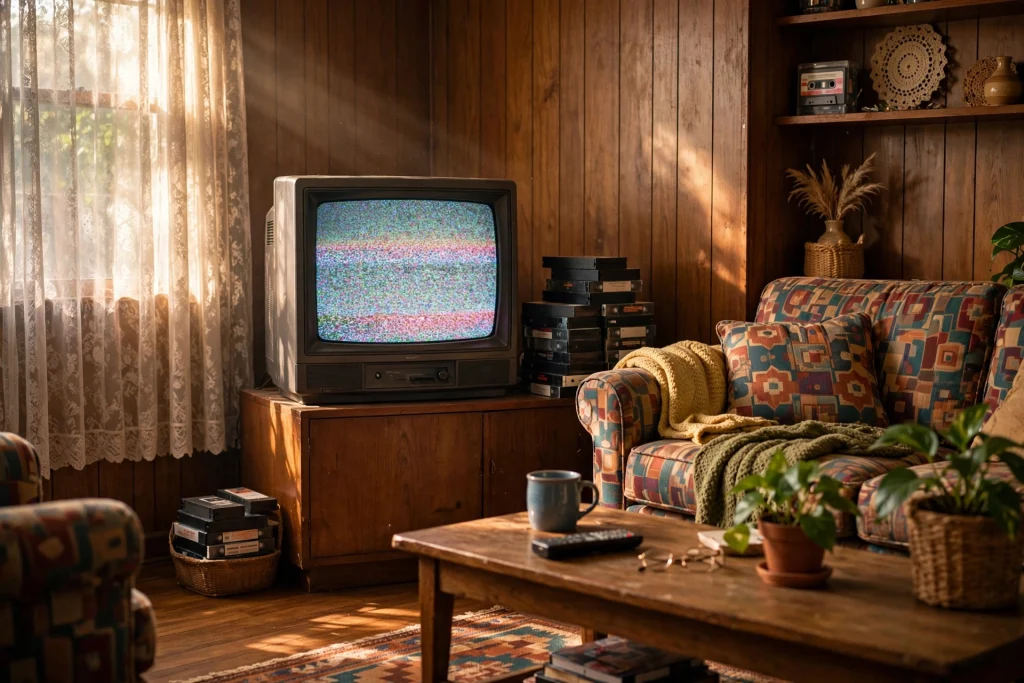
Before streaming gave every living room a thousand movies, there was a place. It had a blue and yellow sign you could spot from the highway, a parking lot that filled up like a stadium on Friday nights, and aisles so full of possibilities that choosing a single movie could take an hour. For a whole generation, the video rental store wasn’t just a shop — it was the weekend itself.
Ask anyone who grew up in the eighties or nineties about Friday night, and their eyes go a little soft. The school week is done, the work week is done, and the whole family piles into the car with one glorious destination. Not a restaurant. Not a mall. The video store. What happened inside those walls — the browsing, the bargaining, the betting — has no modern equivalent. It was a ritual, and rituals leave a deeper mark than routines ever do.
The Friday Night Pilgrimage
Every Friday, right around dinnertime, the migration began. Cars pulled into the lot in waves. Parents herded kids toward the entrance while the kids sprinted ahead, because the best titles went fast and everybody knew it. The doors slid open and the first thing that hit you was the smell — that strange, wonderful cocktail of plastic cases, warm carpet, and popcorn oil from the little snack counter. No other store smelled like that. You could identify it blindfolded.
There was a choreography to it. Dad went one direction, mom went another, and the kids scattered like marbles. Someone would call out a title from three aisles away — “They’ve got it! They’ve got it!” — and suddenly half the store was converging on the same shelf. Friday night at the video rental store was half shopping trip, half treasure hunt, and fully an event. Nobody treated it like an errand. It was the first act of the weekend.
And the clock was ticking in a way nobody thinks about anymore. Most stores had a one- or two-night rental period for new releases, which meant your movie had to be watched that night. There was no “we’ll get to it on Sunday.” The tape went in the VCR the moment you got home, and the family gathered around the television like it was a campfire. The deadline gave the evening a shape — a beginning, a middle, and an end, all decided together.
The New Releases Wall — Always Empty
Every store had one, and every store’s was a cruel joke: the new releases wall, a glowing row of the hottest movies, nearly all of them marked “Rented Out.” You could browse the box art for half an hour and find maybe three actual tapes behind the display cases. The newest action movie? Gone. The comedy everyone was talking about at school? Gone. That horror movie you absolutely were not old enough for? Very gone.
It was frustrating and thrilling in equal measure. Scarcity did something to desire — a movie you might have shrugged at became precious simply because you couldn’t have it. And when you did beat the odds and find a new release sitting there, still in its case, the feeling was electric. People held those tapes up like trophies. You could hear the gasps down the aisle: “Someone found it! Someone actually found it!”
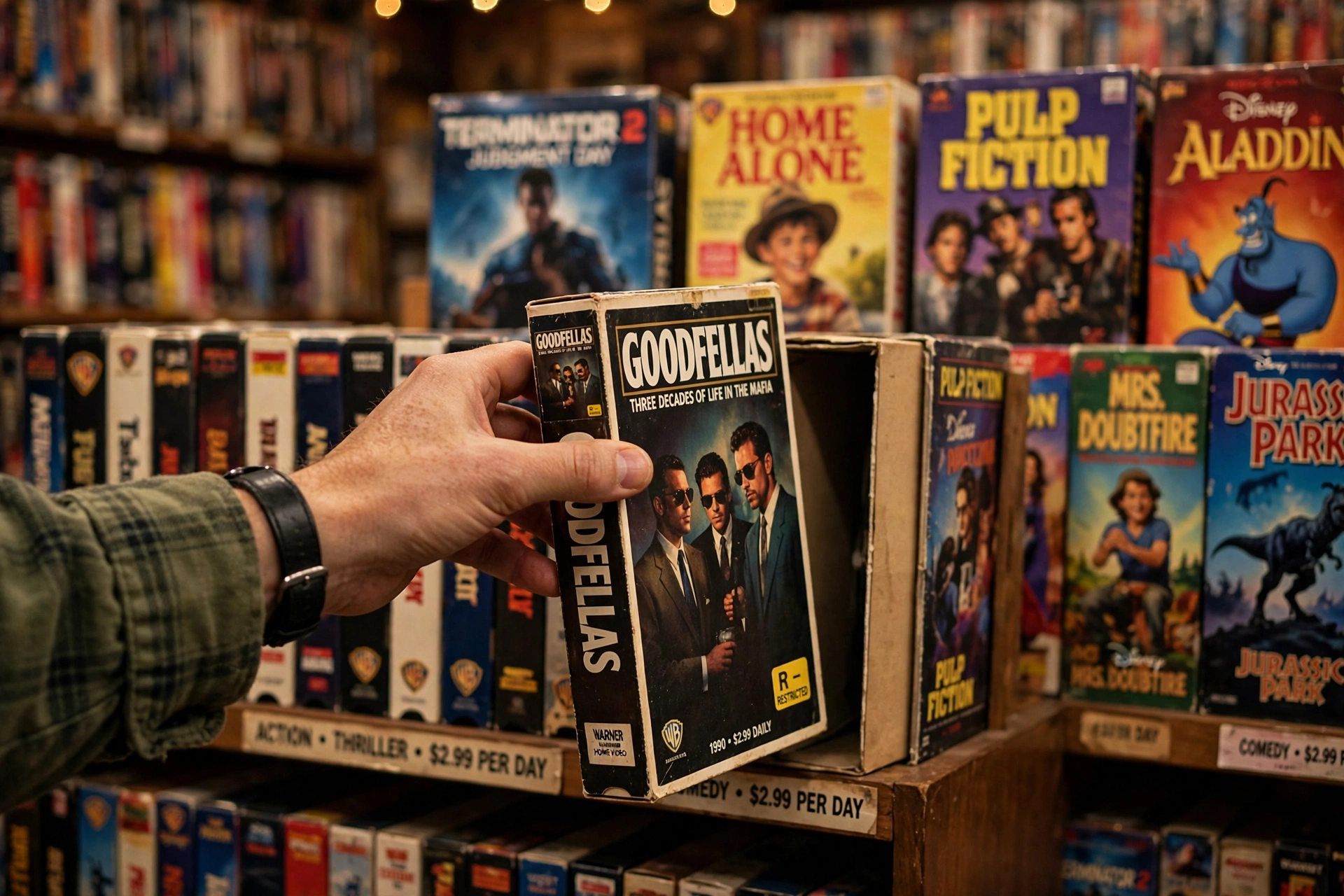
This is where the modern viewer has to work to understand. Today, if a movie exists, it’s available. You press a button and it plays. But in the video store era, wanting a movie and getting it were two very different things, and the gap between them was part of the fun. The hunt was half the entertainment. Kids learned patience, negotiation, and the fine art of the backup choice — skills that translated surprisingly well to the rest of life.
Browsing Was the Event
Nobody went to the video store knowing exactly what they’d get. Oh, sure, people had hopes — they’d go in wanting that one new release — but the real plan was always to browse. To drift. To let the cover art do its work.
And cover art worked. Those boxes were designed like tiny billboards, each one shouting for attention: the hero mid-explosion, the monster lunging from the darkness, the comedy stars making faces that promised exactly the kind of laughs you needed after a long week. Kids judged movies entirely by their covers, and everyone knew it was unreliable, and nobody cared. Sometimes the best Friday nights came from the tape you picked purely because the box looked cool.
The store was organized like a map of your imagination. Action and adventure along one wall. Comedy in the middle. Drama tucked toward the back, where it waited for the parents. And then there was the children’s section — a low, bright corner with boxes arranged at kid height, where the decision-making process was entirely democratic and entirely loud. Reading the backs of boxes became a family activity. Plot summaries were debated. Starring credits were weighed like evidence. “It says two hours long — is that too long?” “She’s the lady from that other movie!” The browsing was the evening. The movie was almost a bonus.
The Horror Aisle
Every store had a horror aisle, and every kid knew it was off-limits — which, of course, made it the most interesting place in the building. It sat there, usually toward the back or around a corner, glowing with lurid covers: skeletons, ghosts, grinning faces in the dark. Children dared each other to walk down it. The brave ones went in a pack, speed-reading the forbidden titles and sprinting back to the safety of the family section with new legends to tell.
The horror aisle was where kids first learned about ratings, reputation, and the magnetic pull of the forbidden. It was a rite of passage. Nobody was actually going to rent those tapes — the parents would never allow it — but standing in that aisle, reading those covers, felt like touching something dangerous. Ask anyone who grew up then: they can still picture exactly what those covers looked like, down to the color of the fake blood.
Candy, Popcorn, and the Counter Culture
No video rental trip was complete without the snack counter. Near the register sat the good stuff: microwave popcorn boxes, candy bars, sometimes a little freezer humming with ice cream. This was strategic genius on the store’s part. You came in for a movie and left with a full movie-night kit — the tape, the popcorn, the soda — all in one transaction. It was the original bundled experience.
And the counter was where the membership cards came out. Those little laminated cards, stamped with the store’s logo, felt like a passport. Kids memorized their parents’ membership numbers. Losing the card was a minor household crisis. Getting your own card — your name printed on it — was a small ceremony of growing up. The card meant you belonged. You were a customer in good standing, a person with rental privileges, someone the store trusted with its precious tapes.
Behind the counter, the clerks were the unsung heroes of the whole operation. They knew everything. Ask them about a movie and they’d tell you whether it was worth your two nights, what the good parts were, and — if you asked nicely — what was coming in next Tuesday. They were recommendation engines before the term existed, and they were better than any algorithm because they knew your family, remembered what you’d rented before, and could read your face when you described what you were in the mood for.
Late Fees and “Be Kind, Rewind”
Every paradise has its rules, and the video store’s rules were legendary. The first: late fees. Return the tape on time or pay the price — usually a dollar or two per day, which doesn’t sound like much until a forgotten tape sat under the couch for a week and suddenly cost more than the rental itself. The dread was real. Kids across the country knew the particular sinking feeling of spotting a rental tape on the back seat on Monday morning, one day too late.
Parents had systems. Notes on the fridge. Tapes placed by the front door the night before. The drop slot — that little metal flap on the outside of the store — became a familiar friend. Some stores had a drive-up return bin, and there was something oddly satisfying about sliding the tape through the slot and hearing it clatter home. It closed the loop. The ritual ended where it began.
The second rule was printed on stickers, repeated by clerks, and eventually became one of the most famous catchphrases of the era: “Be kind, rewind.” Before returning a tape, you were supposed to rewind it to the beginning so the next customer wouldn’t have to. The truly considerate rewound. The lazy didn’t — and everyone in line behind them knew. Some stores even charged a small fee for unrewound tapes, which turned the whole thing into a tiny moral test. Were you the kind of person who rewound? The video store knew your answer.
Running Into Your Neighbors
Here’s the thing that’s hardest to explain to anyone who didn’t live it: the video store was a social space. On a Friday night, you didn’t just browse — you ran into people. Neighbors, classmates, coworkers, the family from down the street. Conversations started over the comedy shelf. “Oh, did you see that one?” “Don’t bother — rent this instead.” Strangers became temporary film critics, trading reviews in the aisle like stock tips.
Kids spotted their friends and immediately began comparing hauls — whose family had grabbed the better titles, who’d gotten to the new releases first. Parents ran into other parents and the browsing paused for a chat. It was a community hub disguised as a retail store. You went in for entertainment and got a dose of neighborhood life along with it.
That social layer is what made the store irreplaceable. A streaming queue doesn’t know your neighbor’s name. An algorithm doesn’t pause mid-aisle to ask how your mom is doing. The video rental store belonged to the physical world, and the physical world had people in it — unpredictable, chatty, opinionated people who occasionally steered you toward the best movie you’d see all year.
Choosing Together vs. Scrolling Alone
Think about how movies get chosen now. Someone grabs the remote, and everyone else stares at a screen while titles scroll past in an endless, frictionless river. There’s no cost to browsing — no ticking clock, no limited copies, no closing time. And somehow, it’s harder. The paradox of the streaming age is that infinite choice made choosing miserable. Families spend forty-five minutes scrolling and then watch nothing, or everyone retreats to their own device and their own queue.
The video store solved this problem with constraints. The store closed at eleven. There were only so many copies. Your budget covered maybe two or three tapes. These limits forced a decision — and more importantly, forced a shared one. The family argued, negotiated, and eventually agreed. That process — the debate in the aisle, the compromise at the counter — was itself an act of togetherness. The movie you watched was a movie everyone had, in some small way, chosen.
Nobody is saying the old way was perfect. The empty new-release wall was genuinely annoying. Late fees were genuinely irritating. Driving across town in the rain to return a tape was genuinely a chore. But the constraints were doing quiet work: they made movie night an event with a beginning, a middle, and an end. They gave the evening a structure that streaming, for all its convenience, never quite replaced.
The Slow Fade: DVD, Redbox, and the Stream
The decline didn’t happen overnight — it happened in stages, each one making the store a little less necessary. First came DVD by mail. Suddenly you didn’t have to leave the house at all; the movies came to you in little red envelopes. It was clever and convenient, and it took a quiet bite out of the Friday night pilgrimage. Why drive to the store when the mailbox could be the store?
Then came the kiosks — those glowing red vending machines outside grocery stores, renting DVDs for a dollar a night. They were fast and cheap and utterly soulless. You punched a screen, grabbed a disc, and left. No browsing. No neighbors. No clerks with opinions. It was the video store with everything stripped out except the transaction — and for a while, that seemed like enough.
And then, of course, streaming arrived and changed the geometry entirely. Why rent a physical object when the movie could live inside the television itself? The economics were brutal: a monthly subscription cost less than a few rentals, offered thousands of titles, and never charged a late fee. One by one, the stores emptied out. The blue and yellow signs came down. The shelves went bare. By the early 2010s, an institution that had defined weekends for two decades was mostly gone — a victim, ironically, of giving people exactly what the store had always promised: movies at home.
The numbers tell the story of a giant. At its peak, the biggest chain operated thousands of stores and was a household name across the country — a company so dominant that its history reads like a case study in both triumph and collapse (Blockbuster’s full story on Wikipedia). It passed on buying a small DVD-by-mail startup that would eventually help bury it. Hindsight makes that decision look like madness; at the time, it looked like common sense. The store model was working. Why fix what wasn’t broken? Nobody saw the stream coming until it was already in the living room.
What the Drive-In Taught Us About Rituals
The video store wasn’t the only movie ritual of its era — it belonged to a whole ecosystem of shared watching. The drive-in theater offered its own version: the car as living room, the stars as ceiling, the whole family piled into the back seat for a double feature. Both rituals understood the same truth — that how you watch matters as much as what you watch. The journey to the screen was part of the show.
There’s a reason these rituals inspire so much longing. They were bounded experiences: you went somewhere, you did something, it ended. Modern entertainment is unbounded — it never ends, never closes, never asks you to decide. The drive-in closed when the second feature ended. The video store closed at eleven. And somehow, those limits made the experience feel larger, not smaller. A frame makes a painting.
The Commercials Between the Movies
The video store era came with its own advertising ecosystem — and if the store taught the ritual of choosing, the era’s commercials taught the soundtrack. Those old TV jingles and childhood ads played in the background of every rental decision: the pizza chain promising the perfect movie-night dinner, the soda brand selling itself as the official drink of Friday night. The store shelves themselves were a form of advertising — every box cover competing for your attention like a tiny thirty-second spot you could hold in your hand.
Kids absorbed it all. The jingles stuck in heads for decades. The mascot characters became as familiar as the movie stars. And the store amplified it: end-cap displays, cardboard standees of the season’s biggest release, the “staff picks” shelf with its handwritten notes. It was marketing you could walk through, and walking through it was fun.
Why the Nineties Remember It Best
The video store’s golden age lined up perfectly with the 1990s — the decade when home entertainment hit its stride. VCRs were in nearly every living room. The movie industry was producing the blockbusters that would define a generation. Friday night rentals were how kids saw the big films they’d missed in theaters, how families caught up on the comedies everyone quoted at school, how teenagers stocked up for sleepovers.
For kids of the nineties, the store is woven into the texture of childhood itself — right alongside the toys, the cartoons, and the snacks. It wasn’t a luxury or a novelty. It was infrastructure, as normal as the grocery store or the library. That’s why the memory hits so hard now: losing the video store wasn’t like losing a product. It was like losing a place. And places are harder to replace than products, because places hold people.
What We Actually Lost
Strip away the romance, and the question remains: what did the video store give us that we don’t have now? It wasn’t the movies — we have more of those than ever. It wasn’t the convenience — streaming wins that contest without breaking a sweat. What it gave us was friction, and friction turned out to be doing a lot of quiet work.
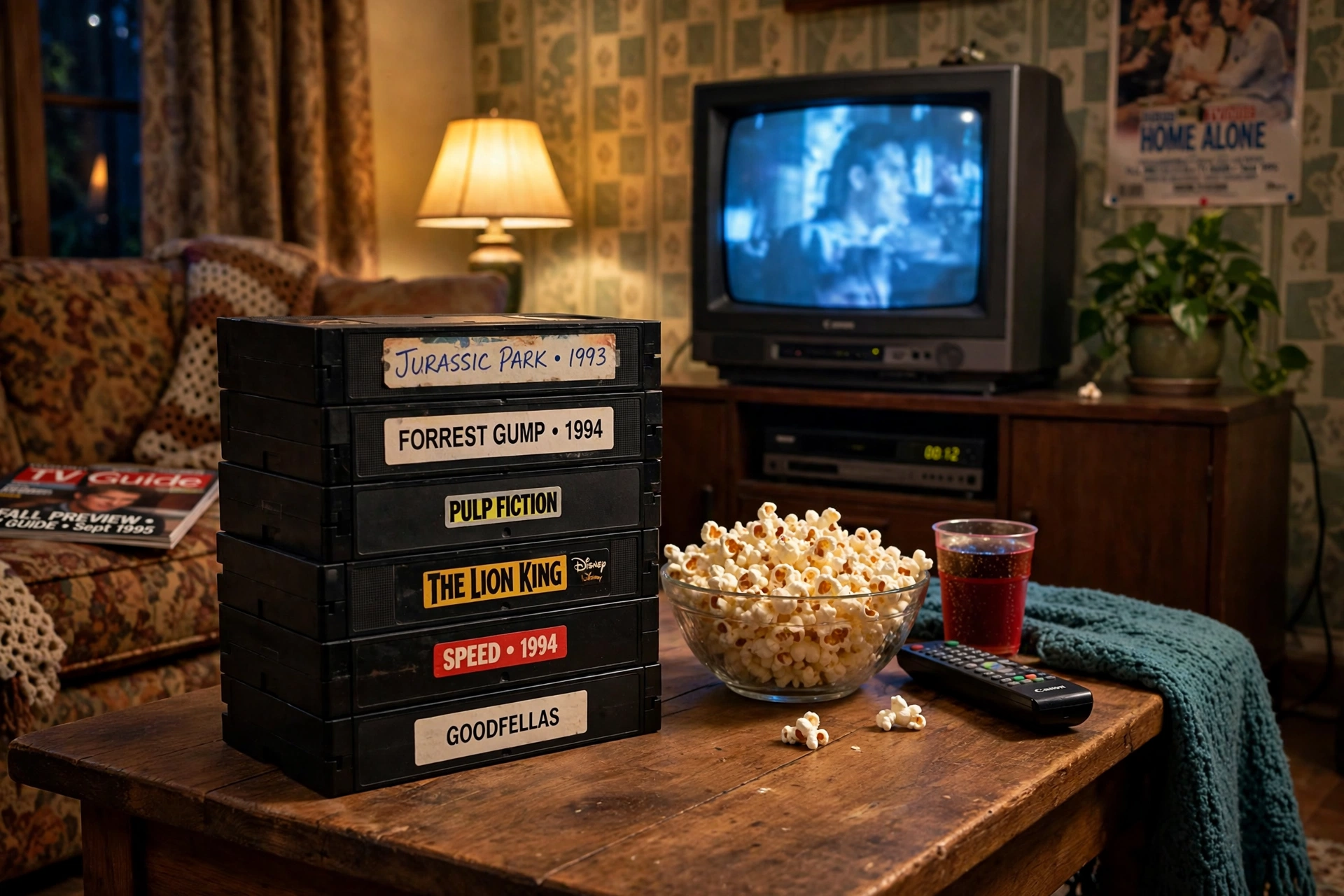
The friction of scarcity made choices matter. The friction of the trip made it an occasion. The friction of the deadline made the evening happen now, not “sometime.” And the friction of the physical space — the aisles, the neighbors, the clerks — made it social. Every one of those frictions has been engineered away, and every one of them was load-bearing.
None of this is an argument for bringing the stores back. The economics don’t work, the technology moved on, and nobody actually wants to pay late fees again. But it’s worth naming what disappeared, because naming it is the first step to rebuilding it in new forms. The family that picks a movie together on a Friday night — phones down, debate allowed, one choice, everybody in — is doing the video store ritual with new tools. The tradition was never really about the tapes. It was about the choosing, together.
The Smell of the Carpet
So here’s the final image, the one that lingers longest: you push through the doors on a Friday night, and there it is — that smell of plastic and popcorn and possibility. Your sneakers squeak on the carpet. The new releases wall glows at the end of the aisle, mostly empty, taunting you. Your family fans out in different directions, and for the next hour, the whole weekend is unwritten.
Somewhere in that building is the perfect tape. You just have to find it. And the finding — the browsing, the debating, the dare down the horror aisle, the clerk’s whispered recommendation, the victory of spotting one copy left on the shelf — the finding was the point all along. The movie was just the excuse.
Streaming gave us every movie ever made. The video store gave us Friday night. Ask anyone who grew up then which one they’d trade — and watch their eyes go soft.