Table of Contents
I was seven the first time I heard my father admit the magic words out loud: “We’re lost.” We had been driving for hours through countryside that all looked the same — cornfields, fences, more cornfields — and somewhere between the last gas station and the setting sun, Dad had taken a wrong turn. Mom was navigating with a map the size of a bedsheet, I was wedged between my sister and the cooler in the back of our station wagon, and none of us was even a little bit worried.
Because road trips before GPS were never really about getting there. They were about getting wonderfully, gloriously lost together — and finding your way back with a story you’d tell for years.
These days my phone tells me which lane to be in before I’ve even wondered. There’s no unfolding, no refolding, no heated debate over whether the blue line or the red line is Route 41. And you know what? I miss all of it. I miss the whole beautiful mess of road trips before GPS — the paper maps, the gas-station directions, the backseat games, the thermos lunches, the neon motel signs. So let’s go back, shall we? Let’s remember what the open road felt like on road trips before GPS, when the only navigation system you owned was a folded piece of paper and your father’s unshakeable confidence.
The Glove Compartment Bible: Road Trips Before GPS Ran on Paper Maps
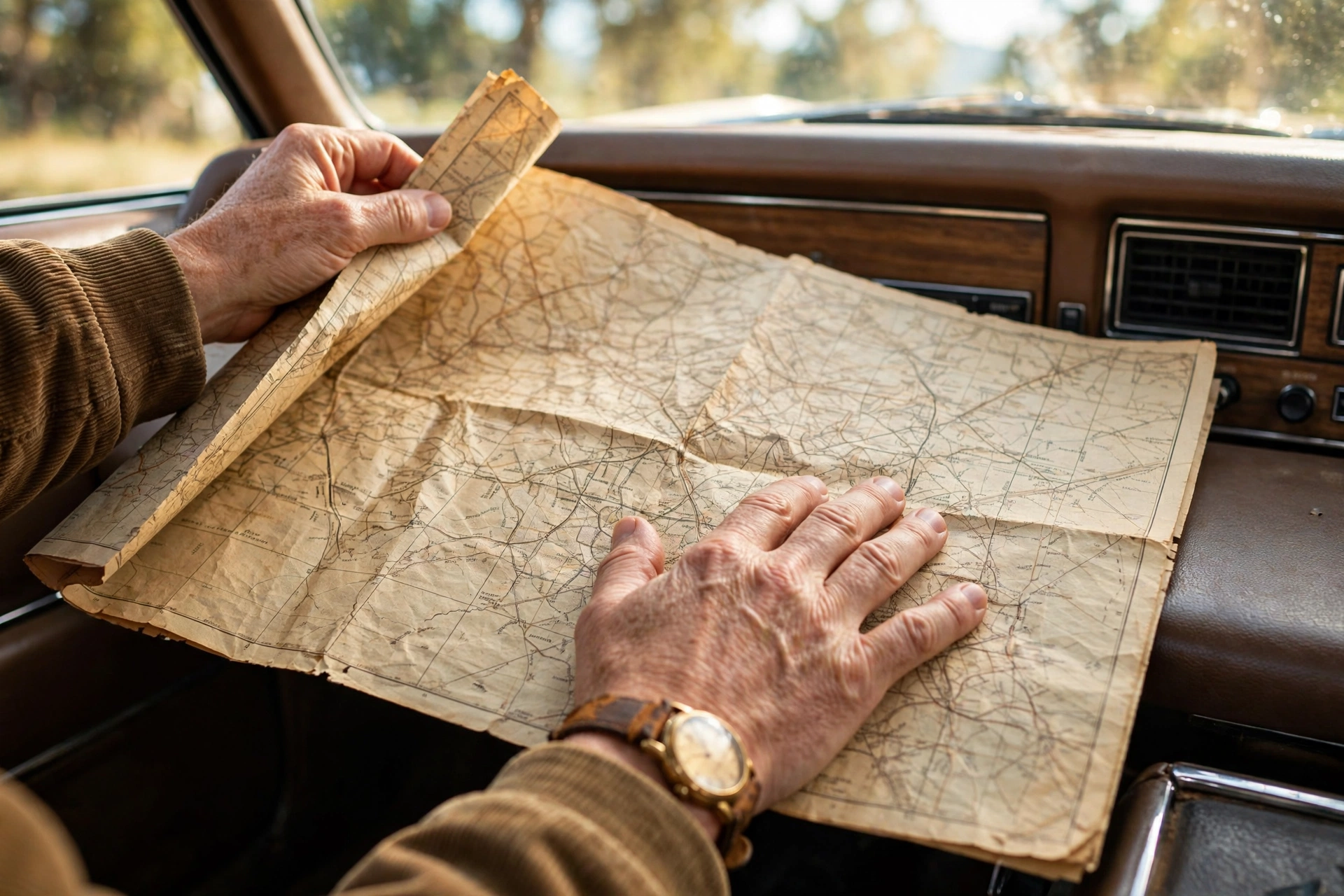
Every family car had one. Ours lived in the glove compartment, a spiral-bound road atlas held together with masking tape and pure stubbornness, its pages soft from a decade of thumbs. Dad called it “the bible,” and he wasn’t joking. Before a big trip he’d sit at the kitchen table the night before, tracing our route with a yellow highlighter, marking the cities we’d pass in careful block letters. That glowing yellow line was our itinerary, our promise, our plan — drawn by hand, smudged by summer sweat, and completely irreplaceable.
Reading a map in a moving car on road trips before GPS was its own art form. You had to fold the giant sheet down to just the quadrant you needed — a skill that took adults years to perfect and children about five minutes to destroy. Mom would hold it with both hands, squinting at the tiny print, calling out, “Okay, we’re looking for County Road J,” while Dad kept his eyes on the windshield and said, “I know, I know, I saw it.” He had not seen it.
Crossing a state line was a small celebration in itself, because it meant stopping at the welcome center to grab a brand-new state map — free, crisp, smelling of fresh ink — and retiring the old one to the growing stack under the seat.
Those paper maps were everywhere, and they were beautiful in their way — whole printed worlds of possibility in reds and blues, dotted with little symbols for scenic overlooks and historic sites that made every drive feel like a treasure hunt. Gas stations gave them away for free with a fill-up. If you’re curious how this humble folded wonder came to be, the history of the road map is a lovely little rabbit hole.
But here’s what no encyclopedia entry can capture: the sound of your dad snapping a map open with one hand while steering with the other, the way the whole family leaned in when Mom found our tiny dot of a town, the triumph of folding it back up correctly — a feat so rare it deserved applause.
The Sacred Ritual of Asking Directions at the Gas Station
Every dad had a limit. Dad could drive forty miles in the wrong direction before his pride cracked, but crack it did — usually around the time Mom said, very quietly, “We should have turned back there.” That’s when the sacred ritual began: pulling into the nearest gas station to ask directions. The attendant, or some local leaning against the ice machine, would squint at our license plate, grin, and launch into directions that made absolutely no sense on paper. “Go on up past the Miller place, take a left where the old oak used to be, and if you hit the creek you’ve gone too far.” And somehow — somehow — it worked.
There was something deeply human about it that I didn’t appreciate until years later. A stranger, with no rating system and no reviews to protect, would take five minutes out of his day to draw you a little map on a napkin, or even say the words every lost traveler dreamed of: “Just follow me, I’m headed that way.” Try getting that from a blue dot on a screen. These exchanges ran on trust and small-town generosity, and they turned anonymous highway miles into something personal. You arrived at your destination carrying not just your luggage but a story about the man at the Texaco who saved your vacation.
I’ll be honest — half the time Dad only stopped because Mom made him. But those forced stops became some of my favorite memories. Stretching our legs, buying a cold soda from the machine out front, watching the attendant wash our windshield with that long squeegee. The car smelled like gasoline and possibility. And when we pulled back onto the highway, armed with napkin directions and renewed confidence, it felt like the trip had officially begun — again.
Backseat Games: Surviving Six Hundred Miles on Imagination Alone
Eight hours a day in the backseat on road trips before GPS — no screens, no headphones, no tablets — just three kids, a window each (if you were lucky), and imaginations running at full speed. The license plate game was our championship sport. Spot a plate from every state, first one to call it gets the point, and Hawaii was basically a mythical creature — worth triple. I still remember the eruption in our car when we spotted an Alaska plate in Ohio. My sister claimed she’d seen it first. She had not. We are still not over it.
Then there was I Spy, which always started innocent and ended in tears because someone picked “something blue” and the answer was “the sky.” Twenty Questions. The alphabet game, where you raced through A to Z using billboards and road signs — Q and X could stall you for entire states. And the quiet games, too: counting cows, making up stories about the houses we passed, inventing dramatic backstories for the truck drivers in the next lane. Kids on road trips before GPS didn’t need entertainment piped in. Give us a window and four hundred miles and we’d build entire worlds out there.
Of course, the backseat was also a war zone. “She’s touching me!” “Mom, he’s breathing on me!” Mom had the ultimate weapon: the threat of Dad pulling over, which he absolutely would do — arms crossed, engine idling — until we negotiated a peace treaty. Looking back, those made-up games carried the same spirit as the street games we played back home — rules invented on the spot, arguments settled by whoever shouted loudest, and fun that cost exactly nothing. The car was just a playground doing sixty miles an hour.
The Station Wagon: America’s Rolling Living Room
Ours was a wood-paneled wagon the color of weak coffee, with the fake wood siding that was supposed to look classy and mostly looked like a station wagon wearing a disguise. The back folded down into a cavernous cargo bay that held the cooler, the suitcases, the pillow-fort supplies, and — on the way home — every souvenir we’d guilt-tripped our parents into buying. My favorite seat was the rear-facing third row, the “way-back,” where you watched the world recede behind you and waved at the drivers stuck behind Dad’s careful fifty-five.
Lunch was never at a restaurant. Mom packed the legendary picnic bag: fried chicken wrapped in wax paper, still faintly warm; sandwiches cut into triangles; a thermos of lemonade sweating in the heat; and a bag of chips that Dad was not allowed to open until we’d crossed at least one state line — his rule, enforced ruthlessly. We’d pull into a rest area, claim a splintery picnic table under the pines, and eat with the highway humming in the background. It tasted better than any restaurant. Everything does when you’re eating it outside, halfway to somewhere wonderful.
And the windows — always down, at least halfway. Air conditioning was a luxury our wagon technically had and practically never used, because Dad insisted it “wasted gas.” So we rode with the wind roaring through, hair tangled into bird nests, shouting conversations over the rush of air. You arrived at the motel looking like you’d been through a wind tunnel, and you didn’t care one bit.
Roadside Attractions and the Tourist Traps Nobody Could Resist
The billboards started fifty miles out, and resistance was futile. “WORLD’S LARGEST BALL OF TWINE — 12 MILES!” “SEE THE MYSTERY SPOT — DEFY GRAVITY!” “SNAKE FARM — LIVE RATTLESNAKES!” Dad would groan and grip the wheel tighter, but we all knew the truth: he wanted to see the giant twine ball as much as we did. These glorious roadside oddities sprang up along America’s highways — many of them riding the great road-building boom of the Interstate Highway System — and stopping at them wasn’t a detour. It was the whole point.
Some were magnificent. Some were a shed with a painted sign and a man who would tell you, with total sincerity, that the two-headed turtle was “a miracle of nature.” We didn’t care. We bought the postcards, posed for the photos, drank the watered-down lemonade, and carried those silly souvenirs home like treasure. The tourist trap understood something the GPS never will: nobody remembers the efficient route. Everybody remembers the place where the alligator wore sunglasses.
Motels With Pools: The Nightly Reward
As the sun dropped, Dad started scanning the horizon for the most beautiful sight in America: a neon VACANCY sign, buzzing and glowing against the dusk. The motel didn’t need to be fancy — it needed a pool. That was the entire criteria. We’d tumble out of the car, stiff and sun-drunk, and before the bags were even unloaded we’d be begging: “Can we swim? Please? Just for a little bit?” And Mom, bless her, almost always said yes.
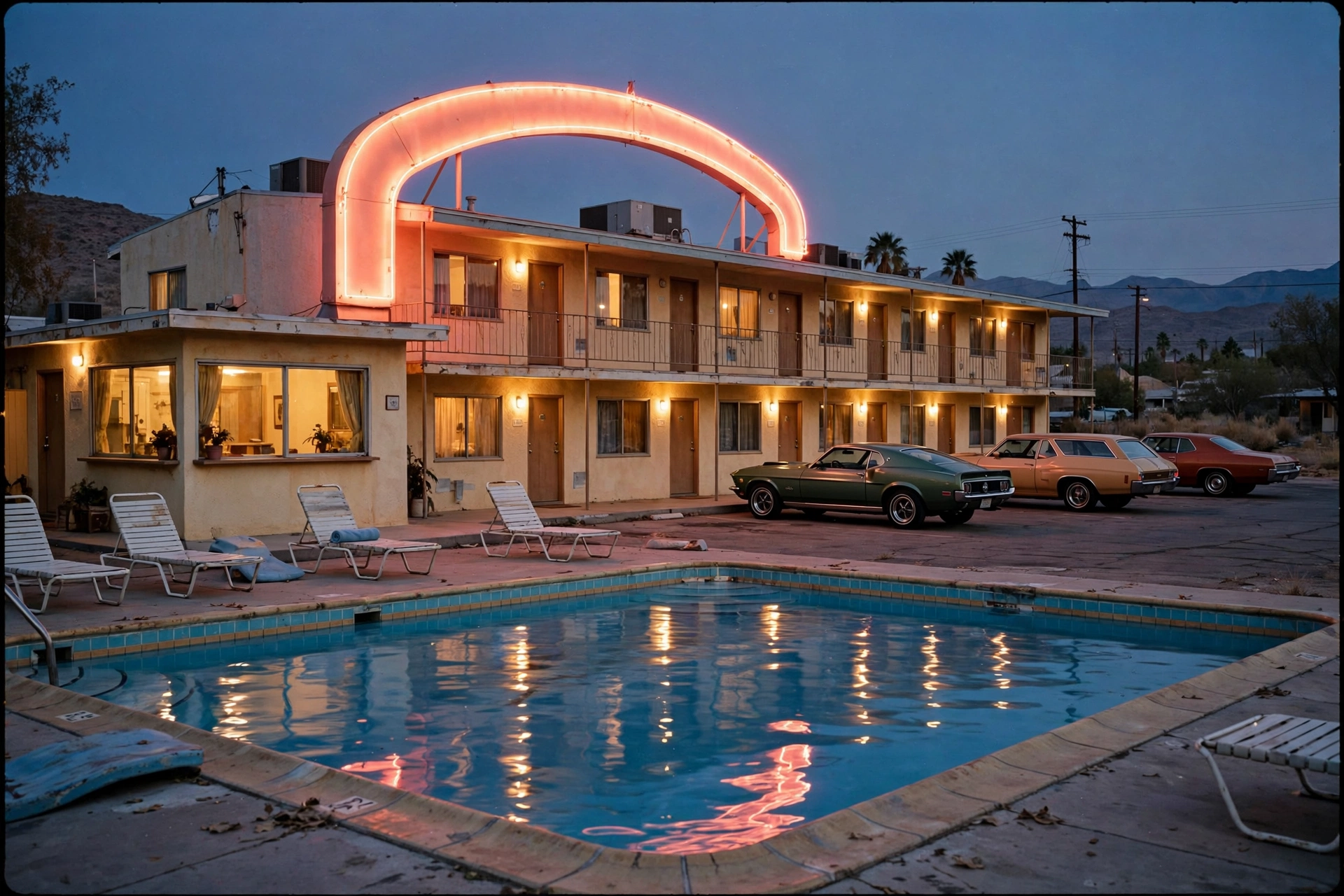
Those pools were paradise — a glowing rectangle of blue under the string lights, the smell of chlorine, the slap of wet feet on concrete. We’d swim until our lips turned blue while Dad figured out the ice machine and Mom laid out tomorrow’s clothes. Back in the room: the little wrapped soaps, the bed that vibrated if you fed it quarters (Dad said absolutely not; we tried anyway), the TV with exactly seven channels. Dinner was whatever the town had — a diner, a pizza place, drive-through burgers eaten cross-legged on the motel beds. It wasn’t luxury. It was better than luxury. It was the road, giving you exactly what you needed.
What GPS Took Away (and What It Can Never Steal)
Here’s the truth nobody puts in the app store reviews: the journey genuinely mattered more than the destination. Getting lost gave us the diner with the legendary pie. The wrong turn gave us the swimming hole. The detour gave us a sunset over a valley we’d never heard of, with all of us gone quiet in the car, watching the sky do something spectacular.
Efficiency was never the point. The point was the hours — long, meandering, unrepeatable hours — when the whole family was sealed inside one car, going somewhere together. Evenings on the road had their own kind of small-town magic, the same glow we wrote about in our piece on drive-in theaters under the stars — America entertaining itself, one carload at a time.
And the radio! The only entertainment system we had on road trips before GPS, and honestly all we needed. Dad worked the dial like a safecracker, catching stations as they faded in and out — a ball game here, an oldies station there, a preacher, a farm report, static, and then suddenly the perfect song crackling through. We’d all sing, badly and loudly, windows down. No playlists, no algorithms, no skipping. Just whatever the road decided to give us, and it was always enough.
GPS is a marvel, and I’m not giving up my phone. But every now and then, I take the long way on purpose, chasing the spirit of road trips before GPS. I leave early, I don’t check the traffic, and if I see a hand-painted sign for the world’s largest anything, I take the exit. Because somewhere in the back of my mind, a seven-year-old is still wedged between his sister and the cooler, watching the cornfields roll by, completely unafraid of being lost — because getting lost on road trips before GPS, it turns out, was the best part of the trip.
Pingback: Drive-In Restaurants: Carhops, Trays and Neon Nights