Close your eyes for a second. Go on, I’ll wait. Now tell me you can’t smell it: that warm, steamy cloud of brown gravy, baked bread, and something faintly sweet that rolled over you the moment the cafeteria doors swung open. School cafeteria food memories don’t live in the same part of the brain as the rest of childhood. They’re deeper. Warmer. A little weirder. You can forget your locker combination, your third-grade teacher’s name, even which bus was yours — but you will never, ever forget the taste of that rectangular pizza.
It didn’t matter what decade you grew up in or which state, because the menu was somehow the same everywhere. The same Salisbury steak drowning in the same brown gravy. The same tater tots, golden and dangerously hot. The same little milk cartons you had to pinch open with fingers that were never quite strong enough. Somebody, somewhere, decided what an entire generation of kids would eat for lunch — and honestly? Most of us wouldn’t trade those meals for anything.
This is for everyone who ever stood in that line, tray in hand, stomach growling, trying to peek past the kid in front to see what was in the steam trays today. Let’s go back.
The Smell Hit You Before the Doors Even Opened
The school hallway had its own smell — floor wax, pencil shavings, that dusty warmth that came off the radiators in winter. But as you got closer to the cafeteria, something changed. The air got heavier. Steamier. Your stomach would do this little flip, like it knew something your brain hadn’t caught up to yet.
Then the double doors, and the noise. Oh, the noise. A thousand trays clattering, chairs scraping across tile, somebody laughing too loud three tables over, the low roar of two hundred kids all talking at once. And underneath it all, the clink-clink of the lunch ladies’ serving spoons against the big metal pans.
You shuffled forward in line, tray balanced, and did the thing every kid did: the lean. That sideways lean past the kid ahead of you, craning your neck to see what was in the trays. Please be pizza day. Please be pizza day. And when it was? The whole line would buzz. News traveled faster than the lunch line moved. Pizza day was practically a school holiday.
Here’s the thing nobody tells you as a kid: you weren’t just hungry. You were part of something. The lunch line was the great equalizer. Rich kids, poor kids, the class clown, the quiet girl who read at recess — everybody stood in the same line, held the same beige tray, and ate off the same compartment plates. For forty-five minutes a day, the whole school was one big, noisy, gravy-scented family.
Mystery Meat Mondays and the Legends of the Lunch Line
Every cafeteria had a day that kids talked about in hushed, dramatic tones. At my school it was Monday. Monday was mystery meat day, and the name was not an exaggeration — nobody, and I mean nobody, could tell you with confidence what animal you were eating.
It arrived as a grayish-brown patty or a ladle of something chunky, always buried under a thick blanket of gravy, like the gravy was there to protect its identity. You’d poke it with your fork, hold it up to the light like a detective examining evidence — and then, because you were eight and starving, you’d eat it anyway. And you know what? It was usually pretty good. That’s the part nobody admits.
Nobody chose the mystery meat. The mystery meat chose you. And somehow, thirty years later, you’d give anything to taste it one more time.
Salisbury Steak: The King of Questionable Meat
Salisbury steak was the crown jewel of the mystery meat lineup. A dense, oval patty swimming in brown gravy, usually parked next to a scoop of mashed potatoes and something green that nobody touched. The gravy was the whole operation — thick, salty, peppery, the kind of gravy that could make a shoe taste comforting.
Kids had theories. Wild ones. It was a running joke that never got old, the kind of joke where the punchline was always the same and everybody laughed anyway. Was it beef? Was it… something else? The lunch ladies would just smile when you asked. That smile said everything and nothing. And the mashed potatoes — instant, obviously, but drowned in that gravy they became something transcendent. You’d build a little volcano, fill the crater with gravy, and eat it like the delicacy it was.
Sloppy Joes: Delicious Chaos in a Bun
If Salisbury steak was the king, the sloppy joe was the court jester — messy, ridiculous, and beloved by all. Ground meat in sweet, tangy tomato sauce, piled onto a soft hamburger bun that immediately surrendered. It was called sloppy for a reason. You didn’t eat a sloppy joe so much as you survived it.
There was a technique, and every kid developed their own. Some went in with both hands and accepted the consequences. Some tried the fork-first approach, which the purists considered cheating. Napkins were deployed like sandbags against a flood. By the end, your tray looked like a crime scene and your face needed a full wash, but you’d be grinning. The sauce got everywhere because joy gets everywhere. That’s just how it works.

The Holy Rectangle: School Pizza That Ruined All Other Pizza
Let’s talk about the pizza. Not round pizza. Rectangle pizza. A perfect, glorious rectangle of thick, bready crust with sauce and cheese baked right onto it, cut from a giant sheet pan and slapped onto your tray still steaming. If you grew up eating school lunch, you know exactly what I’m talking about, and your mouth is watering right now.
That rectangle of pizza ruined every round pizza that came after it — and I mean that as the highest compliment. The crust was thick and chewy, almost like focaccia, with those little air pockets that soaked up the sauce. The cheese was… well, the cheese was its own thing. Not mozzarella like the pizza place used. Something meltier. Stretchier. The kind of cheese that formed those long, impossible strings when you pulled a bite away, strings that could stretch across the whole table while your friends cheered.
And the pepperoni — when you got pepperoni — curled up into little crispy cups that held tiny pools of grease. You’d tilt the slice and watch it run. Some kids blotted it with a napkin. Those kids were wrong, and we all knew it.
Here’s the mystery that still haunts me: why can’t anyone recreate it? People have tried — whole corners of the internet are devoted to reverse-engineering that crust, that sauce, that cheese. It never tastes right. Maybe the secret ingredient was being ten years old, sitting at a long table with your best friends while somebody told a joke so funny that milk came out of somebody’s nose. You can’t bake that into a crust.
Tater Tots, Jell-O Cubes, and the Sides We Fought Over
The main dish got the glory, but the sides? The sides were where cafeteria legends were really made. A perfect tater tot — crispy shell, fluffy potato center, salt clinging to every ridge — was worth its weight in gold. Kids would trade for them. Kids would fight for them. Not real fights, mostly. Mostly.
Then there were the Jell-O cubes. Bright red or electric green, wobbling in little plastic cups or sitting in a quivering square right on the tray. You’d poke it and watch it jiggle. You’d try to eat it in one bite and fail spectacularly. Somebody always tried to see if it would bounce. It never bounced, but the attempt was always worth it.
The Chocolate Milk Carton: A Tiny Masterpiece
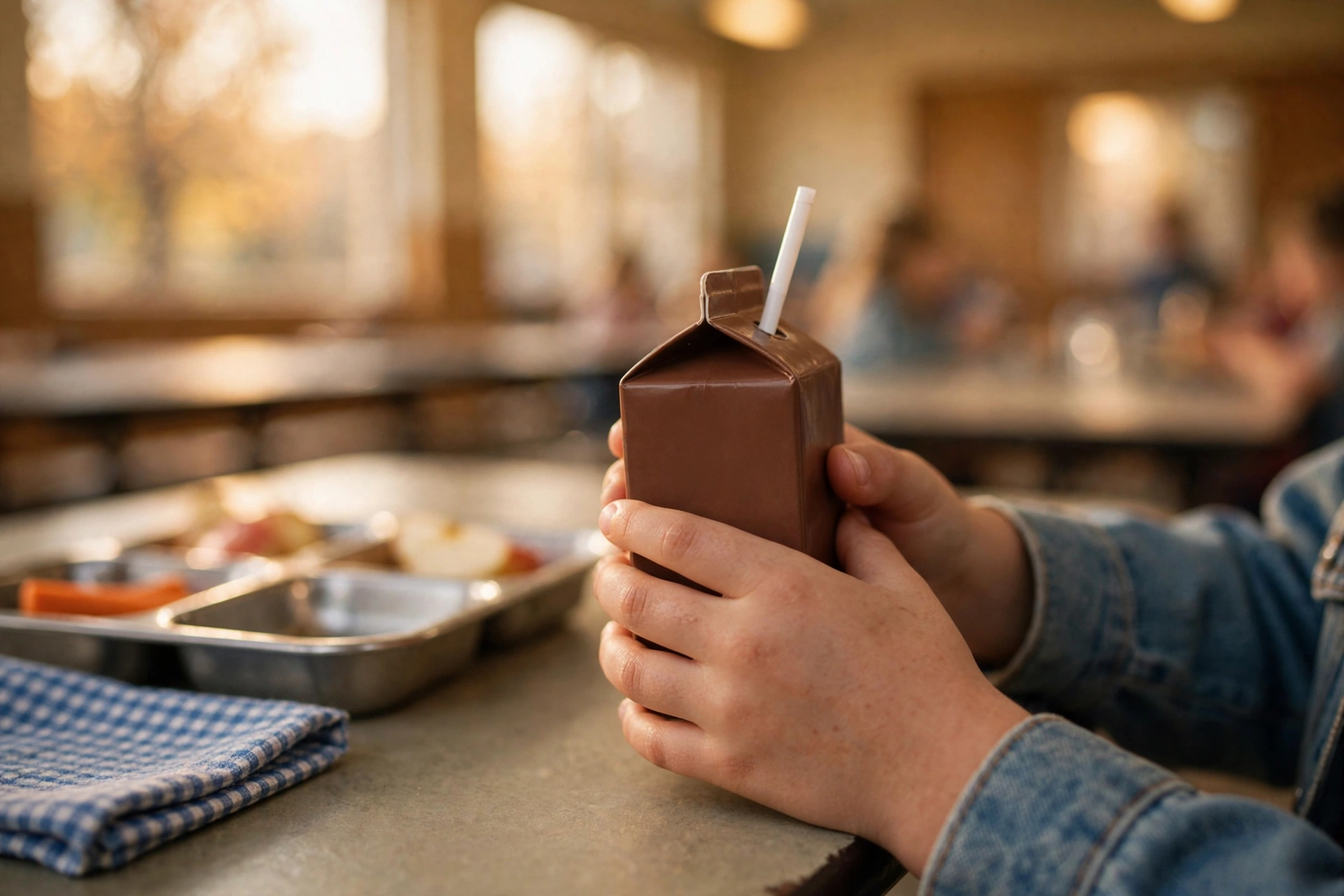
Can we take a moment for the chocolate milk carton? That little half-pint of joy was engineering genius wrapped in waxed cardboard. You’d pinch the top, pop it open, and unfold that little spout — if you were lucky and your fingers cooperated, which was never guaranteed before age nine.
And the straw. That skinny little straw that came in its own paper sleeve, which you’d stab through the top of the carton with the confidence of a surgeon. Sometimes it worked perfectly. Sometimes the straw bent. Sometimes — the worst outcome — the straw punched straight through the bottom and chocolate milk started leaking onto your tray, and you’d have to drink fast, like it was a race, while your friends howled with laughter.
Chocolate milk day made regular milk day feel like a personal insult. If the cooler was out of chocolate and only white milk remained, you’d hear actual groans ripple through the line. It was the original supply-and-demand crisis, and we lived through it every single week.
The Lunch Ladies: The Real Heroes of Our School Cafeteria Food Memories
Behind every great school cafeteria food memory stands a lunch lady. Hairnet on, apron tied, serving spoon in hand like a scepter. These women — and they were almost always women — fed hundreds of kids a day, remembered who was allergic to what, and somehow knew when you were having a bad day before you’d said a single word.
The lunch lady knew your name, your order, and exactly how your day was going before you opened your mouth. She’d slide an extra scoop of mashed potatoes onto your tray with a wink when the teacher had been rough on you that morning. She’d say “there you go, sweetie” or “eat up now, honey” in a way that made the whole noisy cafeteria feel a little smaller and a lot warmer.
Every school had the strict one, too. The one with the ladle who ran a tight ship and did not tolerate line-cutting, tray-banging, or any nonsense whatsoever. Kids were terrified of her. And you know what? Years later, she’s the one everyone remembers most fondly. Because she was fair. Because she kept order in the chaos. Because when she finally smiled at you — really smiled — you felt like you’d won something.
They arrived before sunrise to start the ovens and stayed after the last tray was washed to mop the floors. They did it for paychecks that were never big enough, with an everyday heroism most of us only recognize decades later — usually around the time we’re packing our own kids’ lunches and finally understand.
Lunch Tickets, Token Lines, and Trading-Table Economics
Before there were PIN codes and lunch accounts, there were tickets. Little paper tickets, sometimes color-coded by day, that you’d buy in strips from the office or that your mom would paperclip to your shirt pocket so you wouldn’t lose them. Losing your lunch ticket was a five-alarm emergency. Finding someone else’s lost ticket on the playground made you feel like you’d discovered buried treasure — and then guilty, because you knew exactly how it felt to lose one.
Some schools used tokens or punch cards, punched with a satisfying ka-chunk — and those punches never lasted until Friday. Somehow, they never lasted until Friday.
And then there was the trading table — the unofficial stock exchange of the elementary school cafeteria. A sealed pudding cup was prime currency. Fruit snacks could get you almost anything. The kid who brought the homemade cookies from home was basically a millionaire, and everyone knew it. There were negotiations, there were bidding wars, there were deals you regretted instantly. “I’ll trade you my pudding cup for your brownie” remains one of the most consequential sentences ever uttered by an eight-year-old.
The whole economy ran on pure, unregulated childhood capitalism, and it was beautiful. It taught us negotiation, value assessment, and the harsh lesson that a warm cookie beats a cold apple every single time. These were the days of chalkboards, metal lunchboxes, and a whole old-school world where lunch was an event, not just a meal — and where the snacks we’d trade at the table were nothing compared to the 90s treats we’d tear into the second we got home.
A Quick Bite of Real History
Here’s something that surprised me: the school lunch line is way older than our memories of it. Philadelphia and Boston were serving penny lunches to schoolchildren back in 1894, and during the Depression the government started sending surplus farm food to schools — feeding kids and helping farmers at the same time. In 1946, President Truman signed the National School Lunch Act, making it official.
If you want to fall down a fascinating rabbit hole, the Smithsonian’s look back at a century of school lunches traces everything from those early penny lunches to the rise of frozen foods in modern cafeterias. And the USDA’s own history of the school meal programs tells the story of the women — the original lunch ladies, really — who started it all in church basements and settlement houses long before it was a federal program.
So when we get misty-eyed about tater tots and chocolate milk, we’re actually part of a story that’s more than a hundred years old. Generations of kids have stood in that line, leaned past the kid in front of them, and hoped for pizza day. We’re just the latest ones. There’s something deeply comforting about that.
Why We Can Still Taste Every Single Bite
Here’s what I’ve figured out, after all these years of thinking about it: it was never really about the food. I mean, the rectangular pizza was genuinely great, don’t get me wrong. But what we’re actually tasting when we remember those lunches is belonging.
The cafeteria was the one place in school where nobody had to perform. You didn’t have to raise your hand or get the right answer or run fast enough. You just had to show up, grab a tray, and sit down. For forty-five minutes, you were fed — literally and otherwise — by people who knew your name and kids who knew your jokes. That’s a rare and precious thing, and most of us didn’t appreciate it until it was gone.
So here’s my question for you, and I genuinely want to know: what was the legendary dish at YOUR school? Every cafeteria had one — the thing kids still talk about at reunions, the meal that would make you drive across town just to taste it again. Was it the pizza? The chicken nuggets? Some mysterious casserole that nobody’s been able to identify since 1987? Drop it in the comments. Let’s settle this once and for all: whose school lunch was the best?
Pingback: TV Dinner Memories: Foil Trays and Swanson Nights