The Bell on the Door, the Neon in the Window
You heard it before you saw it — the brass bell above the door, the clatter of thick white mugs, and out on the street, the neon sign in the window buzzing like it knew a secret it would never quite tell. If you carry classic diner memories anywhere in your bones, you know exactly what comes next.
The cold air chased you in. Inside, the air was warm and smelled like coffee, butter, and something sizzling on a flat-top grill — a smell so specific you could bottle it and call it “Saturday.” The counter stretched the length of the room like a runway, lined with chrome stools that spun if you were brave enough to give them a good whirl. Red vinyl booths hugged the windows, cracked just a little at the seams, worn smooth by ten thousand elbows. And somewhere, always, a waitress was already moving toward you with a pot of coffee in her hand.
You didn’t need a reservation. You didn’t need good clothes. You didn’t even need much money. The diner was the one place in America that asked nothing of you except that you come in and sit down. Was there ever a place that felt more like it was built just for ordinary people? The fancy restaurants downtown wanted your suit. The diner just wanted your company.
The Tabletop Jukebox: A Nickel’s Worth of Magic
And then there was the jukebox selector, bolted right to your table — a little chrome shrine with a curved glass top and a fan of colored buttons, each one glowing like candy. For kids of the fifties and sixties, that box was the first piece of interactive technology most of us ever touched. Before touchscreens, before remotes, before anything, there was this: you dropped in a nickel, punched in a code, and the whole universe played you a song.
Those tabletop selectors — the famous Seeburg Wall-O-Matic wallboxes were the best known — didn’t even hold the records themselves. They were remote controls, wired to a big jukebox somewhere by the restrooms or in the back room. You flipped through little printed title strips, argued with your friends about the best picks, and when your selection clicked in, you felt like the star of your own radio show. Three minutes of music, yours, in a room full of strangers. Have you ever felt richer than that on a nickel?

How a Nickel Bought the Whole Room’s Attention
Here’s the part I still can’t get over. One person would punch in a code, and the whole diner would hear it. The clank of forks would soften. Somebody in the back booth might start tapping a spoon on the table in time. Your song was everybody’s song now, and there was nothing to do but sit back and enjoy being the most generous person in the room. A nickel — a dime in the later years — and for three minutes the entire place belonged to your taste in music.
The Whole Table Voted on the Song
Of course, nobody let you pick alone. Choosing a song at the table was a democratic process and a contact sport. Your best friend would slap the selector cover down on your hand. “Not that one. That one.” Your date would roll her eyes and flip to her favorite. And somehow, through this deeply unscientific system, the table always landed on something everyone could sing along to. Do you remember the first song you ever picked out at a diner table? I bet you remember who was sitting across from you, too.
The music never really stopped in those years. Jukeboxes had been filling dance halls and diners since the 1930s, and after the war they became the beating heart of every teen hangout in America. Rock and roll needed a place to be heard, and the diner gave it a home with good lighting and better fries.
Where Classic Diner Memories Began: A Horse, a Wagon, and 1872
Believe it or not, every chrome palace we’ve been picturing started as a wagon. In 1872, in Providence, Rhode Island, a former newspaper pressman named Walter Scott hitched a horse to a modified freight wagon, loaded it with sandwiches, pies, and coffee, and parked it where the late-night workers were — outside the newspaper offices and the factories. Restaurants closed early back then. Workers still got hungry. Scott saw the gap and filled it, one cup of coffee at a time.
His idea was so good it got copied everywhere. By 1887, Thomas Buckley was commercially manufacturing lunch wagons in Worcester, Massachusetts — his were known as “White House Cafe” wagons — and a few years later Charles Palmer earned the first patent for the “Night-Lunch Wagon.” In 1906, the Worcester Lunch Car Company began building them like little buildings, and by the 1920s the word “diner” — borrowed from the dining cars on passenger trains — had stuck for good. If you want the full timeline, Wikipedia’s full history of the American diner lays it all out beautifully.
Out in New Jersey, the Jerry O’Mahony Diner Company built some 2,000 diners between 1917 and 1952 and helped turn the state into the diner capital of the world. And this deep dive into Walter Scott’s story walks through how a horse-drawn cart on a Providence street became one of the most recognizable icons in American life.
Chrome Palaces on the Edge of Town
Then came the golden age, and oh, did it shine. After World War II, diners stopped looking like wagons and started looking like the future. Stainless steel siding. Rounded streamliner curves borrowed from trains and airplanes. Neon signs you could see from half a mile down the highway — pink arrows, flashing stars, good food spelled out in light. Driving home at night, you steered by them like they were lighthouses.
The classic ones were built in factories and shipped to their lots whole, like mobile homes with better food. Long and narrow, a wall of windows glowing gold from the inside, a barrel-vaulted roof, a parking lot full of tail fins. You could spot a real one from the highway and know, instantly, that you were about forty-five seconds from a hot meal. No app required. No reservation. Just follow the neon.
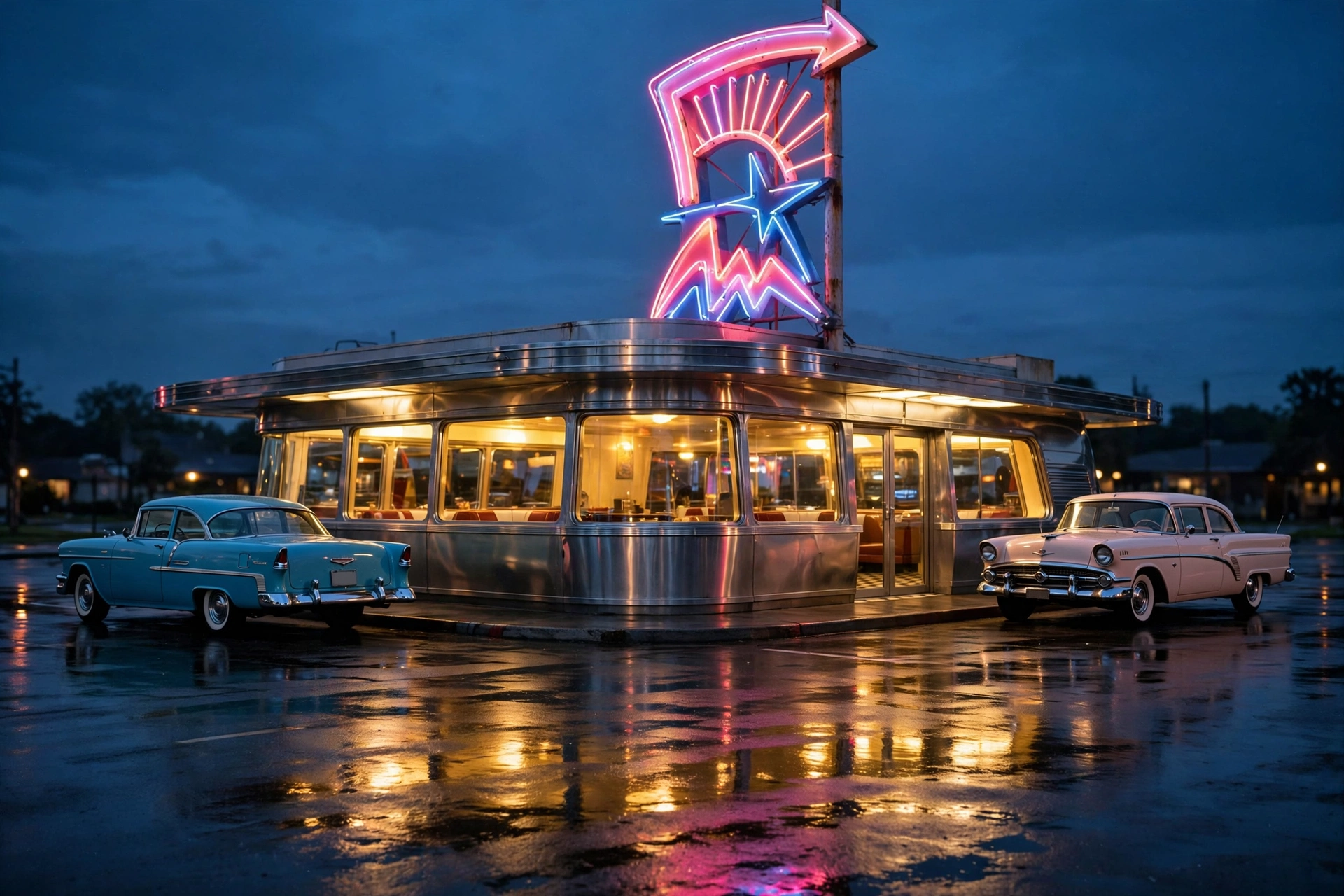
And many of them never closed. The 24-hour diner became America’s unofficial third place — not home, not work, but the glowing box on the corner where a night-shift nurse could get pancakes at 4 a.m. and nobody would bat an eye. In Edward Hopper’s famous 1942 painting Nighthawks, the lonely late-night diner became a symbol of American urban life — proof that these places weren’t just restaurants. They were where the night went to feel less lonely.
Milkshakes, the Pie Case, and the Bottomless Coffee Cup
Let’s talk about the milkshake, because a diner milkshake was not a drink. It was an event. It arrived in a glass so tall you needed two hands, crowned with whipped cream and a cherry, and — here was the magic — the waitress would set down the metal mixing cup beside it, still half full. You got your shake plus the extra. Two servings for the price of one, and nobody ever mentioned it. It was just how things were done.
Thick. Frothy. Cold enough to make your forehead ache in the best way. Vanilla, chocolate, strawberry — the holy trinity. On a hot afternoon, kids would split one between two straws and make it last an hour, watching the world go by through that big window. The machine rattled and churned while the whole counter watched, and the man working it moved like a scientist. Tell me that sound doesn’t take you somewhere.
And the pie case. Every diner had one — a rotating glass display by the register, lit from inside like a jewelry store. Apple. Cherry. Blueberry. Lemon meringue with peaks like snowdrifts. Pecan for the brave. You’d stand there doing arithmetic with your allowance, because a slice might run you a quarter and take a whole afternoon of deciding. Coffee, meanwhile, was often about a dime a cup, and it came in a mug thick enough to survive a drop onto a tile floor. The refills? Nobody ever charged you for those. In the days of penny candy and corner stores, the diner kept the same unspoken rule: a little extra kindness was always on the house.
“Hon,” “Sugar,” “Sweetie”: The Waitresses Who Ran the Place
Nobody ran a diner but the waitress. She was the memory of the place — the one who knew your order before you opened the menu, who kept your coffee filled without being asked, who called you “hon” or “sugar” or “sweetie” like you’d known each other for years. She’d been on her feet since dawn, and she moved through that dining room like it was a dance floor, tray balanced on one hand, calling orders to the grill in a language all her own.
The diner lingo was half the fun. “Adam and Eve on a raft” — two eggs on toast, if you were new. The counter was a theater and she was the star of it, cracking jokes with the regulars, scolding teenagers who got too loud, sliding an extra slice of pie toward a kid who was clearly celebrating something.
The diner never asked who you were. It just asked if you wanted coffee.
She remembered things. Your grandmother’s birthday pie. The week you looked sad and got a bigger portion. In a world that forgets you fast, the diner waitress remembered. And we all knew it, even if we didn’t have the words for it then.
After the Drive-In: The Late-Night Stop
And then there was the after. The movie let out, the credits rolled, and nobody wanted the night to end. So the cars pointed themselves, as if by instinct, toward the nearest glowing sign. Our drive-in restaurant memories belong to the same highway as the diner — the cruising, the carhops, the trays balanced on window ledges — and the diner was where those nights always landed.
The parking lot was half the show. Hoods up, radios on, engines ticking as they cooled. Inside, booths filled with teenagers in varsity jackets and couples on first dates, all of them ordering fries and shakes they didn’t need, because leaving meant the night was over. The waitress never rushed anyone. She knew. At 11:30 on a Friday night, a diner wasn’t a restaurant. It was the last warm room before morning.
We didn’t go for the food. We went for the feeling that the night wasn’t over yet.
The Booth Is Still Warm: A Table Saved for You
So many of them are gone now. The highways changed. The chains moved in. Some of those beautiful chrome buildings sit empty behind weeds, their neon dark, their counters gathering dust. And when you drive past one, doesn’t something in your chest tighten a little? Not just for the food — for who you were when you sat there.
But here’s the thing: the ones that remain are still doing what they always did. The coffee’s still hot. The pie case still turns. Somebody’s still sliding into a vinyl booth and spinning a stool just to hear it squeak. The diner was never about the building. It was about the welcome — a light on, a seat open, a pot of coffee that never seemed to run dry.
Nobody ever just stopped at a diner. You slid in, and time slowed down with you.
So tell me — what was your diner? The one on the corner with the cracked vinyl? The truck stop on the highway where the waitress knew your dad’s name? Who were you with, and what did you always order? Because somewhere in these classic diner memories, there’s a booth with your name on it — and we’d love to hear its story in the comments below.
Pingback: Milkman Memories: When Milk Delivery Was Magic