Close your eyes and hear it. That dry, rattling shake, like sand in a tin, followed by a silence that felt like a dare. The screen was grey again. Clean. Empty. And just like that, whatever you had spent twenty minutes drawing was gone — and you could not wait to start all over. If that sound just pulled a memory straight out of you, then you already know what etch a sketch memories are made of.
I can still feel it in my hands: a red plastic frame, a little heavier than it looked, with two white knobs that turned with a soft, grainy resistance. You held it on your lap like a tiny television, and you drew by turning, not by touching. Left knob for sideways. Right knob for up and down. Both together, very carefully, if you wanted a diagonal and did not want to ruin the whole thing. Nobody taught you that. You just figured it out, one wobbly line at a time, the way every kid did.
Here is the thing about the Etch A Sketch. It never promised you a perfect picture. It promised you something better: a second chance, as many times as you wanted one. Shake, and it was gone. Shake, and you could try again. Long before anyone talked about undo buttons, this little red box had already invented one — and it worked by being turned upside down and rattled like a maraca.
Table of Contents
The Toy That Drew With Knobs
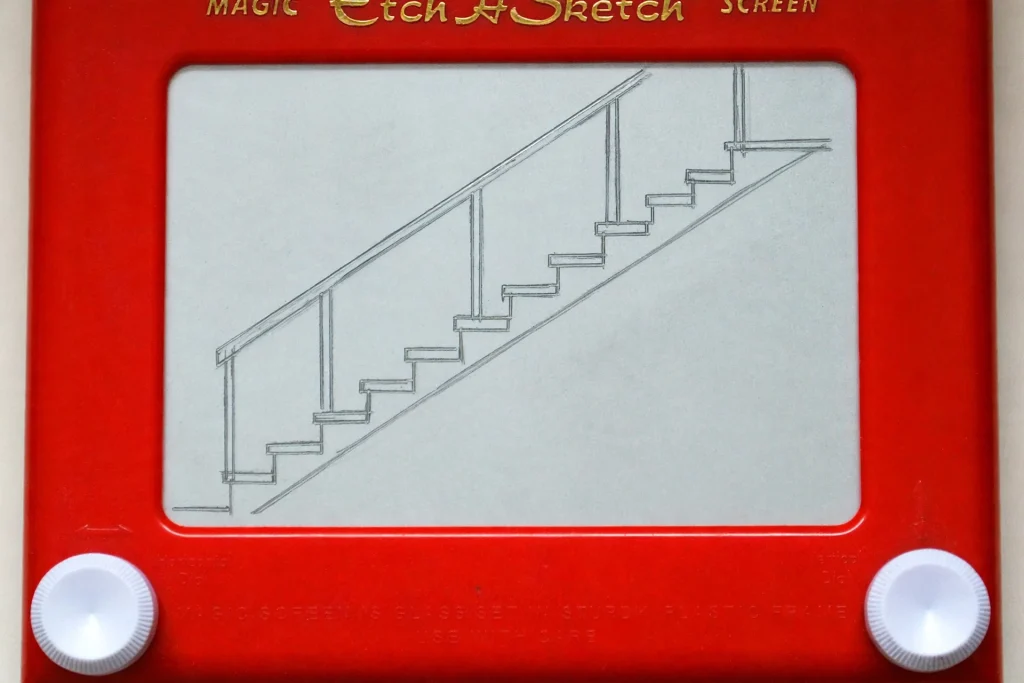
Every kid who ever owned an Etch A Sketch remembers the first lesson, because the first lesson was always the same. You tried to draw a house. You got a staircase instead. The roof slanted the wrong way, the door ended up somewhere near the chimney, and the whole thing leaned like it had been built during an earthquake. And you loved it anyway. You showed it to anyone who would look, holding it up at arm’s length like a masterpiece, because in your hands it was one.
The screen was grey, the line was dark, and that was the entire palette. No colors. No eraser. No save button. That sounds like a limitation now, and maybe it was, but at the time it felt like freedom. You could not waste paper. You could not run out of crayons. You could not make a mess that your mother would find on the carpet. The worst thing that could happen was that your drawing went sideways — literally — and then you shook it away and began again.
There was a particular sound to the knobs, too. Not a click, exactly. More of a faint scrape, like a pencil on very fine sandpaper. You turned the left knob with your left hand and the right knob with your right hand, and if you were right-handed, your left hand always lagged a little behind, which is why so many childhood Etch A Sketch houses lean to the left. Ask anyone. They will laugh, and then they will admit theirs did the same thing.
And the concentration! Oh, the concentration. Your tongue would poke out of the corner of your mouth without you noticing. Your eyebrows would knit together. A whole room could be talking around you and you would not hear a word of it, because you were trying to draw a straight line with two knobs, which is a bit like trying to write your name while wearing mittens. It was hard. That was the point. When a line finally came out right, it felt like a small victory, and you wanted to do it again immediately.
A French Electrician and a Magic Screen
The Etch A Sketch did not start out as a toy at all, at least not in the way we think of toys. It started with a French electrician named André Cassagnes, working in the late 1950s, who noticed something curious: pencil marks showed through aluminium powder clinging to a translucent decal, held there by an electrostatic charge. He called his invention L’Ecran Magique — The Magic Screen — and it was, in its own quiet way, a kind of magic. A screen that could be drawn on without ink, and wiped clean without a cloth.
Cassagnes took his invention to the Nuremberg International Toy Fair in 1959, and at first, hardly anyone paid attention. That is one of my favorite parts of this story. The toy that would end up in millions of homes was almost ignored at the very fair where toys are supposed to be discovered. It sat there, waiting for someone to see what it could be. Eventually, the Ohio Art Company did see it. They bought the licence, gave it a new name — Etch A Sketch — and launched it for the 1960 holiday season.
What happened next is the part every toy company dreams about. In its first year, the Etch A Sketch sold 600,000 units. Six hundred thousand red frames, in a single year, in a time before the internet, before viral videos, before a toy could become famous overnight. Word of mouth did that. Kids showed other kids. Parents watched a child sit quietly for an hour, drawing with knobs, and thought: I want one of those for my house, too.
It is worth pausing on that number, because it tells you something about the world it landed in. In 1960, a toy did not need flashing lights or a television show to sell. It needed to be clever, and sturdy, and just strange enough that a child would pick it up and ask, “How does this work?” The Etch A Sketch answered that question every time a kid turned a knob and watched a line appear out of nowhere.
How Two Knobs Made a Picture
So how did it actually work? Inside that red frame was a grey screen coated on the inside with aluminium powder and tiny plastic beads. A stylus moved behind the screen, and as it moved, it scraped the powder away, leaving a dark line where the powder had been. The left knob moved the stylus sideways. The right knob moved it up and down. Turn both knobs at once, slowly and steadily, and you could coax out a diagonal.
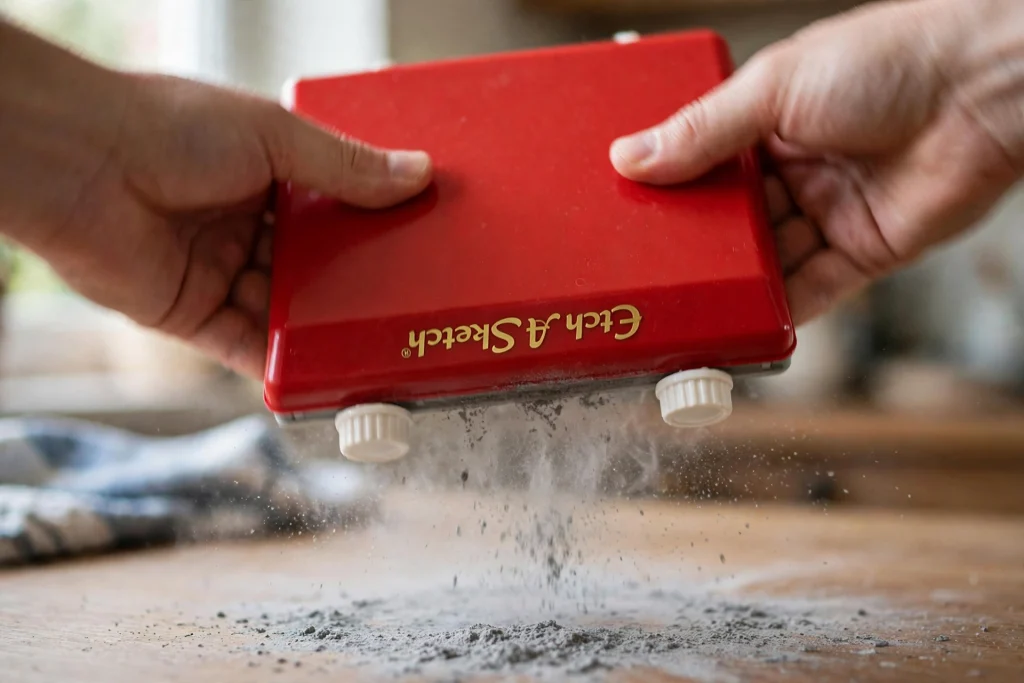
That is the whole trick, and it is a beautiful one. There was no ink to dry out, no lead to snap, no battery to die at the worst moment. The picture was not printed or projected. It was scraped into existence, one thin line at a time, by a child’s hands. And when you were done — or when you had made a glorious mess of it — you turned the whole thing face down and shook it hard. The powder fell back into place, the screen went grey again, and the slate was clean.
That shake deserves its own moment, because every Etch A Sketch kid has a shake story. Some kids shook it gently, like they were rocking a baby. Some kids shook it like they were trying to win a fight with it. Some kids held it above their heads and shook it so hard the beads rattled like a rainstick, and their parents would call out from the next room, “Not so hard!” The screen always came back grey. It always did. That was the promise, and it never broke.
There was also a rule nobody wrote down but everybody knew: you did not shake someone else’s drawing without asking. That was sacred. A kid could spend an entire rainy afternoon on a castle, or a rocket ship, or a portrait of the dog that looked, generously, like a cloud with ears — and shaking it away without permission was a crime on the level of eating the last cookie. You asked first. You admired it first. And then, only then, you shook.
What We Actually Drew
Let us be honest about what most of us drew. Houses. Staircases. Squares inside squares inside squares, because squares were the one thing the knobs were actually good at. If you were ambitious, you tried a car, and the wheels came out as lopsided circles that looked more like potatoes. If you were very ambitious, you tried to write your name, and the letters leaned and wobbled and ran into each other, and you showed it to your mother anyway, and she said it was wonderful, and she meant it.
The best Etch A Sketch artists were a different breed altogether. You know the type. The kid at school who could draw a perfect sailboat, mast and all, without lifting a finger from the knobs — because there was no finger to lift, only knobs to turn, and somehow that made it more impressive. The rest of us watched, open-mouthed, as a staircase turned into a house, turned into a whole street, turned into a town, all in one unbroken line. It felt like watching a magician, except the magician was twelve and sitting next to you in class.
And then there were the contests. Who could draw the longest line without breaking it? Who could draw a circle that actually looked like a circle? Who could draw the whole alphabet? Nobody won those contests, really. The Etch A Sketch was not a toy you won at. It was a toy you kept playing with until someone called you for dinner, and then you carried it to the table, still drawing, because dinner could wait and the line could not.
I remember rainy days best, because rainy days were Etch A Sketch days. The television had three channels and nothing on. The outdoors were off limits. And there it was, on the coffee table or the bedroom floor, waiting. You would pick it up, shake it once out of habit even though the screen was already blank, and start again. A house. A staircase. A rocket. A name, written wobbly and proud. An hour would pass, and it would feel like ten minutes, and that is a feeling no app has ever given me since.
The Shake Heard Around the House
If the Etch A Sketch has a signature moment, it is not the drawing. It is the erasing. Think about it. Every other toy asked you to keep what you made. A Lego castle stayed built until someone knocked it down. A coloring book page stayed colored, for better or worse. A painting dried on the paper and that was that. The Etch A Sketch was the only toy that told you it was fine to let go.
There is something quietly kind about that, especially for a child. You could try, and fail, and try again, and nobody would ever see the failures, because the failures were shaken away into grey dust. You did not have to be good at it to enjoy it. You did not have to show anyone. You could draw something terrible, shake it away, and draw something slightly less terrible, and feel like you were getting better, which you were.
“Two knobs, one grey screen, and a shake to start over — the Etch A Sketch never judged your drawing. It just handed you a clean screen and said, try again.”
Parents understood this, too, which is part of why the toy lasted. It was quiet. It did not need batteries. It did not make a mess. It kept a child occupied on a long car ride without a single screen, a single sound, or a single complaint about being bored — well, almost. A child with an Etch A Sketch on a car ride was a child who was drawing, shaking, drawing again, and asking, “Are we there yet?” only half as often.
And when the car ride ended, the drawing did not have to end with it. That is the funny thing. You could carry your half-finished house into a restaurant, into a waiting room, into a grandparent’s living room, and keep working on it. The Etch A Sketch went where you went, because it was flat, and light, and it fit in a bag. Long before tablets, it was the original portable screen — and it never ran out of charge.
From Toy Box to Hall of Fame
The Etch A Sketch did not fade away after its first big year. It stayed. It showed up under Christmas trees in the 1970s, in toy boxes in the 1980s, in classrooms in the 1990s, and in the hands of a whole new generation who discovered it through the Toy Story films, where it appears as a familiar red friend among the toys. A toy that starts in 1960 and still gets recognized by children decades later has done something rare: it has become part of the language of childhood itself.
In 1998, the Etch A Sketch was inducted into the National Toy Hall of Fame, alongside the kinds of toys that define American childhood. That honor makes sense when you think about what the toy really was. It was not just a drawing tool. It was a lesson, disguised as a game, in patience, in practice, and in starting over without shame. You turned a knob, you watched a line appear, you learned that small, steady movements add up to something bigger than you expected.
It also became a canvas for real artists, which is a story I love telling. Grown-ups with steady hands and endless patience have drawn astonishing pictures on Etch A Sketches — portraits, landscapes, whole city skylines — all in one unbroken line, all erasable with a single shake. Some of those artists refuse to shake their best work away, and they carry the toy around like a framed picture, which is both funny and perfect. The toy that taught us to let go also taught a few people to hold on.
That is the strange double life of the Etch A Sketch. For most of us, it was a toy we shook clean a hundred times a day. For a few, it became an art form. Both are true, and both started with the same two white knobs and the same grey screen.
Why We Still Miss It
Look at what children draw on today. A tablet gives you every color, every brush, an undo button, a save button, a share button, and a thousand stickers. It is wonderful, and it is also, in a way, too easy. Nothing is at stake. You can undo anything, redo anything, filter anything, and the picture never really risks being ruined, because ruin is just another tap away from fixed.
The Etch A Sketch was different, and that difference is why we miss it. A line, once drawn, stayed drawn until you shook the whole thing away. There was no fixing one corner. There was no saving the good half. You either lived with the wobble, or you started over. That sounds harsh, and in a small way it was, but it also taught you something that a tablet never will: that a picture does not have to be perfect to be worth making, and that starting over is not failure. It is just the next drawing.
“Shake it away, start again — the Etch A Sketch taught a whole generation that a fresh start was only ever one good shake away.”
I think that is why adults still buy them, too. Not just for their children, but for themselves. You see them in gift shops, in museum stores, in the toy aisle where a grown-up will pick one up, turn it over in their hands, smile, and say, “I had one of these.” They are not buying a toy. They are buying a feeling: the feeling of a rainy afternoon, a quiet house, a grey screen, and all the time in the world to draw a house that leans a little to the left.
And if you still have one tucked away somewhere — in a closet, in a box in the attic, at the back of a drawer with the old batteries and the rubber bands — go find it. Turn the knobs. Draw something wobbly. Do not worry about whether it looks right. It never did, and that was never the point. Then shake it, hard, and listen to that dry rattle, and feel how good a clean screen can feel.
If you want more trips down memory lane, take a look at another click-through childhood toy that turned a living room into a whole new world, or the toys every kid wanted in the 90s, or another way we kept our pictures before phones did it for us. For the full history, the Columbia Libraries story of the Etch A Sketch and the EDN account of its 1960 launch are both wonderful rabbit holes.
Your Turn: What Did You Draw First?
So here is my question for you, and I really want to hear the answer: what was the first thing you ever drew on an Etch A Sketch? Was it a house that leaned to the left, like everyone else’s? A staircase that went nowhere? Your name, written wobbly and proud, in a line that never quite closed? Or did you draw something nobody else would believe, a sailboat or a rocket or a whole town, all in one unbroken line?
Drop your answer in the comments, and if this post brought back a shake you had forgotten, share it with the friend you used to trade knobs with on long car rides. They will know exactly what you mean — draw it, shake it, draw it again.