
Introduction
In an era dominated by ultra-fast smartphones, cloud computing, and high-speed fiber internet, it is easy to forget how rapidly consumer technology has evolved over the past few decades. Today, holding an entire music library, a high-definition camera, and a supercomputer in your pocket is taken for granted. However, the seamlessly connected digital ecosystem we enjoy today was built on the shoulders of bulky, single-purpose retro devices.
The technology of the 1980s, 90s, and early 2000s may look primitive now, but each device solved a major engineering challenge of its time. Understanding these forgotten gadgets gives us a fascinating perspective on human innovation. Here is an in-depth look at 10 iconic vintage technologies that laid the direct foundation for our modern digital world.
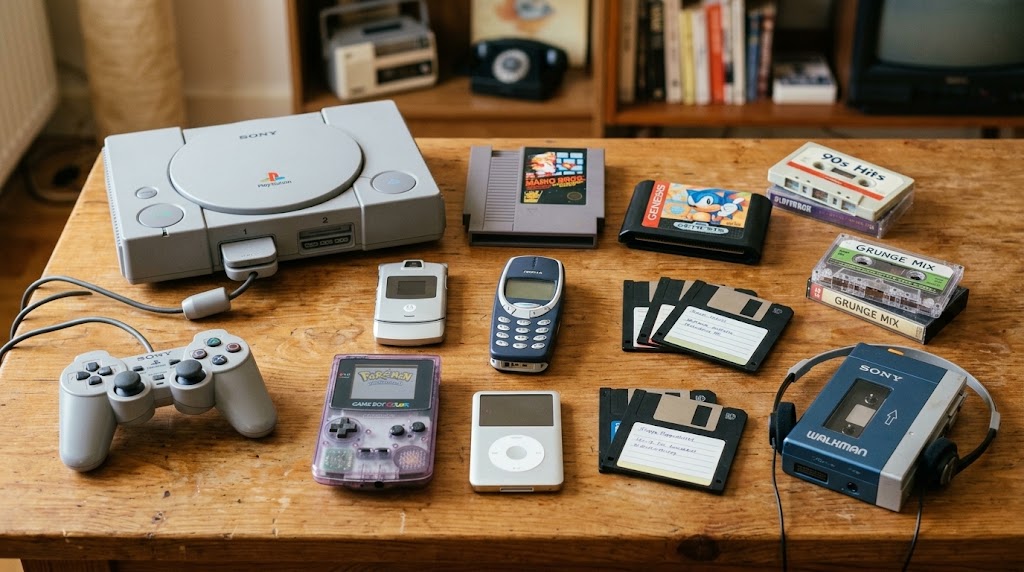
1. The Walkman: The Birth of Personal Audio
Before the Sony Walkman debuted in 1979, listening to music was primarily a shared or stationary experience. You either listened to the radio in your car or played vinyl records in your living room. The Walkman changed human behavior forever by making audio portable and private.
- How It Worked: Magnetic audio cassette tapes passed over a read-head, converting magnetic signals into electric audio signals sent through lightweight headphones.
- Modern Successor: Apple iPod, Spotify, Apple Music, and wireless Bluetooth earbuds.
- Why It Matters: The Walkman introduced the concept of the “personal soundtrack,” allowing people to curate their private audio space while moving through public environments.
2. Dial-Up Modems: The Sounds of the Early Internet
Long before gigabit Wi-Fi, connecting to the World Wide Web required patience, a dedicated landline telephone connection, and the iconic screeching sound of a dial-up modem. Operating at speeds of 28.8 Kbps to 56 Kbps, loading a single image could take several minutes.
- The Technology: Dial-up modems converted digital data from a computer into analog sound waves that could travel over standard copper telephone lines (and vice-versa at the receiving end).
- Modern Successor: Fiber-optic broadband, 5G cellular networks, and Wi-Fi 6.
- Why It Matters: Dial-up proved that global computer networking was commercially viable for everyday households, birthing the initial online communities and web portals like America Online (AOL).
3. Floppy Disks: The Original Portable Storage
Before flash drives, external hard drives, and cloud storage solutions like Google Drive, physical data transfer relied entirely on floppy disks. The most iconic variant—the 3.5-inch magnetic diskette—held a mere 1.44 Megabytes of data.
- Storage Capacity: 1.44 MB (for comparison, a single modern smartphone photo requires roughly 3 MB to 5 MB).
- Modern Successor: USB Flash Drives, Solid State Drives (SSDs), and Cloud Storage.
- Why It Matters: Floppy disks normalized the idea of carrying digital files between home and office computers. Its physical shape remains immortalized worldwide as the universal “Save” icon in software programs.
4. VHS Tapes and VCRs: Revolutionizing Home Entertainment
The Video Home System (VHS) format, introduced by JVC in the late 1970s, transformed how society consumed movies. For the first time, audiences were no longer at the mercy of television broadcast schedules or movie theater showtimes.
- Key Features: Magnetic tape reels capable of recording live television broadcasts and playing back feature-length films.
- Modern Successor: Netflix, YouTube, Disney+, and 4K Blu-ray players.
- Why It Matters: The VHS tape birthed the massive home video rental industry (like Blockbuster) and established the concept of video-on-demand long before digital streaming existed.
5. CRT Monitors and Televisions: Bulky Display Giants
Cathode Ray Tube (CRT) displays were the undisputed kings of visual electronics for over half a century. These massive, heavy glass boxes dominated living rooms and office desks well into the mid-2000s.
- How It Worked: Electron guns at the back of the tube fired streams of electrons toward a phosphor-coated glass screen, causing pixels to glow red, green, and blue.
- Modern Successor: OLED, QLED, and LCD flat-panel displays.
- Why It Matters: CRT displays refined high-refresh-rate visuals and color accuracy, setting the visual standards required for early arcade gaming, home consoles, and personal computer interfaces.
6. Pagers (Beepers): The Pioneers of Wireless Instant Messaging
During the 1980s and 90s, before mobile phones became accessible to the general public, pagers were the ultimate status symbol for business professionals, emergency personnel, and doctors.
- Functionality: Radio receivers that picked up short numeric signals—usually a callback phone number or a short numeric code—sent from a central transmitter.
- Modern Successor: WhatsApp, iMessage, and SMS push notifications.
- Why It Matters: Pagers created the culture of instant reachability, training society to expect real-time notifications long before smartphones arrived.
7. Film Cameras and Darkrooms: The Art of Chemical Photography
Before digital sensors captured instant preview images, photography was an exercise in patience, chemical processes, and precise manual physics. Photographers loaded rolls of 35mm film into mechanical cameras, restricted to 24 or 36 shots per roll.
- The Process: Light exposed silver-halide crystals on a plastic strip of film. The film then had to be developed inside light-proof darkrooms using chemical baths to create negative prints.
- Modern Successor: Digital SLR cameras and multi-lens smartphone cameras.
- Why It Matters: Film photography taught deliberate composition and lighting. The aesthetic of analog film remains so beloved that digital camera apps still rely heavily on retro film filters today.
8. Personal Digital Assistants (PDAs): The Blueprint for Smartphones
In the 1990s, devices like the Palm Pilot and Handspring Visor showed the world what handheld computing could look like. PDAs served as digital organizers featuring touchscreens operated by plastic styluses.
- Core Features: Touchscreen calendars, address books, digital notepads, and basic calculator functions synced to a host PC.
- Modern Successor: Modern iOS and Android smartphones.
- Why It Matters: PDAs proved that touch interface, pocket organization, and mobile apps were the future of mobile productivity, directly inspiring the smartphone revolution.
9. Dot Matrix Printers: Loud and Continuous Printing
Long before laser and inkjet printers delivered silent, photo-quality documents, dot matrix printers ruled offices. They were famous for their loud buzzing sounds and continuous tractor-feed paper with perforated side strips.
- Mechanism: Tiny pins struck an ink-soaked fabric ribbon against paper, forming characters out of small closely spaced dots.
- Modern Successor: High-speed Laser Printers and Thermal Wireless Printers.
- Why It Matters: Dot matrix technology enabled early businesses to automate receipt printing, invoice generation, and large-scale data logging efficiently.
10. Game Cartridges: Solid-State Interactive Entertainment
Early home gaming systems like the Atari 2600, Nintendo Entertainment System (NES), and Sega Genesis stored video games on physical ROM cartridges rather than optical discs or digital downloads.
- Advantages: Near-instant load times due to direct memory access via circuit board pin connectors.
- Modern Successor: Nintendo Switch Game Cards and Digital Game Downloads (Steam, PlayStation Network).
- Why It Matters: Cartridges introduced household interactive media and established the multibillion-dollar home video game console industry.
Final Thoughts
While these retro gadgets have faded into history or survived only as collector items, their architectural concepts live on inside every modern device we use today. The next time you stream a movie, send a text message, or take a high-resolution photo on your phone, remember the bulky cassette tapes, screeching modems, and floppy disks that made it all possible