The sound hits you first, even now, decades later. Hundreds of metal latches snapping shut across a cafeteria, like a rainstorm made of tin. You can hear the clatter of trays, the squeak of sneakers on waxed floors, and underneath it all that bright, hollow clang of a metal lunchbox meeting a lunchroom table. If you grew up between the 1950s and the 1980s, vintage metal lunchbox memories probably live in your body, not just your head. Your fingers remember the latch. Your ears remember the lid. And your heart remembers what was painted on the front — because that artwork wasn’t decoration. It was your whole identity, carried in one hand.
Think about it. Before you had a phone to curate, before you had a profile picture to pick, you had a lunchbox. And everybody in that lunchroom knew exactly who you were the moment you set it down.
The Clatter That Meant Freedom
There was a moment, every single school day, when the bell rang and the classroom emptied toward the cafeteria. Kids who bought lunch drifted to the serving line. But kids with lunchboxes? They walked different. Slower. Taller. Because a lunchbox meant something had been prepared for you that morning, by someone who knew exactly how you liked your sandwich cut.
The whole ritual began at home, in the busy blur of school-day mornings, when the kitchen counter became an assembly line. Sandwiches wrapped in wax paper or foil. An apple with a bruise you pretended not to see. A handful of cookies that were absolutely, definitely not to be traded — until they were. Your mom or dad would snap the latch closed with a sound like a little lock clicking shut, and just like that, your morning was packed. Literally.
And then you carried it. All the way to school, handle in your fist, box banging gently against your leg with every step. Some kids held theirs by the handle like a briefcase, all business. Some hugged them to their chest. There was no wrong way to carry it, because the carrying was the point. It was yours. Nobody else had that exact dent in the corner from where you’d dropped it on the bus steps in third grade.
Here’s the thing nobody talks about: the lunchroom was loud, but your lunchbox had its own voice. The hinges squeaked in a particular way. The Thermos rattled inside with a soft, glassy clink that told you the world was still intact. The latch had a little metallic spring to it, a tiny click-snap that meant lunch was officially happening. You could identify your own box blindfolded, just by sound. Kids did, all the time — reaching into the cubby without looking, trusting their ears.
How Vintage Metal Lunchbox Memories Began
Metal lunchboxes didn’t start as art. They started as workmen’s lunch pails — plain, dented, practical. But sometime in the late 1940s, a company called Aladdin Industries had an idea that changed childhood forever: what if the box had pictures on it? What if it had a hero on it?
In 1950, Aladdin put cowboy star Hopalong Cassidy on a metal lunchbox, and the result was staggering. First-year sales reportedly jumped from about 50,000 units to 600,000. Think about that for a second. Six hundred thousand kids, suddenly carrying a cowboy to school. Aladdin had stumbled onto something enormous: the lunchbox wasn’t a container anymore. It was a billboard for who you loved.
Other companies rushed in. American Thermos went further with full-color lithography on every side — the 1953 Roy Rogers and Dale Evans box is often cited as a breakthrough moment, reportedly selling in the millions in its first year. Suddenly every fall, like car companies rolling out new models, lunchbox makers revealed new designs: cowboys, spacemen, TV stars, cartoon crews. The Smithsonian’s research on the era notes that around 450 different lunchbox designs were produced between 1950 and 1985 — a whole parade of American childhood, pressed into tin. If you want the full story of the company that started it all, the Aladdin story is a fascinating read.
Here’s what I love about that number. Four hundred and fifty designs. That means somebody, somewhere, made the deliberate choice to put a rocket on a box, or a cowboy, or a school bus, and a kid somewhere picked it up and thought: this is me. Marketing people call that “brand affinity.” Kids called it “the one I want.”
Choosing Your Lunchbox Was Choosing Who You Were
Nobody was ever nobody if they had the right lunchbox.
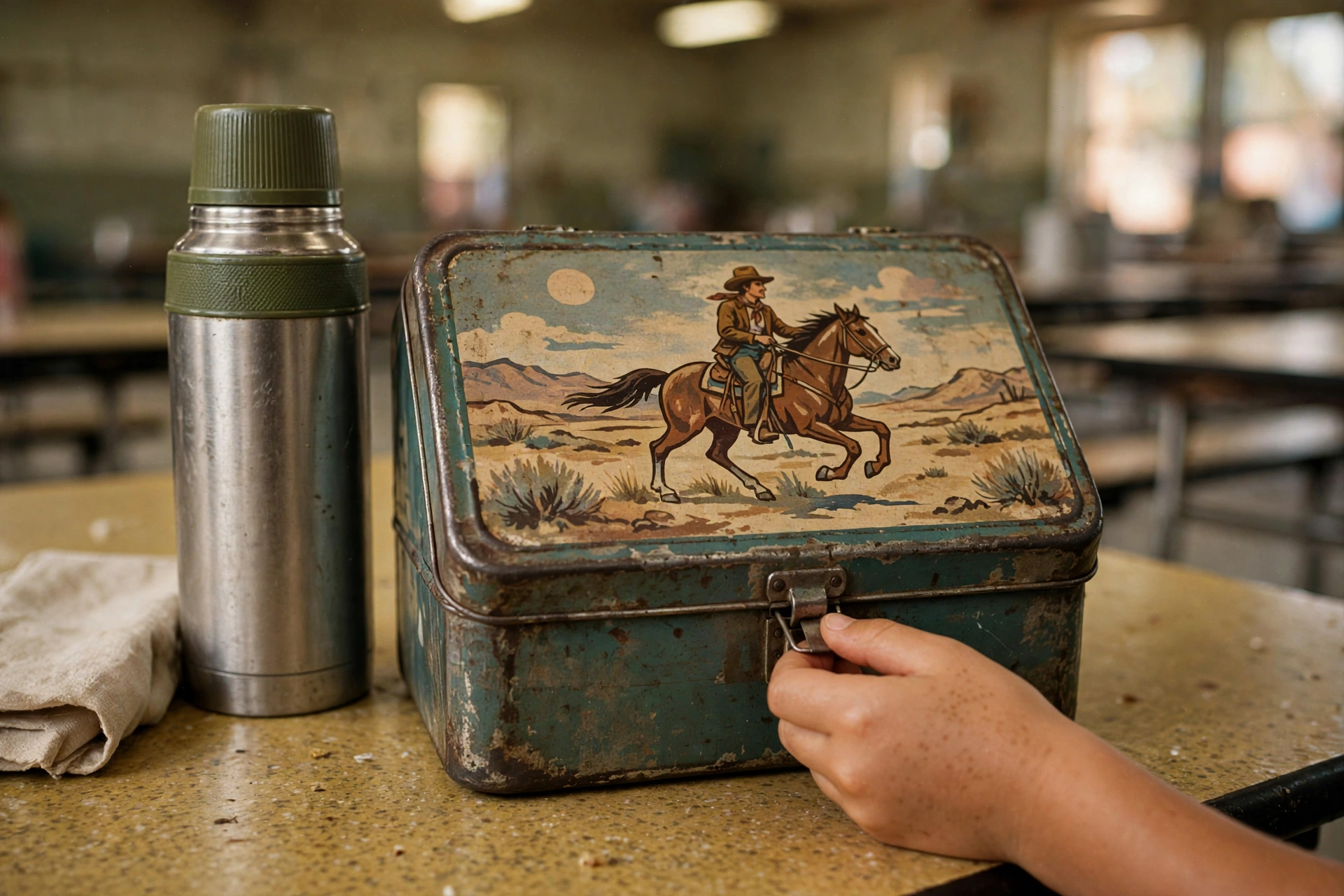
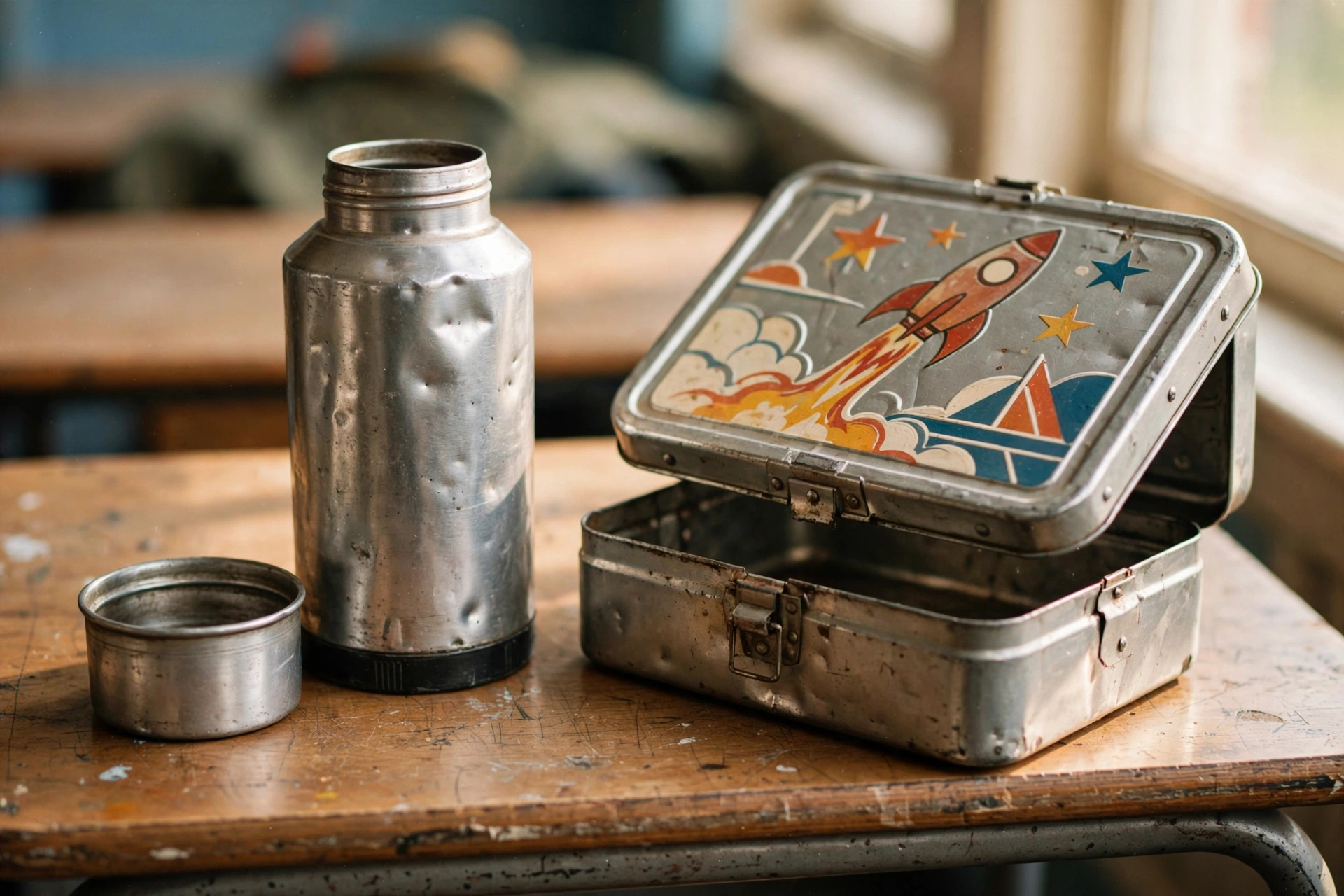
That’s a big claim, but ask anyone who was there. The lunchbox you carried was a declaration. It told the whole lunchroom what you watched on Saturday mornings, who your hero was, and — just as important — what kind of kid you were. The boy with the space rocket box was going places. The girl with the horse box had big feelings and a bigger imagination. The kid with the plain plaid box? Either their parents didn’t get the memo, or they were so cool they didn’t need a memo.
And the choosing itself was serious business. This wasn’t a purchase. This was a commitment. You stood in the store aisle, probably at the start of the school year, and you stared at a wall of shiny metal faces, and your whole social future hung in the balance. Parents watched the price tag. Kids watched the artwork. Everybody won, eventually, but the negotiation was real.
The Character Wars
Every September, the lunchroom became a silent battlefield of pop culture. Cowboys versus astronauts. Cartoon crews versus TV detectives. You didn’t just like a show — you carried it. And here’s the beautiful part: your lunchbox introduced you before you ever opened your mouth. A new kid walked in on the first day, set down a box covered in rocket ships, and three kids slid over and said “cool.” Friendship, initiated by tin.
Of course, there was strategy involved. You didn’t want last year’s hero. Kids absolutely noticed. “Oh, you still have the cowboy one?” was a sentence that could ruin a Tuesday. So every fall, the begging began, fresh as the new school year. New shoes, new pencils, new lunchbox. Even if last year’s box was perfectly fine — and they were, those things were built like tanks — you needed the new one. Planned obsolescence, but make it childhood.
There Was a Box for Every Kid
Not every box had a TV star on it, and that’s worth saying. There were boxes with horses and rockets and school buses and Western landscapes. There were pretty “campus queen” style boxes aimed at girls in the 1950s and 60s — aspirational, glamorous, a little dreamy. Some kids had plain plaid boxes that their parents picked because they were practical and a dollar cheaper. And you know what? Those kids did just fine. Because after a year of dents and scratches, every box told the same story: this kid is loved, and this kid eats lunch here.
The Thermos: The Most Underappreciated Hero of the Lunchroom
Let’s give it up for the Thermos, the quiet partner in every great lunchbox.
Every metal lunchbox came with its own vacuum bottle — a steel shell with a fragile glass liner inside, a cup for a lid, and a stopper that smelled faintly of milk no matter how many times you washed it. That little bottle was a marvel of old-school engineering. The vacuum flask itself goes back to 1892, when Scottish scientist James Dewar invented it for his cryogenics research — two walls with the air sucked out between them, so heat couldn’t sneak through. A German glassblower named Reinhold Burger turned the lab invention into a household product, trademarked the name “Thermos” in 1904, and the rest is lunchroom history. The name became so famous that in 1962, a U.S. court ruled “thermos” had become a generic word — which is why any company, including Aladdin, could print it in lowercase on their bottles. The Thermos trademark story is genuinely one of the wildest tales in product history.
But here’s what the history books won’t tell you: the Thermos had a sound. When you picked up your lunchbox and that bottle clinked softly against the metal, it was the sound of everything being okay. Hot soup stayed hot. Cold milk stayed cold. It was a tiny miracle, sitting in the corner of your box, and you never thought about it until the day it broke.
The Heartbreak of the Broken Glass Liner
Oh, the broken liner. Every kid knew the tragedy.
One bad drop — off the bus steps, onto the cafeteria floor, a shove in the hallway — and suddenly your Thermos went silent. That soft clink was gone. In its place, a dead rattle, or worse, a crunch. You’d unscrew the cup, peer inside, and there it was: the glittering evidence. Shards of glass. Your soup days were over until someone bought a replacement, and replacements cost real money.
And yet, somehow, the broken Thermos still went to school. Because the box was still good, the artwork was still yours, and a lunchbox with a dead Thermos was better than a paper bag. The paper bag kids — we saw them. We felt for them. Nobody chose the paper bag if they had a choice. Paper bags were what happened when your latch broke, or your box rusted through, or your little brother inherited yours and you got the hand-me-down shame. The hierarchy was real, and everybody knew it.
The Lunch Table Trading Floor
If the lunchbox was your identity, the lunch table was your stock exchange.
Trading was the real curriculum of the cafeteria, and every kid had a strategy. The kid with the homemade chocolate chip cookies was basically a millionaire. The kid with the bologna sandwich was — well, the kid with the bologna sandwich. There was an unspoken exchange rate, and everybody knew it. One homemade cookie was worth two store-bought ones. A pudding cup could get you almost anything. And nobody, in the history of school lunches, ever successfully traded away the weird sandwich. You know the one. The one with the mystery filling that your grandma made with love and you ate with quiet resignation.
The smells were part of it. Metal lunchboxes had little air vents, and by the time the lid flipped open, the whole table knew what you had. Bologna had a particular smell — salty, a little sharp, unmistakable. Peanut butter was warm and sweet. Egg salad announced itself from three tables away, for better or worse. You didn’t just eat lunch. You broadcast it.
And the trading itself was theater. “I’ll give you my apple for your cookies.” “Your apple has a bruise.” “It’s a good bruise!” Deals were negotiated, alliances formed, friendships sealed over swapped snacks. It was commerce, diplomacy, and comedy all at once — and honestly, some of us learned more about human nature at that table than in any classroom. Looking back, those afternoons had the same golden feeling as trading treats on long summer evenings, when the currency was ice cream instead of sandwiches but the joy was exactly the same.
There were rules, too, unwritten but ironclad. You didn’t trade something and then take it back. You didn’t brag about a great trade in front of the kid you traded with. And you never, ever touched someone else’s Thermos without asking. That was sacred. The Thermos was personal in a way the sandwiches weren’t. It had your germs. It had your milk. It had history.
Why the Metal Era Really Ended
So what happened? Why did the glorious metal lunchbox disappear?
There’s a story that gets passed around — that schools started banning metal lunchboxes in the 1970s because parents complained kids were using them as weapons in fights. It usually starts in Florida, in the retelling, with concerned mothers lobbying for bans. Here’s the honest truth: historians have dug into this, and the big statewide ban doesn’t seem to have existed. It’s one of those stories that feels true because metal boxes were undeniably solid — you wouldn’t want to be on the wrong end of one — but the paperwork for a sweeping ban just isn’t there. Sometimes a legend is just a legend wearing a very convincing costume.
The real ending was quieter and, frankly, cheaper. Plastic got cheap. By the mid-1980s, manufacturers could mold a plastic box for a fraction of what a lithographed tin one cost. Vinyl boxes had a brief, flimsy moment in the 1970s — basically cardboard wrapped in shower-curtain fabric, and almost none of them survived — but plastic was the real successor. It was lighter, it didn’t rust, it didn’t dent, and it cost less to make. The metal lunchbox didn’t lose a fight. It lost a price war.
The last hurrah came in 1985: a Rambo-themed metal box, which collectors generally consider the final licensed-character metal lunchbox. Rambo. Of course it was Rambo. The metal lunchbox went out the way it came in — carrying a hero with a weapon, tougher than everything around it. There’s something almost poetic about that.
Where the Metal Lunchboxes Went
They didn’t all go to the dump. Not by a long shot.
Some went to attics, where they sat in cardboard boxes for thirty years, quietly rusting, waiting. Some went to younger siblings, then to cousins, then to the neighbor kid, collecting dents and stories like passport stamps. And some — the lucky ones — went to collectors, who treat them like what they are: artifacts of American childhood.
There’s a whole museum for them, by the way. The Lunch Box Museum in Columbus, Georgia, holds more than 2,000 lunchboxes, curated by a man who grew up listening to the radio shows that became the artwork. Two thousand boxes. Imagine walking through that — row after row of tin childhoods, each one somebody’s whole personality, once upon a time. People stand in front of those shelves and point and say “I had that one,” and for a second, they’re eight years old again, and the bell just rang, and it’s time for lunch.
Collectors have their own language now. They talk about lithography and seams and color depth. A mint-condition 1954 Superman box once sold at auction for over eleven thousand dollars. Eleven thousand. For a box that once held a peanut butter sandwich. But that’s the thing about nostalgia — the price was never about the metal. It was about the memory the metal was holding.
Why We Still Can’t Let Go
Plastic boxes hold food. Metal boxes held who you were.
That’s the whole story, really. The lunchbox era was the last time our identities were physical things we carried in our hands — before screens, before profiles, before everything became digital and infinite and somehow less real. Your lunchbox had weight. It had dents. It had a latch that clicked in a way no touchscreen ever will. It was yours in a way that’s hard to explain to anyone who never had one.
And maybe that’s why, when someone finds their old lunchbox in their parents’ attic, they don’t just smile. They hold it. They flip the latch. They listen for the click. And for just a second, they can smell bologna and hear the lunchroom and feel the handle in their small hand, and the whole world is simple again: eat your sandwich, trade your cookies, be home by four.
The latch was the drumroll. The Thermos was the encore. And the kid carrying it? The kid carrying it was the whole show.
So now it’s your turn. What was on your lunchbox — and who did you trade snacks with? Did your Thermos survive the bus steps, or did you carry a dead rattle all through fourth grade? Tell us in the comments. Somebody out there had the exact same box, and they’ve been waiting thirty years to talk about it.