Close your eyes for a second. It is after dinner, the house is dark, and the only light in the room is coming from a glowing butterfly on your lap. Your fingers are sticky from pushing a hundred tiny plastic pegs into a black paper screen, your eyes are tired in the best possible way, and when you finally flip that little switch — click — the whole room gasps. That, my friend, is the feeling of Lite-Brite memories, and if you grew up anywhere between the late sixties and the nineties, you just traveled back in time. Those lite brite memories still glow as bright as ever.
Table of Contents
The Toy That Turned Darkness Into Art
Let me set the scene for anyone lucky enough to have missed this one. The Lite-Brite was a light box — a chunky, suitcase-like plastic case with a bulb inside — covered with a dark screen full of holes. You laid a sheet of black paper over the screen, paper printed with a dotted outline of a butterfly, a sailboat, a clown, whatever the template book gave you. Then you pushed small, translucent, candy-coloured pegs through the paper, hole by hole, following the dots like the world’s most satisfying dot-to-dot puzzle.
And then came the moment. You switched off the bedroom light, clicked the Lite-Brite on, and your flat, boring peg board became a stained-glass window. Every peg caught the light from behind and glowed like a tiny jewel. A red peg was not just red — it was ruby red, glowing from within. The whole design floated in the darkness like magic. There was nothing else in the toy world that did this. Crayons were flat. Paint dried. But a Lite-Brite design hung there in the dark, humming softly from the little bulb, and it felt like you had made electricity beautiful.
The bulb did get warm, I will be honest with you. On long art sessions you could smell that faint warm-plastic smell, and your mom would pop her head in and say the thing every mom said: “Turn that off for a while, it’s getting hot.” Did any of us listen? Of course not. We had a peacock to finish.
Born From a Skyline of Lights
Here is my favourite part of this story, because the Lite-Brite did not start in a toy lab. It started with a view. The Chicago design firm Marvin Glass and Associates — the legendary studio behind dozens of classic toys — sent some of its designers to New York for the 1966 Toy Fair trip. One night they saw a building display covered in twinkling lights, the kind of big-city sparkle that makes you stop on the sidewalk and just stare. Somebody on that team had a thought that would change childhoods: what if a kid could make their own twinkling lights?
The firm developed the idea and licensed it to Hasbro in 1967, and by 1968 the Lite-Brite was sitting on store shelves, waiting to turn living rooms into little art galleries. Think about that timeline for a second — an idea born from a glowing building in 1966, a licensed toy in 1967, and in millions of homes by 1968. That is how fast the best toy ideas used to move.
Now, a quick note because I care about getting this right: you will see different sources quote 1967 or 1968 as “the year.” The honest truth is that the licensing happened in 1967 and the toy hit stores by 1968, so both dates are a little bit right. If anyone at a trivia night tries to pin you down, just tell them the whole story and watch them put the buzzer down.
You can read more about the toy’s backstory in this Lite-Brite history piece on MoneyDigest, and the design credits on Wikipedia’s Marvin Glass and Associates page — the same studio’s table of creations lists Lite-Brite right alongside the other classics they dreamed up.
That Satisfying Ritual — Peg by Peg
Every Lite-Brite kid remembers the ritual, and it never changed. First, you fought your sibling for the template book — not the boring geometric patterns, the good stuff. You wanted the parrot, the rocket ship, the puppy. Then you laid the black paper on the screen with the kind of care surgeons reserve for operations, because if it shifted by half an inch, your whole butterfly would come out lopsided and you would have to start over, and nobody wanted that conversation with themselves.
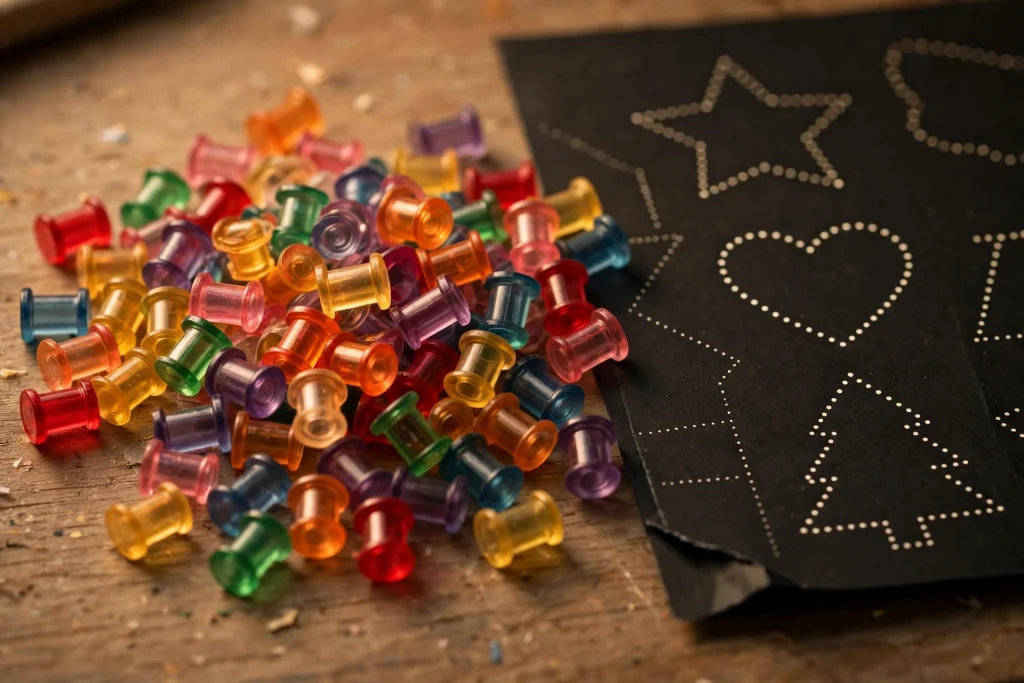
Then the pegging began. Pick a peg, find the dot, push. Click. Pick another, find the dot, push. Click. There is something about that tiny resistance — the peg gripping the hole — that made the whole thing addictive. Your thumb would get sore. Your back would ache from hunching over. And you did not care, because the picture was growing under your hands, one jewel at a time.
Halfway through, you would hold the whole thing up to the window or the lamp, squinting, checking your progress like an artist stepping back from a canvas. “The blue goes here, the yellow goes here — no wait, the outline says green.” And then, finally, the paper fully pegged, you would carry it to the darkest room in the house, take a breath, and flip the switch.
That first second of glow was everything. Kids today have tablets that do a thousand tricks, and I am not here to knock that — but a tablet has never once made a whole room go silent the way a finished Lite-Brite did. You had made that. With your hands. Out of plastic pegs and paper and patience.
The Sounds and Smells Nobody Talks About
Let us get specific, because this is where the memories live. Do you remember the sound of the peg box? That soft plastic rattle when you shook the tray looking for a green one — because you were ALWAYS out of green. There was a hierarchy of pegs, and everybody knew it: red and yellow disappeared first, blue was precious, and green was basically currency. I have a theory that somewhere in America there is a landfill made entirely of Lite-Brite templates where someone coloured outside the lines.
Do you remember the feel of the pegs? Smooth little capsules, slightly warm after the light had been on. The way they rolled under the couch and your dad found them with his bare feet at midnight — a rite of passage in every Lite-Brite household. The cardboard template book with its cracked spine, pages you had already used held in with tape because you could not bear to throw them out.
And the smell — warm plastic and paper when the bulb had been on for an hour. I swear I can still smell it. It is funny how the nose keeps the best archive of childhood. One whiff of a warm light bulb and I am eight years old again, cross-legged on the carpet, tongue sticking out in concentration, building a glowing clown at 9 PM on a school night.
Our Whole Street Had One
Here is the thing people forget: the Lite-Brite was not a solitary toy. It was a show-off toy. You did not finish a design and quietly put it in a drawer. You ran down the hallway yelling for your mom to come look. You carried it — carefully, so carefully, one hand under the base — into the living room to show your dad. You took it to show-and-tell. You invited the neighbor kid over specifically to watch you flip the switch, and you timed it for maximum drama: lights off, one… two… CLICK.
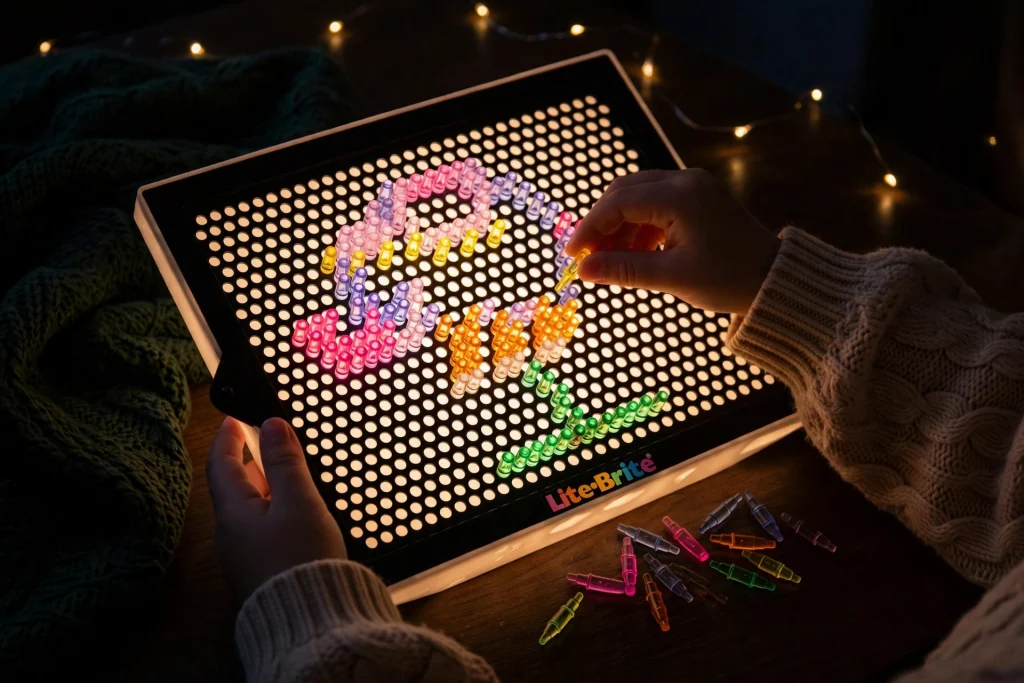
The neighbor kid’s jaw dropping was the whole point. That was the social media of 1978. You did not post your art; you performed it. You staged a little gallery show in a dark bedroom, and your audience of one or two kids lost their minds over a glowing mushroom.
And there was always a hierarchy of Lite-Brite artists on the block. The kid who could do freehand designs — no template, just pegs straight into the black screen, spelling out names in glowing letters — that kid was basically a wizard. Freehand letters took planning. You had to count holes, space the letters, keep it symmetrical. I tried it once and my “S” came out looking like a lightning bolt. I told everyone it was lightning on purpose. Nobody believed me.
The Template Book Wars
Let us be honest about the template wars, because every family had them. The book that came with the set had maybe a dozen designs, and within a month everyone had done all of them. The parrot. The sailboat. The clown. The flower. You knew them by heart. So the good stuff — the licensed character sheets, the fancy refill packs — those were Christmas and birthday territory. Finding a fresh pack of templates in your stocking was better than candy. Candy lasted a day. A new set of templates lasted until the pegs ran out.
And in the later years, the options exploded. Disney characters, Looney Tunes, superheroes — the template catalog grew up alongside us. A kid in 1970 got the parrot; a kid in 1989 got licensed characters with real names on the box. The toy kept reinventing its wardrobe while the magic underneath — pegs, paper, light — never changed at all.
Pegs, Pop Culture, and One Very Big Glow-Up
The Lite-Brite did not fade away the way so many toys did. It stayed. It glowed through the seventies, the eighties, and the nineties, sitting on Christmas lists for three straight decades — which is basically a century in toy years. Hasbro kept making new versions, including the Lite-Brite Cube in 2002, a little rotating cube that let you build glowing art on all four sides. The modern “retro” Classic models still sell today, looking almost exactly like the one from your childhood bedroom.
And then came the honour that settles every playground argument: in 2022, the Lite-Brite was inducted into the National Toy Hall of Fame. That puts it in the same company as the very greatest toys ever made — the ones that did not just sell well but actually shaped how generations of kids played. It took fifty-odd years, but the little light box got its hall-of-fame jacket. It earned it one glowing butterfly at a time.
If you collected toys every kid wanted back in the day, the Lite-Brite probably sat on your shelf between the action figures and the board games — the quiet one that did not need batteries for noise, just a bulb for beauty. It was part of the same golden era that gave us another 1970s craze, and it shared shelf space with the cameras that gave us another way we kept our pictures. Different toys, same magic: simple ideas that asked kids to slow down and make something with their hands.
What Lite Brite Memories Taught Us
I think about this more than I probably should. The Lite-Brite taught patience in a way no lecture ever could. A good design took an hour, sometimes two. There was no shortcut, no fast-forward, no undo button. If you put a blue peg where a red one belonged, you pulled it out and fixed it, and you learned to look before you pushed. That is craftsmanship training disguised as play.
It taught planning, too — counting holes for freehand letters, saving the rare green pegs for the centre of the flower. And it taught something even rarer: delayed gratification. The picture looked like nothing while you worked. Just pegs in a black board. The beauty only appeared at the very end, in the dark, when you flipped the switch. You had to trust the process. How many toys today ask a kid to trust a process for two hours?
Most of all, it taught that ordinary materials plus imagination equals wonder. Plastic pegs. Paper. A light bulb. That is the whole ingredient list. And somehow, on a dark winter evening, it was enough to make a child gasp.
The Glow Never Really Left
I still think the most beautiful thing about Lite-Brite memories is how physical they are. Nobody remembers the high score. Nobody remembers the level they reached. They remember the sore thumb. The warm plastic smell. The click of the switch. The way their finished picture looked like it was floating in space.
So many of our childhood toys were about winning — beating the game, finishing first, getting the most points. The Lite-Brite was about none of that. There was no score. There was no opponent. There was just you, a box of coloured pegs, and the quiet, glowing proof that you had made something beautiful. Maybe that is why it is still here, still selling, still in the Hall of Fame. We never really stopped wanting that feeling.
So here is my question for you, and I genuinely want to know: what did you make on your Lite-Brite? Were you a template purist who followed every dot, or a freehand rebel who spelled your name in glowing letters? Did your family fight over the green pegs too? And be honest — did you ever carry your finished design into a dark room, flip the switch, and just stand there staring at it for a while? Drop your answer in the comments. Let us light this one up together.