Look at the save icon on your phone right now. That little blue square — the one you tap a hundred times a day without a thought. Now ask yourself: have you ever actually held one of those? For a generation of computer users, that icon wasn’t a symbol of anything. It was a real object. A rigid plastic square, three and a half inches on a side, with a sliding metal shutter and a label you wrote on by hand. The floppy disk was the entire universe of portable computing for two decades, and every file you owned passed through one.
Ask anyone who was there, and the floppy disk brings it all back instantly — not just the object, but the rituals around it. The satisfying click-clack as it slid into the drive. The grinding, whirring song of the read head finding your data. The stack of labeled disks beside the monitor, each one a little chapter of your digital life: school essays, game saves, a boot disk you treated like a golden ticket. It was a slower world, and the floppy disk was its slowest, most beloved citizen.
Today’s kids will never know the particular anxiety of a disk that might be corrupted, the particular triumph of a disk that worked on the first try, or the particular pride of a disk box organized by color. But for those who lived it, the floppy disk era was computing’s charming, tactile childhood — when your data had a weight you could feel, and saving your work was a physical act. This is the story of the little square that taught the world what “save” means.
The 3.5-Inch Square That Ran the World
Before it, there were bigger disks — the 8-inch giants of the 1970s and the 5.25-inch floppies that wobbled in their paper sleeves through the 1980s. The 3.5-inch floppy disk arrived like a design revolution: smaller, sturdier, and protected by its own hard plastic shell instead of a flimsy jacket. No more bending it. No more coffee rings destroying your spreadsheet. The new disk felt like a finished product — something engineered, deliberate, and built to be carried around in a backpack without a care.
Inside that hard shell was the actual “floppy” part: a thin, circular piece of magnetic film, not much thicker than a piece of tape, that spun at 300 revolutions per minute while the drive’s read head hovered over it. The disk got its name because this inner platter really did flop around a little when you handled it. The genius of the 3.5-inch design was the sliding metal shutter — a little guillotine of stainless steel that snapped open when the disk entered the drive and snapped shut the moment it left, protecting the delicate film inside from fingers, dust, and sunlight.
And then there was the capacity: 1.44 megabytes. Write that number down and stare at it, because it defined an era. One-point-four-four megabytes was everything you could carry at once. A modern phone photo is three times that size. But in the 1990s, 1.44 MB was the agreed-upon currency of computing — enough for documents, enough for programs, enough for a whole game if the programmers were clever. Everyone lived inside that limit, and nobody questioned it. It was simply the size of the world.
Insert Disk, Hear the Metal Shutter Click
The physical ritual of using a floppy disk is something no cloud service will ever replicate. You picked the disk up, felt its light weight and smooth edges, and slid it into the drive — shutter first — with a confident push. Then came the click-clack: the drive grabbing the disk, the shutter snapping open, the whole mechanism locking into place with a solidity that said you are now in business. Ask anyone who was there — that sound alone is a time machine.
Removing a disk was its own ceremony. You pressed the eject button, and the drive spat the disk out with a spring-loaded thunk that sent it popping a centimeter into the air, ready to be plucked. Nobody pressed eject gently; the button begged to be pressed with authority. And heaven help you if you ever tried to pull a disk out while the drive light was still on — that glowing LED meant the disk was spinning, the data was flowing, and yanking it early could corrupt the whole thing. The drive light was law.
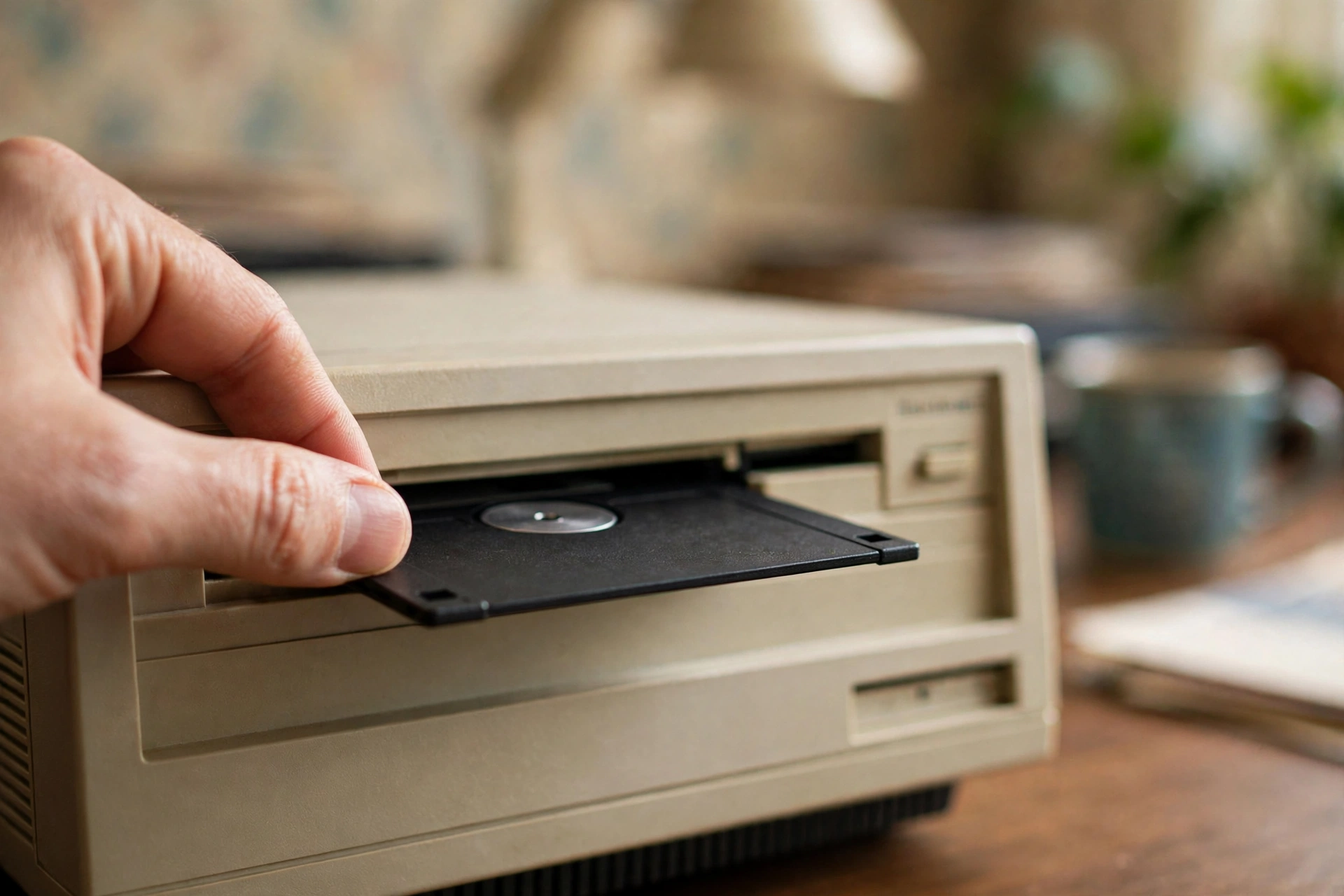
The write-protect tab deserves its own moment of respect. That tiny sliding square in the corner of the disk — move it one way and the disk was locked forever, safe from accidental deletion; move it the other way and it was writable again. It was hardware-level security you could feel between your thumb and forefinger, and it has never really been replaced. No software toggle has ever given you that same physical certainty: this disk cannot be changed, and I know it because my finger moved the tab.
Then there was the sound of the drive itself. When the computer read a disk, the drive produced a distinctive rhythm of grinding clicks and whirrs — brr-click, brr-click-click — as the head sought back and forth across the disk surface. Experienced users could hear whether a disk was reading cleanly or struggling. A healthy read sounded like a machine chewing thoughtfully; a dying disk sounded like a machine having a small seizure, with an extra-long grinding pause that made your stomach drop. Nobody needed a progress bar when they had ears.
1.44 MB: When That Was Plenty
It is hard to explain to a modern user just how much life fit inside 1.44 megabytes. A school year of essays? Easy — a text document was barely a few kilobytes. Your entire term’s homework could live on one disk with room to spare. A favorite game? Programmers compressed entire adventures into a single disk, sometimes two, and the best of them — the 8-bit era’s finest included — proved that creativity expands to fill whatever space it’s given.
The limit taught a whole generation to be ruthless editors. You didn’t keep twelve drafts of a document; you kept the good one. You didn’t hoard files; you curated them. Filenames had to be eight characters or fewer — thanks, DOS — so every file became a tiny puzzle of abbreviation. “ENGL1024.DOC.” “SKEDFALL.WK1.” Your disk directory was a haiku of your life, and you learned to read it fluently.
But the limit also created the era’s most legendary drama: the file that was just too big. A document at 1.5 MB on a 1.44 MB disk was a tragedy in three acts. You’d delete clip art. You’d compress the images. You’d start a second disk with mounting dread, because splitting a project across two disks meant the constant disk-swapping dance — insert disk one, copy, eject, insert disk two, paste, eject, repeat until the gods of magnetic media were satisfied.
The Arithmetic of Patience
Installing software from floppy disks was an exercise in meditation. A serious program might arrive on six, eight, even a dozen disks, and the installation ritual went like this: insert disk one, click install, wait for the prompt — “Please insert disk 2” — eject, insert, wait. Disk three. Disk four. You sat there for twenty minutes feeding the machine like it was a slot machine that paid out in software, and when the progress bar finally hit one hundred percent, the relief was physical.
And then, sometimes, disk eleven would fail. “Error reading disk 11 of 12.” Eleven! You had sat through eleven disks of progress, and the last mile was corrupted. The accepted remedies were a folk science: try the disk in a different drive, blow gently on the shutter (debatable), or perform the ancient ritual of copying the disk’s contents to a fresh disk and trying again. Everyone had a theory. Nobody was ever fully sure. But somehow, usually, disk eleven was coaxed back to life — and the legend of your patience grew.
The Sacred Art of Labeling Your Disks
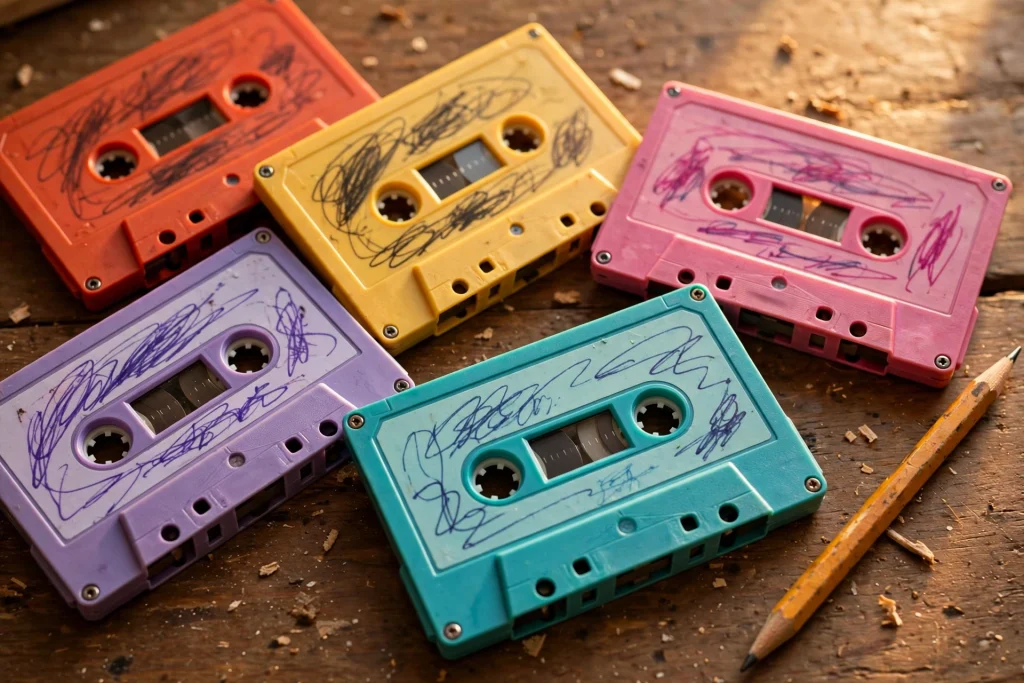
Every floppy disk came with a sticky label and a blank rectangle begging to be named. Labeling a disk was a small act of authorship: you took a pen — never a ballpoint pressed too hard, the elders warned, or you’d dent the disk — and wrote what lived inside. “SCHOOL STUFF.” “DOOM LEVELS.” “MOM’S RECIPES — DO NOT FORMAT.” A stack of well-labeled disks was a shelf of books, each spine telling its story at a glance.
The great debates of the era played out in handwriting. Do you label both sides? Do you date the label? Do you use the little color dots that came in the box? Color-coding was for the advanced — blue disks for work, red disks for games, black disks for backups that you prayed you’d never need. A disk box organized by color and category was a sight to behold, and the person who maintained it earned a quiet reputation as someone who had their life together.
Then there was the darker art: the relabeled disk. Crossed-out titles, stickers layered over stickers, handwriting that degenerated across three generations of contents. A disk that started life as “MATH QUIZ” and ended as “BAND PRACTICE 2 (FINAL-ish)” told a story of its own — the story of a disk that had been formatted and reborn more times than a comic-book hero. These palimpsests were everywhere, and they were beautiful in their own chaotic way.
Disk by Disk: Life Before Drag-and-Drop
Moving files between computers in the floppy era was a full-contact sport. There was no email attachment — or if there was, it took an hour to arrive over the dial-up connection and might be too big anyway. If you wanted to take your essay from the school computer to the home computer, you copied it to a disk, put the disk in your pocket, rode your bike home, and copied it off again. The floppy disk was the original sneakernet, and your sneakers did the routing.
This made disks social objects in a way files have never been since. Disks were lent. A friend’s game, a cousin’s program, a classmate’s essay template — all of it traveled on borrowed floppies, handed over with the solemnity of a book exchange. “Bring it back tomorrow.” “Don’t format it.” “It’s the blue one with the star sticker.” Losing someone’s disk was a genuine social crime, and everyone knew the sentencing guidelines: you owed them a new disk, and you owed them lunch.
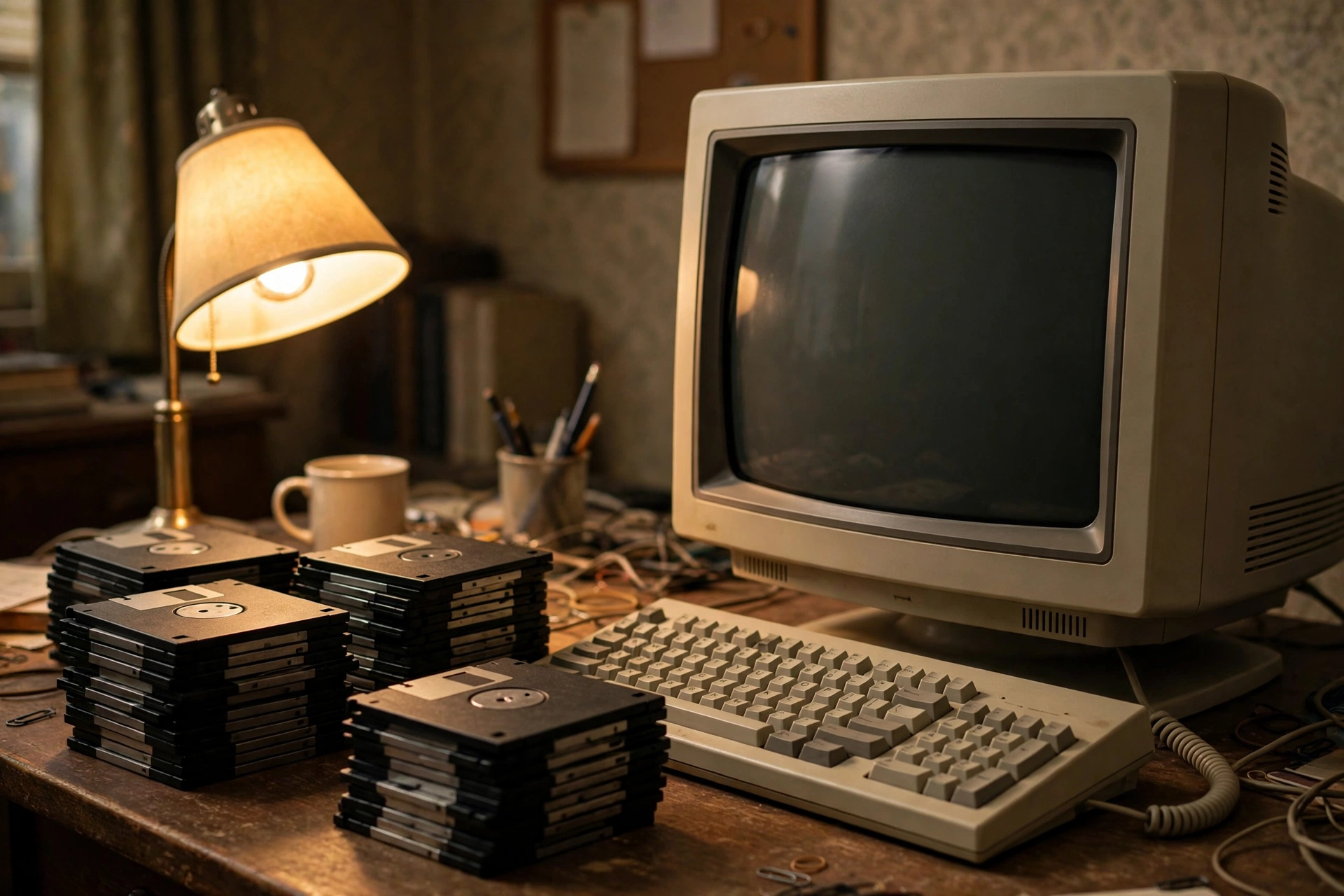
The boot disk occupied a special, almost mythical place in this economy. A boot disk was a floppy containing just enough system software to start a sick computer — and when your machine refused to start, a friend with a working boot disk was the only doctor in town. People guarded their boot disks like passports. Some users decorated them with skulls and crossbones, as if to warn: this disk has seen things. It had. It had seen the blue screen, and it had won.
And then there were the shareware disks, the era’s viral distribution network. Small software companies mailed out floppy disks with free demo versions of their games and programs — “try it, love it, pay us.” Those demo disks were passed around schools and offices like mixtapes, copied and recopied until the labels were illegible. It was open-source culture before the term existed, and it ran entirely on 3.5-inch squares of magnetic film.
The Sounds You Can Still Hear
Close your eyes and you can still hear the floppy disk era. The click-clack of insertion. The thunk of ejection. The grinding seek of the read head, like a tiny robot clearing its throat. The drive’s activity LED casting its small red glow across the desk in a darkened room — the universal signal that the machine was thinking, and that you should absolutely not touch anything.
These sounds have become ASMR for a generation. There are videos online — millions of views — of nothing but floppy drives reading disks, and the comments are full of people saying the sound makes them feel calm. It makes sense. The floppy drive’s song was the sound of a machine working for you, audibly, mechanically, honestly. Modern computers do a thousand times more in total silence, and something about that silence feels less trustworthy. The old machines told you what they were doing. You could hear the effort.
The Click of Death, and Other Horror Stories
Every era has its ghost stories, and the floppy era’s were about data loss. The “click of death” — a drive’s read head failing with a rhythmic, ominous clicking — meant the disk inside might be taking its data to the grave. A disk left on top of a speaker could be wiped by the magnet inside. A disk bent in a backpack could arrive home unreadable. The elders’ commandments were simple: keep them away from magnets, keep them out of the sun, never stack heavy things on the box. The disks were tough, but they were not invincible — and everyone had lost at least one disk to the void.
This fragility is what made the survivors precious. Ask anyone who was there about the disk they still remember: the one with the novel draft, the saved game at 99 percent completion, the letter from a faraway friend. Those disks were handled like artifacts because they were artifacts — physical objects holding irreplaceable pieces of a life. The cloud backs everything up now, but it has never made anyone feel the way a recovered disk did: like a small, square miracle.
Why the Save Icon Never Left
Here is the floppy disk’s strangest legacy: it died, and its ghost runs the world. The save icon — that little 3.5-inch disk silhouette — is used by billions of people who have never seen, touched, or heard of an actual floppy disk. Children tap it daily. Professionals click it hourly. It is one of the most recognized symbols in human history, and it depicts an object that stopped being relevant before many of its users were born.
Designers have tried to kill it for decades. Every few years, someone proposes a modern save icon — an arrow, a cloud, a checkmark — and every proposal dies on contact with reality. The floppy disk won because it feels like saving: a small, solid thing being put away safely. The metaphor is physical, and physical metaphors outlive the objects they depict. The floppy disk stopped being a storage medium around the turn of the millennium; it became pure symbol, and symbols are immortal.
There is something deeply comforting about this. Technology is supposed to be ruthless — the old makes way for the new, and the past is forgotten. But the floppy disk refused to be forgotten. It embedded itself in the visual language of computing so deeply that removing it would feel like removing a letter from the alphabet. Long after the last drive was manufactured, the disk lives on in every toolbar, every menu, every “don’t forget to save” — a fossil that became a monument.
The Long Goodbye
The floppy disk didn’t die all at once. It faded in stages, and each stage had its own melancholy milestone. First came the CD-ROM, holding hundreds of times more data and making the multi-disk install ritual obsolete overnight. The burned CD era carried the torch for a while — same physical rituals, vastly bigger capacity. Then came the USB flash drive, smaller than a floppy and a thousand times roomier, and the writing was on the wall. Finally, the cloud arrived, and “saving” stopped meaning a physical act at all.
Computer makers dropped the floppy drive one by one, usually without ceremony — a line missing from the spec sheet, a blank panel where the drive used to be. The last holdouts kept their external USB floppy drives for years, just in case, the same way you keep a candle during a power outage even though the lights are back on. And somewhere in a drawer near you, right now, there is probably a floppy disk. Everyone has one. Nobody throws them away.
That drawer disk is the perfect ending to the story. You can’t read it — you haven’t owned a drive in fifteen years. You don’t need what’s on it. But you’ll never throw it away, because throwing it away would mean admitting that a piece of your life is truly unreadable now. So it stays, a small square of the past, waiting in the dark. The shutter still clicks if you slide it open. The label is still in your handwriting. And somewhere inside, magnetized into the film, is a version of you that the cloud never got to meet.
So Here’s to the Little Square
The floppy disk era lasted roughly from the mid-1980s to the early 2000s — barely twenty years, a blink in the history of computing. In that blink, it taught the world to save, to label, to organize, to back up, to lend, and to lose things gracefully. It was the training wheels of the digital age, and we rode them farther than anyone expected.
So here’s to the floppy disk. To the click-clack and the thunk. To the 1.44 MB that was somehow enough. To the write-protect tab and the color-coded boxes and the boot disks that saved sick computers. To the disks lent and never returned, and the ones returned with new games copied on as interest. To the save icon that outlived its own body and became immortal.
The next time you tap that little blue square, pause for half a second. You’re not just saving a file. You’re performing a ritual that started forty years ago, with a piece of spinning magnetic film inside a plastic shell, in a drive that sang while it worked. The disk is gone. The gesture remains. And honestly? That’s the best kind of legacy a piece of technology can have.