Table of Contents
Before you ever saw it, you heard it. A wobbly little melody floating down the street on the hot afternoon air, getting louder with every block — and just like that, the entire neighborhood froze mid-game. Kickball in the street? Frozen. Tag in someone’s backyard? Abandoned. We all became radar dishes, heads cocked, trying to figure out which direction it was coming from. My ice cream truck memories don’t begin with ice cream at all. They begin with sound.
There was no app to tell you when it was coming. No GPS ping, no delivery notification, no group text. There was just your ears, your bike, and a sprint that could shame an Olympic athlete. The ice cream truck was the one event in childhood that needed no advertising beyond a tune played through a crackling speaker — and we showed up every single time, coins clutched in sweaty fists, breathless, bargaining with our friends over which flavor deserved our hard-earned seventy-five cents. Some ice cream truck memories are just that vivid.
Ice Cream Truck Memories Begin With That Distant Jingle
Every kid in America could identify that melody from two streets away. The tinny, looping tunes — most famously the bouncy ragtime riff of The Entertainer, a 1902 piano piece by Scott Joplin that found its second life riding on truck speakers — became the unofficial national anthem of summer. Music-box melodies were cheap to loop and impossible to ignore, which was exactly the point: the truck didn’t need to drive past your house to announce itself. It haunted the whole block with sound.
We became little experts in audio detection. We could tell, just from the pitch and the wobble, whether the truck was still a few streets over or about to round our corner. Some kids claimed they could name the tune. Others swore they could recognize their truck by its particular brand of speaker distortion, the way it warbled on the high notes. We didn’t need science to know that when the jingle faded, you had missed it — and there was no sadder feeling on earth than hearing that music grow faint as you chased it down the street too late, your flip-flops slapping uselessly against the pavement.
The Mister Softee trucks had their own famous jingle, and here’s a detail I love: it was adapted from a much older tune called “The Whistler and His Dog” and written for the company around 1960. Think about that. Generations of kids sprinted through Brooklyn and New Jersey and Philadelphia chasing a song most of them never knew had a name — let alone words — yet those wordless tunes became some of our most enduring ice cream truck memories.
The Mad Dash: Bare Feet, Clutched Coins, Full Speed
Nothing in adult life will ever again give you the urgency of the ice cream truck sprint. You heard that first note and your body simply went. It didn’t matter what you were doing. It didn’t matter that you were barefoot and the asphalt was roughly the temperature of the sun. You ran. We all ran. It was the only race every kid on the block entered willingly, and there was no prize for second place — the truck waited for nobody, and that is exactly what ice cream truck memories are made of.
And then there was the money situation, which deserves its own chapter. Children did not carry wallets back then. We carried whatever we could dig out of couch cushions, birthday-card envelopes, and the mysterious bottom of Mom’s purse — a damp fistful of pennies, nickels, and the occasional glorious quarter. We counted that money on the curb like tiny accountants. I can still feel the stickiness of those coins, warm from being clenched in my palm for the entire sprint.
If you were short by five cents, your whole summer was at stake. Brothers and sisters became emergency lenders. Friends became short-term creditors. The ice cream truck taught a generation its first lessons in personal finance — and some of our fondest ice cream truck memories.
The Menu Board: A Rainbow of Impossible Choices
Getting to the truck was only half the battle. Then you had to face the menu board — that glorious painted panel bolted to the side of the truck, lined with bright little pictures of frozen treasures. This was decision-making under pressure. There was a line of kids behind you, the driver was waiting, your money was melting-temperature warm in your hand, and you had about ten seconds to commit. It was the most important choice you’d make all day, and everyone knew it.
Some kids had a signature order they never changed. Others were pure chaos, studying the board like it was a treasure map and changing their minds at the last second to the visible frustration of everyone in line. Nobody judged you for taking too long, though. We’d all been there. The menu board was a place of dreams, and dreams take time — which is exactly why these ice cream truck memories still feel so real.
The Good Humor Bars That Started It All
Long before any of us were born, the whole ice cream truck phenomenon began with one treat. In 1920, an Ohio candy-maker named Harry Burt developed a way to coat a brick of vanilla ice cream in chocolate — and when his kids suggested sticking a wooden handle in it, the Good Humor bar was born. Burt sent his bars out in gleaming white trucks with drivers in white uniforms, and the ice cream truck became an American institution. The Smithsonian’s account of that history is worth a read if you want the full story of how a small-town invention changed every summer that followed.
Decades later, those Good Humor bars were still the pride of the menu — the chocolate crunch bars, the toasted almond bars with their sandy-sweet coating, the strawberry shortcake bars with the pink crumbs. Good Humor’s long history spans more than a century now, and somehow that toasted almond coating still tastes exactly like being eight years old — the very flavor of ice cream truck memories.
The Red, White, and Blue Rockets
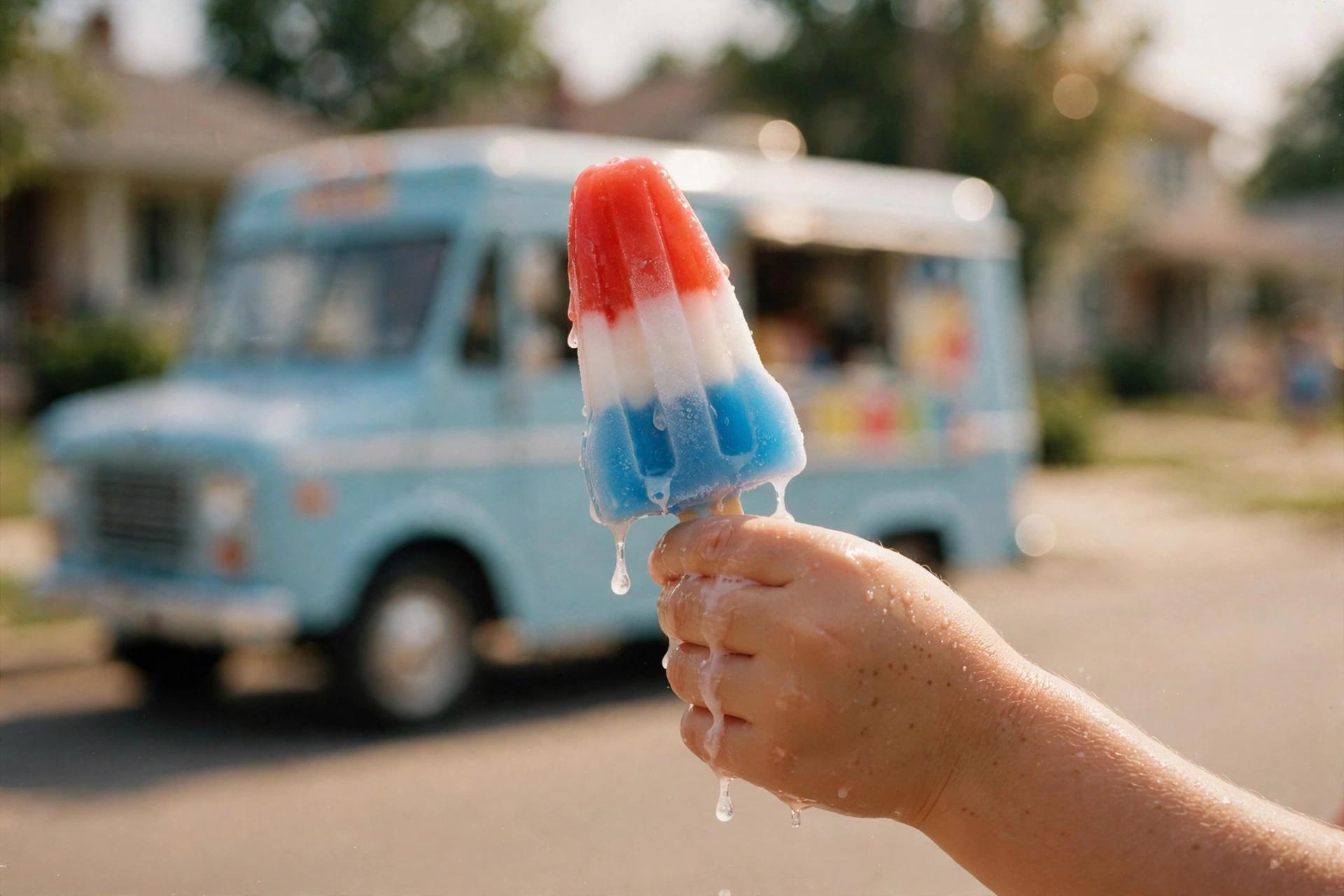
And then there was the Bomb Pop. Cherry, lime, and blue raspberry stacked into a six-finned rocket — invented on July 30, 1955, by James S. Merritt and D.S. Abernethy at Merritt Foods in Kansas City, Missouri. Nobody back then was thinking about nostalgia; they were thinking about making the coolest-looking ice pop on the planet. But the Bomb Pop became something bigger: a perfect symbol of American summer, red, white, and blue right down to the stains it left on your tongue.
Eating a Bomb Pop was a performance. Some kids licked it top to bottom in neat, careful layers, protecting each color. Others attacked it head-on, gnawing straight through the middle in a glorious red-and-blue mess. There was no wrong way — but there was one universal rule. The race against the sun. On a truly hot day, that pop was melting faster than you could eat it, and you finished with sticky forearms, a blue-stained tongue, and absolutely zero regrets — just the kind of ice cream truck memories summer was made for.
The Legends We Still Argue About
Ask any group of friends about their favorite truck treat and you’ll start a debate with no winner. The Choco Taco is the perfect example. Invented in 1983 by a Philadelphia ice cream man named Alan Drazen — a waffle-cone shell folded into a taco, filled with vanilla ice cream, fudge, and peanuts — it became a cult legend over nearly four decades. When the company discontinued it in 2022, people genuinely mourned. Grown adults posted tributes. There were petitions. There were heartfelt farewell posts. A discontinued ice cream got a better send-off than most TV shows — which tells you how deep these ice cream truck memories run.
And the supporting cast was just as beloved. The Flintstone Push-Ups, which you pushed up from the bottom like a little orange-plunger masterpiece. The Firecrackers with their popping candy surprise. The Screwball, with the gumball waiting at the very bottom like a bonus prize. The giant King Cone with its chocolate-lined point that you saved for last. The SpongeBob faces with the gumball eyes that never quite looked like the picture. We used to compare them, laughing, because the face on the box and the face in the wrapper were never the same creature.
Looking back at these treats alongside other childhood favorites — the kind of snacks we celebrated in our look at the 90s snacks that ruled our lunchboxes — it’s clear we weren’t just hungry. We were collectors. Every flavor was a badge of honor, every wrapper a trophy. You didn’t just eat ice cream from a truck. You curated a summer.
Mister Softee and the Soft-Serve Swirls
On the East Coast, there was royalty — and its name was Mister Softee. Founded in 1956 in Philadelphia by brothers William and James Conway, who bolted soft-serve machines into trucks and drove the whole concept straight into neighborhoods, Mister Softee turned the simple swirl into a work of art. The tall, curling cone with rainbow sprinkles. The chocolate-dipped soft serve with its satisfying crack. The strawberry sundae that looked like a postcard.
Watching that swirl get built was half the pleasure. The driver would pull the lever and the soft serve would rise in perfect ribbons, twisting up into that impossible peak. Kids stood there hypnotized. Could any of us have made one at home? Of course not. It took a trained professional with a magic machine, and we respected that.
The Mister Softee truck was also a landmark. “Meet you by the truck” was a legitimate plan. It was where the neighborhood gathered on summer evenings, where parents caught up while their kids compared orders, where the whole street felt like one big front porch. The truck wasn’t just selling dessert. It was hosting the block party, and those summer evenings remain some of my favorite ice cream truck memories.
The Driver Who Knew Everybody’s Name
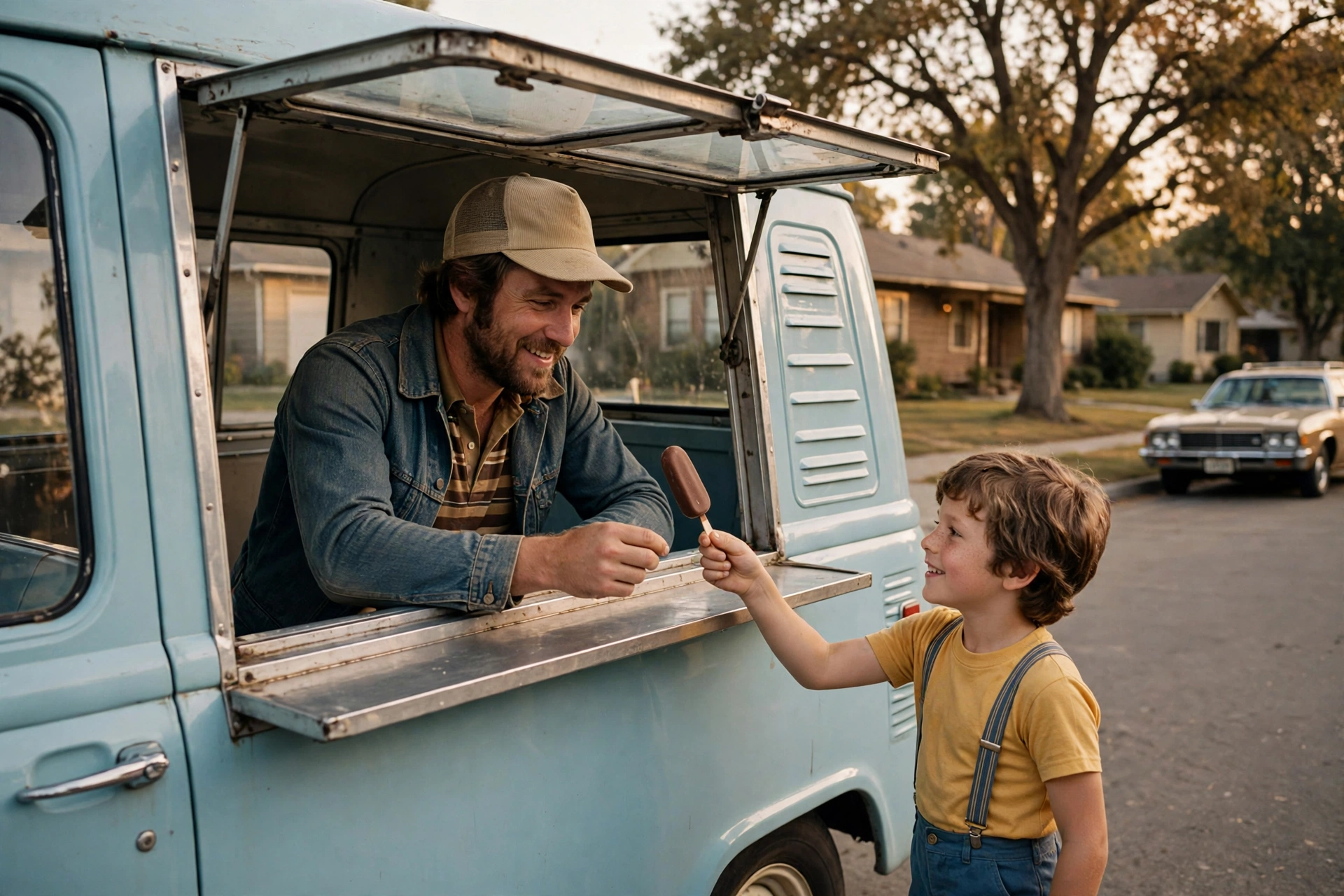
Every neighborhood had one — the ice cream man (or ice cream lady) who was practically family. They knew your name. They knew your usual. They knew that your little brother always ordered the wrong thing and then tried to trade. They’d spot you from half a block away and start pulling your order before you even reached the window.
These drivers were institutions. Some of them worked the same routes for years, and kids who grew up and moved away still talk about them like local celebrities. There was something deeply comforting about it: in a world that was constantly changing, the same friendly face showed up every summer afternoon, in the same truck, with the same menu, ready to take your coins. It felt like the one guarantee childhood came with. The drivers, I think, are the unsung heroes of our ice cream truck memories.
Sticky Change and the Sweet Economics of Childhood
Let’s talk about the money again, because it matters more than you think. The ice cream truck ran on a currency system no bank would recognize: couch-cushion pennies, birthday dollars folded into tiny squares, the nickel your grandmother slipped you “for something sweet.” There were no prices a kid couldn’t parse. You knew exactly what you had and exactly what it could buy. If the Bomb Pop was forty cents and you had thirty-eight, that was a math problem with emotional stakes.
And honestly? That whole little economy — the counting, the borrowing, the lending, the agony of being two cents short — taught us more about money than any classroom ever did. It’s the same kind of corner-store arithmetic we explored in our piece on penny candy and corner store memories, where every coin had a name and every purchase was an event. The truck window was the first counter any of us ever stood at, and we took it very seriously — a cornerstone of classic ice cream truck memories.
Why That Jingle Still Echoes
Here’s the thing about the ice cream truck: it sold us more than dessert. It sold us the feeling of a day with absolutely nothing to do and nowhere to be. That jingle meant freedom. It meant the sun was out, school was a distant rumor, and the biggest decision of your afternoon was which frozen treat deserved your pocket change. We didn’t need a calendar to tell us it was summer. We had a melody, and that melody is the beating heart of our ice cream truck memories.
That’s why you can still hear it. Somewhere in your brain, that tune is permanently filed next to the smell of fresh-cut grass and the feeling of sunburned shoulders. I sometimes catch myself humming it when I least expect it — in a grocery store freezer aisle, watching a grandchild or a niece chase a modern truck down a modern street, the same sprint, the same coins, the same joy. Some things change. Some things, thank goodness, don’t.
The ice cream truck was never really about ice cream. It was about being eight years old on a July afternoon, with the whole street as your playground and the future as wide open as that summer sky. And every once in a while, on a hot enough day, if you listen closely — I swear you can still hear the music drifting down the street, carrying a lifetime of ice cream truck memories with it.
So now I want to hear from you: what was YOUR order? The Bomb Pop? The Choco Taco? The toasted almond bar you never strayed from? And here’s the real test — do you still remember the name of your ice cream truck driver? Drop it in the comments, and tag a friend who ran barefoot beside you. Let’s hear those jingles together — and share your own ice cream truck memories below.