TV Dinner Memories: The Night the Foil Came Off
You could hear the hiss before you ever saw the tray. The oven door swung open, steam rolled out carrying the smell of Salisbury steak gravy all the way down the hallway — and just like that, it was TV dinner night. Nothing in childhood announced a special evening quite like the crinkle of that foil, and tv dinner memories are stitched into some of the warmest hours of growing up.
Table of Contents
I remember the exact sound of it. Not the polite rustle of a potato chip bag. This was deeper — a slow, crackling sizzle as Mom peeled the foil lid back off the tray, the way steam would rise up and fog the kitchen window for a second. We’d be hovering like seagulls, three kids in socks on the linoleum, and Dad would be in the living room calling out, “Is it ready yet?” like we hadn’t been standing there asking the same question every four minutes since the timer went in.
There was a ceremony to it, and every kid knew the steps by heart. First, the trip to the freezer, where you’d press your nose against the glass door and study the boxes like they were treasure chests. Fried chicken? Salisbury steak? Turkey with the stuffing? Choosing felt enormous — bigger than it had any right to be — because whatever you picked, that was YOUR dinner, in YOUR tray, and nobody could trade you out of it later. (They could try. Oh, they could try.)
Then the wait. Twenty-five minutes at 425 degrees. In kid time, that’s roughly a year and a half. You’d wander back to the kitchen every few minutes to peek through the little oven window, watching the foil puff up like a tiny silver pillow. And when that timer finally rang? Pure electricity. The whole house seemed to tilt toward the kitchen.
Mom would carry each tray out on a potholder — those foil trays came out of the oven hot enough to brand you — and the smell would hit you in waves. Savory gravy. Buttery corn. And underneath it all, that faint metallic warmth of the aluminum itself, which somehow made everything taste better. Don’t ask me why. It just did.
A Happy Accident: How the TV Dinner Was Invented
Here’s the part that always makes me smile: one of the most beloved rituals of American family life started as a mistake. Back in 1953, the Swanson company found itself with a serious problem — a massive surplus of frozen turkey left over after Thanksgiving. We’re talking about a mountain of birds, far more than anyone could sell the normal way. Somebody at Swanson had to get creative, and fast.
That somebody was a salesman named Gerry Thomas, who looked at the situation and had an idea that would change how America ate. He remembered the compartmentalized trays that airlines were using to serve food to passengers, and he thought: why not do that for the freezer aisle? Turkey, cornbread stuffing, peas, and sweet potatoes — a whole Thanksgiving-style meal, frozen into an aluminum tray with separate compartments, ready to heat and eat. It went on sale for just 98 cents, baked for 25 minutes at 425°F, and flew off the shelves.
Ninety-eight cents. Let that sink in for a second. A full hot dinner for less than a dollar — for a family in 1953, that was nothing short of miraculous. And the timing couldn’t have been more perfect. Television was sweeping into American living rooms like a tidal wave, and Swanson leaned right into it. They called it the TV Dinner, and the name stuck so hard it became the generic word for every frozen tray meal that ever followed. If you want to fall down a wonderful rabbit hole, the Swanson TV dinner story has the whole timeline, from that first turkey dinner to the microwave era.
Why the Name “TV Dinner” Stuck
Part of it was genius marketing, sure. But part of it was that the name was simply TRUE. The whole point of the thing was that you could eat it in front of the television. Swanson even leaned into the visual — early packaging played up the TV connection, and before long, everybody just called them TV dinners no matter whose name was on the box. It was one of those rare product names that described the entire experience: the food, the tray, the glowing screen in front of you. Say “TV dinner” to anyone who grew up in the sixties or seventies and watch their eyes go somewhere else for a second. That’s the power of a name that told the truth.
The Ritual of TV Dinner Night
Here’s what the history books don’t tell you: the TV dinner was never really about the food. I mean, don’t get me wrong — that food hit the spot in a way that’s hard to explain to anyone who didn’t live it. But the real magic was the ritual. TV dinner night was an event. It was the one night the dining room table sat empty and nobody felt one bit guilty about it.
It usually went like this. Dad would announce it on the way home, or Mom would mention it at lunch, and the whole day would take on this electric charge. “TV dinners tonight!” It sounded like a holiday. Regular dinner was a chore you sat through. TV dinner night was a celebration you counted down to.
And the food itself? Let’s be honest with ourselves here — nobody was confusing it with a home-cooked Sunday roast. The peas were a little wrinkly. The mashed potatoes had that distinctive reconstituted smoothness. The gravy came from a place of mystery. But you know what? When you’re seven years old and you’re eating it off a tray in front of the TV, it tastes like the finest meal on earth. It was a darn sight more exciting than school cafeteria food, and every kid knew it.
There were rules, too — unwritten ones, but ironclad. You ate what was in your tray. You did NOT reach into your brother’s tray. The dessert compartment was sacred territory, defended like a castle. And heaven help the kid who tried to claim the burnt corner of the brownie — that was the best part, the crispy edge where the chocolate had caramelized against the foil, and everybody knew it.
Setting Up the TV Trays
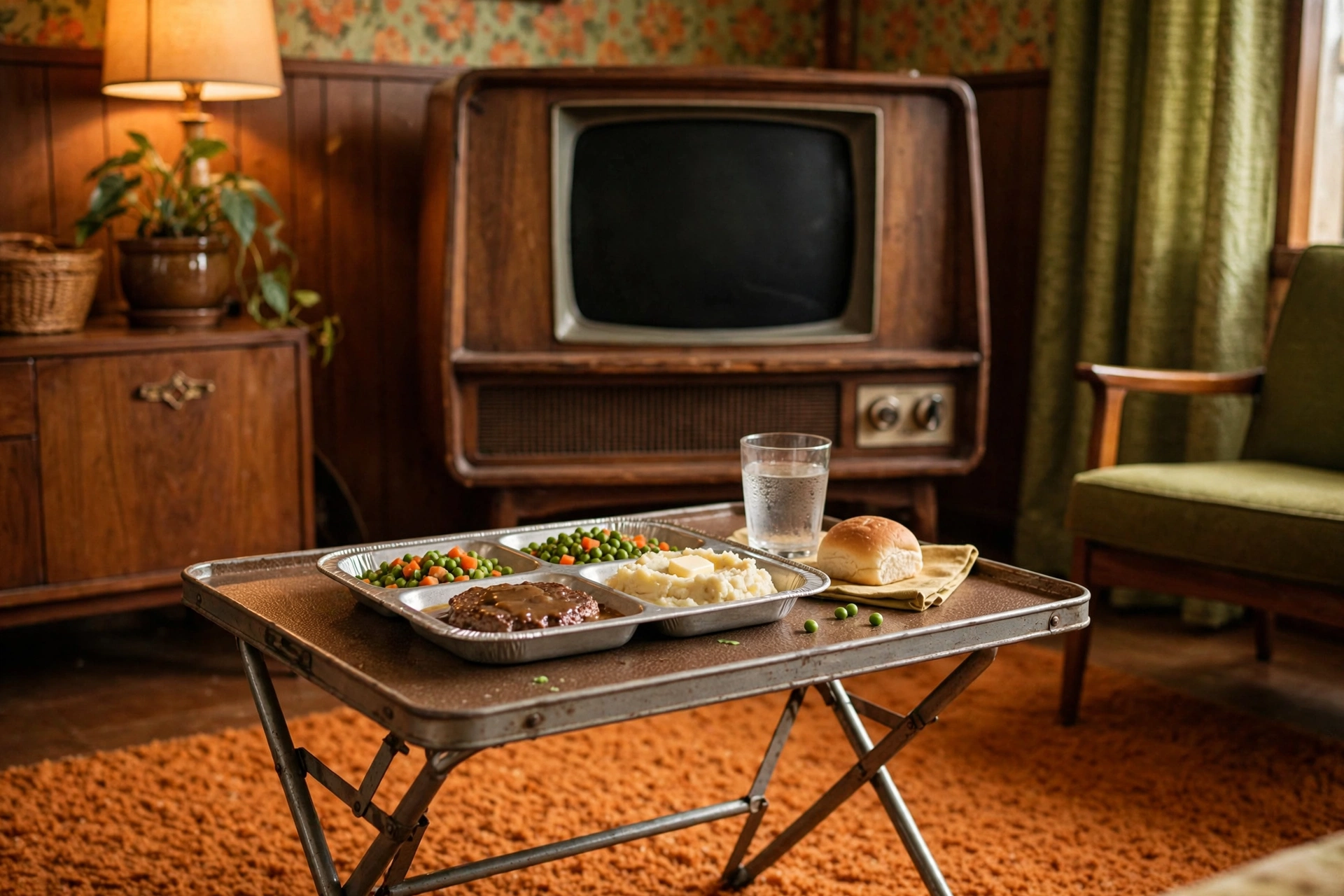
Before the food could even come out, there was the furniture. The folding TV tray tables! Those wobbly-legged metal miracles that lived folded up in a corner or behind the couch, waiting for their moment. Setting them up was half the fun — you’d unfold the legs with a satisfying snap, carry your table into the living room like you were setting up a restaurant, and claim your spot. Front row, obviously. Closest to the TV, where the sound was best and the glow lit up your tray like a stage.
Every family had their system. In our house, Dad got the big chair and the sturdiest tray. Mom took the couch. Us kids sprawled on the floor with our trays, or dragged ours right up to the coffee table. The trays themselves were works of art in their own way — some had fake wood grain, some had flowers, ours had this green marbled pattern that I can still see when I close my eyes. They wobbled. They always wobbled. You learned to eat with one hand hovering near the edge, ready to catch the whole operation before the peas made a break for it.
What Was on the Screen
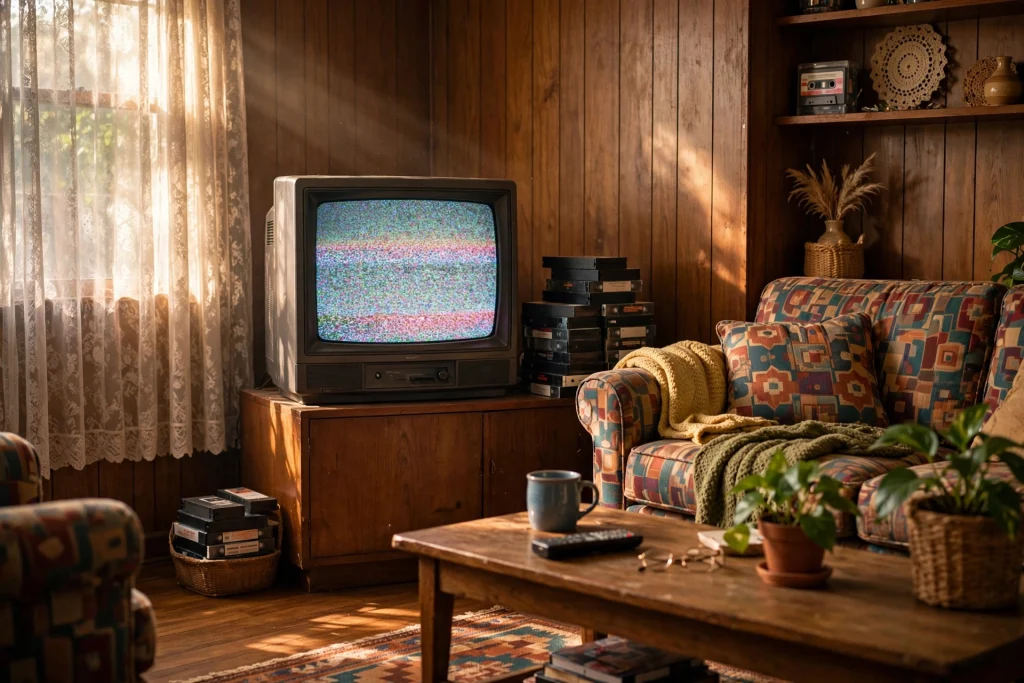
And then — the main event. The TV flickered on, and for the next hour, the whole family was together in a way that just didn’t happen at the regular dinner table. Maybe it was a western, the whole family holding its breath during the showdown. Maybe it was a variety show with singers and comedians and that live-audience energy crackling through the speakers. Sunday nights had their own sacred programming — the whole week seemed to build toward it.
Here’s the thing nobody talks about enough: TV dinner night was family time wearing a disguise. Mom wasn’t up to her elbows in dishes. Dad wasn’t reading the paper at the table. The kids weren’t squirming through grace and vegetables. Everybody was relaxed, everybody was happy, and everybody was in the same room, laughing at the same jokes, gasping at the same plot twists. The TV dinner didn’t just feed us. It gathered us.
The Menu Hall of Fame
Now let’s pay our respects to the lineup, because the TV dinner menu was a genuine hall of fame. Every kid had their favorite, and defending your pick was a matter of honor. The fried chicken dinner was the undisputed heavyweight for a lot of families — crispy-ish coating, corn that somehow stayed sweet, mashed potatoes drowning in gravy. It was the one that made you feel like you were getting away with something.
Then there was the turkey dinner, the original, the one that started it all back in 1953 — turkey slices, cornbread stuffing, peas, sweet potatoes, all in their little foil neighborhoods. It tasted like a tiny Thanksgiving, and on an ordinary Tuesday in February, a tiny Thanksgiving felt like a miracle. The fish dinners had their loyalists. The veal parmigiana had its moment. The Mexican-style dinners showed up later and felt wildly exotic to kids who’d never seen a taco in real life.
But the real turning point came in 1960, when Swanson added something that changed everything: dessert. A whole separate compartment, just for something sweet. Apple pie. Cherry pie. And the undisputed champion of the dessert compartment — the brownie. That dense little chocolate square, warm from the oven, with the edges just barely crisped against the foil. Kids didn’t just eat the brownie. They guarded it, negotiated over it, and in the most desperate cases, tried to trade their entire vegetable compartment for someone else’s.
Salisbury Steak and the Little Brownie
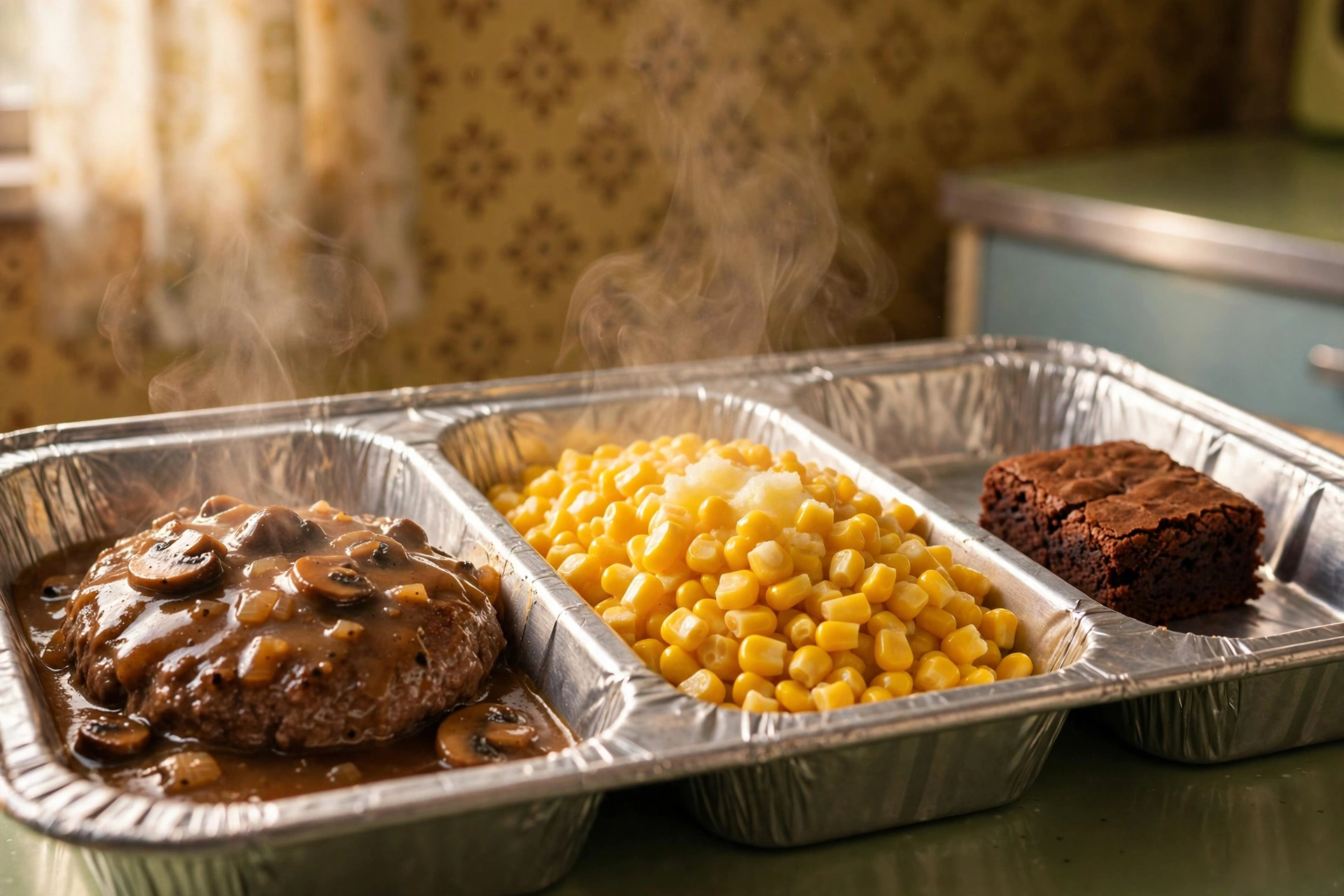
If the TV dinner had a signature dish, it was the Salisbury steak. That oval patty of seasoned beef, smothered in brown gravy with those little mushroom slices, sitting in the biggest compartment like it owned the place. The gravy would always creep over the divider into the mashed potatoes, and nobody minded — that was a feature, not a bug. Gravy-soaked mashed potatoes might be the single greatest accidental invention in frozen food history.
And the brownie. Let’s take a moment for the brownie, because it deserves its own paragraph. It was small — let’s not pretend otherwise — but it punched so far above its weight. The top would get this delicate crackly crust in the oven, and the middle stayed fudgy, and the corners… the corners got dark and chewy where they’d pressed against the hot foil. Every kid in America developed a strategy for the brownie. Some ate it first, getting the best part out of the way before anyone could suggest sharing. Some saved it for last, building the whole meal toward that final bite. Some — the true diplomats — broke it in half and shared it, earning goodwill that lasted for weeks.
Nobody in the history of TV dinners ever willingly gave up their brownie. Not once. Not ever.
Hungry-Man: When Appetites Got Serious
Then 1973 rolled around, and Swanson looked at the teenage boys of America and said: we see you, and we hear your stomachs. The Hungry-Man dinner arrived with bigger portions, heartier food, and an advertising campaign fronted by “Mean” Joe Greene — the Pittsburgh Steelers’ legendary defensive tackle, one of the toughest men in football. If Mean Joe Greene said this dinner was enough to satisfy a real appetite, you believed him. The man could have eaten the tray itself.
The Hungry-Man was a rite of passage. Getting your first Hungry-Man meant you were officially a big kid, someone whose hunger could not be contained by a standard tray. Dads claimed them. Older brothers hoarded them. And the commercials — Joe Greene’s booming presence telling you this was a dinner for serious appetites — made every kid feel like they’d been personally challenged to finish one. It was brilliant marketing, but it was also genuinely true to the product: those trays were loaded.
By 1986, the trays themselves got an upgrade with microwave-safe versions, and the whole ritual sped up. No more 25-minute oven wait — you could go from freezer to couch in minutes. It was progress, sure. But ask anyone who lived through the oven era, and they’ll tell you something was lost when the waiting went away. The anticipation was part of the flavor.
What Those Little Trays Really Meant
So what was it, really? A frozen meal in a foil tray. Objectively, nothing special. But TV dinners arrived at a moment when American family life was changing fast — more moms working outside the home, evenings busier, the television becoming the hearth of the house — and they fit that moment perfectly. They gave families permission to relax. They turned an ordinary weeknight into an occasion. They made “easy” feel like “special,” and that’s a trick very few products have ever pulled off.
For Mom, TV dinner night meant a night off. No chopping, no stirring, no mountain of pots in the sink — just trays in the oven, trays out of the oven, and trays in the trash. You could see the relief in her shoulders. She got to sit on the couch with the rest of us, tray on her lap, laughing at the same show. That image — Mom actually relaxing at dinnertime — is one of my fondest memories, and I bet I’m not alone in that.
For Dad, it was a break from the formality of the dinner table. No “sit up straight,” no “don’t talk with your mouth full” — well, fewer of those, anyway. He could kick his feet up, eat his Salisbury steak, and watch his show. For kids, it was pure joy: dinner as entertainment, food as adventure, the whole evening feeling like a treat instead of a routine.
And here’s the part that gets me, every time I think about it: those trays taught us something. They taught us that togetherness doesn’t require perfection. The food wasn’t fancy — it wasn’t even close to the kind of meal you’d get at the classic diners with their jukeboxes and milkshakes — but the togetherness was real. The laughter was real. The feeling of the whole family in one room, trays balanced on laps, eyes on the same glowing screen? That was as real as anything.
For a little while there, the finest dining room in America was the living room — and the finest table was the one that folded.
The foil tray was the original multitasker, too — plate, pan, and serving dish all in one, no dishes to wash, no leftovers to wrap. You ate, you tossed the tray, and the evening was yours. In a world that keeps telling us everything has to be artisanal and complicated, there’s something deeply comforting about remembering when dinner came in a 98-cent foil tray and it was the highlight of the week.
Those nights are gone now, mostly. The trays changed, the ovens changed, the shows changed. But the feeling? The feeling is still right there, waiting, every time you hear foil crinkle or catch a whiff of gravy on a cold evening. That’s what nostalgia is, really — not the thing itself, but the warmth it left behind.
So tell me — which TV dinner was yours? Were you the fried chicken kid, the Salisbury steak loyalist, or the one who always tried to trade their peas for somebody else’s brownie? Drop your answer in the comments below, and tag the sibling you used to fight over the dessert compartment with. I have a feeling this is going to bring back some delicious memories.