Before phones became fragile glass slabs that crack if you look at them wrong, the world ran on Nokia phones — devices you could drop down a flight of stairs, fish out of a snowbank, and use to hammer in a loose nail — and they would still have three bars of battery left. They made calls. They sent texts. They played one perfect game. And an entire generation loved them with a devotion that no smartphone has ever inspired.
The Nokia phones of the late nineties and early two-thousands weren’t just gadgets; they were companions. They lived in pockets, backpacks, and cup holders through years of daily abuse. They developed the patina of a well-loved tool — the worn keypad, the scratched screen you could still read perfectly, the slightly loose battery cover that everyone just accepted. Ask anyone who owned one, and they’ll tell you the same thing: it was the best phone they ever had, and nothing since has come close.
What made these brick phones legendary wasn’t a single feature. It was the total package: reliability so absolute it became a joke, battery life measured in days instead of hours, and a simplicity that meant the phone never got in the way of life. It did a few things, and it did all of them flawlessly. In an age of devices that try to do everything, there’s something almost radical about remembering when one device did almost nothing — and did it perfectly.
Nokia Phones Were Built Like a Tank
The durability of the classic Nokia is the stuff of internet legend, but the legends were earned. These phones survived drops onto concrete, dunks in puddles, and the general chaos of teenage life with barely a scratch. The secret was gloriously unglamorous: thick plastic shells, tiny screens set deep behind protective bezels, and internal components with actual empty space around them to absorb shocks. They were over-engineered in the best possible way.
Everyone has a story, and every story follows the same arc. The phone flies out of a hand, cartwheels across the parking lot, separates into its three constituent parts — body, battery, back cover — and the owner performs the ancient ritual: pick up the pieces, snap them back together, press power. The little startup jingle plays. The phone works. It always worked. That moment of resurrection never got old, and it built a brand loyalty that advertising money can’t buy.
The memes came later — the jokes about Nokias cracking floors instead of screens, about archaeologists finding working Nokias in a thousand years. But the humor worked because it was barely exaggeration. These were devices from an era when “mobile phone” meant something you could rely on absolutely, the way you rely on a hammer or a flashlight. It wasn’t precious. It was permanent.
Snake: The Game That Ate Commutes
Every Nokia came with a secret: a game so simple and so addictive that it consumed cumulative years of human attention. Snake — a growing pixel serpent chasing pixel dots around a monochrome screen — was the perfect mobile game precisely because it asked so little and gave so much. No tutorial needed. No internet required. Just you, a growing tail, and the walls closing in.
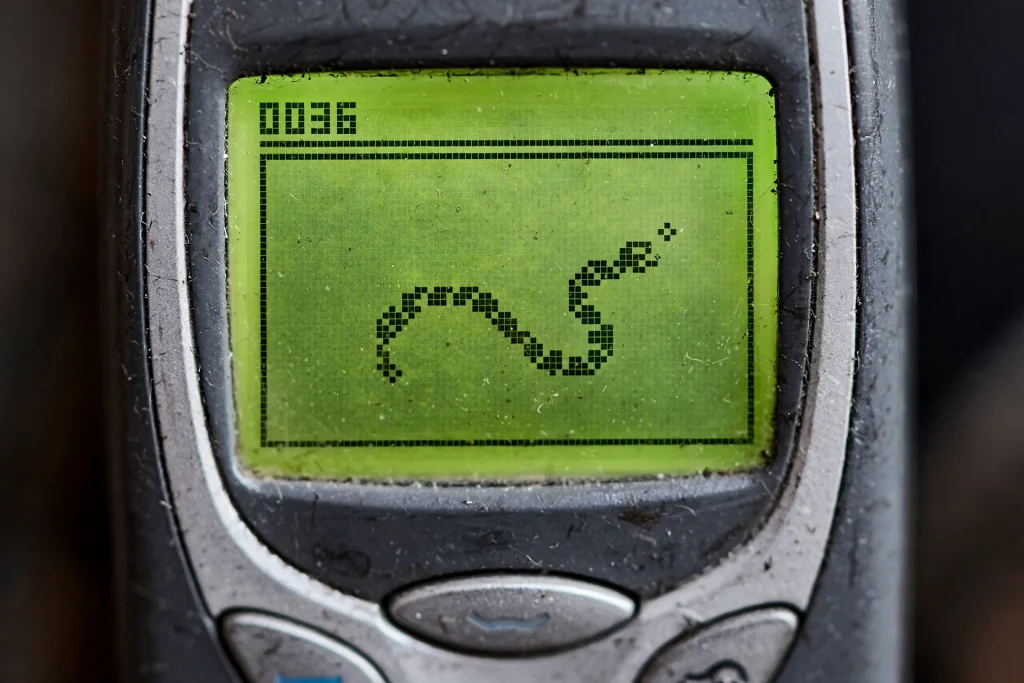
The genius of Snake was its purity. The controls were four directional buttons. The goal was obvious. The difficulty scaled naturally — every dot made you longer, every length made survival harder. And the high score table turned every bus ride into a tournament. Everyone knew someone who claimed a legendary score, and everyone quietly tried to beat their own best in stolen moments: waiting rooms, boring classes, long car rides as a passenger.
There were sequels and variants — Snake II added mazes and moving obstacles — but the original’s elegance was untouchable. It proved something the entire mobile gaming industry would later build on: the best phone game isn’t the most impressive one, it’s the one you can play with one thumb while half paying attention to something else. The arcade era had taught the same lesson with quarter-munching cabinets — simple, addictive, endlessly replayable. Decades later, people still download Snake clones, chasing the ghost of that green screen.
A Week of Battery: The Lost Superpower
Let’s talk about the battery, because younger readers may not believe this part. A fully charged Nokia could last a week. Not a day. Not a day and a half with careful management. A full, honest week of normal use — calls, texts, Snake sessions and all. The little battery meter became a background detail of life rather than a source of constant anxiety.
Think about what that meant. Nobody carried a charger. There were no portable battery packs, no frantic searches for outlets at airports, no battery-percentage dread. The charger lived in a drawer at home, used on Sunday nights like a weekly ritual. Forgetting to charge your phone simply wasn’t a failure mode that existed. The phone was always ready, the way a landline was always ready — it was infrastructure, not a pet that needed feeding.
How did they do it? Tiny monochrome screens sipped power. There was no Wi-Fi, no GPS, no background apps phoning home every thirty seconds. The phone did almost nothing when idle, which meant idle was nearly free. Modern smartphones are miraculous computers, but the trade was real: we gained the world in our pockets and lost the ability to ignore our pockets for a week.
T9 Texting: Poetry at Twelve Keys
Before touchscreens, there was the numeric keypad — twelve buttons that had to produce the entire English language. The solution was T9 predictive text, and learning it was a genuine skill, like touch-typing for thumbs. Each key held three or four letters; you pressed each key once per letter and the phone guessed the word. It felt like magic the first time it worked.
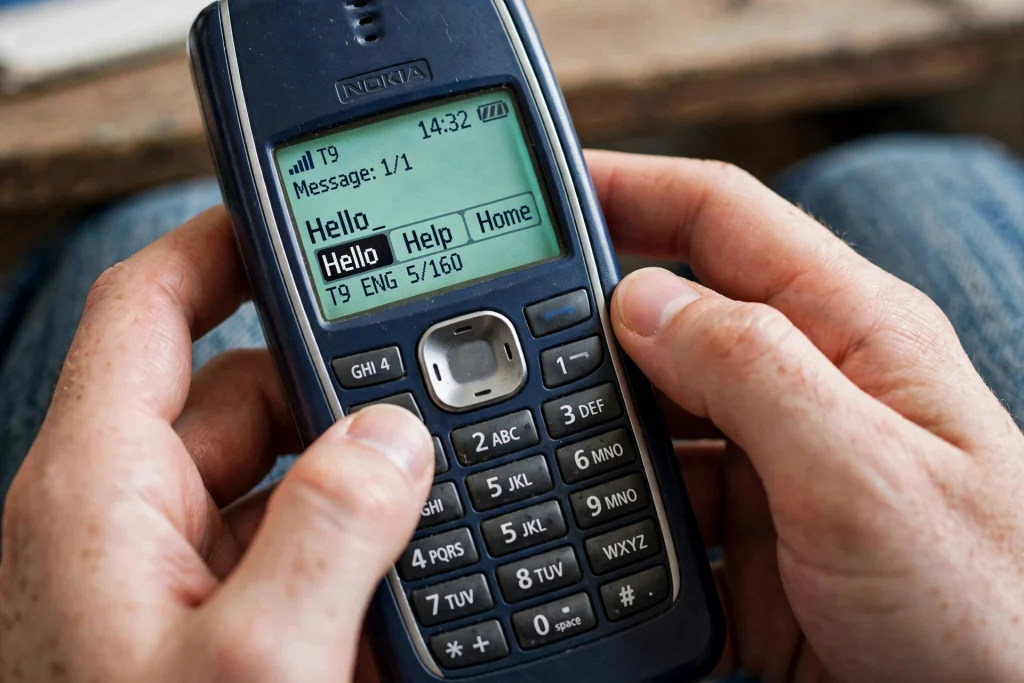
Everyone developed T9 fluency, and with it, T9 war stories. The system guessed wrong in endlessly entertaining ways — suggesting the wrong word from the same key sequence, turning innocent messages into accidental comedy. Veterans learned the dictionary’s quirks by heart: which words needed manual correction, which sequences were safe, how to cycle through alternatives with the star key. Texting became a craft, and fast texters were admired the way fast typists once were.
There was also the legendary ability to text without looking. Muscle memory took over completely — thumbs danced across the keypad inside a pocket, under a desk, beneath a blanket past bedtime. Ask anyone who grew up then about blind texting, and watch the thumbs twitch involuntarily. It was a superpower, and like all superpowers, it faded the moment touchscreens arrived and every key became a flat piece of glass.
The 160-character limit shaped a generation’s writing style. Messages were compressed, abbreviations flourished, and every character counted — literally, since longer texts cost double. People learned to say more with less, to pack meaning into fragments. The texting shorthand of the era — the abbreviations, the number-for-word swaps — was born of genuine constraint, not laziness. It was efficiency as art form.
Polyphonic Ringtones: Your Phone Had a Personality
The ringtone was identity. In the monophonic era, your phone beeped out simple melodies — and then polyphonic sound arrived, and suddenly your phone could play actual multi-note tunes. Choosing a ringtone became self-expression. The default Nokia tune is one of the most recognized melodies on Earth, but everyone customized: pop hooks, classical snippets, TV themes rendered in cheerful chiptune.
Ringtones were also commerce. Magazine ads and TV spots sold downloadable tones for a few dollars each, and teenagers spent real money building their collections. The tinny rendition of a favorite song, bursting from a pocket in a quiet classroom, was both a status symbol and a minor act of rebellion. Composing your own — punching notes into the built-in composer, testing each phrase — was a whole hobby. Some kids got genuinely good at it, transcribing songs by ear into the phone’s little editor.
And then there was the social theater of the ringing phone. In a crowded room, everyone’s head turned at a familiar tune, followed by the scramble to check whose pocket was singing. Custom ringtones for specific contacts turned the phone into a herald: you knew who was calling before you looked. It was a small thing, but it made the device feel personal in a way that notification sounds never quite have since.
The Xpress-On Covers: Fashion for Your Phone
Nokia understood something profound: a phone you carry everywhere should look like you. The Xpress-On covers — snap-on faceplates in dozens of colors and patterns — turned customization into a retail category. Swapping your phone’s face took ten seconds and completely changed its personality. Monday’s phone could be midnight blue; Friday’s could be racing red.
The covers were also practical. A fresh faceplate hid the scars of daily life, making a two-year-old phone look new. They were gifts, collectibles, impulse buys at mall kiosks. Limited editions and licensed designs turned phone fashion into a minor obsession. It was personalization at its most tactile — not a software theme, but a physical transformation you could feel in your hand.
Looking back, the Xpress-On era was the ancestor of the phone case industry, but with a crucial difference: the customization was designed in, not bolted on. The phone was meant to change its clothes. Modern phones hide behind cases for protection; Nokias changed faces for fun. The spirit was play, not fear.
The Handshake: Two Seconds of Pure Brand Magic
Every Nokia owner knows the ritual by heart. You pressed and held the power button, and two hands reached toward each other across the little screen, meeting in the middle as the startup jingle played. That animation — simple, warm, unmistakable — was the “Connecting People” promise made visible. It took two seconds, and it never got old.
The jingle itself deserves its fame. Those few notes are among the most recognized sounds in human history — played billions of times in pockets and purses across every continent. It was the sound of the phone waking up, of the day beginning, of someone about to be reachable. Modern phones boot in silence. The Nokia announced itself, cheerfully, every single time.
And the slogan wasn’t just marketing. In an era before social media, the phone genuinely was the connection — the device that linked you to everyone you knew. The handshake animation understood that emotionally: two hands, reaching, connecting. It was corporate branding that accidentally became poetry, and a generation carries those two seconds of animation in their memory like a tiny film they watched a thousand times.
Why the Legend Endures
Nokia’s dominance eventually ended — the smartphone revolution rewrote the rules, and the company that defined mobile phones struggled to define what came next. But the legend of the brick phone only grew. The Nokia 3310, released in 2000, became the single most mythologized gadget of its era: over a hundred million sold, and a reputation for indestructibility that outlived the company that made it.
The nostalgia isn’t just for the device. It’s for what the device represented: technology that served you without demanding you. A phone that made calls, lasted a week, survived your life, and asked for nothing in return — no updates, no subscriptions, no attention economy. It was a tool, and tools don’t need your love. They just need to work. And this one worked, week after week, drop after drop, Snake high score after Snake high score.
There’s a reason the old Nokia phones still turn up in drawers and still power on. They were built for a world where a phone was something you owned for years, not something you leased from the future. The era of the Walkman taught us to carry our music; the era of the cassette taught us to carry our patience. The Nokia era taught us to carry something unbreakable — and then, somehow, we all agreed to start carrying glass instead.
Maybe that’s the real lesson in the legend. Not that old tech was better — it wasn’t, not really — but that there was a brief, beautiful moment when the most advanced thing in your pocket was also the toughest, simplest, and most reliable thing you owned. The battery lasted a week. The Snake score was 4,000 and change. And if you dropped it down the stairs, you’d just pick up the pieces, snap them together, and hear that little startup jingle. It always worked. It always worked.
Pingback: Pay Phones: Coins, Cords & Life Before Cell Phones