There was a time when your closest friend might have lived four thousand miles away and you had never heard their voice. Not once. Yet you knew their handwriting better than your own sister’s, you knew the name of their dog, you knew what they ate for breakfast on school days — and they knew yours. That was the quiet miracle of pen pals: friendships built one envelope at a time, carried by postmen and planes, arriving with a flap of the mailbox that could make an ordinary Tuesday feel like your birthday.
I still remember the weight of a letter that was meant for me. Not a bill, not a flyer — a real letter, my name spelled out in someone else’s careful letters, the envelope faintly warm from being held. Did you have that too? That small, private thrill of seeing your own name on paper that had crossed an ocean?
How You Actually Found Pen Pals Back Then
Nobody signed up for anything. There was no app, no algorithm, no “friend suggestions.” Finding a pen pal was a slow, slightly mysterious process, and that was part of the charm. You usually heard about it through one of a handful of perfectly ordinary channels, and once the idea got into your head, you couldn’t shake it.
School was the most common beginning. A teacher might announce that the class would exchange letters with a class in another town or another country, and suddenly every kid had a name on a slip of paper and a head full of questions. What does a school in Scotland look like? What do kids eat for lunch in Malaysia? You wrote your first letter with the nervous energy of a first date, crossing things out, starting over, trying to sound interesting without trying too hard.
The little pen pal columns in the back of magazines
Then there were the magazines — children’s and teen magazines especially — with tiny sections tucked near the back where readers printed their names, ages, and addresses, asking for pen pals. Reading those columns was its own entertainment. A girl in Denmark who loved horses. A boy in Canada who played hockey. Someone in France who listed three bands you had never heard of. You picked a name, wrote a hopeful first letter, and posted it into the great unknown, trusting that somewhere out there a stranger would open it and write back.
Pen pal clubs and community notice boards
Some towns had informal pen pal clubs run through libraries or youth groups. You’d show up, write your details on a card, and a grown-up would match you with someone roughly your age from a different city. It sounds impossibly trusting by modern standards, and in a way it was — but it also worked. Those clubs understood something we’ve half forgotten: that a child can be trusted with a little bit of the wide world, and that the wide world, mostly, writes back kindly.
The Ritual of Writing a Letter
A pen pal letter was never dashed off. It was a production. You didn’t sit down and “send a message” — you prepared. First came the stationery decision, which was genuinely important. Plain ruled paper was fine, but the good stuff was the patterned notepaper: flowers in the corners, a pale blue border, maybe tiny stars. Some kids had special pens reserved only for letter-writing — a gel pen that wrote in silver, a fountain pen that made everything look important. The letter had to look the way the friendship felt: a little bit special.
Then there was the draft in your head. You sat with your chin in your hand and thought about what had happened since last time. The funny thing your teacher said. The storm that knocked the power out. The new song you couldn’t stop humming. Writing to a pen pal taught you to notice your own life, because your life was the material. Nobody else in that faraway house had seen your street, your school, your sky — and you were their reporter.
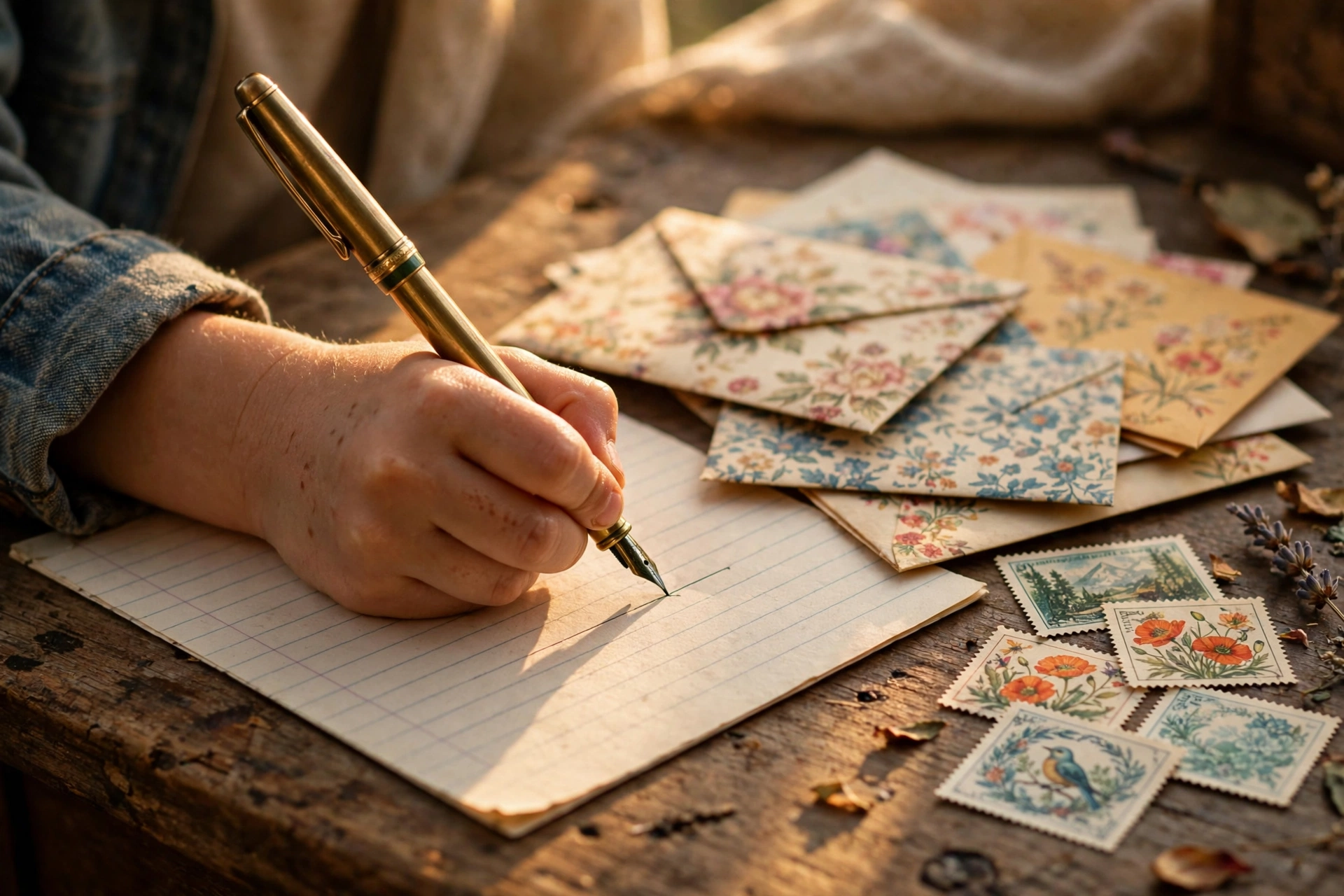
Length mattered, though nobody ever said so. A one-page letter felt stingy; it suggested you had nothing to say, or worse, that you didn’t care. The unwritten rule was at least two pages, front and back if you could manage it, and the truly devoted wrote five or six, filling every line until the ink started to crowd at the margins. You learned to write small. You learned to number your pages in case they fell out of order. These were small disciplines, and they felt important.
And the signature — oh, the signature. Kids who scribbled their name on everything else slowed down for this. You signed your full name like it was a document, or you invented a special way of writing it just for this one friendship. Some added a tiny drawing after their name: a smiley face, a star, a heart. It was the only flourish you allowed yourself, and it said more than the whole letter: this is really me, signing off.
Waiting for the Mail Was Half the Magic
Here is the part that is hardest to explain to anyone who grew up with instant replies: the waiting was not a flaw in the system. The waiting was the system. You posted a letter on a Monday and you knew — you absolutely knew — that you would hear nothing for at least two weeks. Maybe three. Maybe a month, if the letter had to cross an ocean. And somehow, instead of being frustrating, that delay made everything bigger.
You checked the mailbox every single day anyway. You knew the postman’s schedule better than your own timetable. You could hear the mailbox flap from inside the house, and your stomach did a small flip every time, even when you knew the timing was wrong. Rushing home from school to check the mail became a daily ritual with the emotional weight of opening a present. Some days there was nothing, and you felt a tiny, unreasonable disappointment — as if the mail owed you something.
And then, one ordinary afternoon, there it was. The envelope with the foreign stamp, or the familiar handwriting you’d come to recognize. Do you remember what that felt like? The way you carried it inside like it was fragile. The way some kids saved the letter to open in their bedroom, alone, where they could read it twice without anyone watching them smile. A reply arrived and the whole cycle began again — reading, rereading, and then the slow, happy work of writing back. That was the rhythm of pen pals everywhere: send, wait, receive, answer. Nothing in it was instant, and nothing in it was wasted.
What Went Inside the Envelope
A pen pal letter was rarely just a letter. The envelope was a little care package, a flat museum of the friendship. Everybody had their own style of extras, and discovering what your pen pal tucked inside became one of the delights of the whole exchange. The letter was the main event, but the extras were the applause.
Photos and the mix of two handwritings
Photos were the most precious enclosure of all, back when taking a picture cost money and you couldn’t see it until the film was developed. You chose carefully — one photo, maybe two, slipped between the pages. A school portrait. A snapshot of your street. Your dog asleep on the rug. And when the letter came back, you’d get photos of a life you had only imagined: their house, their family, their schoolyard. You pinned them up, these faces you’d never seen in person, and they became as familiar as neighbors.
Then there was the handwriting itself, which became a kind of voice. You could tell when your pen pal was in a hurry — the letters leaned forward, crowding together. You could tell when they were relaxed — the writing got round and loopy, spreading across the page. Some kids wrote in pencil, some in blue ink, some switched colors mid-letter for emphasis. Nobody taught you to read handwriting this way; you just learned, the way you learn anything about someone you care about.
Stickers, dried flowers, and little flat treasures
The extras said everything about who you were. Stickers from a new pack, pressed carefully onto the last page. A dried flower picked on the way home from school, crumbling a little at the edges. A bus ticket, a movie stub, a pressed leaf in autumn. Bookmarks, foreign coins taped to a card, a tiny friendship bracelet folded into the envelope. None of it had any value, and all of it was priceless. When you opened a letter and something small and unexpected fell out onto your lap, it felt like the other person had reached through the paper and tapped you on the shoulder.
Decorating the envelope itself was an art form. Some kids drew elaborate borders, wrote the address in rainbow letters, covered the corners in doodles. The airmail envelope — that thin, blue-and-red-bordered beauty marked par avion — needed no decoration at all; it announced itself. But even plain envelopes got the treatment: stickers on the seal, a little “open me!” written in the corner, the address written with extra care so it would survive the journey. You were, in a small way, an artist, and the postal service was your gallery.
Pen Pals Across Countries and the Wonder of Foreign Stamps
If your pen pal lived in another country, the friendship came with a bonus education you never asked for but never forgot. You learned geography the way it was meant to be learned — not from a textbook, but from a person. You learned that Australia’s seasons were upside down. You learned what a real winter felt like from someone in Norway, and what the rainy season meant from someone in Thailand. Their ordinary was your exotic, and your ordinary was theirs. Every letter was a small window into a life running parallel to yours, half a world away.
And the stamps! Ask anyone who had a foreign pen pal, and the stamps will come up within a minute. Those tiny, colorful rectangles were miniature works of art — birds you’d never seen, leaders you’d never heard of, scripts you couldn’t read. Kids kept them. Soaked them off in a bowl of water, dried them on a towel, slipped them into albums or shoeboxes. A letter from Japan might arrive with a stamp showing a temple; one from Brazil might show a parrot in impossible colors. The envelope told you where it had been before you even opened it, and that felt like holding a piece of the journey.
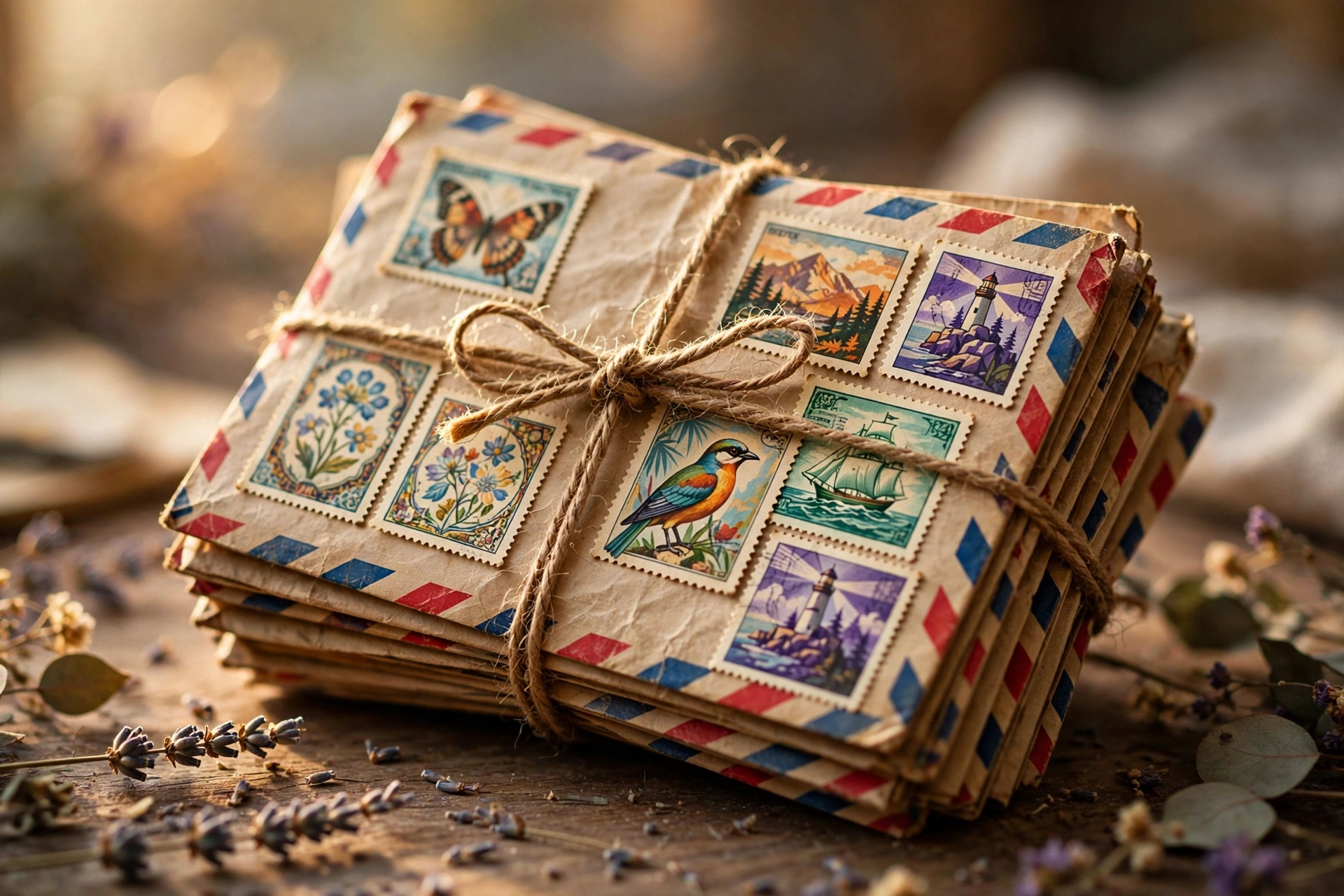
There was also the delicious mystery of the foreign postmark — the blurred black circle with a date and a city name in another language. You’d hold it up to the light, trying to read it, sounding out the syllables. It was proof, stamped in ink, that your letter had traveled. In an age before tracking numbers and delivery notifications, the postmark was the only evidence of the journey, and it was enough.
Some friendships crossed real cultural distances, and the letters handled it gracefully. You explained your festivals; they explained theirs. You described your food; they described theirs, and you tried to imagine the taste. Misunderstandings happened — a joke that didn’t translate, a reference that landed flat — but they were gentle misunderstandings, smoothed over in the next letter. The slowness helped. When you have three weeks to think about your reply, you rarely say anything unkind.
Then Instant Messaging Arrived
It didn’t happen all at once. First the letters got shorter — “I’ll just tell you the rest online,” someone would write, and that sentence was the beginning of the end. Then the replies started coming through a screen instead of the mailbox. Then one day you realized you hadn’t written a real letter in months, and the stationery sat in the drawer like a relic.
The arrival of instant messaging changed the texture of friendship completely. Suddenly you could talk to anyone, anytime, in seconds. The waiting — that long, sweet, terrible waiting — vanished overnight. A question asked was a question answered. A joke told was a joke laughed at, right now, with a little laughing face to prove it. It was miraculous, and nobody at the time would have traded it back. Who would choose three weeks over three seconds?
And yet. Something got thinner in the trade, even if it took us years to notice. Messages became shorter because they could be — why write three paragraphs when you can send three messages? Conversations splintered into fragments scattered across the day. Nobody kept them; nobody could reread a chat the way you’d reread a letter for the fifth time, noticing something new. The permanence leaked out of friendship. A letter was a thing you could hold, keep, tie with a ribbon, find in a box twenty years later and read with your heart in your throat. A chat log is a thing you scroll past.
It’s not that the new way was wrong — it was genuinely wonderful, and it connected people in ways letters never could. But it replaced a ritual with a utility. Writing a letter was an event; sending a message is a reflex. The pen pal era asked something of you: patience, attention, the willingness to sit with your thoughts until they were worth sending. The new era asks almost nothing, and gives almost instantly, and somewhere in that exchange the friendship lost a little of its weight — the good kind of weight, the kind you can feel in your hands.
Why Letter Writing Still Matters Today
So why does any of this still matter? The mailboxes are quieter now, the stationery drawers are empty, and most of those childhood friendships faded when the letters stopped — not with a fight, just with a slow, mutual silence. But the things those friendships taught us didn’t fade. They went into us, quietly, and stayed.
Writing to a pen pal taught you to pay attention to your own life, because your life was the story you had to tell. It taught you patience — real patience, the kind measured in weeks. It taught you that someone far away could matter to you, that a stranger could become a friend through nothing but words. And it taught you the deep, physical pleasure of being known on paper: the sight of your name in someone else’s handwriting, the proof that you existed in another person’s thoughts, miles and miles away.
There’s also the matter of what survived. Somewhere, in attics and old shoeboxes and the backs of wardrobes, those letters still exist. Bundles tied with string, envelopes gone soft at the edges, ink faded to brown. If you have a bundle like that, go find it. Read one. You’ll be surprised how much comes back — not just the facts, but the feeling. The person you were when you wrote it. The person they were when they answered. A whole friendship, preserved in paper, waiting patiently for you to remember it.
How to start a pen pal friendship again
Here’s the lovely secret: nothing is stopping you from starting again. The post still runs. Paper still exists. And the world is full of people — kids, grandparents, strangers in distant cities — who would be quietly thrilled to find a real letter in their mailbox. You don’t need a club or a column; you just need a name, an address, and the willingness to write the first letter.
Start small. Write to an old friend you’ve only been texting. Write to a grandparent, an aunt, a cousin across the country. Or find one of the many letter-writing communities that still exist online — the spirit of the old pen pal columns lives on, just moved to a screen for the matchmaking part. Get some decent paper. Pick a pen that feels good in your hand. Write two pages, front and back if you can manage it. Tuck something small inside — a photo, a pressed leaf, a sticker. Nobody outgrows that little thrill.
And then — the hardest part, and the best part — post it, and wait. Check the mailbox every day even though you know the timing is wrong. Feel your stomach do that small flip at the sound of the flap. Let the waiting do its old magic. Because some things the pen pal tradition understood will always be true: that friendship is worth a little patience, that your own life is worth noticing, and that there is no feeling quite like seeing your name, in someone else’s handwriting, on an envelope that traveled a long way just to reach you.
Those of us who grew up in the decades when the 90s felt like home remember a childhood stitched together from small, tangible things — and the friendships of our childhood days spent outdoors and at the mailbox belong to the same lost album. The letters may have stopped, but the lesson stayed: the best friendships were never instant. They arrived in an envelope, and they were worth every day of the wait.