world book encyclopedia memories never start with a book. They start with a knock — three short raps on the screen door, landing right after the dinner plates were cleared, when the whole family was still gathered around the kitchen table and nobody was expecting company.
I can still hear it. I can still see my dad glancing up from his coffee, my mom wiping her hands on the dish towel, and me — maybe eight years old — already halfway out of my chair, because a visitor at night was an event. A stranger stood on our porch with a briefcase in one hand and a smile that said he knew exactly what was about to happen. He always knew. He’d done this a thousand times before.
“Good evening, folks,” he’d say. “I won’t take much of your time. But I think I have something here your children are going to love.”
And just like that, he was inside. The briefcase clicked open on our kitchen table. And out came two of the heaviest, most beautiful books I had ever seen in my life.
Do you remember that sound? That deep, satisfying thud when a real hardcover volume lands on a wooden table? My brother and I leaned in so close our chins nearly touched the pages. The salesman flipped one open — I swear he went straight to the pictures, because he knew kids — and there it was: a full-page, full-color spread of the solar system, the planets glowing against the black. My jaw hit the floor. We had nothing like this in our house. We had a dictionary, a Bible, and a stack of my dad’s old car magazines. This was something else entirely.
That night changed the furniture of our childhood. And if you grew up in the seventies or eighties, I bet a version of this story happened at your kitchen table too.
Table of Contents
The Knock That Changed Our Living Room Forever
Here’s the thing about the encyclopedia salesman that nobody talks about: he wasn’t just selling books. He was selling a vision of who your children could become. He looked at my mom and dad — two tired parents in a modest house, doing their best — and he said the magic words: “Every good student needs a library at home.”
My mother squeezed my father’s arm. I saw it. That little squeeze said everything: we can’t really afford this, but how do we say no to our children’s future?
The salesman had an answer for the money question before my dad could even ask it. Of course he did. He reached into that bottomless briefcase and pulled out a payment booklet — those little coupon books, remember those? — and explained how families just like ours were bringing the whole set home for a few dollars a week. Less than the cost of a night at the drive-in. Less than a tank of gas. “An investment,” he called it, “in your children’s education.”
My dad rubbed the back of his neck the way he always did when he was doing mental math. My mom kept turning the sample volume over in her hands, running her thumb along the gold lettering on the spine like it was already ours. My brother whispered, “Can we get the one with the dinosaurs?” and the salesman — bless him — laughed and said, “Son, you get all of them.”
That was the moment. Right there at our scratched-up kitchen table, with the coffee going cold and the sample pages glowing under the overhead light, my parents made one of those quiet sacrifices that kids don’t understand until they’re grown. They signed the little card. The salesman shook my dad’s hand like they’d just closed a deal on a house. And he promised the full set would arrive in a few weeks.
Those were the longest weeks of my childhood.
World Book Encyclopedia Memories Began at the Kitchen Table
Every family I knew had the same origin story, and every kid my age can picture the delivery day. The boxes arrived — heavy, glorious, cardboard boxes that took two grown-ups to carry — and suddenly our living room had a new centerpiece. Not the television. Not the stereo. A bookshelf. A real one, bought on purpose, for one purpose only.
My dad assembled that shelf himself on a Saturday morning, humming along to the radio, while my brother and I sat cross-legged on the carpet “supervising.” Then came the ceremony: volume by volume, A through Z, slid into place in perfect order. The gold lettering caught the afternoon sun coming through the curtains, and for one shining moment our little house felt like a mansion. We had a library. A library!
I ran my finger along the spines and read the letters out loud like they were treasure: A… B… C… All the way down the row. It felt like standing in front of a vault.
The Installment Plan: Knowledge on Layaway
Here’s the part that gets me now, all these years later, as a grown-up who knows what money is. My parents weren’t rich. Not even close. We clipped coupons. We drove a car with a rusted-out floorboard you could see the road through. And yet every single month, there was that little payment booklet on the counter, and every single month, my mom tore out a coupon and mailed a check.
They bought us the whole world — one monthly installment at a time.
Let that sink in for a second. No smartphone. No payment app. Just a paper booklet, a stamp, an envelope, and a quiet determination that their kids would have something they never had. I don’t think I ever thanked them properly for that. If your parents did the same, you know exactly what I mean, and you might be feeling that lump in your throat right now too.
Years later I learned the scale of what that salesman was part of. At its peak, the company behind those gold-spined volumes employed something like 60,000 door-to-door salespeople — sixty thousand men in neat suits and polished shoes, knocking on screen doors across America, carrying the world in a briefcase. That army of salesmen built a generation’s worth of living-room libraries, one kitchen-table pitch at a time.
What the Salesman Knew About Kids
Those salesmen were psychologists in disguise. They never opened the sample volume to the article on agriculture or the entry on Belgium. Oh no. They went straight for the gold: dinosaurs, the human body, outer space, sharks. The salesman at our table turned to a page showing a cutaway diagram of the human heart — big, red, glorious — and my brother gasped so loud my mom shushed him. Sold. We were sold before the pitch even started.
And can you blame us? Nothing in our house had ever looked like that. Our school textbooks were black-and-white and boring. The encyclopedia was in color. It had maps you could get lost in and photographs that looked like windows into other worlds. It was the internet before the internet — except it smelled better and you couldn’t break it by clicking the wrong thing.
Twenty-Two Volumes of Pure Gold
Let’s talk about the books themselves, because they were objects of genuine beauty. The bindings were deep and rich — that dark, handsome color with the gold lettering stamped into the spine — and they looked important sitting there in a row. Company coming over? They’d notice the encyclopedias. They always noticed. There was an unspoken message in those gold spines: this is a house where children learn things.
My mom dusted those shelves every single Saturday. Not the rest of the house — that got dusted when it got dusted — but the encyclopedias were sacred. She’d pull each volume out, wipe it down, and slide it back in with the care of a museum curator. “These cost good money,” she’d say, which was mom-code for these represent sacrifice, so treat them like treasure. And we did. We were the only kids on the block who washed our hands before reading. Our friends thought we were weird. Our mom thought we were civilized.
The Gold Spines and the Alphabet of Everything
There was a whole geography to that shelf that every encyclopedia kid understood instinctively. The fat volumes in the middle — your M, your S, your C — were the workhorses, thick with the stuff of school: mammals, states, countries, science. The skinny ones at the ends were mysteries. X was practically a pamphlet, and we all knew it, and we all checked anyway, just in case.
Pulling a volume off the shelf had a ritual to it. You didn’t just yank it out. You tilted the top toward you, slid it free, and felt that satisfying weight settle into your hands. These were heavy books. A full volume could double as a doorstop or, in a pinch, a booster seat. My little brother once tried to carry three at once and nearly face-planted into the carpet. We laughed until our stomachs hurt.
And the pages — oh, the pages. That thin, smooth, almost silky paper that turned with a whisper. The articles were written in a way that respected kids: clear, direct, fascinating, never talking down. You could open any volume to any page and fall down a rabbit hole for an hour. One minute you’re looking up your home state for a school project, the next you’re reading about volcanoes, and somehow you’ve ended up at an article about Venice with a photograph of a gondola that made you promise yourself you’d go there someday.
Childcraft: The Books We Actually Read First
Now, the grown-ups bought the encyclopedia for homework. But let’s be honest about what the kids actually grabbed first: Childcraft. Those smaller companion volumes — the ones with the fairy tales, the poems, the “how things work” pictures — were pure magic. While the big gold-spined set was for school, Childcraft was for us.
I devoured the volume with the folk tales. My brother lived in the one about machines and how they worked — he could tell you how a combustion engine functioned at age nine, a skill that impressed exactly no one at the dinner table but delighted him endlessly. Those books had the same quality as the Scholastic book fairs we waited for all year at school — that same feeling of stories made just for kids, except these lived in our house permanently. No waiting. No book fair flyer. Just open and read.
Childcraft was the gateway drug of curiosity. It taught a generation of kids that reading wasn’t just for school — it was for wonder. And then, when we were ready, the big volumes were waiting on the shelf above, like the next level of a game we couldn’t wait to unlock.
The Smell of a Fresh Volume
Close your eyes for a second. Do you remember it? That smell when you cracked open a brand-new volume for the first time — the glue, the ink, the fresh paper, all of it warm and sharp and full of promise. Knowledge used to have a smell. It smelled like a freshly opened encyclopedia volume.
I’m not being poetic here; I’m being literal. That scent is burned into my memory the way the smell of crayons or a new box of school supplies is. New volumes arrived over the years — the annual yearbooks, the updated editions — and every single time, my brother and I would fight over who got to open the box. The winner got the first smell. It was an actual prize. We were ridiculous, and it was wonderful.
Even now, decades later, if I walk into a used bookstore and catch that particular blend of old paper and binding glue, I’m eight years old again, cross-legged on the living room carpet, with the whole alphabet of everything spread out in front of me. Smell is the strongest memory trigger we have, and mine is permanently set to encyclopedia.
Homework by Lamplight
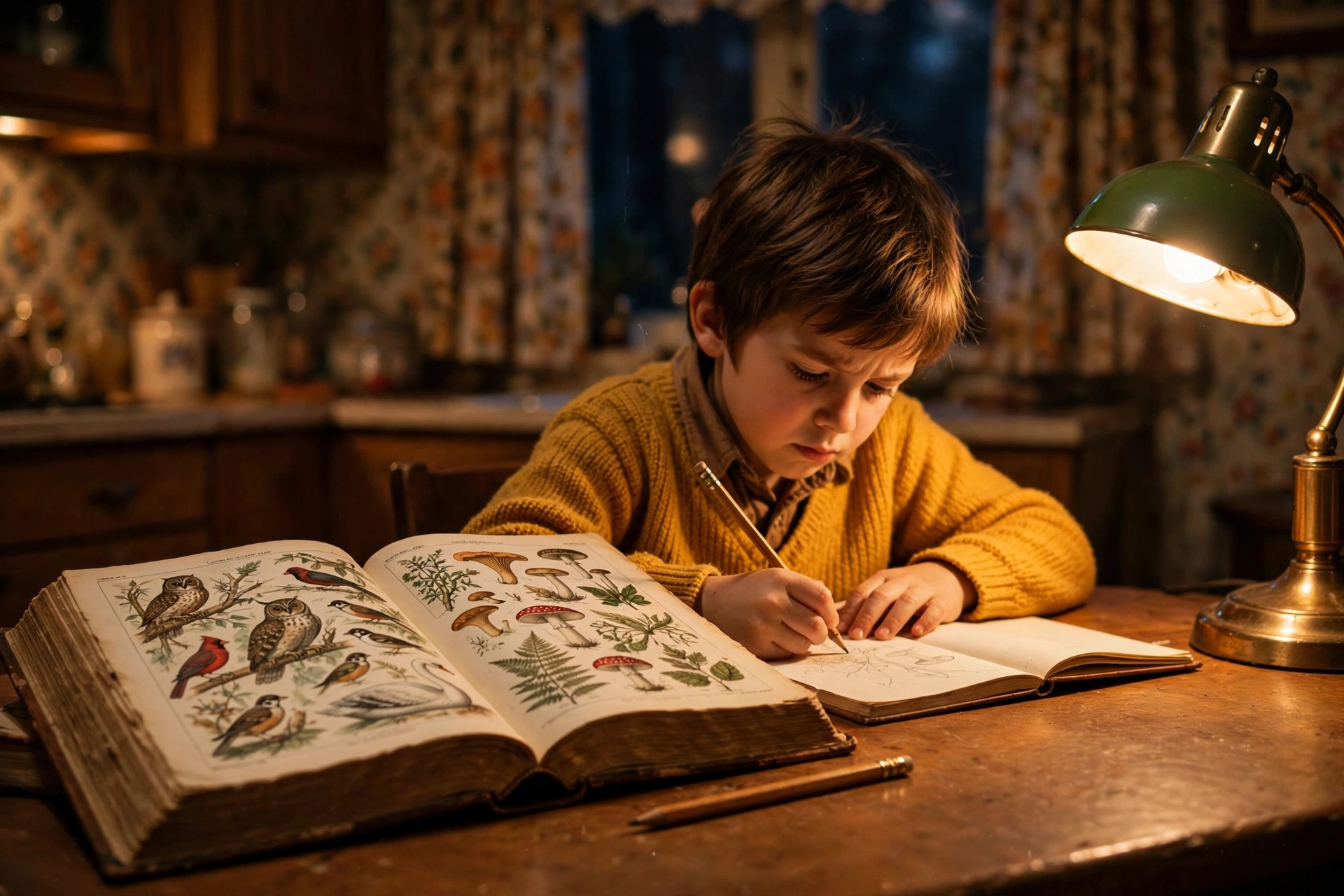
But the encyclopedia earned its shelf space the hard way: on school nights. When the teacher assigned a report on an animal, a country, a president, or a planet, there was no typing a question into a glowing rectangle. There was the walk to the shelf. The choosing of the right letter. The thud of the volume on the kitchen table. The hunt through the index with a finger tracing down the columns.
Homework took time back then. Real time. You had to find the article, read it — actually read it, the whole thing — decide what mattered, and then write it down in your own words. In pencil. In a notebook. With your handwriting getting progressively worse as the night wore on and the lamplight got warmer and your eyes got heavier.
My mom would sit across the table, mending socks or paying bills, glancing up every so often to make sure I wasn’t just copying word for word. “In your own words,” she’d say, without looking up, like she had radar. And she was right to insist, because here’s the secret nobody tells you: that slow, painful, by-hand process is how the facts actually stuck. I still remember things I wrote in those book reports. I couldn’t tell you a single thing I “researched” on a phone last month.
The Ritual of the Book Report
Every encyclopedia kid knew the ritual by heart. Step one: pick your topic and find the right volume. Step two: locate the article and read it twice — once for fun, once with the notebook open. Step three: the outline, written in that special school outline format with the Roman numerals that teachers loved and kids dreaded. Step four: the actual writing, in your best handwriting, because Mrs. Patterson absolutely judged penmanship and everyone knew it.
And step five — the step we all secretly loved — the bibliography. You got to write, in your most official handwriting: World Book Encyclopedia, 1982 edition. It felt like citing a real source because it was a real source. We were tiny scholars. We had citations. We were very serious people, hunched over the kitchen table at 8:30 on a school night.
We wrote those reports the same way we wrote everything back then — by hand, in pencil, the same way we traded paper letters with pen pals across the country. Every word cost effort, so every word meant something. There was no backspace key. There was an eraser worn down to a nub, and the faint gray ghosts of mistakes past haunting the margins of every page.
The Articles Every Kid Looked Up First
Okay, confession time. Before the encyclopedia was ever used for a single homework assignment, every kid in America used it for the same sacred purpose: looking up the forbidden, the fascinating, and the funny. Admit it. You know exactly what I mean.
First stop: the human body. The transparent overlay pages showing the layers of anatomy were the most visited pages in the entire set, and every parent knew it, and every kid pretended they were studying “science.” Second stop: your own birthday in the yearbook volumes, to see what happened on the day you were born. Third: dinosaurs, sharks, or snakes — pick your poison. Fourth: the flags of the world, because there was something deeply satisfying about memorizing flags nobody would ever quiz you on.
And then there was the dog section. Oh, the dog section. Every kid who ever begged for a puppy has spent an hour on the living room floor with the volume open to dog breeds, pointing at pictures and making their case. “Look, Mom, the golden retriever is good with children. It says so right here. In the encyclopedia. You can’t argue with the encyclopedia.” The encyclopedia was the ultimate authority. It settled playground debates. It ended sibling arguments. If it was in the World Book, it was true, and that was that.
My personal weakness was maps. I’d open the atlas section and just… travel. Trace the rivers with my finger. Find the tiny islands in the Pacific with names I couldn’t pronounce. Wonder what it would be like to stand in those places. The encyclopedia didn’t just give me facts; it gave me a severe case of wanderlust years before I was old enough to act on it.
What Replaced Them — And What We Lost Along the Way
Then, slowly, the world changed. The knocks on the door stopped. The salesmen with their briefcases faded into history, replaced by something nobody saw coming: a little box on a screen where you could type any question and get a million answers in half a second. The living-room library — the shelf my dad built on that Saturday morning, the gold spines my mom dusted every week — became a decoration. Then a relic. Then, in many houses, a donation to the thrift store.
Don’t get me wrong: I love being able to look things up instantly. It’s a miracle, and I use it fifty times a day. But something real got lost in the trade, and I think every encyclopedia kid feels it, even if they can’t quite name it.
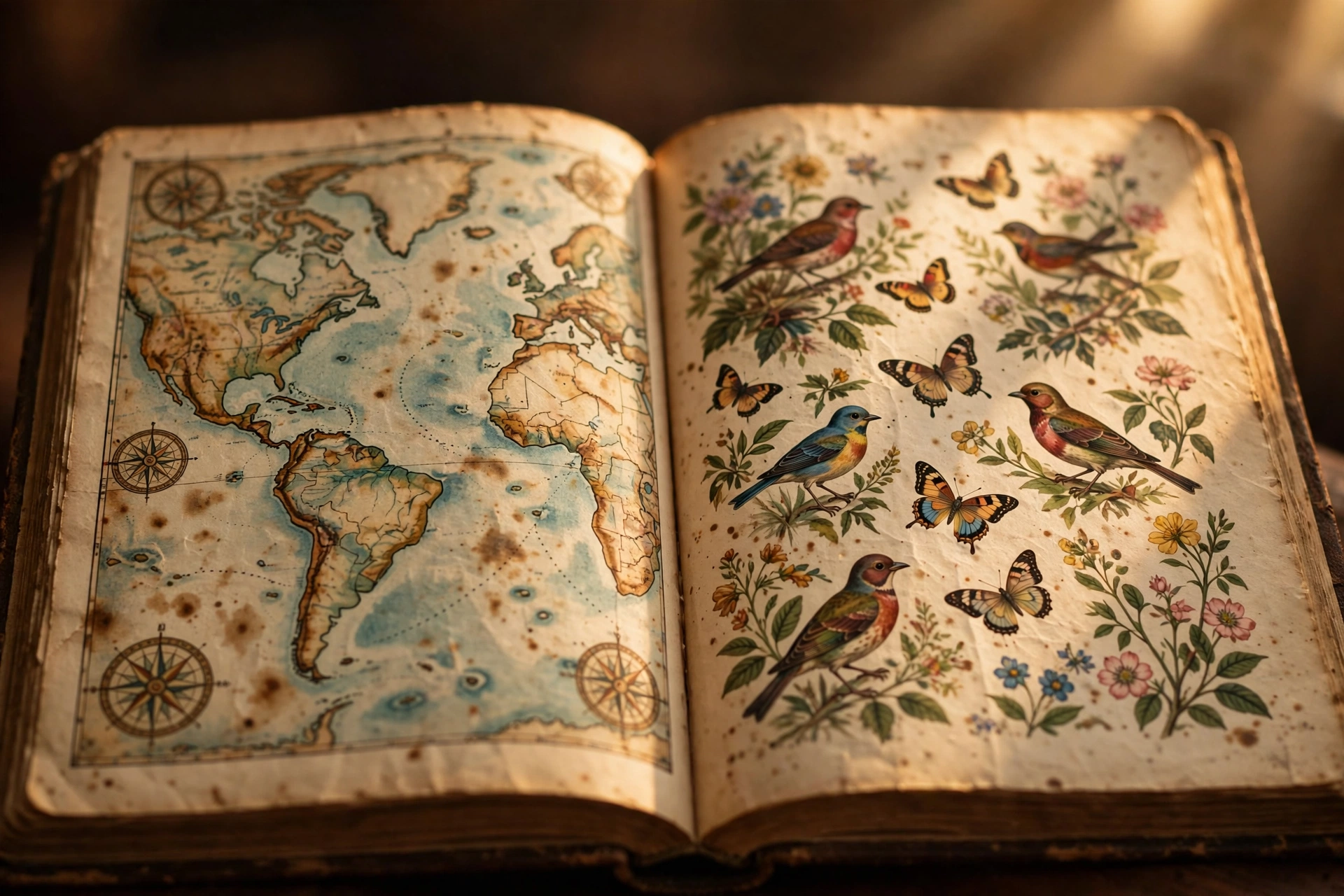
We lost the search. Not the finding — the searching. Flipping through an encyclopedia meant stumbling across things you weren’t looking for: the article next to the one you needed, the photograph on the opposite page, the map that caught your eye on the way to something else. It was wandering through a forest of knowledge. Now we take a helicopter straight to the one tree we want, and we never see the forest at all.
We lost the weight of knowledge — literal weight. A twenty-two-volume set says something that a search bar never can: this stuff matters. It’s heavy. It took up a whole shelf. Your parents paid for it month after month. You treated it with respect because respect was built into the object itself.
And we lost the shared ritual. The whole family gathered around the kitchen table while the salesman did his pitch. Mom and Dad making the big decision together. Kids sprawled on the carpet, traveling the world one map at a time. Before Google, the answer to everything lived on a shelf in our living room — and the whole family knew exactly where to find it.
The Story Didn’t End, Though
Here’s something that surprised me when I looked into it: the World Book never actually died. If you want the full chronology, you can read the World Book story — it was first published back in 1917 in Chicago, has put out annual editions since 1925, and the 2024 edition still runs 22 volumes and more than 14,000 pages. The company was bought by Scott Fetzer in 1978, which later became part of Berkshire Hathaway. It’s still sold in print today, more than a century after that first edition.
Think about that. Through radio, television, the internet, and the smartphone — through every revolution that was supposed to kill it — the World Book kept publishing. The door-to-door army is gone, but the books endure. There’s something deeply comforting about that, like finding out an old friend you lost touch with is doing just fine.
My parents’ set is gone now — given away years ago in one of those clean-out-the-house weekends that felt necessary at the time and heartbreaking later. But I kept one volume. Just one. The S volume, fat with sharks and states and space, the one I wore out the most as a kid. It sits on my own shelf now, the gold lettering a little faded, the pages still smelling faintly of that particular glue-and-paper perfume. Sometimes I pull it down just to hold it. Just to remember the weight of it.
Because here’s the truth I keep coming back to: our parents didn’t just buy us books. They bought us proof that we were worth investing in. Every month, when my mom tore out that little coupon and mailed that check, she was saying something she never put into words: you are worth the whole world, and I’m going to put it on a shelf in our living room to prove it.
Our parents bought us the whole world — one monthly installment at a time. If that’s not love, I don’t know what is.
So now I want to hear from you. Which volume was yours? Which letter did you wear out first — the dog-eared D with the dinosaurs, the beloved S, the mysterious X you checked anyway? Do you still remember the smell when the pages cracked open for the first time? And did a salesman ever sit at your kitchen table and change your living room forever? Tell me your story in the comments — I read every single one, and I have a feeling this is going to be a good thread.