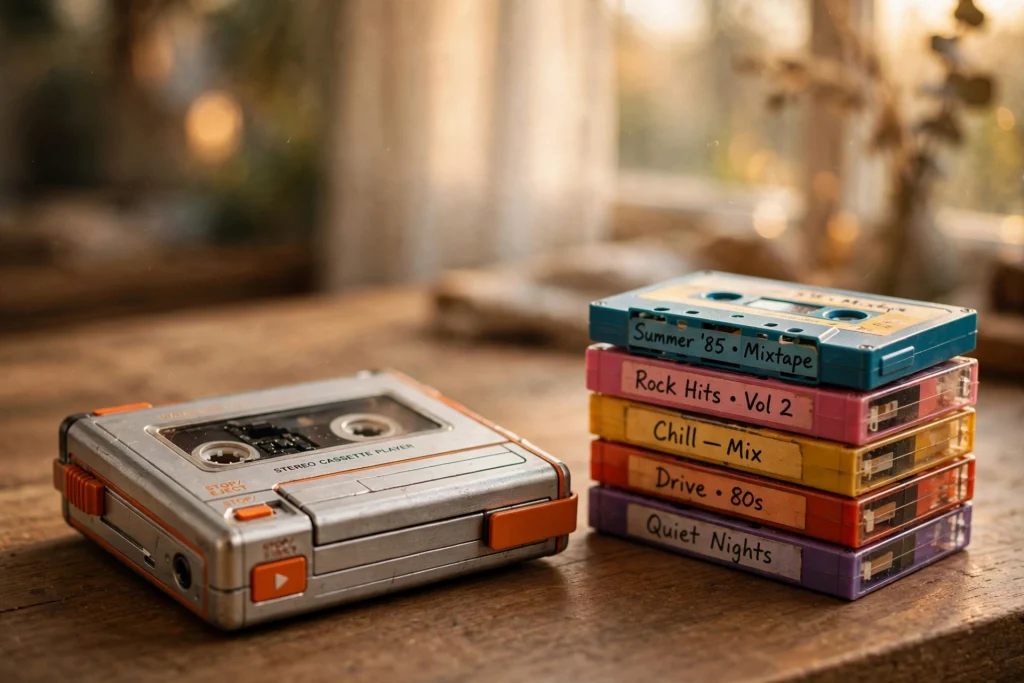
You hear it coming. The song is building — the drums swelling, the singer leaning into the chorus you have been waiting for all day — and then… KA-CHUNK. The music stumbles, dies for half a second, and when it fades back in, the song has jumped somewhere it was never supposed to go. If you flinched a little reading that, congratulations. You have 8-track tape memories, and we are about to take a long, winding drive down memory lane together.
For about fifteen years, music on the move meant a chunky plastic cartridge the size of a paperback book. Too big for a pocket, too stubborn to rewind — and perfect anyway. Friday night freedom with the windows down, an album at your fingertips, and not a single radio DJ telling you what to listen to.
Slide one into the slot with me — feel that mechanical grab — and try not to get emotional when the ka-chunk hits mid-song.
Table of Contents
What 8-Track Tape Memories Are Made Of
Officially the format was called Stereo 8, but nobody said that. Each cartridge held an endless loop of quarter-inch magnetic tape wound around a single reel and divided into four stereo programs. The player pulled tape from the inside of the reel, dragged it past the head, and wound it back onto the outside of the same reel. Simple, clever — and completely unable to rewind.
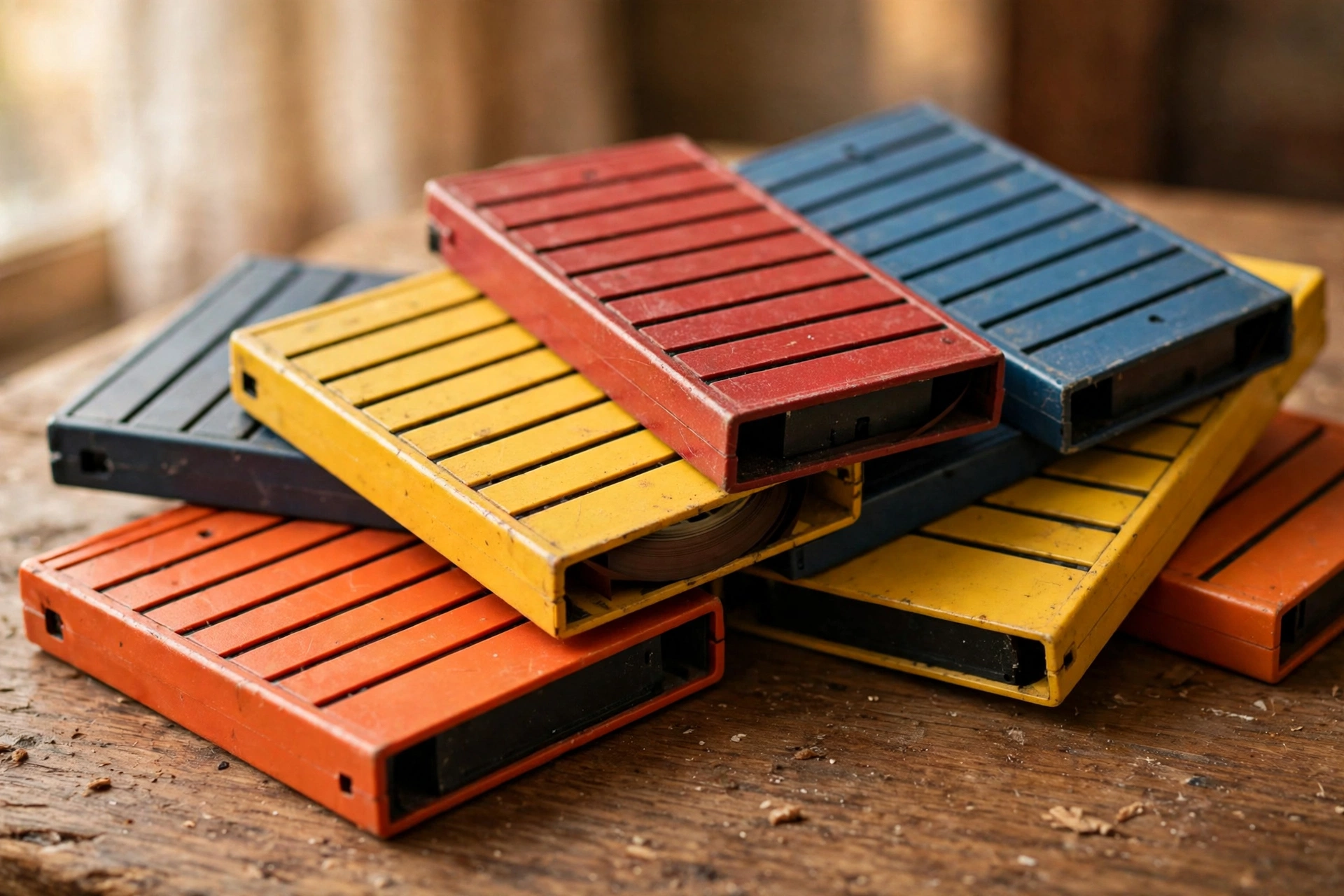
The cartridges were gloriously oversized — over five inches long and nearly an inch thick, giants next to the cassette that would eventually replace them. They rattled in the glove box and stacked like chunky dominoes on the back seat. The labels were tiny works of art: band photos, sunset gradients, bold lettering you could read from across the car. Holding one felt like holding something that meant business.
And the sound? For its day, genuinely good. Tape ran at 3.75 inches per second — twice cassette speed — with a warmth that felt like the band was riding shotgun. Quirks and hiss aside, it gave you something no spec sheet measures: the feeling of being the luckiest person on the road.
Bigger Than a Cassette, Smaller Than a Heartbreak
You did not finesse an 8-track into a player — you committed. You gripped that brick of plastic, lined it up with the slot, and shoved it home like a blackjack dealer sliding a card. The player grabbed it with a satisfying mechanical thunk, and a second later the music bloomed out of the dashboard like it had been waiting for you all along.
Ejecting one was its own ceremony. One big chrome button launched the cartridge out with enough force to catch midair — a move every teenager practiced until it looked casual. Nobody ever just pressed the button. You pressed it like you were ejecting from a fighter jet.
A Jet Designer, Three Car Giants, and One Wild Idea
Here is the part that still sounds made up: the 8-track was invented by the man who built the Learjet. The remarkable Bill Lear held over 140 patents, helped create the car radio, and co-founded Motorola. In the early 1960s he wanted music in his private jets, but reel-to-reel players were as practical in a cockpit as a grand piano. So he built something better.
Lear took an earlier four-track cartridge, doubled its tracks to eight, and simplified the mechanics — most famously moving the pinch roller inside the cartridge itself. In 1965 he teamed up with Ampex, Ford, General Motors, Motorola, and RCA Victor to commercialize his Stereo 8. That September, Ford offered 8-track players on its 1966 Mustang, Thunderbird, and Lincoln, and RCA released a flood of pre-recorded cartridges. The car stereo was born.
Think about that. For the first time, ordinary drivers chose their own soundtrack. No flipping records, no waiting for the radio to play something good — a whole album, front to back, at a volume your parents did not approve of. Freedom you could hold in your hand, weighing about half a pound.
The Day Your Car Became a Concert Hall
Before the 8-track, cars had radios and that was it. After it, the car became a listening room. Dad played his country tapes on the drive to grandma’s. Older siblings guarded their rock cartridges like contraband. And on Friday nights, cruising Main Street meant music pouring from every window — a dozen cars, a dozen albums, one shared ritual of turning it up until the bass rattled the mirror.
The Endless Loop: No Sides, No Rewind, No Escape
The 8-track’s party trick — and its fatal flaw — was the endless loop. One continuous circle of tape meant no sides to flip; when the music ended it simply started over, seamless as a dream. Up to eighty minutes without lifting a finger. For long drives, that was magic.
But the loop had a price: you could not rewind. Players offered play, fast forward, and a program-change button, but if you missed the song you wanted, you waited for the loop to come back around or gambled on fast-forward. The format that set your music free also locked it in a circle — you were in charge, right up until you weren’t.
Oddly, that changed how people listened. You learned patience. You let albums play the way the artist sequenced them. You discovered deep cuts because skipping was such a hassle. The 8-track’s limitations made listeners more loyal than any shuffle button ever could.
Four Programs, One Thin Ribbon
Inside every cartridge, the tape was divided into four stereo programs of roughly twenty to twenty-five minutes each. A metallic foil splice in the loop signaled the end of a program, the head shifted with that famous click, and the next program began. Producers had to squeeze albums into those four uneven chunks — so songs got rearranged, shortened, or infamously split down the middle.
The Foam Pad You Learned to Fix Yourself
Every owner eventually became a repair tech. Inside each cartridge, a small foam pad pressed the tape against the player’s head, and over the years those pads crumbled to dust. The fix was pure analog genius: peel off the old pad, glue on a bit of weatherstripping, and the tape sang again. Kids who could not change a tire were doing precision surgery on cartridges in their bedrooms.
KA-CHUNK: The Interruption We All Pretended to Hate
Now the elephant in the dashboard. The program change did not wait politely for a song to end — it fired exactly when the foil splice said so, which meant the ka-chunk regularly landed mid-track. The music faded out mid-phrase, the head shifted with a loud click-clunk, and the song faded back in a few bars later like nothing had happened. Except you noticed. You always noticed.
Millions of us have a ka-chunk story — the ballad that faded out before the big note, the solo that lost its final flourish, the whole car groaning “oh, come ON” in unison. It was the format’s most hated feature, and the thing we remember most fondly. Because the interruption became part of the song. You heard those albums so often that the fade-out fused into the music, and years later the clean version on the radio felt wrong — like it was missing a verse only you knew.
The Fade-Out Nobody Ordered
Producers softened the blow by fading songs out and back in around program changes — clumsy but charming cliffhangers. Some albums even got rearranged orders or bonus material to fit the four programs. Collectors treasure these quirks: 8-track editions are genuinely different recordings, accidents of art frozen in plastic.
Learning to Love the Flaw
Here is a quotable truth: the ka-chunk taught us that perfect is boring. Streaming gives you flawless audio and zero surprises. The 8-track gave you a machine that would occasionally body-slam your favorite song — and you loved it anyway, because the alternative was the radio, and the radio didn’t care about you. The 8-track cared. It just had commitment issues about timing.
Road Trips Wore Denim and Smelled Like Vinyl Seats
Nothing captures the era like a road trip. Late sun through the windshield, windows cracked, that warm vinyl-and-gasoline smell of a 1970s interior, cartridges sliding around the back seat every time dad took a corner too fast. The kid in the passenger seat was always the DJ — reading spines by feel, slamming the next tape in without missing a beat.
Every family had rituals: the tape that only played on the way to the lake, the one mom vetoed, the cartridge with the worn-off label everyone argued about. And the unwritten, unbreakable law — whoever chose the tape chose the mood, and the mood of the car was the mood of the vacation.
Shareable moment number one: everyone remembers the exact stretch of highway where their favorite song got ka-chunked. Burned in like a mile marker — chorus building, windows down, and then the click. To this day, driving that road, I hear the gap.
When the Living Room Got a Slot
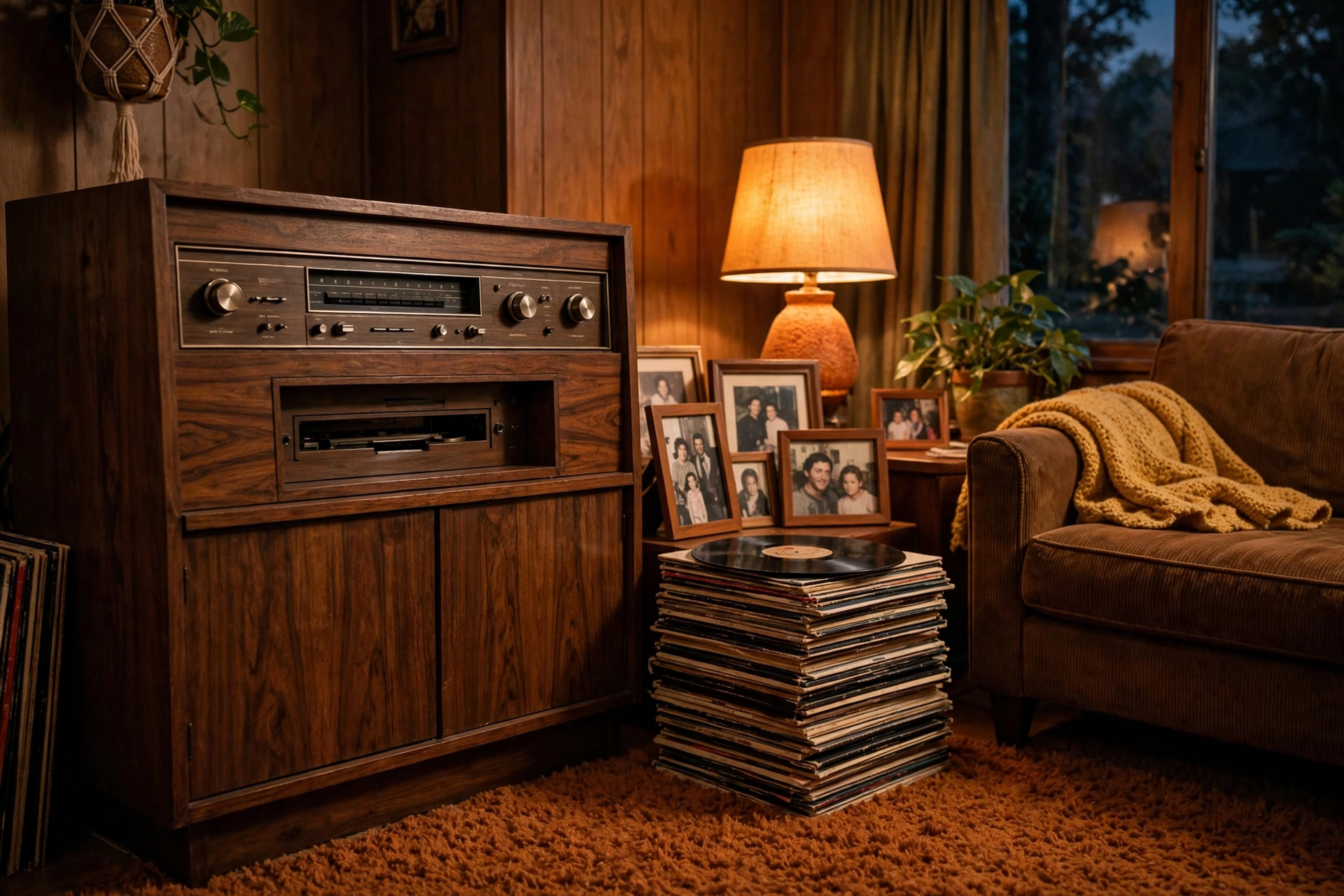
The 8-track started in cars but did not stay there. Home players arrived in 1966, and by the late 1960s the format had muscled into the most sacred furniture in the house: the living room console stereo. These wooden beasts held a turntable under the lid, a glowing radio dial, and — pride of place — a slot for your 8-tracks. Parents played records; kids snuck in rock tapes when nobody was looking.
There was a whole choreography to it. Pull a cartridge from the rack beside the unit, slide it in, settle into the good chair. The warm crackle of vinyl records owned one side of that era, but the 8-track owned the party — no flipping, no getting up every twenty minutes, just continuous music while the grown-ups talked and the kids sprawled on the shag carpet.
Portable boombox-style 8-track players existed too, for believers who wanted their chunky bricks at the beach or the tailgate. Heavy enough to count as exercise equipment. Nobody cared — music you could carry was still a miracle.
The Console That Anchored the House
The console was the hearth of the 1970s home, and the 8-track slot made it interactive. Dinner party? The mellow tape. Saturday cleaning? The upbeat one. The 8-track turned every homeowner into a DJ, decades before playlists were a word.
Quadraphonic: Surround Sound Before Surround Sound Was Cool
Then the industry tried to make the format futuristic. In the fall of 1970, quadraphonic 8-tracks arrived — four channels instead of two, genuine surround sound years before home theater. A little notch in the cartridge’s corner told compatible players to engage the extra tracks, and for one brief shining moment your living room could sound like a concert hall.
It was the format’s moonshot: expensive, finicky, gloriously over the top — special player, four speakers placed just so, specially mixed tapes. Audiophiles swooned; everyone else squinted at the price. It never went mainstream, but it proved the clunky cartridge was capable of real innovation, not just compromise.
The Notch That Changed Everything
One tiny cut in the plastic, and the whole machine behaved differently. No software updates, no settings menus — just cleverly shaped plastic telling a cleverly built machine what to do.
The Long Goodbye: How the Humble Cassette Won
Every golden age ends, and this one ended at the hands of the cassette — the 8-track’s dorky little brother, around since the early 1960s but saddled with worse sound. Then the sound caught up, and in 1979 Sony released the Walkman.
The Walkman changed everything overnight. Music was not just portable anymore — it was personal. Headphones, your pocket, your world. The 8-track, built for dashboards and living rooms, had no answer for a device that fit in a jacket pocket. Cassette sales surged; 8-track sales, which had peaked in the U.S. in 1978, fell off a cliff. By the early 1980s the war was over.
For the full story of what came next — including the little cassette hacks we all eventually mastered, pencil-rewinding and all — that is another trip down memory lane. But spare a thought for the 8-track: it lost the war and won the era that mattered. And if you want the full story of the 8-track cartridge, it is a rabbit hole worth falling into on a rainy afternoon.
Why the Ka-Chunk Still Makes Us Smile
Here is the funny thing about obsolete tech: we miss the flaws, not the perfection. Nobody gets misty-eyed over flawless digital audio. But mention the ka-chunk to anyone over fifty and watch their face light up. That clunky mechanical honesty is the memory — proof that music used to be a physical thing you wrestled with and loved anyway.
And the format refuses to die. Collectors refurbish cartridges and players with loving care; a 1995 documentary, So Wrong They’re Right, celebrated its stubborn fandom; even modern artists have issued albums on 8-track as novelties — Cheap Trick’s The Latest in 2009, and a Dolly Parton Christmas album with a track available only on 8-track. The brick keeps coming back, one ka-chunk at a time.
Shareable moment number two: we did not love the 8-track despite the ka-chunk. We loved it because of the ka-chunk. The imperfection was the personality. The glitch was the charm. The machine had opinions, and that made it feel alive.
I have told you mine — now I want yours. What was the first 8-track you ever owned? Was there a song that got ka-chunked so badly it became a family joke? Did your dad keep a glove box of country tapes, or was your older sibling guarding the rock cartridges like treasure?
Shareable moment number three, and I will leave you with this: somewhere out there, in an attic or a garage, your old 8-tracks are still waiting — and if you pressed one into a player today, the ka-chunk would find you exactly where it left you.
So tell me in the comments: what is your ka-chunk story? Which cartridge do you wish you still had? And be honest — when you heard that click in the middle of your favorite song, did you get mad… or did you just turn it up?