You remember it the moment your hand touched the door. That heavy brass handle on the lobby doors of the old neighborhood theater — solid, cool, and just a little sticky — and then the rush of cool air, the smell of warm butter and old carpet, and the sound of the lobby buzzing before the show. If those old movie theater memories don’t live in your bones somewhere, you missed out on one of the sweetest rituals of growing up.
I can still see our theater. The Royal, three blocks from my grandmother’s house, with its marquee hanging over the sidewalk like a promise. The letters were those black plastic ones you slid into the tracks by hand, and half the time the kid doing it got the spacing wrong, so the title ran crooked up the side. Nobody cared. It was Friday night, or Saturday afternoon, and you were going to the movies — not a screen, not a stream, the movies.
This is for everyone who grew up when a movie theater was the center of the social universe. The palace you escaped to. The dark room where your whole neighborhood laughed at the same joke at the same time. Let’s walk back inside.
Table of Contents
The Heavy Doors and That First Breath of Buttery Air
Every old theater had its own smell. You could blindfold a kid from the seventies or eighties, walk him through those doors, and he’d know exactly where he was. Butter, of course — real melted butter dripping down the side of the popcorn bag, the kind that left a translucent grease spot on your jeans for the rest of the day. But under that: carpet. Thick, patterned carpet that had been soaking up soda spills since before you were born. And something else — a faint dustiness, a smell of velvet and cold air conditioning and old wood.
Do you remember the ticket booth? That little glass box out front, with the cashier behind the curved glass and the round speaker hole. The ticket seller — usually a teenager who looked bored out of his mind — would rip your ticket in half and hand you the stub. And you kept that stub. You didn’t throw it away. You stuck it in your pocket like it mattered, because it did. A ticket stub was proof: I was there.
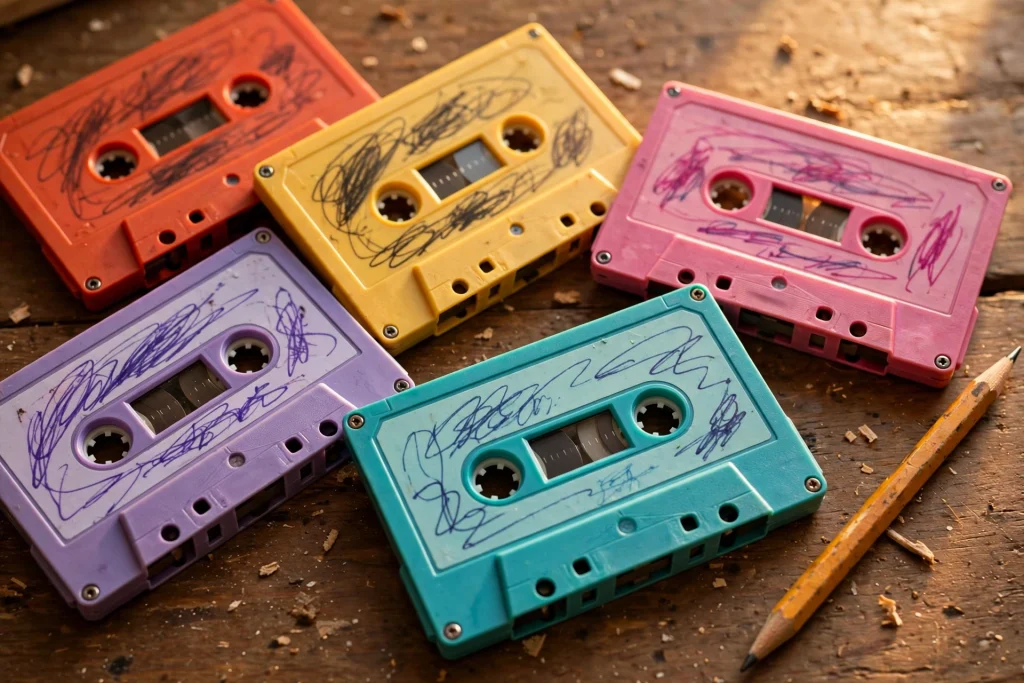
Some kids had a whole ritual with their stubs. A buddy of mine kept every single one in a cigar box under his bed, rubber-banded by year. Concert tickets, too. It was his museum, and on rainy afternoons he’d lay them all out on the carpet and relive every showing. Can you remember the last ticket stub you kept? I bet you know exactly which movie it was for.
Saturday Matinees: Two Movies for Pocket Change
Now here’s where the real magic lived — the Saturday matinee. If you grew up in the right era, Saturday afternoon belonged to the theater, and the deal was almost too good to believe. One ticket, a cartoon or two, a serial chapter, maybe a newsreel, and then not one but two movies, back to back. The double feature. For what your allowance could actually cover.
Kids would roll in on their bikes at noon and not come out until the streetlights flickered on. Parents dropped us off without a second thought — the theater was the neighborhood babysitter, and honestly, it did a better job than most. The usher might have to quiet us down once or twice, but for three solid hours we were exactly where we belonged.
The Serials That Kept Us Coming Back
Before the main feature, theaters ran chapters of Saturday serials — ten, fifteen minutes of cliffhanger action that ended with the hero tumbling off a cliff or tied to the railroad tracks. The screen would go dark and that “continued next week” feeling would buzz through the whole auditorium. You’d walk out arguing with your friends about whether Flash Gordon was really going to make it out of that one. He was. He always was. But that didn’t stop the debate, which continued all week at the lunch table.
Cartoons Big Enough to Touch
And the cartoons — oh, the cartoons. Watching a Looney Tune on a thirty-foot screen is a completely different animal from catching one on the kitchen TV. Bugs Bunny was eight feet tall and he was talking to you. The whole theater would roar at the gags in a way that never happened at home. That shared laughter — hundreds of people gasping at the same pratfall in the same second — is something streaming will never reproduce. You had to be there. The room itself was part of the joke.
The Balcony: The Best Seat in the House
Ask anyone who remembers, and they’ll tell you the balcony was sacred ground. Getting to sit in the balcony was a milestone — a rite of passage. Little kids sat downstairs with their parents. But the balcony? The balcony was for teenagers, for older siblings, for kids who’d earned their independence one Saturday matinee at a time.
The climb up those carpeted stairs felt like ascending to another country. The railing curved in a grand sweep, the ceiling was lower and more intimate, and the screen seemed to float below you like a window into another world. From up there, the sound washed over you differently. And the best part: you could see everything — the audience, the projection beam cutting through the dark above the seats, the tiny figures of latecomers tiptoeing down the aisle below.
The Crying Room and the Balcony’s Little Secrets
Some of the grander theaters had a crying room — a glassed-in box, usually at the back or off to the side, where parents could take fussy babies without missing the picture. Soundproofed, the story went, so the little ones could wail all they wanted while mom and dad still caught the show. As a kid, the crying room seemed like something out of a spy movie: a secret compartment built right into the theater. Was it real? The grown-ups said so, and we believed them, wide-eyed.
And let’s be honest about the balcony’s other legend. Every theater had stories about what happened up there after the lights went down. Nothing scandalous — mostly older kids sharing popcorn, holding hands, whispering through the scary parts. The balcony was the first place most of us practiced being grown-ups, in the dark, with a flashlight-wielding usher somewhere below to keep us honest. Which brings us to the most underrated heroes of the old theater.

The Ushers With Flashlights: The Flashlight Code
Before multiplexes turned everything into self-service, the theater had a human being in charge of order: the usher. Usually a teenager in a little vest or a bow tie, armed with nothing but a flashlight and unshakeable confidence. And that flashlight beam, sweeping across the auditorium, was the law.
Here’s what nobody tells you about the usher’s flashlight: we all learned to read it. A quick sweep down the aisle meant somebody’s feet were on the seat in front of them — a warning. A slow, deliberate beam that stopped and rested on you meant you were done. Talking during the show? The beam found you. Throwing popcorn? The beam found you. That light was surgical, and it never missed.
But the ushers were also part of the show. They tore your ticket with a flourish. They’d lead you down the dark aisle with the flashlight pointed at the floor, guiding you to the perfect seat like a pilot landing a plane. “Right here is good,” they’d whisper, and somehow it always was. And when the movie was over, they’d walk the rows collecting the cups and boxes the audience had tucked under the seats — an avalanche of popcorn containers, candy wrappers, and soda cups that told the story of the afternoon better than any review.
There was an unwritten contract with the usher. He’d pretend not to see you sneak from the first feature into the second. You’d pretend not to notice him pretend. Everybody won. Tell me that’s not a better system than anything we have now.
Let’s All Go to the Lobby: Intermission Magic
And then — the lights would come up halfway through. The velvet curtain would sweep closed, the house lights would rise, and the screen would flash that famous invitation: Let’s all go to the lobby. For anyone under forty reading this, let me explain: movies used to take a break. Right in the middle. The theater just… paused. And everybody stood up, stretched, and filed out for snacks like it was the most natural thing in the world. Because it was.
Intermission was a social event all its own. This was when you bumped into your neighbors, when kids compared notes on the plot, when couples debated whether the hero was really dead. The lobby would fill in seconds — a wave of people blinking in the sudden light, everyone talking at once. You’d hear the same conversation fifty times: “Did you see that part where—” followed by wild hand gestures.
The concession stand was the real destination. And what a place it was.
The Concession Stand: Popcorn, Candy, and Hard Choices
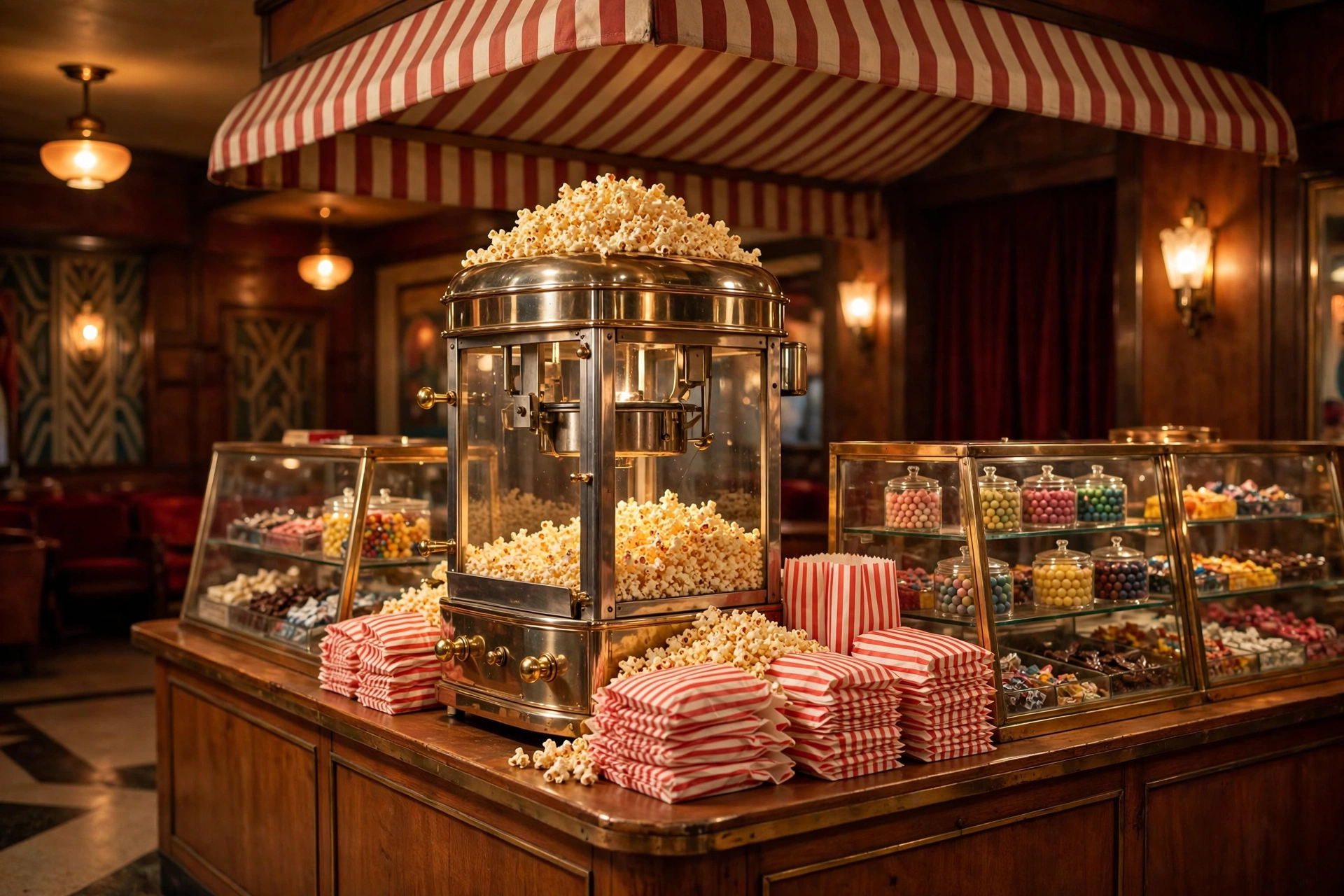
Glass cases full of candy — boxes of Milk Duds and Raisinets, Junior Mints and Goobers, licorice whips, wax lips, those little candy cigarettes nobody thought twice about. A cold drink sweating in a waxy cup. And the popcorn, of course, heaped in the glass machine like golden treasure, scooped into bags that went limp with butter within minutes.
Here’s the thing about theater popcorn: you could not recreate it at home. People tried. Stovetop, air poppers, microwave — none of it came close. There was something about that machine, that glass box and those stainless-steel scoops, that made it taste like the movies themselves. You’d buy the biggest bag your money could stretch to, and it would be gone before the curtain opened again. Every single time.
And the prices — don’t get me started. Kids today hear the old numbers and think we’re making them up. A whole afternoon’s entertainment and snacks for less than what a single candy bar costs now. I’m not saying we should go back to those prices (the theater owners were apparently running a charity), but doesn’t it tell you something about how movies were woven into ordinary life? This wasn’t a luxury. It was Saturday.
Sticky Floors and Velvet Curtains
Let’s talk about the sticky floors, because if you remember, you remember. That slow shhhk sound as your shoe peeled off the lobby floor. Decades of spilled soda had lacquered the carpet into something approaching glue. You learned to lift your feet a little higher in the theater, like walking through shallow water. Nobody complained. It was part of the deal — proof that this place was used, loved, lived in.
And then there were the velvet curtains. Before the movie started, that deep red curtain hung across the screen like a promise. The lights would dim in stages — lobby, aisles, then that last warm glow — and the curtain would begin to move. Slowly at first, then sweeping back to reveal the screen, already glowing. That moment — the curtain parting — was pure theater magic. It said: forget the outside world for a while. Something wonderful is about to happen.
The curtains had weight. They swayed. They caught the light at the edges. Some theaters had curtains with gold fringe or tassels, the kind of thing that belonged in an opera house. And when the show was over and the curtain closed again, there was always a beat of silence before the house lights came up — one breath where the dream lingered, and nobody wanted to be the first to stand.
Movie Palaces: Castles Built for Ordinary People
Not every theater was a grand palace, but the grand ones — oh, they were something. In the golden age of moviegoing, architects designed theaters like fantasy castles: marble staircases, chandeliers the size of cars, murals on the ceilings, organ lofts with actual pipe organs for the silent pictures. Working-class kids walked in off the street and, for two hours, lived like royalty. That was the whole point. The palace didn’t care how much money you had. A nickel bought you the same chandelier as everyone else.
Even the smaller neighborhood houses had their grandeur. The marquee alone was a work of art — hundreds of bulbs chasing around the border in sequence, spelling out the titles in changeable letters. On a summer night, with the bulbs lit and the crowd spilling onto the sidewalk, the theater was the brightest, most exciting thing on the block. Nothing else in the neighborhood glowed like that.
Film historians love this era, and Britannica’s look at the motion picture reminds us how quickly movies became the first true mass entertainment — and the theater was where that magic happened, in the dark, together. Of course, movies under the sky had their own charm — the outdoor cousin of the neighborhood theater has its own story here — but there was nothing quite like the palace: the hush, the velvet, the curtain, the beam of the projector over your head.
Why These Memories Still Glow
So why does it hit so hard? Why does the smell of buttered popcorn in a grocery store aisle stop a grown adult in their tracks? Because the old theater wasn’t really about the movies. Not entirely. It was about being together in the dark — laughing at the same moment, gasping at the same scare, emerging into the daylight blinking and buzzing, all of us carrying the same story home.
Think about what the theater taught us without ever saying a word. Patience — you waited for the show, and the waiting was part of the fun. Community — you shared the experience with strangers who felt like neighbors by the final reel. Wonder — the curtain, the beam, the hush before the first frame. These are old movie theater memories, but they’re also just… memories of being young in a world that made room for wonder.
Some of us kept the ritual alive at home later — Friday nights renting a tape at the video store with the same deliberation we once used choosing a matinee. Same hunger, smaller screen. But nothing ever quite replaced the palace.
The old theaters are mostly gone now — turned into churches, pharmacies, parking lots, or just left to fade behind boarded marquees. But here’s what I believe: every time you smell popcorn butter and get pulled backward in time, every time you catch yourself humming that lobby jingle, the theater is still open. Somewhere in your memory, the curtain is parting, the lights are going down, and your seat — the good one, the one you always picked — is waiting.
So tell me: what was your theater called? Was it the balcony for you, or were you a front-row daredevil? Did you keep your ticket stubs, and do you still have the box? Drop your memory in the comments — I have a feeling this is going to be a good one.