The floors knew my name before I ever spoke it. Every Saturday morning, my mother and I would push through the glass doors of Woolworth’s on Main Street, and the creaky wooden floorboards would announce us — squeak, groan, pop — like the old store was waking up to say hello. The air smelled like coffee from the lunch counter, like toasted bread and popcorn and something sweet I couldn’t name but recognized the way a song can find you before the first verse is over. Those five-and-dime store memories still live in my chest like a hand-written note I keep re-reading.
Do you remember the smell? Not perfume, not plastic — the honest, human smell of a store that had been loved for decades. Warm grease from the grill, vanilla from the soda fountain, the faint dusty sweetness of the candy aisle where glass jars glowed like treasure chests under the fluorescent lights. You didn’t walk into Woolworth’s. You were welcomed into it.
And somewhere in the middle of all that noise and color and wonderful chaos, there was a ten-year-old version of me with a warm nickel burning a hole in his pocket, trying to decide between a paper bag of penny candy or a cherry Coke at the counter. Life has never offered me a harder choice.
Table of Contents
Why the Dime Store Felt Like Magic
Before malls swallowed downtowns and before the internet swallowed everything, the five-and-dime was the center of the universe for a kid with pocket money. It wasn’t glamorous. Nobody went to Woolworth’s or Kresge to impress anyone. You went because it was yours. It was the one place in town where a child’s dollar actually meant something — where you could walk in feeling broke and walk out feeling rich, pockets bulging with little white paper bags.
I remember the sound of the place most of all. The wooden floors creaked under every step, a deep, friendly groan that no carpeted superstore has ever matched. There was the ding of the brass cash register, the snap of a paper bag being folded, the hiss of the soda fountain when the clerk pulled a cherry Coke. Somewhere in the back, a parakeet chirped in a cage near the pet department — yes, Woolworth’s sold parakeets, goldfish, and baby turtles in green plastic bowls. What other store sold you a hamster and a hot dog in the same visit?
Ask anyone who grew up in the sixties or seventies, and they’ll tell you: the dime store was the first place you ever felt independent. Your mother would give you fifty cents — an enormous fortune — and let you wander while she browsed the fabric department. Fifty cents! You could buy the world with fifty cents. A dime for candy, a nickel for a pack of wax lips, fifteen cents for a balsa wood glider, and still have change jingling. We walked those aisles like little kings surveying our kingdom, and honestly? We were.
The Creak of the Wooden Floors
Let me tell you about those floors, because they deserve their own paragraph. They weren’t smooth or shiny. They were worn down by a million footsteps into soft, wavy paths between the counters, darker in the middle where generations of shoppers had walked. They creaked in different notes depending on the aisle — a low cello groan by the toys, a higher squeak near the candy counter, like the floor was gossiping about what you were buying.
Rainy days were the best. Your wet shoes would squeak extra loud on the boards, and the smell of damp wool and wet rubber mixed with the coffee from the lunch counter, and the whole place felt like the warmest blanket in the world. Outside it might be pouring, but inside Woolworth’s, nothing bad could reach you. You were safe, you were dry, and you had a nickel. What else could a kid need?
The Aisles of Everything
The beautiful chaos of the merchandise is hard to explain to anyone who only knows big-box stores. Nothing was organized by brand or algorithm. A aisle of fishing lures ran into an aisle of greeting cards. There were buttons and thread next to plastic army men. Scented soaps shaped like roses sat a few feet from rat traps and mousepads — don’t ask me why, that’s just how it was, and it was glorious.
The toy department was its own country. Not a gleaming toy megastore with electronic everything, but a humble few shelves that somehow held infinite possibility. Paper dolls with perforated dresses. Cap guns and rolls of caps that smelled like sulfur and freedom. A balsa wood glider for fifteen cents that would fly — actually fly — if you assembled it right and threw it off the porch with just the right arc. Silly Putty for a quarter, which we pressed onto Sunday comics to lift the images off like magic. And jacks. Who knew a rubber ball and twelve little metal pieces could entertain you for an entire summer?
Christmas turned the whole store into something out of a storybook. The toy department expanded to take over half the floor. There were mechanical displays in the windows — little skaters gliding around a mirror pond, elves hammering away in a workshop, their tiny arms moving up and down on hidden motors. We pressed our noses to the cold glass and watched until our breath fogged the windows and our mothers pulled us inside. Of course, if your family couldn’t afford the store-bought magic, there was always the Sears Christmas catalog to circle and dream over. But the dime store at Christmas? That was a dream you could walk around in.
Five-and-Dime Store Memories at the Lunch Counter
Now let’s talk about the beating heart of it all: the lunch counter. If the wooden floors were the store’s soul, the lunch counter was its soul. A long, gleaming stretch of red-and-chrome Formica with a row of round swivel stools bolted to the floor, and behind it, in a starched white uniform, a waitress who had probably been pouring coffee since before you were born — and who treated every kid like a regular and every regular like family.
The menu was a laminated masterpiece. Hamburgers for thirty-five cents. Grilled cheese for a quarter. A hot dog for twenty cents. Chicken pot pie on Thursdays that people planned their whole week around. But the real treasure — the crown jewel, the thing that made Woolworth’s famous in every small town in America — was the soda fountain.
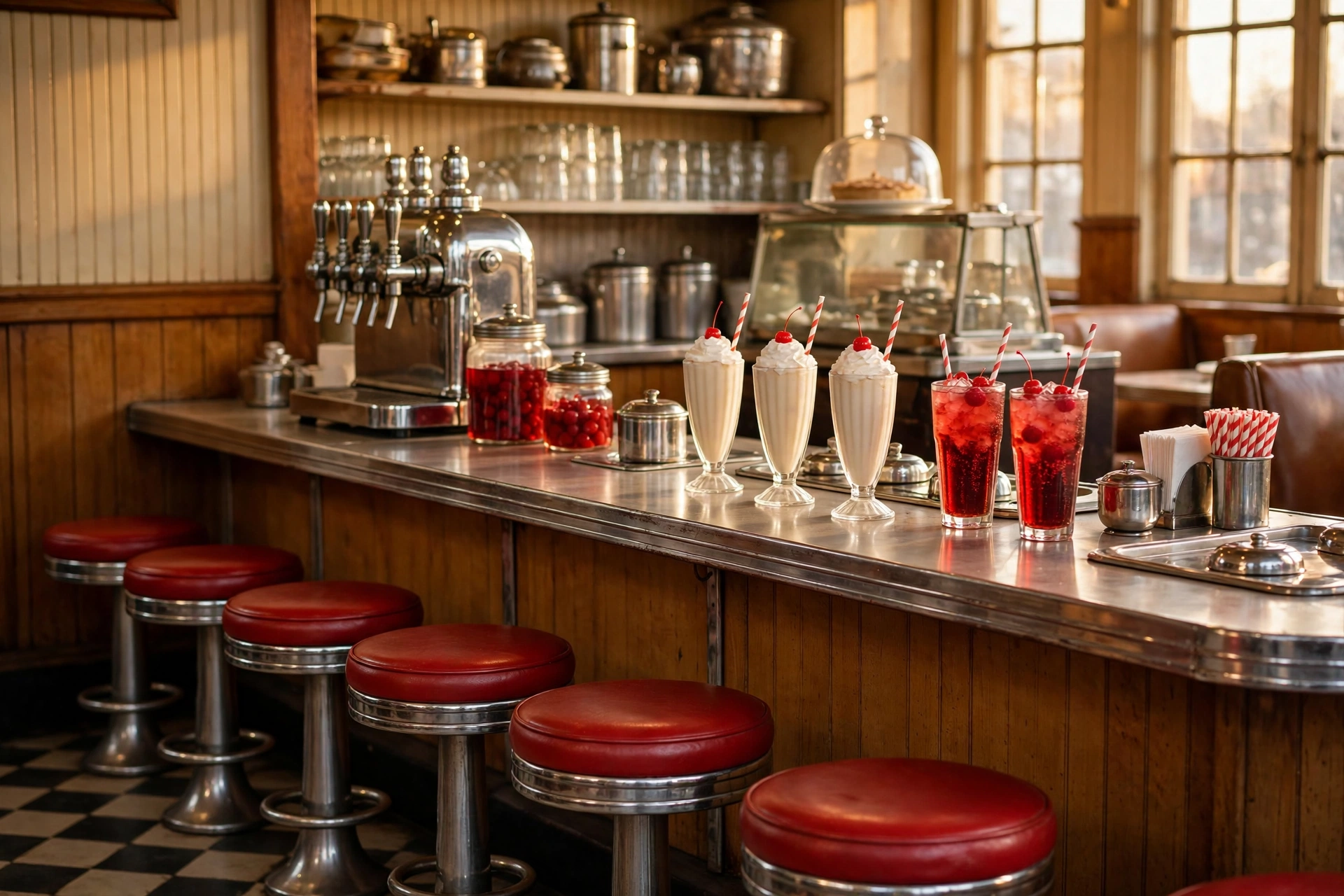
Cherry Cokes. Oh, my friends, cherry Cokes. Not the bottled kind — the kind made right in front of you, where the waitress would pump dark red syrup from a chrome dispenser, stir it into a tall glass of bubbling Coca-Cola, and crown it with a maraschino cherry that sank slowly through the fizz like a tiny red sunset. It cost a dime. A dime! And it tasted like summer tasted, like freedom tasted, like being twelve years old on a Saturday afternoon with nothing to do and nowhere to be tasted.
Root beer floats were a nickel more, and worth every penny. Vanilla ice cream drowning in foamy root beer, served in a heavy glass with a long spoon, and the way the foam would rise up over the rim so you had to lick it off the sides of the glass while it was still fizzing — I can taste it right now. I mean that literally. My mouth is watering as I type this.
The stools were the best seats in town. They swiveled — swiveled! — and every kid knew that the proper way to sit at the lunch counter was to spin at least three full rotations before your order arrived. The waitress would pretend not to notice, but you could see the corner of her mouth twitch. She’d seen a thousand kids do the same thousand spins, and she’d let a thousand more, because that was the whole point. The lunch counter was a place where being a kid was the entire business plan.
And the coffee — my mother and her friends could nurse a bottomless cup of coffee for two hours at that counter, catching up on town news, trading recipes, laughing until the waitress refilled them without being asked. For a dime, my mother bought two hours of friendship and peace. Try getting that deal anywhere today.
The Waitresses Who Knew Your Name
Every lunch counter had one. Ours was named Dot, and Dot had been working that counter since Eisenhower was president. She called every kid “hon” and every adult by their first name, and she had the remarkable gift of remembering exactly how you liked your hot dog — mustard and relish, no onions, just like last Saturday.
Dot didn’t write orders down. She just nodded, turned around, and called into the grill window: “One cheeseburger deluxe and a cherry Coke for the young man with the spinning problem!” And it arrived hot, and it arrived right, and she winked at you when she set it down. People talk about customer service like it was invented yesterday. Dot invented it. She just called it being nice.
The Counter as Community Center
Here’s what the history books miss when they talk about five-and-dimes: the lunch counter was a town’s living room. Before social media, before texting, the counter was where news traveled. Who was getting married. Whose baby had taken its first steps. Which teacher was retiring. All of it flowed over cherry Cokes and coffee, and it mattered more than any of us realized at the time.
It was also, in 1960, the stage for something far bigger than grilled cheese. At the Woolworth’s lunch counter in Greensboro, North Carolina, four young Black college students sat down and asked to be served, and their quiet courage changed American history. Those Greensboro sit-ins turned an ordinary lunch counter into a symbol of the civil rights movement. When you sat at that counter — any Woolworth’s counter — you were sitting in a place that had meant something enormous. The stools held everybody. That was the idea. That is still the idea.
The Sweet Ritual of Penny Candy
But let’s be honest — as much as we loved the lunch counter, the candy aisle was the true shrine. It deserves its own section, its own candle, its own moment of silence. The penny candy counter at Woolworth’s was a cathedral of sugar, and we were its most devoted worshippers.

Picture it: a long glass case, the kind with the sliding doors, filled with trays of loose candy. And behind the case, rows of tall glass jars on the shelves, each one holding a different treasure. Red wax lips. Wax bottles with colored syrup inside that you bit the top off of. Root beer barrels. Mary Janes with their peanut-butter centers. Smarties in their pastel rolls. Atomic Fireballs that could melt your tongue off and you bought them anyway because pain was part of the fun. And the candy buttons — those long strips of paper dotted with colored sugar drops, which you peeled off one by one, licking paper and all, until your tongue was a rainbow.
Everything cost a penny or two. That was the whole beautiful point. You didn’t need a dollar. You needed pennies, and pennies had a weight and a dignity they don’t have now. We all had a penny jar, or a little coin purse, and the walk to Woolworth’s with a handful of warm pennies clutched in your fist was a journey of pure anticipation. Which ones would you pick? You had to plan. You had to strategize. A penny was a penny, and you didn’t waste pennies.
I remember the ritual so clearly. You’d press your face to the glass case and point, and the clerk — patient as a saint — would slide open the door and scoop your choices into a little white paper bag with a metal scoop. “Three red hots, two Mary Janes, one wax bottle, and… can I get one of those big jawbreakers? The blue one.” The clerk would fold the top of the bag with a crisp crease and hand it over, and that folded bag was a small masterpiece. You carried it home like it was made of glass.
There was an art to eating penny candy, too. You didn’t just eat it — you rationed it. The wax lips you wore around the house for an hour before chewing them. The jawbreaker you carried in your pocket for a week, taking it out for one careful lick at a time. The candy cigarettes — yes, we had those, and yes, looking back it’s a bit alarming, but at the time we just thought we looked cool, which, to be fair, we absolutely did.
If the dime store candy counter was your cathedral, you’ll love remembering the penny candy at the corner store too — because every neighborhood had its own little sugar shrine, and the rituals were just as sacred there.
The Shopping Rituals That Shaped Us
Woolworth’s taught us things no school ever could. It taught us the value of money, for one. When everything costs a nickel or a dime, you learn arithmetic without trying. You learn to budget. You learn that if you spend your quarter on the balsa glider, you can’t also have the cherry Coke, and that is a genuine life lesson about trade-offs disguised as a Saturday afternoon.
It taught us manners. You said please and thank you to the clerk. You didn’t touch what you couldn’t buy. You put things back where they belonged. Dot at the lunch counter would give you the look if you spun your stool too wildly, and one look was all it took. Respect was free at Woolworth’s, and it was non-negotiable.
And it taught us patience. Christmas shopping at the dime store was a master class in anticipation. You’d walk the toy aisles for weeks — weeks — staring at the thing you wanted, doing the math, counting your pennies, hoping nobody else bought it first. When you finally walked out with it in a brown paper bag, the triumph was enormous. We didn’t get things instantly back then. We waited for them, and the waiting made them sweeter.
Saturday: The Sacred Day
Saturday was the day. The week was school and chores and waiting. Saturday was Woolworth’s. The ritual went like this: breakfast eaten in a hurry, chores done in a blur, and then the walk or the bus ride downtown with your friends or your mother, everyone buzzing with the same electricity.
You’d hit the toy department first, just to look. Then the pet department, to watch the goldfish and talk to the parakeets. Then the candy counter, the main event, where you’d spend ten agonizing minutes deciding. And finally — if you had any money left, and you always planned to — the lunch counter for a cherry Coke, where you’d spin on your stool and feel like the most sophisticated person alive. Then home, pockets full, bag folded with that perfect crease, already counting the days until next Saturday.
The Things Money Could Buy
Let me do the math for the young people, because I want you to feel this. A nickel in 1965 had the buying power of roughly forty cents today — but in the dime store, it felt like five dollars. A dime was a fortune. A quarter was wealth. For a dollar — one single dollar — a kid could buy a balsa glider, a bag of penny candy, a cherry Coke, a pack of baseball cards, and still have change for the gumball machine by the door.
The gumball machine! A penny for a gumball, and if you got the speckled one, you won a prize. The prize was usually a plastic whistle or a tiny ring that turned your finger green, but winning was winning, and we’d march home with that green finger held high like we’d won the Olympics.
The Quiet Closing of an Era
All good things, as they say, must end. But the ending of the five-and-dime era didn’t come with a bang. It came with a slow, quiet drift — the way a good friend moves away, not all at once, but one goodbye at a time.
The malls came first. Big, bright, air-conditioned palaces on the edge of town with a hundred stores under one roof. They had escalators and food courts and everything was new and shiny. Downtown started to feel old. The parking was easier at the mall. And one by one, the customers drifted away from Main Street like leaves off a tree in October.
Then the discount giants arrived, and the math got cruel. The dime stores couldn’t compete on price anymore. The lunch counters, which had never been huge moneymakers — they were loss leaders, really, kept alive because they brought people through the doors — started closing first. The soda fountains went dark. The stools were unbolted and sold off. Dot retired, or moved to the diner across town, and the counter that had been the town’s living room became an empty stretch of Formica with the lights turned off.
I remember the day our Woolworth’s closed. There was no announcement, no ceremony — just a sign in the window one Monday morning: STORE CLOSING, EVERYTHING MUST GO. The fixtures were sold. The glass candy jars went to collectors. The wooden floors — those beautiful, creaky wooden floors that had known my name — were covered over or torn up. And then the doors were locked, and Main Street got a little quieter, and a little less kind, and nobody talked about it much because what was there to say?
For the record, the Woolworth company story is a remarkable one: Frank Winfield Woolworth opened his first successful five-and-ten-cent store in Lancaster, Pennsylvania, back in 1879, built an empire on the radical idea that everything could cost a nickel or a dime, and the chain became a fixture of American downtowns for over a century before the last U.S. stores closed in July 1997. The company lives on today as Foot Locker — but the lunch counters, the candy aisles, the creaky floors? Those live on only in us.
What the Malls Couldn’t Replace
The malls had everything, they said. But they didn’t have Dot. They didn’t have the creak of the wooden floors greeting you by name. They didn’t have a place where a kid with a nickel was treated like a valued customer instead of a nuisance. The food court had a dozen options, but none of them served a cherry Coke made by hand in a tall glass with a maraschino cherry sinking through the fizz.
Efficiency replaced warmth. Variety replaced familiarity. And something real was lost — not just a store, but a way of being together. The dime store didn’t just sell things. It held a town’s memories in its walls, in its floors, in the worn paths between the counters where a million Saturday afternoons had walked.
Why These Memories Still Matter
So why am I writing this? Why does a store that closed nearly thirty years ago still make my chest ache? Because the five-and-dime wasn’t really about shopping. It was about a world where things were simpler, slower, and sweeter — where a nickel had dignity, where the waitress knew your name, where the floors talked to you and the candy came in folded paper bags.
Those stores raised us. They taught us the value of a dollar and the value of a neighbor. They gave us our first taste of independence — that first solo walk to the candy counter with a fistful of pennies — and our first lessons in patience, manners, and arithmetic. Every creak of those wooden floors was a small lesson in belonging: you are welcome here, you matter here, come back next Saturday.
“You could buy the world with fifty cents.” If that sentence doesn’t make you smile, you never stood in a dime store on a Saturday morning. And if it does make you smile, then you know exactly what I’m talking about — the smell of the grill, the hiss of the soda fountain, the weight of a folded paper bag of penny candy in your hand, and the feeling that everything good in the world cost a nickel.
“Dot never wrote anything down, and she never got an order wrong.” Think about that for a second. In a world of apps and algorithms and self-checkout, there was a woman in a starched uniform who remembered how you liked your hot dog. That wasn’t customer service. That was love, disguised as a lunch counter.
I can’t go back. The store is gone, the counter is dark, and the floors have been torn up or paved over. But here’s the thing: every time I hear a floorboard creak, every time I smell coffee and vanilla together, every time I see a kid clutching a handful of change like it’s treasure — I’m back there. I’m ten years old, the nickel is warm in my pocket, and the whole world smells like cherry Coke and possibility.
So tell me — what was your dime store? Was it Woolworth’s, or Kresge, or Newberry’s, or the little local five-and-dime with the name nobody else remembers? What did you buy with your first dollar? Who was your Dot? Drop your memories in the comments below, because these stories don’t belong to me — they belong to all of us, and the only way they survive is if we keep telling them. What’s the one smell, the one sound, the one taste that takes you right back to those creaky wooden floors?
Pingback: Candy Corn Memories: Ultimate 140-Year Love-Hate Classic