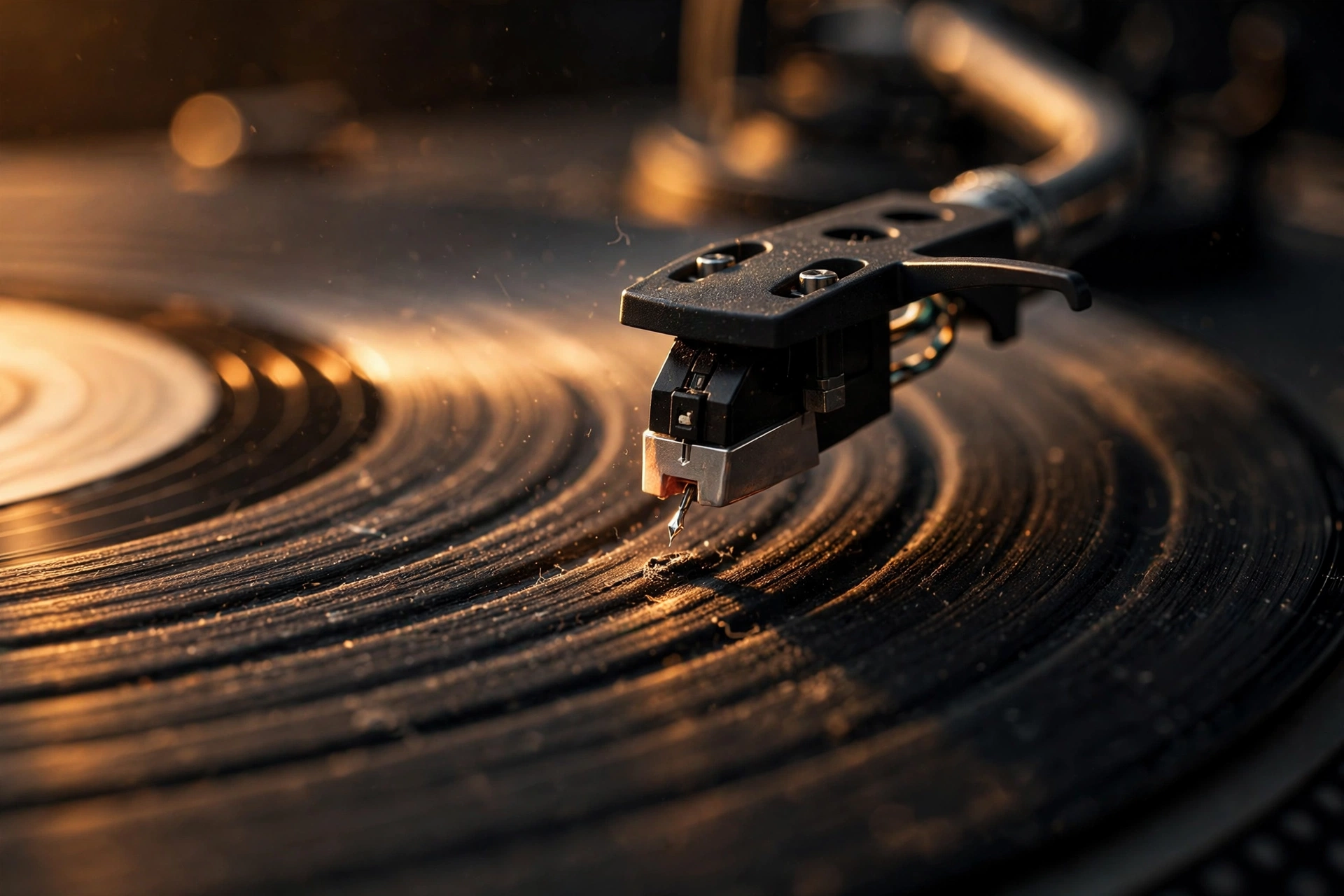
There is a sound that no streaming service has ever managed to copy. It isn’t the song itself — it’s the half-second before the song starts. The soft thump of the needle settling into the groove. That gentle, whispery crackle, like a tiny fireplace being lit. If you grew up with vinyl records, that sound probably just sent a shiver down your spine. And if you didn’t, you might be wondering what all the fuss is about. Pull up a chair. This one’s worth hearing out.
I still remember the first record I ever played by myself. I was nine, standing on a dining chair because I couldn’t quite reach the turntable, while my dad hovered behind me with his hands out like he was spotting a gymnast. The album was one of his — a classic rock record, worn at the edges, the sleeve soft as cloth from a thousand handlings. I lowered the needle with the kind of concentration usually reserved for brain surgery, and then… crackle, hiss, and the opening chord bloomed out of those big wooden speakers like sunlight through a curtain. I had heard music before, of course. But I had never felt it arrive like that.
Why Vinyl Records Sound Different (And Why We Love It)
Let’s get the nerdy question out of the way first, because somebody always asks: do vinyl records actually sound better than digital? The honest answer is that “better” is the wrong word. They sound different — warmer, rounder, a little more human. Digital music is made of samples, tiny snapshots of sound stitched together so fast your ear can’t tell. A vinyl groove is a continuous physical carving of the actual sound wave. The needle rides it the way a sled rides a hill. There’s nothing in between you and the music except physics and a very thin piece of diamond.
But here’s what the audio engineers will tell you if you buy them a coffee: most of what we love about vinyl isn’t measurable on a chart. It’s the imperfections. The faint crackle between tracks. The way a loud passage makes the whole cabinet hum just slightly. The occasional pop where a speck of dust survived your cleaning ritual. Digital audio scrubs all of that away in the name of perfection, and perfection turns out to be a little cold. Vinyl keeps the fingerprints on the glass, and somehow the music feels more alive for it.
There’s also the volume question — not how loud, but how dynamic. Old albums were mastered for the living room, with quiet parts that were genuinely quiet and loud parts that knocked the pictures crooked. Modern digital tracks are often mastered to be uniformly loud, like someone shouting the entire conversation. Put on a well-pressed record from the seventies and the music breathes. It swells and whispers. Your ears get a workout they didn’t know they missed.
The Science of the Groove (Without the Boring Lecture)
A record is absurdly simple when you think about it. It’s a flat disc of vinyl with a single spiral groove running from the outside edge to the center label — on a typical LP, that groove is about half a mile long if you unwound it. The walls of the groove wiggle left and right (and up and down, on stereo records) in the exact shape of the sound waves. The needle traces those wiggles, a little magnet and coil turn the movement back into electricity, and the amplifier does the rest.
No batteries. No software updates. No subscription. A technology invented in the 1940s, refined through the fifties, and still working perfectly in your grandfather’s attic. Try saying that about your phone. There’s something deeply reassuring about a machine you can understand by looking at it — you can see the music happening, watch the label spin, and know exactly where you are in the album by how close the needle is to the center. Try doing that with a progress bar.
The Ritual: More Than Just Music
Here’s the thing streaming took from us without asking: the ceremony. Playing a record is a small liturgy, and every step of it matters. You choose the album — a real choice, from a real shelf, where the spines stare back at you like old friends. You slide the disc out of its sleeve, and the sleeve itself is an event: twelve inches of artwork you can actually see, liner notes you can actually read, maybe a lyric sheet folded inside like a treasure map.
Then the handling. You hold the record by the edges, fingertips on the label, because your skin oils are the enemy and every collector learns this the way kids learn not to touch a hot stove — usually once, memorably. You place it on the platter. You might give it a quick pass with the anti-static brush, watching dust lift away like morning mist. You cue the tonearm, take a breath, and lower the needle. Crackle. Hiss. Music.
Compare that to tapping a thumbnail while you brush your teeth. Streaming is wonderful — I use it every day, and I’m not giving it up. But it’s the difference between a home-cooked meal and a drive-through. One feeds you. The other feeds you and slows you down long enough to taste it. Vinyl demands your attention, and in return it gives you something attention always gives: a deeper experience.
And then there’s the side flip, the great forgotten punctuation mark of music. Every twenty-odd minutes, the music stops, and you have to get up, walk across the room, and turn the record over. It sounds like an inconvenience. It was actually a gift. Side one ends on a cliffhanger — albums were sequenced for it, with the big emotional moment often landing as the last track before the flip. You’d stand there in the sudden silence, the room still ringing, and make the small pilgrimage to the turntable. It gave the music chapters. Beginnings, middles, ends. When was the last time an album had chapters for you?
A Brief Spin Through Vinyl History
The long-playing record as we know it was born in 1948, when Columbia Records introduced the 33⅓ rpm LP — twenty-plus minutes per side, a minor miracle at the time. RCA answered with the 45 rpm single, seven inches of pure jukebox energy. Together, they built the modern music industry. The fifties gave us the first rock and roll singles crackling out of jukeboxes. The sixties turned the LP into art — albums you listened to start to finish, in order, in the dark, preferably with the lyric sheet. The seventies were the golden age: gatefold sleeves, concept albums, and a turntable in every living room that mattered.
If you want the full story of how those decades sounded, the folks at Wikipedia keep a lovingly detailed history of the phonograph record — from Edison’s cylinders to the LP format wars and everything after.
The Golden Age
Picture a Saturday in 1975. The record store is packed. New releases hit the shelves on the same day everywhere, and the big ones were events — people lined up, argued in the aisles, went home and played the thing four times in a row. Album covers were billboards you hung on your bedroom wall. Classic rock anthems weren’t just songs; they were sides of vinyl you knew by heart, including the exact spot where side one faded out.
And it wasn’t just rock. Soul, funk, disco, jazz, country, classical — everything lived on vinyl. The format didn’t care about genre. Your parents’ collection probably had guilty pleasures they’d never admit to, and that’s the beauty of a physical shelf: it keeps your secrets in plain sight. Every collection was an autobiography you could read by running a finger along the spines.
The Fall (and the Glorious Comeback)
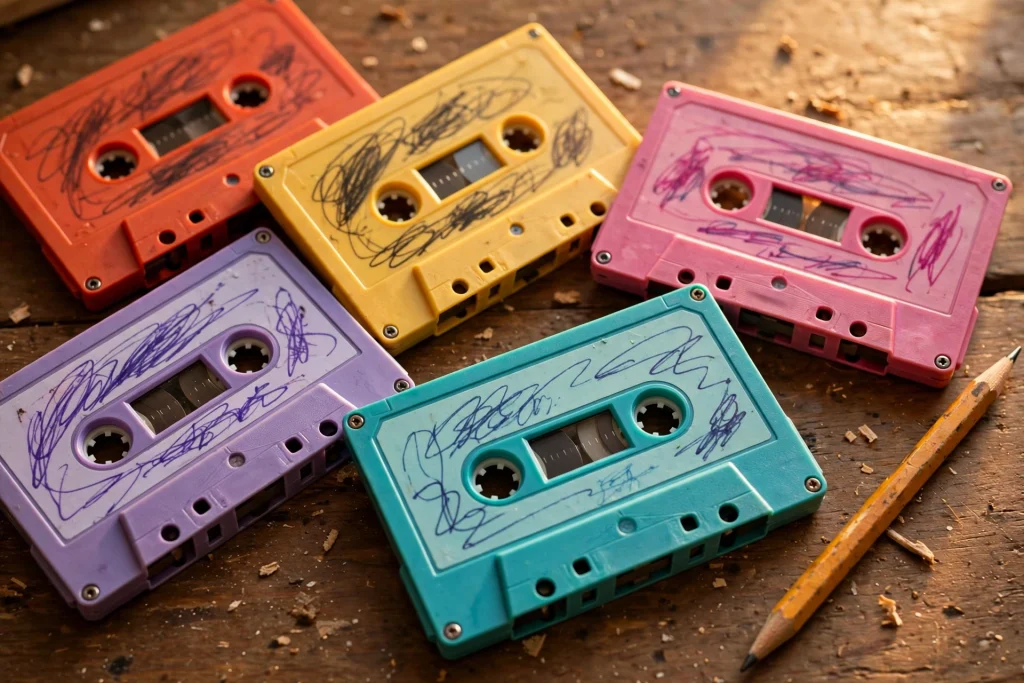
Then came the eighties, and the compact disc arrived promising “perfect sound forever.” The nineties brought the cassette’s last stand — we all remember rewinding cassette tapes with a pencil — and then the CD took over completely. Record stores ripped out their vinyl bins. Turntables gathered dust in attics. By the mid-2000s, vinyl was a rounding error in the music business, kept alive by DJs, audiophiles, and stubborn romantics.
And then — nobody saw this coming — it started climbing back. Slowly at first, then faster. Kids who’d grown up on MP3s started buying turntables. Old pressing plants, some down to a single working machine, suddenly had waiting lists. By the 2020s, vinyl was outselling CDs again, year after year. The vinyl revival is one of the strangest and most heartwarming comebacks in the history of technology: the “obsolete” format that refused to die, now being discovered by the very generation that was supposed to bury it.
Why? Ask a twenty-year-old crate digger and you’ll hear the same words the old collectors use: it sounds warmer, it feels real, it slows you down. The kids aren’t being ironic. They’re being hungry — hungry for something you can hold, something that asks for your time instead of just your thumb.
Crate Digging: The Thrill of the Hunt
There is no streaming equivalent of crate digging, and there never will be. Crate digging is the act of flipping through bins of used records — hour after hour, sore knees, dusty fingers — looking for treasure. Every record store, every flea market, every garage sale with a cardboard box marked “RECORDS $1” is a potential gold mine. You never know what’s in the next crate. That uncertainty is the whole drug.
The veterans have techniques. Flip fast but look slow. Check the condition of the vinyl, not just the sleeve — a beautiful cover with a scratched disc is heartbreak in a jacket. Learn the labels: certain pressings, certain years, certain little logos in the dead wax that mark a first pressing worth ten times the reissue. And always, always check the dollar bin last, because that’s where the miracles hide. Somebody’s ex-boyfriend’s collection, priced to move, containing the album you’ve hunted for three years.
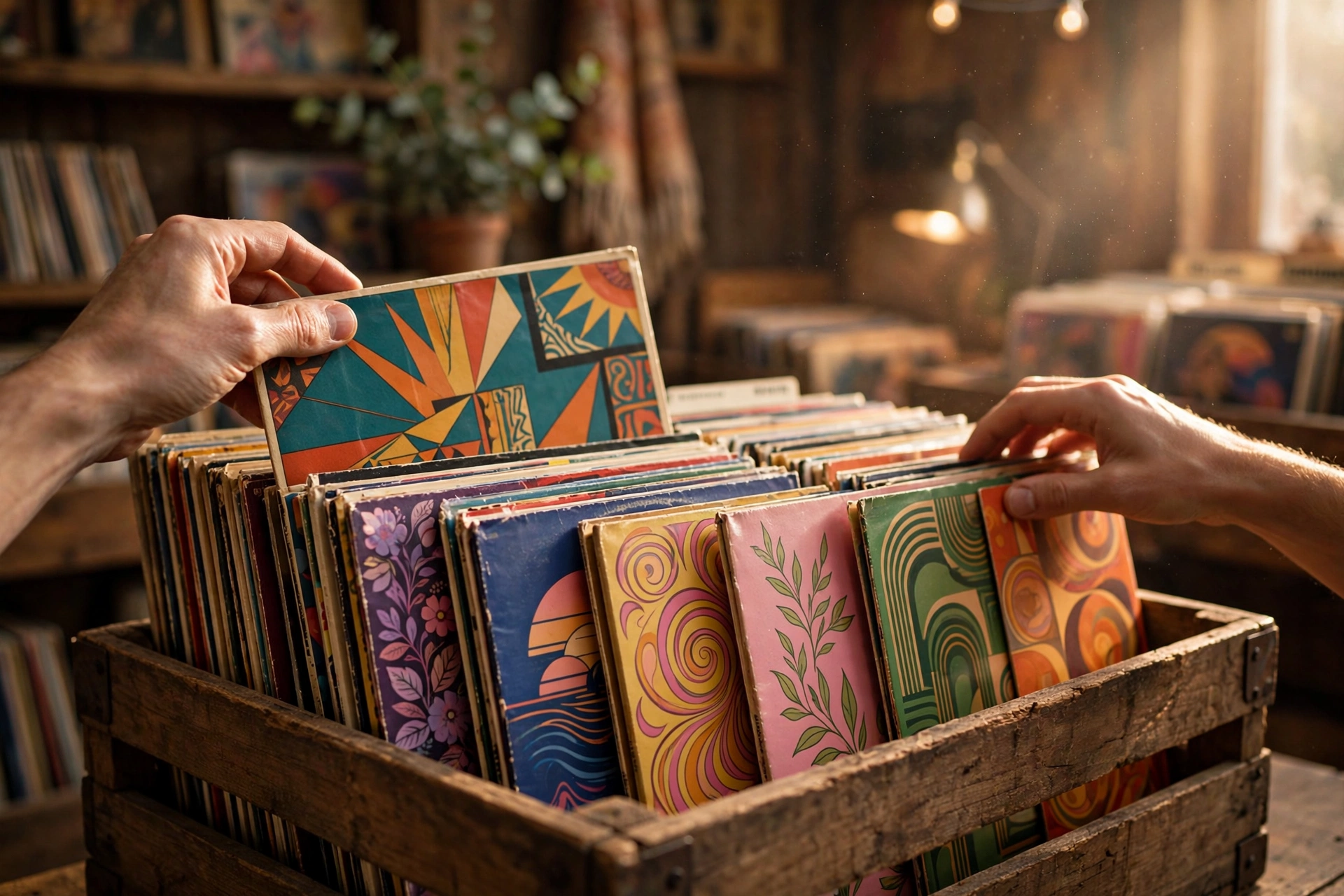
The finds become legends. The original pressing of a jazz classic for two dollars at a church sale. The out-of-print soundtrack in the free box outside a closing store. The record your dad owned, the one that got lost in a move decades ago, suddenly back in your hands with his initials still on the label. You don’t get stories like that from an algorithm’s “Discover Weekly.” You get them from showing up, getting dusty, and flipping.
And the community! Record people are the friendliest obsessives on earth. Strike up a conversation in the bins — “Oh, you’re into soul jazz? Have you heard this one?” — and you’ll walk out with three recommendations and possibly a new friend. Store clerks who remember what you bought last month. The nod between two strangers reaching for the same bin. Crate digging is a solo sport played in public, and the regulars look out for each other.
Starting Your Own Collection
Thinking about joining the revival? Good. Here’s the gentle truth: you don’t need much, and you definitely don’t need to spend much. The barrier to entry is lower than the internet wants you to believe. A decent starter turntable, a pair of speakers (even modest ones), and five records you genuinely love — that’s a complete setup. Everything after that is gravy.
Start with music you already know by heart. The first record should be an old friend, because you’ll hear things in it you never heard before — a bass line hiding under the mix, a breath before the chorus, the room the band recorded in. That’s the moment that hooks people. That’s the moment the crackle stops being noise and starts being part of the song.
Your First Turntable
A quick word of advice from someone who’s watched friends learn this the hard way: skip the cheapest suitcase-style players with the built-in speakers. They’re cute, but their heavy tracking force wears records out fast, and life’s too short to sand down your collection. You don’t need a $2,000 audiophile rig either. A solid entry-level belt-drive turntable from a reputable brand, with an adjustable counterweight and a replaceable cartridge, will treat your records right and sound wonderful.
Buy used if you can. The vintage market is full of beautiful old turntables — heavy, simple, built like tanks — that just need a new belt and a fresh stylus to sing again. There’s something poetic about rescuing a forty-year-old machine and putting it back to work. It was built for this. Let it do its job.
Where to Find Records
New pressings are everywhere now — most current artists release vinyl, and reissues of the classics are constantly in print. But the real joy, as we covered, is in the hunt: independent record stores, flea markets, estate sales, thrift shops, and that friend of a friend who’s “getting rid of a bunch of old records” (say yes immediately, ask questions later). Online marketplaces work too, but nothing beats holding the disc up to the light and checking the grooves yourself.
One more tip: build slowly. A collection assembled over years, one Saturday at a time, means more than a shelf filled in a weekend. Every record should have a story — where you found it, who you were with, what it cost you in dignity when you haggled. Ten years from now, you won’t remember the price. You’ll remember the day.
Caring for the Collection
Vinyl rewards a little care and punishes neglect, but the maintenance is part of the pleasure, not a chore. Store records upright, never stacked flat — stacked records warp into bowls over time, and a warped record is a sad record. Keep them in their inner sleeves (paper is fine, anti-static plastic is better), keep them out of direct sunlight and away from heat, and they’ll outlive you. Seriously: a well-kept record from 1960 plays beautifully today. Find me a digital file format with that track record. Pun intended.
Clean before you play, at least a quick pass with a carbon-fiber brush. For deeper cleaning, there are machines and fluids and entire internet forums devoted to the subject — welcome to the rabbit hole, it’s cozy down here. Handle by the edges, cue gently, and replace your stylus when it’s worn (a worn needle doesn’t just sound bad, it carves up your grooves). Treat the collection like the library it is, and it will pay you back every single evening.
Oh, and one rule every collector learns: never, ever lend a record you can’t bear to lose. Lending records is how collections develop mysterious gaps and friendships develop mysterious tensions. Buy your friend their own copy. It’s cheaper than the alternative, which is thinking about your missing album every time you look at the shelf.
Why Vinyl Records Will Never Truly Die
They’ve tried to kill it three times now — the CD, the download, the stream — and it’s still here, still spinning, still selling. There’s a lesson in that. Convenience wins the market, but it doesn’t win the heart. The heart wants weight. It wants texture. It wants the small human frictions — the flip, the dust, the crackle — that remind us a real person made this music and another real person is listening to it, right now, on purpose.
My dad’s turntable sits in my living room now. Same wooden cabinet, same soft thunk when the needle drops. My kids stand on the same dining chair I stood on, and I hover behind them with my hands out, just like he did. The records are older now, a little more worn at the edges, the sleeves even softer. But the crackle is the same. The sunlight-through-the-curtain feeling is the same. Some technologies get replaced. Some just get handed down.
So here’s my suggestion: find a record. Any record. Borrow a turntable, visit a friend, wander into a record store on a Saturday afternoon. Lower the needle yourself. Wait for the crackle. And when the music blooms out of the speakers — warm, and wide, and wonderfully imperfect — you’ll understand. Some things were never broken. They were just waiting for us to come back.
Pingback: 8-Track Tape Memories: The Ka-Chunk Era