Close your eyes and listen. Somewhere down the hallway, a pair of real metal bells is ringing — not a gentle buzz in your pocket, not a ringtone you downloaded, but an actual brass alarm loud enough to jolt a whole house awake at midnight. That was the sound of rotary phones, and once you lived with it, you never forgot it.
There was usually one phone. Just one, bolted to the kitchen wall or sitting like a small black throne on the hallway table, and it belonged to the entire family. When it rang at dinner, everybody froze mid-bite. Somebody’s grandmother would answer with the phone number like a little song she had memorized. And when you wanted to call someone yourself, you didn’t tap a screen — you dialed, finger by finger, and you earned every single conversation.
Come back with me for a few minutes. The cord is already stretched around the corner.
The Sound That Ruled the House
Modern phones make noise. Rotary phones made announcements. Inside that heavy plastic shell sat two tuned metal gongs and a little clapper that swung between them, driven by an electrical signal from the exchange. When your number was called, that clapper went to war — brrring-brrring! — so loud the neighbors could hear it through the walls.
And it rang for the whole house, because the whole house shared one line and one phone. There was no silent mode. No “decline.” If you were in the bathtub, you sprinted. If you were outside playing, you came flying through the screen door. People used to let it ring ten times or more, because everyone understood: getting to the phone was a journey, and the caller on the other end knew it too.
The phone always seemed to ring at the worst possible moment — right in the middle of dinner, or during the best scene of the show the whole family was watching together. Those cozy family TV nights had their own special agony: the phone ringing during the finale, and everyone shouting “don’t answer it!” while somebody answered it anyway.
Answering had its own ritual. You lifted the heavy receiver — solid Bakelite, cool and weighty in your hand — and said your piece: “Hello?” or the family name, or in some houses, the phone number itself, recited like a password. The voice on the other end crackled just a little, warm and human, with none of today’s digital crispness. It sounded like a person talking through a person-sized machine. Because that’s exactly what it was.
The Dial Was a Workout
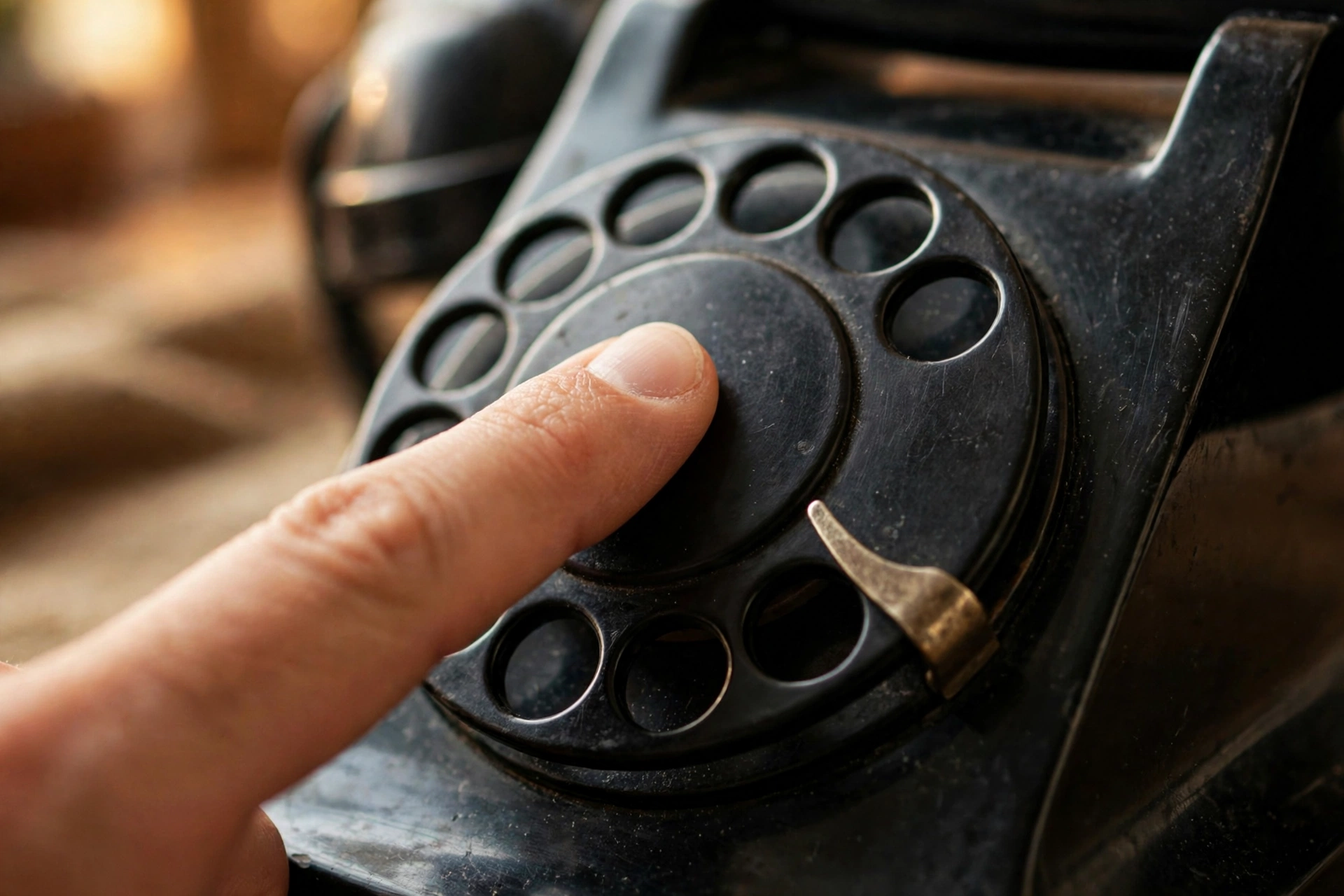
Here is what dialing on rotary phones actually felt like. You put your fingertip into the little hole for the first digit, dragged the heavy dial clockwise until your finger hit the metal stop — clack — and then let go. The dial spun back on its own with a whirring, clicking sigh that took its sweet time. Then you did it again. And again. Seven digits. Every single call.
A number full of ones and twos? Lovely. Quick little flicks. But a number full of nines and zeros? That was a genuine arm workout. Each high digit meant dragging the dial almost all the way around and waiting out that long, lazy spin back. Kids learned early that calling a friend whose number was something like 909-9009 felt like running a marathon with your index finger.
And heaven help you if you misdialed. One wrong digit on digit six and the whole thing was ruined — you hung up, waited for the dial tone to come back, and started over from the very beginning. There was no backspace. No redial button. Just you, the dial, and your own stubborn patience.
What Was Actually Happening Inside That Dial
It looked like magic, but it was beautifully simple engineering. Each time the dial spun back to rest, it interrupted the electrical current on the line in rapid pulses — one pulse for a 1, five for a 5, ten for a 0. Those pulses traveled to the exchange and stepped mechanical switches through banks of contacts until they landed on the right line. Your finger was literally flipping switches miles away, one click at a time. You can read the full technical story on the Wikipedia page about the rotary dial, but honestly, the short version is more romantic: you wound up the phone like a toy, and it carried your call where it needed to go.
The whole idea came from an unlikely inventor — a Kansas City undertaker named Almon Strowger, who in the 1890s decided human operators were too slow and built the first automatic dial exchange himself. Decades later, the design most of us remember arrived: the Western Electric Model 500, styled by Henry Dreyfuss in 1949. Around 93 million of them were built. They came in black at first, then harvest gold, avocado green, and princess pink, and they were built to survive forty years of daily use. You could drop one down the stairs and still get a dial tone.
Then in 1965 came the Trimline — the first phone with the dial tucked right into the handset, with a clever moving finger stop that let the dial be smaller. It looked like something from the future. For about twenty years, it was the future.
Rotary Phones and the Great Cord Stretch
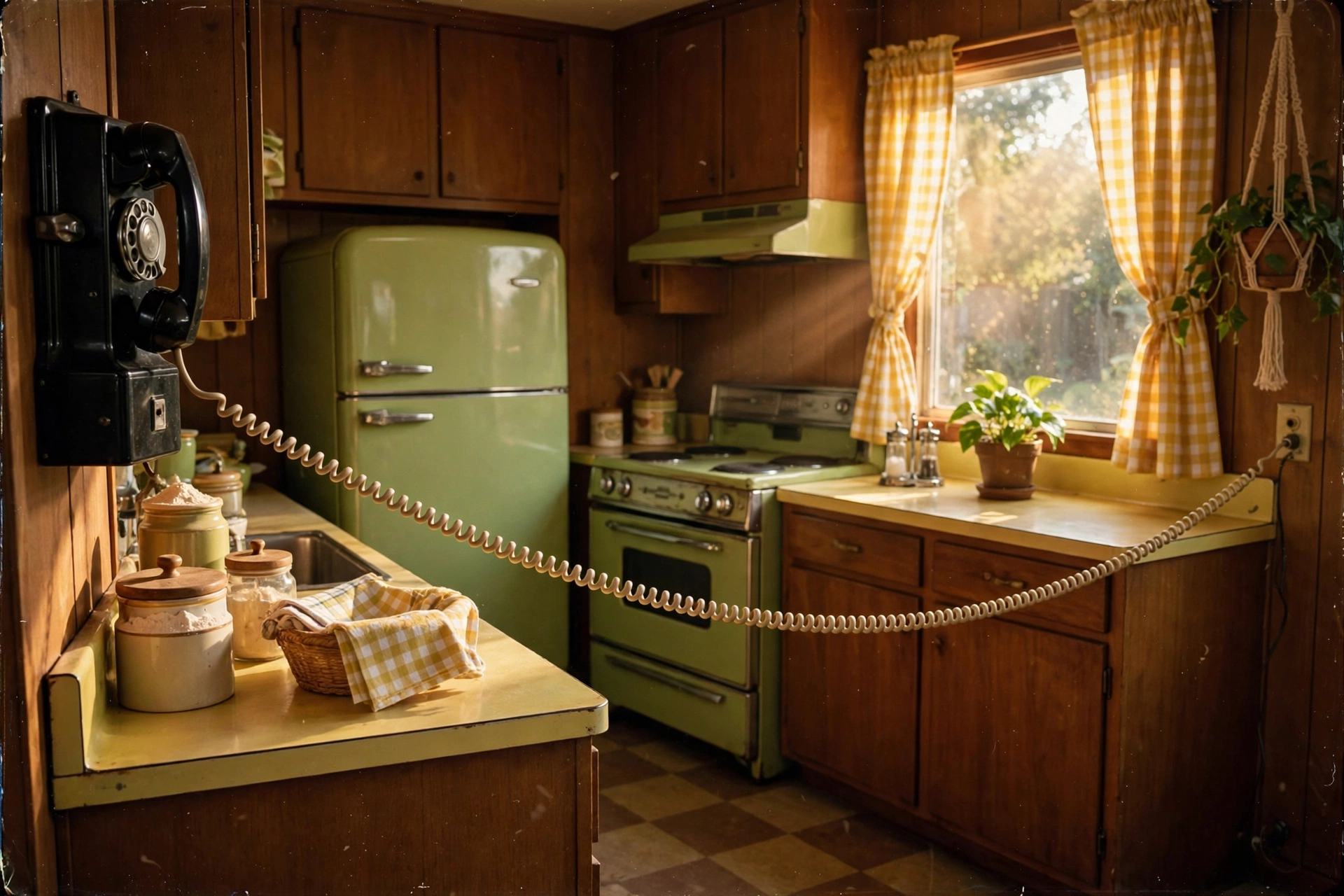
The coiled handset cord arrived in 1953, and it changed everything. Before that, phone cords were straight and short, and you stood exactly where the phone told you to stand. After 1953, you had reach. Glorious, elastic, tangled reach.
Every family had the same trick: stretching that coiled cord as far as physics allowed, wrapping it around the doorframe, and pulling the receiver into the next room for a whisper of privacy. Teenagers perfected this art. The phone lived on the kitchen wall; the teenager lived on the kitchen floor, cord stretched around the corner into the hallway, voice dropped to a murmur, finger twirled in the cord’s coils. Parents knew. Parents always knew.
But cords had a dark side, and its name was tangles. A coiled cord left to its own devices would twist itself into knots that defied all known laws of geometry. Untangling it meant holding the receiver up and letting it spin, or detaching it and shaking it out like a garden hose while someone yelled at you to hurry up because they were expecting a call. We all did the spin-the-receiver trick. It never fully worked, and we never stopped doing it.
Here’s the thing nobody tells you about the long cord era: the phone gave you reach, but it never gave you escape. The cord was the original leash. Your conversations happened in one place, in the open, with the clatter of dishes and your little brother listening from the stairs. Privacy wasn’t a setting. Privacy was a stretched cord and a closed door that didn’t quite latch.
Beep-Beep-Beep: The Dreaded Busy Signal
Picture this: you’ve worked up the courage to call your crush. You’ve dialed all seven digits perfectly — a small miracle — and instead of ringing, you hear it. Beep-beep-beep-beep-beep. Rapid, merciless, mocking. The busy signal. The line is taken. Your heart sinks straight through the kitchen floor. Ask anyone who grew up with rotary phones about that sound, and watch their whole face change.
The busy signal was the soundtrack of the rotary era. Somebody was on the phone — always somebody — and there was no call waiting, no voicemail to fall back on, no text to send instead. Your options were exactly two: hang up and try again later, or hang up and try again in five minutes. And then five minutes after that. Entire evenings were spent in this loop, lifting the receiver, hearing the beeps, sighing loud enough for the whole house to hear.
Parents were the undefeated champions of the busy line. Mom on a marathon call with her sister. Dad “checking something” with the office for forty-five minutes. You’d pick up the kitchen phone, hear voices already mid-conversation, and realize with horror that your own family was the reason your best friend couldn’t get through. The rule was simple: keep calls short, because somebody else was always waiting. Nobody kept calls short.
And when you finally got through — when the ringing started instead of the beeps — the relief was physical. Your whole body unclenched. You’d mouth “it’s ringing!” to anyone watching. Getting a call through felt like winning something, because in a small, real way, you had.
Party Lines: When the Whole Street Was on the Call
Now imagine the busy signal, but permanent, and shared with your neighbors. That was the party line — one telephone line split between several households, mostly in rural areas and small towns where running a private line to every farmhouse would have cost a fortune. It was cheaper, it worked, and it came with a catch the size of a barn door: anyone on your line could pick up their receiver and hear your conversation.
Party lines had their own etiquette, and everyone knew it. You were supposed to hang up immediately if you heard someone else talking. You were supposed to keep your calls brief. You were supposed to yield the line in an emergency without being asked. And human nature being what it is, plenty of people did none of these things — which is exactly why party lines were the original social network. The town’s news traveled along those shared wires faster than any newspaper.
To keep some order, many party lines used coded rings — your house might be two longs and a short, the neighbors’ three shorts. You learned to count rings the way kids today learn notification sounds. But the code didn’t stop the listening. Every small town had its legendary eavesdropper, the neighbor who always seemed to know everyone’s business, and everyone knew exactly how she knew it.
Here’s the part that surprises people: party lines weren’t some ancient 1920s curiosity. They hung on for decades. One of the very last ones in America, serving a handful of homes in Woodbury, Connecticut, didn’t shut down until 1991. People were sharing a phone line with their neighbors the same year grunge broke through. Let that sink in.
Dialing 0 for the Operator
Before the dial could do everything, there was a human being in the middle of every call that mattered. You dialed 0, and a voice answered — almost always a woman’s voice, calm and unhurried: “Number, please?” She connected long-distance calls by hand, patched cords into jacks, rang the other end, and sometimes stayed on the line just long enough to make sure it all worked.
The operator was the original search engine, directory, and customer service desk rolled into one — and that human warmth was the world rotary phones came from. She could place a collect call — “Will you accept the charges?” crackling down the line at your grandparents’ house — or a person-to-person call, where you refused to pay unless the exact person you wanted actually picked up. Kids used person-to-person calls as a free signaling system: call yourself at grandma’s, ask for yourself, get refused, and grandma knew you’d arrived safely. It cost nothing and it worked every time.
Operators knew their towns. In small exchanges, the operator often knew every family on her board — who was sick, who was expecting a call, whose kid was supposed to be home by six. She might soothe a frightened child, track down a doctor in the middle of the night, or ring the neighbors when the river started rising. The machine took over eventually, but nobody ever loved the machine the way they loved their operator.
And here’s a detail that stops younger people cold: the phone wasn’t yours. For most of the rotary era, you rented your telephone from the phone company — it said so right on the bottom of the set. When it broke, a repairman in a uniform came to your house and fixed it on your kitchen counter, free. That whole world cracked open in 1984, when the Bell System broke apart and, for the first time, you could actually own your own phone and plug any phone you liked into the wall. The Smithsonian keeps old telephones in its collections for exactly this reason — they’re not just gadgets, they’re artifacts of how America used to talk to itself.
The Hang-Up That Felt Like Victory
Nothing — and I mean nothing — in modern life matches the satisfaction of slamming down a rotary receiver. The handset was heavy, the cradle was solid, and when a conversation ended badly, you could bring that Bakelite hammer down with a CLANG that rattled the bells and announced your feelings to the entire household. It was punctuation. It was therapy. It was the original “I’m done talking to you.”
Try slamming a smartphone. Go ahead. You’ll be shopping for a new screen by dinner.
The heavy receiver was also the gatekeeper of young love. Calling your crush meant running a gauntlet: first the dial, then the prayer that the line wasn’t busy, and then the real boss battle — whoever answered. “Hello, is Sarah there?” you’d squeak, while Sarah’s dad performed a full background check through the receiver. Half the romance of the rotary era was simply surviving the parents. If you made it to the actual girl, you had already won.
Wrong numbers were a daily adventure. Seven digits, dialed by hand, meant mistakes were constant — and every wrong number came with a tiny human moment. “Sorry, wrong number!” you’d blurt, and a stranger’s voice would laugh and say “no problem, honey” before you both hung up. Nobody was angry. It happened to everyone. It was just the cost of doing business with your fingers.
And prank calls — the gentle, silly kind — were a rite of passage for every kid with rotary phones in the house. “Is your refrigerator running? Well, you’d better go catch it!” Every kid knew that joke, every adult had heard it a hundred times, and somehow it never stopped being funny at age eleven. There was no caller ID to hide behind and no *69 to fear (well, not on rotary), so prank calls ran on pure courage and a hand cupped over the receiver.
If nobody answered, the phone just rang. And rang. There was no voicemail waiting to catch the call — the answering machine existed, but plenty of families never owned one — so callers let it ring ten, twelve, fifteen times, imagining you sprinting from the garden. And if you weren’t home at all? The call simply didn’t happen. It waited, patiently, for a world with pay phones on every corner and, eventually, phones in every pocket.
Would You Trade One Week?
Here’s what I keep coming back to. The rotary phone was never just a device — it was a place. The phone lived on the wall, and you went to it. Calls had weight because they cost effort: the dialing, the waiting, the busy signals, the stretched cord, the whole family listening from the next room. You didn’t half-talk to someone while scrolling through something else. When you were on the phone, you were on the phone, cross-legged on the kitchen floor, twirling that cord around your finger, fully and completely there.
Some historians call the old landline network America’s first social network, and they’re right — except it was better than the ones we have now, because everybody had to take turns. You shared the line with your neighbors. You shared the phone with your family. You shared the conversation with whoever happened to be in earshot. Connection wasn’t private and frictionless; it was public and effortful, and somehow that made every call matter more.
We gained the world when the dial disappeared. We can reach anyone, anywhere, instantly, silently, from the palm of our hand. But we lost the whir of the dial spinning home. We lost the busy signal’s honest not now. We lost the slam of the receiver and the sprint down the hallway and the delicious secrecy of a cord stretched around the corner.
So here’s my question for you — and I really want to know. What color was your family’s phone? Black? Avocado green? Harvest gold? And did you ever get caught listening in on the party line, or stretching the cord somewhere you definitely weren’t supposed to? Tell us your story in the comments. Somebody out there is waiting to hear that dial spin home again.

Pingback: Typewriter Memories: Clacks, Dings and White-Out Days
Pingback: Yellow Pages Phone Book Memories: Life Before Google
Pingback: Answering Machine Memories: Beeps & Blinking Lights