Caught between two centuries, the early two-thousands were the awkward adolescence of modern life — and that in-between feeling is exactly what early 2000s nostalgia is made of. The nineties had been analog and cozy; the twenty-tens would be sleek and always-online. But the years from about 2000 to 2007 were something stranger and more wonderful: a transitional era when the future kept arriving in installments, and every installment felt like a small miracle.
This was the era of the family computer in the living room, of internet that still made noises but was getting faster, of phones that flipped open with a satisfying snap. It was the last moment when technology felt optional — you could still live mostly offline — and the first moment when being online started to feel essential. Early 2000s nostalgia hits different because it remembers a world mid-transformation, when nobody quite knew what was coming next, and that was thrilling.
Ask anyone who was a teenager then, and they’ll describe the same constellation: the glow of a CRT monitor in a dark bedroom, the chirp of a new message, the whir of a CD burner doing its slow magic. These weren’t just gadgets and apps. They were the furniture of a generation’s inner life — the places where friendships deepened, romances sparked, and identities got their first drafts.
MSN Messenger: The Heart of Early 2000s Nostalgia
School ended at three. Real social life started at four, when everyone logged on. MSN Messenger — and its cousins AIM and Yahoo Messenger — turned the home computer into the town square. The contact list was a social map: green meant available, red meant busy, and the little status messages were the original social media posts, broadcast to everyone who cared.
The rituals were elaborate. Your display name was identity — song lyrics, inside jokes, cryptic fragments that meant everything to your friends and nothing to your parents. Custom emoticons were currency; the best ones were traded like secrets. And the nudge — that window-shaking buzz you could send to demand attention — was the nuclear option of online conversation, deployed sparingly and always noticed.
Conversations had their own physics. Typing indicators created delicious suspense. Logging off mid-argument was the ultimate power move. And the art of the sign-off — the casual gtg, the dramatic offline disappearance, the “brb” that lasted three hours — carried real social weight. These were the first digital-native social skills, learned by millions of teenagers with no instruction manual, and they shaped how an entire generation communicates to this day.
There was also the delicious secrecy of it. Parents knew the computer was “for homework,” and homework was occasionally even involved. But the real curriculum was social: learning to read tone in text, to manage multiple conversations at once, to present a self through a screen name and an avatar. It was practice for a future nobody could yet see — and it was, somehow, more intimate than anything that came after. A Messenger conversation at midnight felt like passing notes in class, except the class was the whole world.
Burned CDs: The Mixtape Grows Up
The mixtape had ruled the nineties, but the burned CD was its millennial heir — and in many ways, its perfect form. A CD-R held seventy-four minutes of music, cost almost nothing, and could be assembled with drag-and-drop ease. The ritual evolved: instead of hovering over the radio with a finger on the record button, you curated playlists in media player software, arranged the track order with obsessive care, and hit burn.
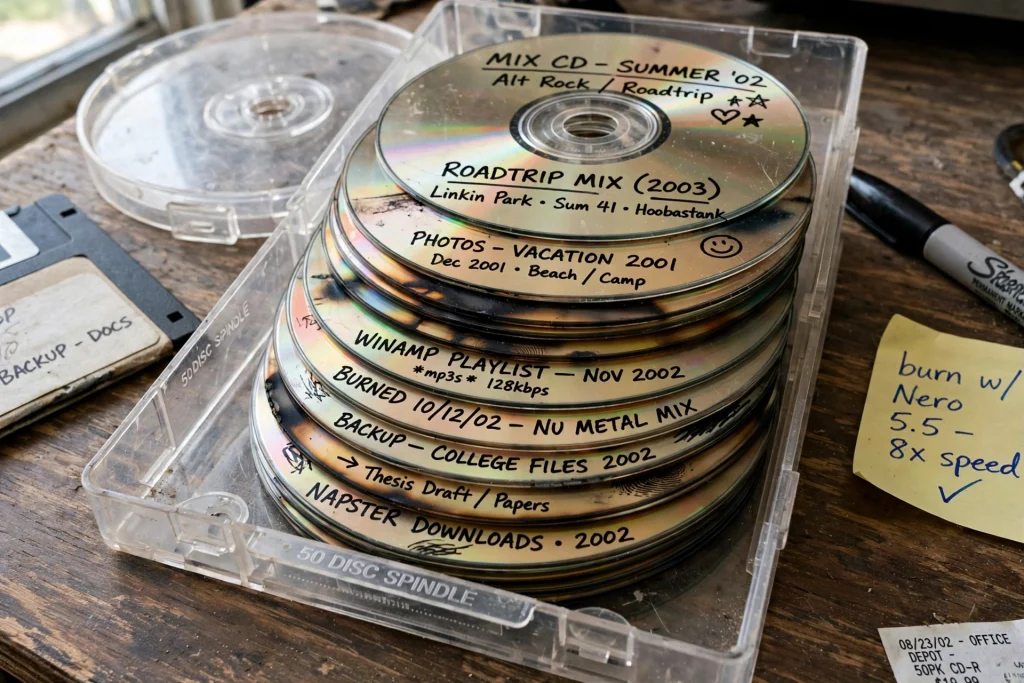
Then came the wait. CD burners were slow — a full disc could take twenty minutes, during which the computer was essentially held hostage. Everyone learned the sacred rule: don’t touch anything while it burns. One wrong move, one screensaver kicking in at the wrong moment, and you’d produce a coaster — a ruined disc, good for nothing but sliding across the kitchen floor. The successful burn, announced by the drive tray sliding open with a mechanical sigh, felt like a small triumph every single time.
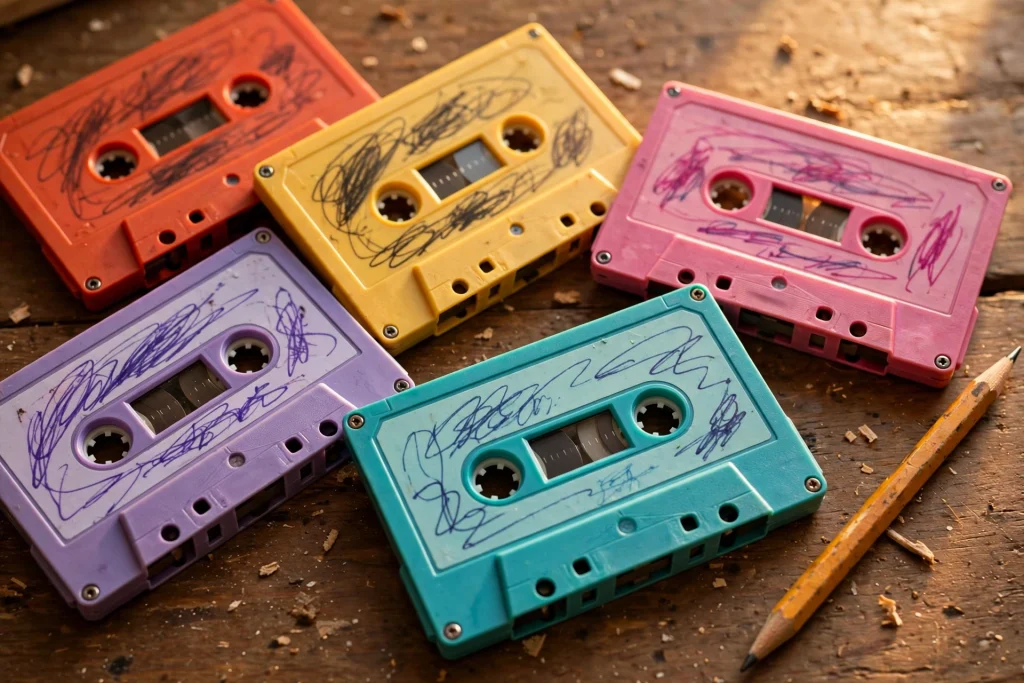
The Sharpie label was the soul of the thing. Blank discs begged for decoration: album titles in careful lettering, track lists in tiny print, doodles and dedications in the margins. A burned CD was a gift economy’s currency — made for road trips, for crushes, for friends who needed cheering up. The cassette era’s pencil trick had given way to the CD era’s buffer underrun, but the spirit was identical: music you made with your hands, for someone specific.
Napster, LimeWire, and the Wild West
You can’t talk about burned CDs without the source material. File-sharing turned every computer into a record store with infinite inventory and zero prices. The ethics were murky and mostly unexamined — teenagers weren’t thinking about the music industry; they were thinking about finally owning the song they’d heard once on the radio. Downloads took forever, files were mislabeled with cheerful inaccuracy, and every other track seemed to be a different song wearing the right one’s name.
It was chaos, and it was glorious. Whole musical educations were built on mislabeled MP3s. Kids discovered genres their local radio would never play. The album as a unit dissolved into the track as a unit, and the playlist — the burned CD’s tracklist — became the new art form. The industry would spend a decade catching up to what teenagers already knew: music wanted to be portable, personal, and free.
Flip Phones: The Satisfying Snap
If the Nokia brick was a tool, the flip phone was a prop — and everyone wanted screen time. There was something deeply cinematic about flipping a phone open to answer a call. It felt decisive. It felt cool. And ending a call by snapping it shut delivered a punctuation that the red “end call” button has never matched. Hanging up had choreography.
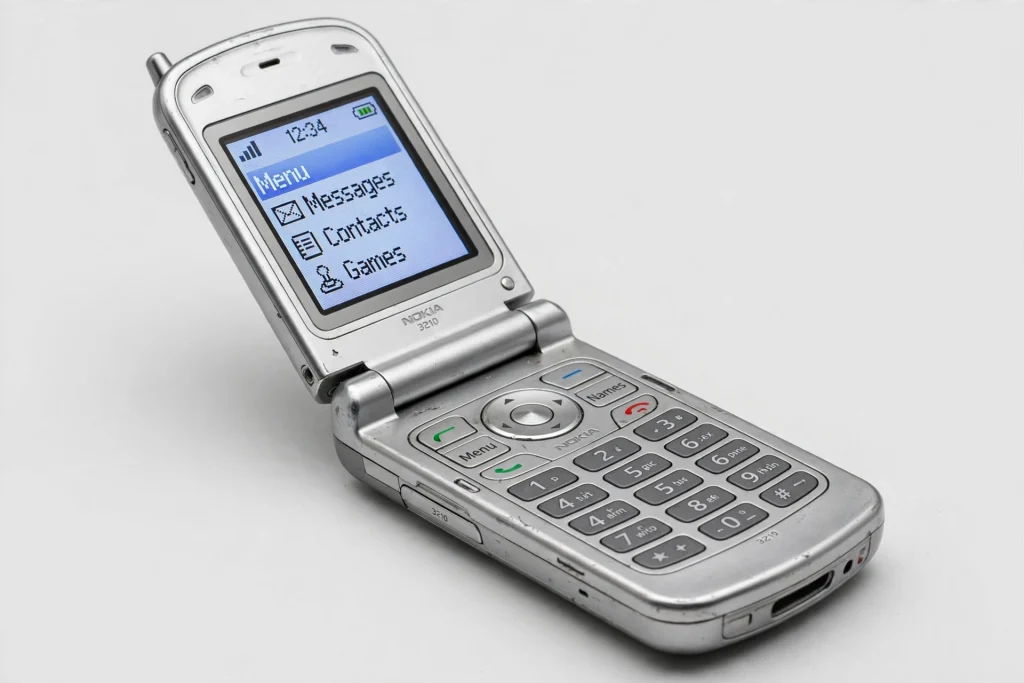
Flip phones were also the great democratizers of the camera. Early camera phones were terrible by any objective measure — grainy, tiny, washed-out — but they were there, in your pocket, always. The first generation of phone photography was gloriously bad and completely addictive. Every blurry concert photo, every pixelated sunset, was a small miracle: you captured a moment with your phone. The film era’s week-long wait had collapsed to instant, and nobody quite knew what to do with the power.
Customization reached its peak with flip phones. Faceplates, charms dangling from the antenna stub, glow-in-the-dark keypads — the phone was an accessory in the fullest sense. And the T9 texting skills honed on Nokias transferred perfectly, thumbs flying across tiny keys at improbable speeds. The flip phone era was short, but it was the bridge between the phone as tool and the phone as lifestyle — and it snapped shut with style.
Broadband Arrives: The Internet Stops Screaming
For years, getting online meant the modem’s screeching handshake and the tyranny of the phone line — no calls while someone was browsing. Then broadband arrived, neighborhood by neighborhood, and changed everything without fanfare. The internet was just… on. Always. No dialing, no busy signals, no negotiating with family members for phone time.
The always-on connection rewired daily life quietly. You could leave Messenger running all evening. Downloads happened in minutes instead of hours. Web pages loaded before you finished blinking. It sounds mundane now, but the psychological shift was enormous: the internet stopped being a place you visited and became the water you swam in. The nineties version of online life had been an expedition; the two-thousands version was a habitat.
And with the habitat came the first real internet culture. Forums for every obsession. Flash animation sites that were the era’s viral video. Early memes spreading at the speed of email forwards. The web was still weird and handmade — personal homepages with visitor counters and “under construction” GIFs, webrings linking hobbyist sites in daisy chains. It was the last moment when the internet felt small enough to explore completely, and the people who were there still talk about it like a neighborhood that got demolished for a highway.
The Family Computer: One Screen for the Whole House
Before everyone had their own device, there was the computer — singular, shared, and usually parked in the living room or a parent’s home office. It was a beige tower with a CRT monitor the size of a microwave, and using it required negotiation. Homework had priority (officially). In practice, the schedule was a complex diplomacy of siblings, each with their own urgent need to be online right now.
The family computer had its own culture. Everyone knew not to delete anyone else’s files. Everyone knew which programs were off-limits. The desktop wallpaper was a battleground of personalities, changed in small acts of rebellion and restored in truces. And the dial-up or early broadband connection was a shared resource — when someone picked up the phone and killed the connection mid-download, the outrage was genuine and loud.
School computer labs were the other great shared space. Rows of identical machines, the hum of CRTs, the teacher’s practiced patrol for off-task browsing. This is where a generation learned to type, to research (Encarta before Wikipedia), and to minimize windows with lightning speed when footsteps approached. The skills were practical; the memories are oddly fond. There was something communal about computing when the computer belonged to everyone — a digital campfire that the era of personal devices quietly extinguished.
The Y2K Hangover and the New Millennium’s Mood
The decade opened with the strangest non-event in history: Y2K. The world had spent years bracing for a computer apocalypse that never came. Midnight struck, the lights stayed on, and everyone felt a peculiar mixture of relief and embarrassment. But the anticlimax set the era’s tone perfectly — the future arrived not with a bang but with a software update.
What followed was a decade of bright, shiny optimism about technology, at least at first. The aesthetic was silver and blue, translucent plastic, everything “i”-prefixed. The future looked like brushed aluminum and glowing buttons. Pop culture was maximalist and glossy. It was the last era that believed, without irony, that tomorrow would be cooler than today — and for a while, with each new gadget, it was right.
Fashion, Music, and the Rest of the Time Capsule
The early two-thousands had a look, and it was unmistakable: frosted tips, low-rise everything, chunky highlights, velour tracksuits. The music was pop at its most polished and hip-hop at its most inventive. Reality TV was inventing itself in real time. And the movies — the big franchises were laying foundations that would dominate the next twenty years.
What makes early 2000s nostalgia so potent is its specificity. The nineties blur into a warm general glow, but the two-thousands are high-definition memories: the exact sound of a dial tone giving way to broadband silence, the exact weight of a flip phone snapping shut, the exact blue of a Messenger window at midnight. It was the decade when the modern world booted up — and everyone who was there remembers the startup sound.
The MSN Messenger service ran from 1999 to 2013, outliving the era it defined. When it finally shut down, the tributes were genuinely emotional — grown adults mourning a chat program like an old friend. That’s the thing about transitional eras: the tools are temporary, but the version of yourself that used them is permanent. The burned CDs are coasters now. The flip phones are drawer relics. But the person who stayed up too late typing into that glowing window? Still here, still typing.
So here’s to the nudge, the buffer underrun, and the satisfying snap. To the Sharpie-labeled discs and the mislabeled MP3s. The early two-thousands were the internet’s awkward, wonderful adolescence — gangly, earnest, and utterly unforgettable. We grew up. So did it. And somewhere in the cloud, a contact list still shows us as “away.”
Pingback: Pen Pals and Paper Letters: When Friendship Arrived in an Envelope - NostalgiaHub
Pingback: 90s Snacks We Still Love: Dunkaroos, Gushers & Lunchables